
Near Challis, Idaho
Continue readingForest Service needs help identifying thieves who stole Osbourne Fire Finder
From a lookout tower near Bunker, Missouri
Continue readingFirefighting helicopter crashes in Turkey killing two
The Interior Ministry of Turkey reported that two people were killed and five were injured when a firefighting helicopter crashed as it was en route to the Turkish port of Marmaris.
Personnel on the helicopter included two Russians and five Turkish citizens but the ministry did not give the nationalities of the deceased.
An official at the General Directorate of Forestry told journalists the helicopter had flown in from the northern province of Kastamonu to join others at Marmaris, a resort town on the Aegean Sea.
No cause was given for the crash which occurred in a field in the Çardak district, Denizli province.
The helicopter may have intended to assist with a large wind-driven fire in the Yalancıboğaz area of Marmaris. On Wednesday aircraft working on the blaze included 15 helicopters and 8 fixed wing aircraft assisting 500 firefighters on the ground. The fire is near a naval base which prompted the response of military personnel and equipment to assist in suppression.
Aviation Safety Network reports the helicopter was a Kamov Ka-32 operated by Avialift. It had departed from Kastamonu en route to Marmaris. 
We send out our sincere condolences to the family, friends, and co-workers of the deceased and injured.
California’s Proposition 30 could add up to $1 billion to CAL FIRE’s budget

On November 8 California voters could approve a proposition that would add up to $1 billion to the California Department of Forestry and Fire Protection budget.
Proposition 30 would create an additional 1.75% state tax on personal income above $2 million that would used for zero-emission vehicle subsidies; zero-emission vehicle infrastructure, such as electric vehicle charging stations; and wildfire suppression and prevention programs.
The nonpartisan Legislative Analyst’s Office expects the measure would would raise $3.5 billion to $5 billion annually, growing over time. Of that, 20 percent would be spent on wildfire response and prevention activities. In general, the state would have to prioritize spending to hire, train, and retain state firefighters. The rest of the money could be used for other wildfire response and prevention activities. The proposition would increase state funding for wildfire response and prevention activities by $700 million to $1 billion annually. The state typically spends about $2 billion to $4 billion annually on wildfire activities, mostly on firefighting.
The other 80 percent of the additional revenue would be used to help households, businesses, and governments pay for part of the cost of new passenger zero emission vehicles, as well as electric vehicle charging stations at apartment buildings, single-family homes, and public locations.
In other news about California’s spending on its wildfire program, Governor Gavin Newsom has proposed $800 million over the next two years to implement various efforts to improve forest health and make communities more resilient to future wildfires.
Portugal to purchase six firefighting-capable Blackhawk helicopters
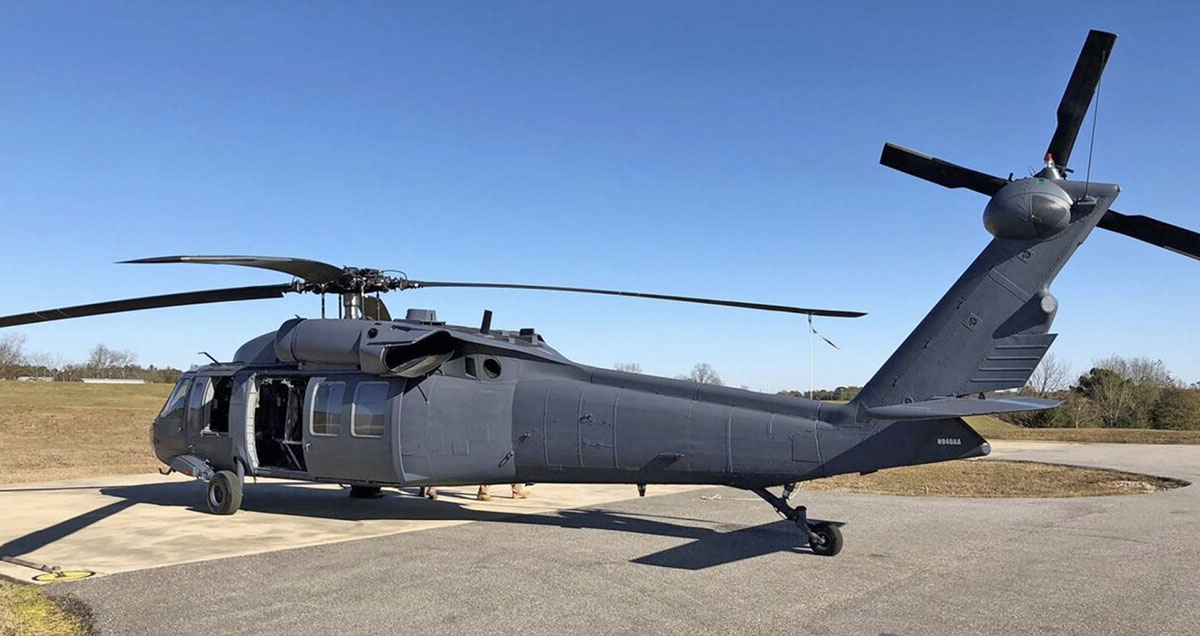 Blackhawk helicopter. Photo by Arista Aviation Services.
The Portuguese Air Force has signed an agreement to purchase six Blackhawk helicopters outfitted for fighting wildfires. The aircraft will be supplied by Arista Aviation Services, a US-based firm which specialises in modernising surplus US Army UH-60 Black Hawk helicopters.
Delivery of the first two is scheduled for the first quarter of 2023.
The contract includes the supply of material and tools, plus technical maintenance support until 2026 and training for six pilots and 21 mechanics. The UH-60 Black Hawk will allow transport of 12 firefighters and their equipment and has the capacity to carry up to 780 gallons of water.
The Expresso publication reported that the terms of the contract allow for the helicopters to be up to 35 years old. While age of the body of the ships may be measured in decades, it is possible that the helicopters have been modernized with recent technology.
In recent years a number of agencies in the United States have purchased new S-70i Blackhawks, which are given the “Firehawk” name after adding a 1,000-gallon (3,785-liter) water tank system, a raised landing gear (to accommodate the tank), and associated integrated avionics — a process that typically takes six months.
But some agencies go the UH-60 route, taking a former military helicopter and performing a similar conversion to a firefighting machine. Ventura County Fire Department in California is an example.
When I was in Portugal in 2012 working on a fire consulting project, the aerial firefighting capabilities of the country were very, very limited. There was no significant air tanker fleet or a system for providing aerial platforms for intelligence, surveillance, and reconnaissance. A problem that confronted firefighters on a large fire was not knowing exactly where the fire was or how far it had spread, which made ordering evacuations a challenge.
 Kamov Ka-32A on standby at Loulé heliport in Portugal. Photo by Bill Gabbert August 29, 2012.
In 2006 the government spent €348 million to buy six Kamov Ka-32A helicopters which could transport personnel and drop water, but over the last 10 years have had difficulty keeping them airworthy. In January none of the six were operational. The Helicopter Investor reported that in April the Portuguese government expelled a team of Russian mechanics working on three of the Kamovs, and shut down the hangar in Ponte de Sor where the maintenance crew was working.
 Embraer C-390 equipped with a MAFFS II. Embraer photo.
Portugal was Embraer’s first export customer for the C-390 fixed wing aircraft when it ordered five in 2019 for $930 million. Recently Embraer has successfully completed the flight test certification campaign for the Modular Airborne Fire Fighting System (MAFFS II), which provides the C-390 with the ability to drop up to 3,000 gallons water or retardant on wildfires.
Some areas of Mosquito Fire receive more than an inch of rain
Flash flood watch in effect for the burn scar
Continue readingEmbraer tests the C-390 with a MAFFS II retardant delivery system
Embraer C-390 equipped with a MAFFS II. Embraer photo.Embraer has successfully completed the flight test certification campaign for the Modular Airborne Fire Fighting System (MAFFS II), which provides the C-390 Millennium with the ability to drop water or retardant on wildfires. The tests were carried out at the Embraer facility in Gavião Peixoto, São Paulo State, in Brazil. After full certification, the firefighting capability will be available to the aircraft’s operators.
The MAFFS II can discharge up to 3,000 gallons. It is designed to interface with the aircraft’s Cargo Handling System and requires only aircraft power to operate. The conclusion of these tests, which included several in-flight water drops, proved the system’s ability to integrate with the aircraft, and demonstrated suitable aspects of flight quality and maneuverability at low speeds.
When the first C-390 or KC-390 rolled out of the factory in 2014 and had not yet completed its first flight, Embraer was comparing it to the American-built C-130, saying it would be multi-role, including serving as an air tanker. Their web site included an artist’s conception of the aircraft outfitted with a first generation MAFFS, with two nozzles exiting through the open rear cargo ramp. The MAFFS II pumps the water or retardant out the troop door on the left side, as seen in the recent photos from Embraer.
 Embraer had this image on their website in 2014, showing an artists conception of the new KC-390 dropping on a wildfire. It is now known as the C-390.
Thanks and a tip of the hat go out to Tom.
Fire in Incident Command Post office tent
Arson is suspected
Continue readingProgress made on Mosquito Fire, but the weather will be changing
The fire is 35 miles northeast of Sacramento, CA
Continue readingHow big does a short haul site need to be?
 Example of a location that could serve as a short haul extrication site. (From the Rapid Lesson Sharing report)
While extricating an injured firefighter last month the firefighters on the ground were not sure how large a clearing was needed in order for a helicopter short haul rescue.
Short haul means moving people suspended from a helicopter on ropes or cable from the rescue location to some place where they can be safely unhooked from the rope or cable. The helicopter can land and the people who were unhooked are moved inside the helicopter to continue the flight.
A Rapid Lesson Sharing report was completed, along with a video. Here is the text, followed by the video:
Do You know what a Short-Haul Site Looks Like?
On August 10, 2022, Collin Hagan was struck by a tree while working to suppress the Big Swamp fire in central Oregon. Collin’s crew immediately requested short-haul. Crews hurriedly improved potential sites by falling trees and cutting brush to varying degrees but said they weren’t sure what was actually necessary for a short-haul site. When the helicopter arrived overhead, the short-haul crew noted that although Collin was in an unimproved site, it was suitable for extrication and moving Collin to the improved site was not necessary.
The short-haul crew described characteristics of a potential short-haul site:
Generally, zero improvement is required to perform a short-haul. With the right flight conditions, we need an opening in the canopy, about the size of a Volkswagen bug. If the terrain is steep, excavating a platform can make it easier once we’re on ground to package and depart smoothly with the patient.
The purpose of this learning product is to provide the field a general reference for what a short-haul site could be. Always remember that final site approval is ultimately up to the helicopter pilot and crew. An in-depth narrative from the perspective of the participants and other lessons learned are forthcoming as part of the Big Swamp Serious Accident Investigation.
The final narrative will be posted at: https://www.wildfirelessons.net/viewdocument/big-swamp-fire-hit-by-tree-fatality.