
Near Challis, Idaho
Continue readingA quick look at seven fires in the Central Idaho area
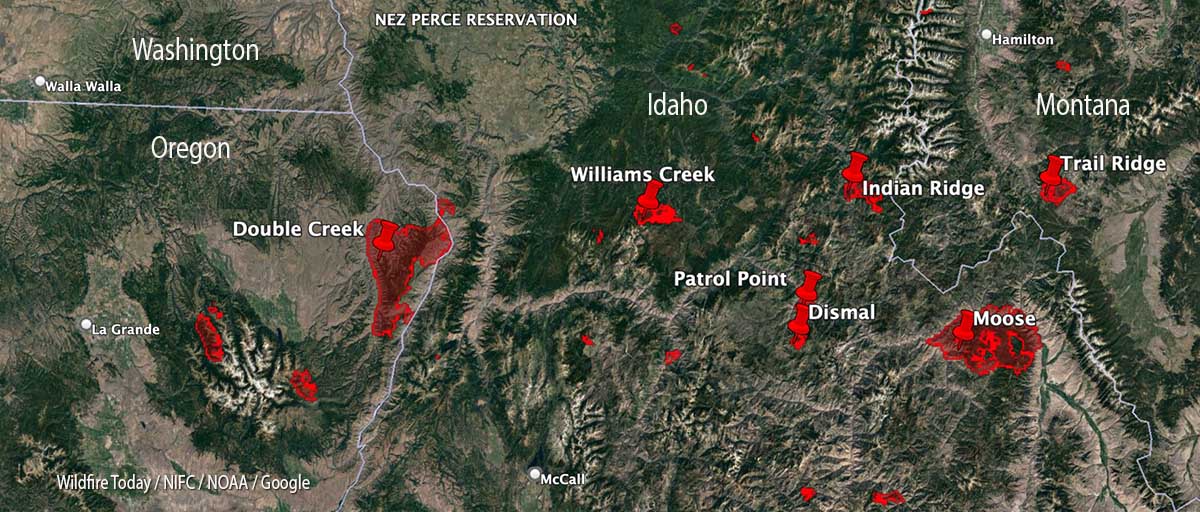 Map of fires in central Idaho, Sept. 9, 2022.
With 35 large uncontained wildfires currently burning in the United States, and many, many more in various categories, we can’t report extensively on all of them, so today we will take a slice of geography and look briefly at seven fires spreading in the Central Idaho area, and extend it just a bit into Oregon and Montana.
Moose (Idaho)
The largest of these seven fires is the Moose, which has been chewing through eastern Idaho since July 17. As far as the cause, the Salmon National Forest says, after almost two months, it is “human caused,” which only eliminates the causes of volcano and lightning. Nine structures have been destroyed. On Friday 650 personnel are assigned to the 125,000-acre blaze which is 5 miles northwest of Salmon, ID. A satellite overflight Friday afternoon only found large heat sources in the southeast portion and that is where an additional 15,000 acres burned Wednesday night, prompting evacuations near Salmon.
Crews reengaged the fire and began preparing new contingency lines along the west edge of the city. Several water pumps, five log decks, and some portable water storage tanks (nicknamed pumpkins because of their shape and color) were destroyed Wednesday. No firefighters were injured. Nearly 500 acres of the city’s Municipal Watershed burned that night, something the various incident management teams had been trying to protect since July.
Cooler temperatures, higher relative humidity, and thick smoke contributed to minimal fire behavior across the fire Thursday.
Indian Ridge (Idaho)
Northwest of the Moose Fire near the Montana border is the lightning-caused 8,670-acre Indian Ridge Fire on the Bitterroot National Forest. It is in the Selway-Bitterroot Wilderness 30 miles southwest of Darby, Montana. The fire has been active this week primarily along the western and northern flanks and north of Indian Creek as it burns through steep, rugged, remote terrain with heavy surface fuels and dead standing timber.
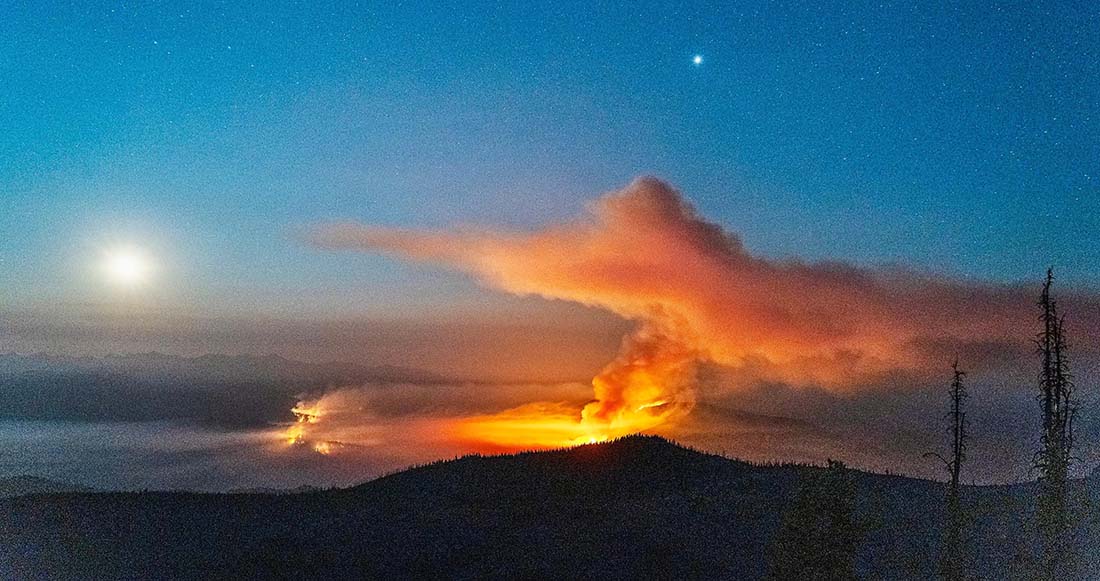 Indian Ridge Fire the night of August 18, 2022. InciWeb.
The fire is not being fully suppressed. Their daily reporting says, “Fire managers are utilizing a point protection strategy to prevent any critical wilderness infrastructure from being negatively impacted by the fire.”
Dismal and Patrol Point
These two fires are very close to merging after significant growth since September 6, and combined have burned an estimated 23,000 acres. They are about 50 miles northwest of Salmon, Idaho. Smoke and the unavailability of infrared mapping aircraft have made it difficult to determine the current perimeters, but there is a lot of new burned acreage between the two fires. Recent low humidity and strong winds are in part responsible for the recent growth.
Areas that fire managers intend to protect include Cold Meadows Guard Station, Root Ranch, and Lantz Bar.
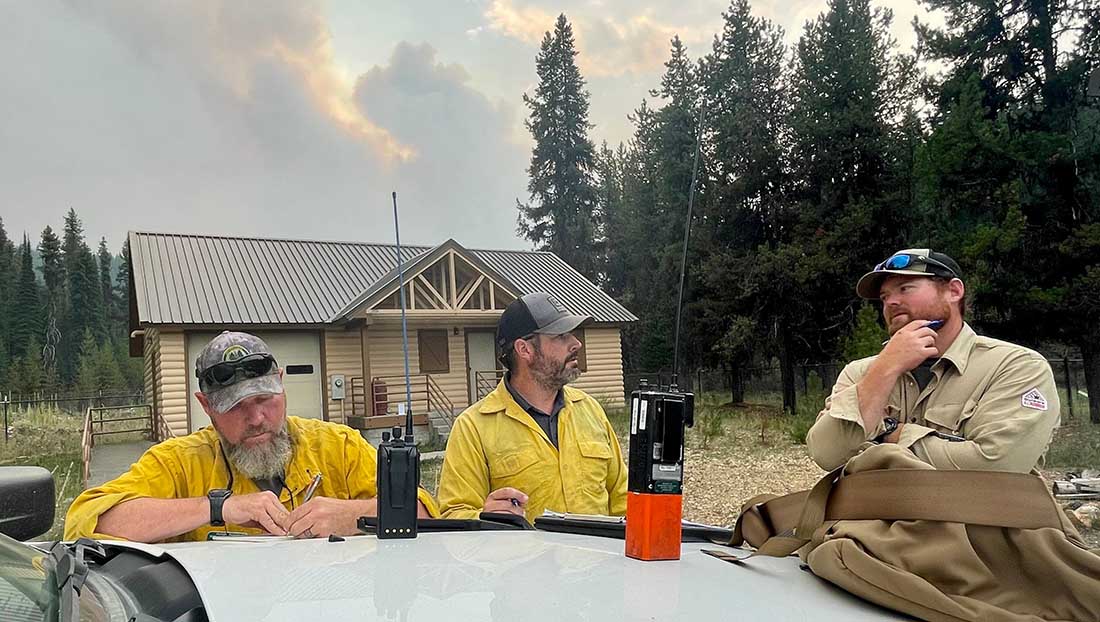 Fire personnel on the Williams Creek Fire in Idaho. InciWeb, posted 9-8-2022.
Williams Creek
The 11,881-acre fire is 5 miles west of Orogrande, near Wildhorse Lake, 7 miles southwest of Elk City, and 8 miles north-northwest of Dixie.
“Resources will continue to engage the fire in Orogrande and the Crooked River corridor, addressing and extinguishing hot spots and conducting damage assessments,” said a September 9 update from the Incident Management Team. “The fire and associated winds did impact structures and outbuildings; crews are still assessing the extent of the damage. Fallen trees, burned snags, and downed power lines continue to present safety hazards.”
Double Creek (Oregon)
The 137,000-acre lightning-caused Double Creek Fire is in Oregon just west of the Idaho border. It has burned to the Snake River in the Pittsburg Landing area. A River Group has been established to assess and protect structures along the waterway. The fire is being fully suppressed and crews are looking for locations to establish the control line farther from Lower Imnaha Road where topography allows. Two structures have been destroyed.
Trail Ridge (Montana)
The 13,000-acre Trail Ridge fire is on the Beaverhead-Deerlodge National Forest in Western Montana about 5 miles east of the Idaho Border and 4 miles southeast of Sula, MT. The cooler weather experienced Thursday and Friday was helpful in slowing the spread of the fire and decreasing the severity of fire behavior. It is burning above 7,000 feet elevation near the Continental Divide and there is no current or expected threat to private land and property. It is not being fully suppressed.
Moose Fire grows to 37,264 acres
Northwest of Salmon, Idaho
Continue readingMoose Fire near Idaho-Montana border grows to more than 28,000 acres
Most of the 5,000 acres of growth was on the west and east sides
Continue readingHelicopter crashes into Salmon River while working on Moose Fire
Updated 3:56 p.m. MDT July 22, 2022
More information is available about the helicopter crash in Idaho.
Both pilots have died, the U.S. Forest Service said on Friday.
Mary Cernicek with the Salmon-Challis National Forest said Thomas Hayes, 41, of Post Falls, Idaho, and Jared Bird, 36, of Anchorage, Alaska, died from injuries they sustained when their CH-47D Series Chinook crashed in the Salmon River about 3:30 p.m. Thursday.
The pilots were employees of the Anchorage-based ROTAK Helicopter Services and were working on the Moose Fire northwest of Salmon, Idaho.
7:52 a.m. MDT July 22, 2022
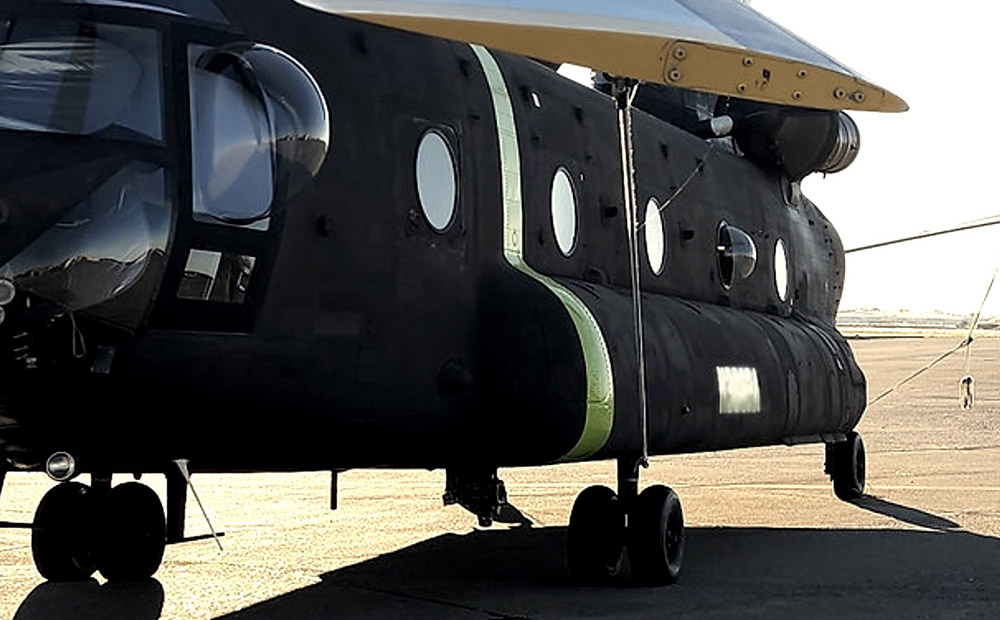 CH-47D. ROTAK photo.
Thursday afternoon a CH-47D Chinook helicopter operated by ROTAK Helicopter Services crashed into the Salmon River while working on the Moose Fire northwest of Salmon, Idaho. The US Forest Service reported Friday morning there were two fatalities.
The company released a brief statement Thursday evening.
It is with heavy hearts that we confirm that on July 21, 2022, at approximately 3:30 p.m. a CH-47D series “Chinook” helicopter operated by ROTAK Helicopter Service with two pilots on board was involved in an accident near Salmon, Idaho. Emergency medical teams are responding to the scene. ROTAK is working closely with all appropriate agencies and will issue a full statement as information is confirmed.
We send out our sincere condolences to the families, friends, and co-workers of the two that were killed.
Growth of the fire
The Moose Fire grew incrementally on Friday, showing growth on all sides, primarily south of the Salmon River on the west and east sides. Very little growth occurred north of the river.
A mapping flight Thursday night determined it had burned 23,620 acres, an increase of nearly 3,000 acres. Much of that difference was due to an overnight change in procedure, a decision to not consider in the acreage the unburned islands in the interior. Previously the size of those islands had been subtracted from the total exterior perimeter.
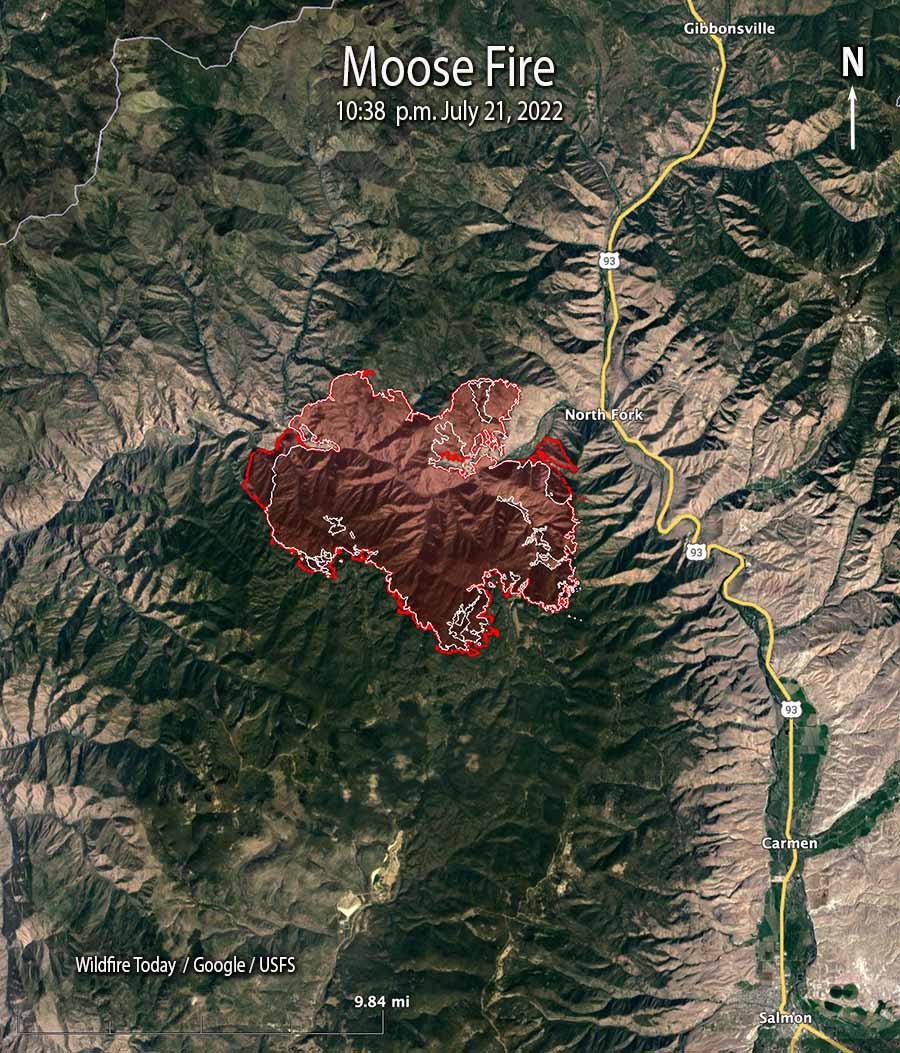 Moose Fire map. The red line was the perimeter at 10:38 p.m. July 21, 2022. The white line was the perimeter about 24 hours previously.
Weather
The forecast for Friday afternoon is for increasing winds, gusting out of the west and then northwest at 31 mph with the relative humidity in the mid-teens. After sunset the wind will drop to about 6 mph out of the north. Saturday should bring 5 to 8 mph winds out of the south shifting to the north, with 13 percent relative humidity.
Firefighters expect the weather on Friday could lead to spread south of the Salmon River west towards Spring Creek, east towards North Fork, and spotting to the north side of the river.
Resources
Resources assigned to the fire Thursday evening included 18 hand crews, 25 fire engines, and 7 helicopters for a total of 517 personnel, a 24-hour increase of 141 individuals.
Structures
There are no reports of structures burning, but 301 are threatened. Evacuation information is available at the Lemhi County website.
Moose Fire burns tens of thousands of acres north of Salmon, Idaho
Both sides of the Salmon River
Continue reading