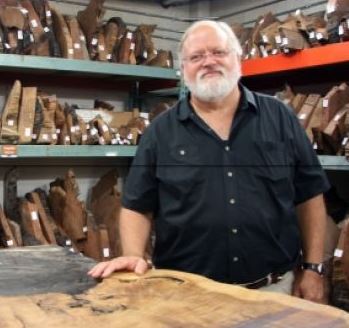
The Fires of Change exhibition is a collaborative science and art partnership among the Southwest Fire Science Consortium, Flagstaff Arts Council, and the Landscape Conservation Initiative. The exhibition will open at the Coconino Center for the Arts in September 2015 during the Flagstaff Festival of Science. This film documents the workshop the artists attended at the North Rim of the Grand Canyon to learn about fire management. For more information about the project, the partnership, and the artists involved, visit the Flagstaff Arts Council web site.
I am really curious about what will be created out of this very intriguing project. If it works out the way it possibly could, it should be a travelling exhibition, or, other areas could conduct similar initiatives.
Fires in U.S. and Australia determined to be caused by power lines
Map of Pfeiffer Fire at Big Sur, California, looking northwest, showing the fire perimeter at 10:34 p.m. PST, December 18, 2013. (Click to enlarge)
Two fires, in Western Australia and California, have recently been determined to be caused by electrical power lines.
The Pfeiffer Fire at Big Sur, California started on December 16, 2013 and burned 34 homes and 917 acres in the coastal community 23 miles south of Monterey. The U.S. Forest Service reported on Wednesday:
The cause of the fire was determined to be high resistance heating of the Pfeiffer Ridge Mutual Water Company electrical control wires immediately adjacent to a steel water pipe line. The high resistance heating of the electrical control wires created a competent ignition source for this fire. The first fuel ignited was accumulated dried leaves and redwood needles.
The other fire was in Western Australia. Below is an excerpt from an article in Western Australia Today:
A rotted power pole infested with termites has been blamed for the Parkerville bushfire which destroyed more than 40 homes this year. But EnergySafety director Ken Bowron said the organisation would not take action against Western Power or the landowner.
The EnergySafety report into the cause of the fire on January 12 was released on Thursday and found the bushfire originated from a private pole at 180 Granite Road, Parkerville.
“There was no evidence to suggest the work performed by Western Power to replace the surface aerial seven months before the incident, or the work to replace the adjacent pole two day before the bushfires, causes the PA pole to fail,” Mr Bowron said.
“Based on the available evidence and legal advice, EnergySafety will not be taking any legal action against any party. The clear finding of the report is that the pole failed because it was rotten and had been infested by termites.
Hearing in Prescott on Granite Mountain Hotshots’ retroactive retirement benefits
From the Daily Courier in Prescott, Arizona:
Now nearly a year and a half after 19 Granite Mountain Hotshots died fighting the Yarnell Hill wildfire, the matter of retroactive retirement benefits continues to play out at Prescott City Hall.
With its earlier decision granting retirement benefits to the family of fallen Hotshot Andrew Ashcraft still under appeal, the local fire retirement board will take on two new retirement cases today.
During a 9 a.m. Thursday hearing at Prescott City Hall, the Prescott Board of the Public Safety Personnel Retirement System Board will turn to the retirement claims by the families of Sean Misner and William Warneke, and whether the scope of the actual hearings on the claims should be limited…
Tree ring researcher at the University of Arizona honored
Thomas W. Swetnam with tree-ring specimens in the UA’s Laboratory of Tree-Ring Research. (Photo courtesy of Michaela Kane/Arizona Daily Wildcat)
Thomas W. Swetnam, Regents’ Professor of dendrochronology and director of the University of Arizona Laboratory of Tree-Ring Research, has been named a Fellow of the American Association for the Advancement of Science (AAAS), the world’s largest general scientific society.
As part of the Section on Geology and Geography, Swetnam was elected as an AAAS Fellow for his investigations of tree rings as a record of past changes in climate, allowing scientists to predict future forest-fire frequencies in the Southwest.
Mr. Swetnam specializes in analyzing climate changes through history and prehistory, dangerous insect outbreaks and forest fires. In recent years, enormous blazes, some 10 times greater than those that firefighters have been accustomed to seeing in California and Arizona, have forced scholars to attempt to understand this phenomenon. The conclusions from Swetnam’s studies of these so-called megafires and their alarming size, duration and frequency have made the scientific community, governments throughout the world and media to pay close attention. Swetnam has appeared on programs such as PBS’ “NewsHour” and CBS’ “60 Minutes.”
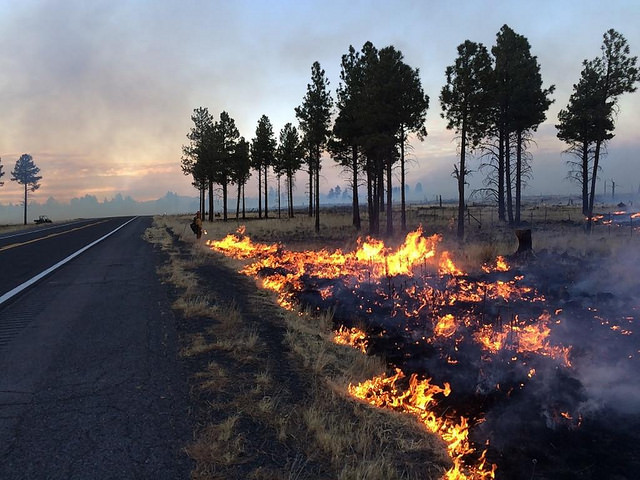
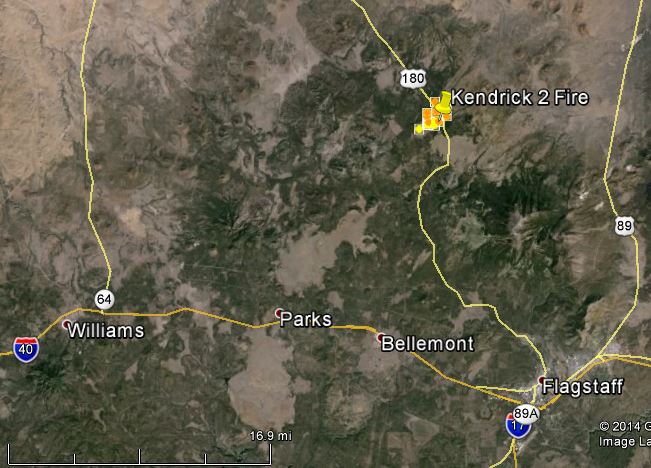
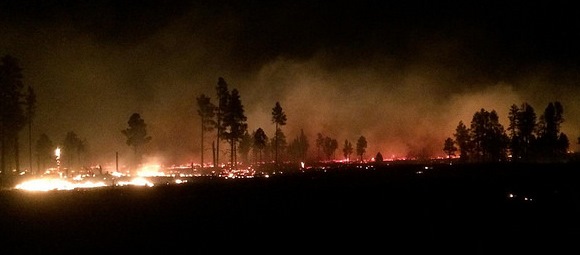
Firefighters on the Coconino National Forest have contained two fires north of Flagstaff, Arizona. The 509-acre Kendrick 2 Fire, about 20 miles northwest of Flagstaff on Highway 180 Near Kendrick Mountain, has a fireline around it, meeting the definition of containment, but the incident commander is calling it only 50 percent contained Monday morning.
Highway 180 remains closed in both directions Monday morning. Fire managers expect to recommend reopening the highway later today.
Map showing the approximate location of the Kendrick 2 Fire.
The other fire was 12 miles north of the Flagstaff Mall on the west side of Hwy 89 near Forest Service Road 418. It was named for its location at milepost 431 on Hwy 89. The fire was contained after burning 204 acres.
The video below features the Geronimo Hotshots, firefighters from the San Carlos Apache Reservation in southeastern Arizona. It was shot by crew member Samson Belvado in 2013, much of it with a helmet camera, and put together by the The Atlantic filmmaker Sam Price-Waldman.
Yarnell Hill Fire at 8:16 p.m. June 29, 2013, as seen from Yarnell, Arizona. The photographer wishes to remain anonymous.
We received some photos today of the Yarnell Hill Fire that we had not previously seen. Most of them are snapshots of smoke coming up from behind a ridge or distant air tankers in the sky, but one of them captured our interest, the image above. It does not generate much new information, but it appears to show that when it was taken, at 8:16 p.m. on June 29, 2013 (according to the time stamp on the file), 27 hours after the fire started, it was still not a large fire. This photo is consistent with the photo below taken at 7:30 p.m. on June 29, 2013 which has been public since last year.
Yarnell Hill Fire at 7:30 p.m. MST, June 29, 2013, approximately 21 hours before the 19 fatalities. Photo by ATGS Rory Collins, Oregon Department of Forestry.
According to information released by the Arizona State Forestry Division on July 16, 2013, on the second day of the fire at 5:30 p.m. on June 29 there were 13 firefighters working on the fire and it had burned six acres. By the afternoon of day three of the fire, June 30, it had grown to be much, much larger than it had been the evening before. At 4:47 p.m. that day the incident commander and the Arizona Dispatch Center received notice from Air Attack that firefighters had deployed fire shelters. The Granite Mountain Hotshots, 19 of them, died in the fire when a predicted wind shift changed the direction of the spread of the fire and entrapped the firefighters. The intensity of the fire exceeded the protection capabilities of the shelters.
The ordering and use of ground and aerial firefighting resources was less than aggressive on June 29, the day before the tragedy when the fire was still small. The only air tankers used that day were two single engine air tankers, and for only part of the day, dropping a total of 7,626 gallons. After being released, they were requested again by Air Attack, but dispatch only allowed one to respond to the fire, wanting to keep one in reserve in case there were other fires.
General Norman Schwarzkopf’s philosophy when confronting the enemy was to use “overwhelming force”. This strategy also is effective when confronting a wildfire. Overwhelming force for a short amount of time can prevent megafires burning for weeks, consuming many acres, dollars, and sometimes homes and lives.
The bottom line: Being timid or TOO cost-conscious during initial attack or the first burning period of a fire can be far more expensive in dollars and in the worst case, lives.
After the June, 2010 Schultz fire burned 15,000 acres in the Coconino National Forest near Flagstaff, Arizona, the floods that followed had an economic impact of about $130 million. Not only did the residential communities adjacent to the fire experience flooding, but subdivisions 10 miles away were also flooded.
Two recent studies have quantified the benefits of forest thinning projects from economic and ecological perspectives.
[One] study calculated the potential wildfire and flood-related costs that will be avoided with the Flagstaff Watershed Protection Project. The other study quantified the watershed benefits of forest thinning similar to that proposed by the Four Forest Restoration Initiative.
The FWPP economic study estimated that the wildfire and post-fire flooding-related costs Flagstaff will avoid could total between $573 million and $1.2 billion.
More than 70 percent of Flagstaff voters approved FWPP in 2012.
The study, which is likely one of the first to anticipate wildfire-related costs from flooding, helps put the FWPP’s initial price tag into context, said Paul Summerfelt, the city of Flagstaff’s wildland fire management officer.
“We’re using it to reassure voters that $10 million was wise investment,” he said. “We pay a little now to prevent, or a whole lot more later just to try to fix.”
The analysis, performed by Northern Arizona University’s Arizona Rural Policy Institute, accounted for everything from the projected costs of fighting a severe wildfire in Flagstaff’s watersheds to the revenues businesses could lose to post-wildfire flooding. That number, for example, came to $15 million over five years.
The Arizona State Forestry Division (ASFC) has posted on YouTube 21 videos recorded during the Yarnell Hill Fire The state received them on November 7, 2014 through a Freedom of Information Act request to the US Forest Service. The ASFD explained that “the videos are presented exactly as they have been received. The redactions were done before these videos came into the possession of Arizona State Forestry.”
On June 30, 2013 19 members of the Granite Mountain Hotshots became entrapped by fire and died on the Yarnell Hill Fire south of Prescott, Arizona.
In portions of some of the videos, you can hear and at times understand radio conversations and firefighters near the cameras.
Below are links to the videos in the order that they were listed on the ASFD website. We embedded seven of them below the links with the corresponding video number. Like the ASFD said, the USFS provided absolutely no information about the videos, but they appear to be roughly in chronological order — this is not yet confirmed, however.
M2U00266R — Firefighters discussing the radio traffic they heard earlier about the Granite Mountain Hotshots deploying fire shelters.
M2U00267 — Firefighters in an urban-interface area with scattered active fire. At 1:21 you can see what appears to be a propane tank venting, with the escaping gas burning.
A ramp at the Prescott Airport. The red stains on the tarmac are typical of ramps at air tanker bases. Google Earth. (click to enlarge)
The City of Prescott, Arizona has agreed to accept a $1.44 million grant from the Arizona Department of Transportation (ADOT) which will go along with $1 million from the U.S. Forest Service for improvements at the air tanker base at the Prescott Airport.
The ADOT funds will be used to upgrade the apron used by air tankers, while the USFS funds will add new plumbing infrastructure and a taxiway. The changes will increase the number of loading pits from two to three. The ADOT grant will cover 90 percent of the cost of the apron project, and the City of Prescott will supply the additional 10 percent.
In spite of the new construction which is scheduled to begin June 2015, the runway will still not be able to support Very Large Air Tankers such as the DC-10, according to City Manager Craig McConnell. During the Yarnell Hill Fire last year, two DC-10s reloaded at Phoenix-Mesa Gateway Airport, 90 air miles southeast of the fire.
Engine crew works on the Wallow Fire in 2011. Photo by Jayson Coil.
On a recent October day south and west of Alpine, AZ, James Nesslage and Brandon Billy were harvesting a bumper crop of cones from the top branches of a 100-foot tall ponderosa pine. That tree and others like it are survivors of the 538,049-acre Wallow Fire that burned in eastern Arizona and western New Mexico in 2011, most of it within the Apache-Sitgreaves National Forest. The cones being picked will yield the seeds needed to continue the restoration of parts of that vast burn.
James Nesslage climbs a rope rigged in a 100-foot ponderosa pine tree as as he and his crew prepare to harvest seed cones on the Apache-Sitgreaves National Forest southwest of Alpine, AZ. Photo by Tom Story.
Plans to restore the forest began before the Wallow Fire was contained. Initial estimates were that high burn severity over much of the fire area would result in natural regeneration being hampered by a lack of available seed trees.
To have the best chance of survival, seedlings must be grown from cones taken from parent trees in the area. Patrick Murphy, silviculturist on the Apache-Sitgreaves, explained:
Several factors are used in determining where cones are harvested and from which trees seed is collected. The forest has pre-established “seed zones”. These seed zones are geographic locations found throughout the forest. In collecting seed we take into consideration if the parent tree is free from insects, disease, defects, deformity, or forking. The tree should also exhibit superior height and diameter growth. We will plant seedlings in the same seed zone and elevation band where the parent tree is located.
Earlier in the year, there was a larger crew of 20 people harvesting the seed cones. Now as the cone picking season, which began in mid-August, was winding down, there were only two other people; father and son Randy and Brandon James, working that day. It would take two to three hours for each team to completely strip the tree of its cones. “The contract specifies eighty-percent (of the cones on each tree)” said Mr. Nesslage, “but we try to do better than that”. The pine that the James duo picked that morning barely produced a bushel of good cones while the tree that Mr. Nesslage and Mr. Billy harvested yielded over three bushels.
Brandon Billy works his way out on a limb as James Nesslage (mostly hidden at right) uses a hook to pull the cone laden tip of a limb close to Mr. Billy during the seed cone harvest. Photo by Tom Story.
A general contractor in the construction business, Mr. Nesslage came across a solicitation for a seed cone harvesting contract on the Federal Business Opportunities website and thought it was a chance to put some of his climbing experience to good use. “Go camping, climb trees and get paid for it! Sweet!” was his reaction. He was awarded a contract and started picking in 2012. He admitted that the learning curve was a little steep at first but was able to complete the harvest. The cone crop in 2013 was poor and was not picked, so when Mr. Nesslage’s teams returned to the woods this year, not only was there more to harvest, they had a larger crew and more knowledge of how to do the job better and more efficiently.
One of the two Interagency Hotshot Crews not run by a state or federal agency has been disbanded. The Ironwood Interagency Hotshot Crew (IHC), formed by the Northwest Fire District near Tucson, Arizona, was shut down October 3.
In 2008 the District’s Type 2 Initial Attack crew became a trainee Type 1 crew, and achieved Type 1 status in late 2009 with Greg Smith as the Superintendent. Between 2008 and 2014 they responded to 118 fires for a total of 924 days — an average of 103 days a year.
Now that the Ironwood Hotshots are gone, that leaves 114 IHCs in the United States, with 109 being federal (USFS, BLM, BIA, and NPS), 4 run by states (Utah and Alaska), and 1 County crew (Kern County in southern California). The official list of Hotshot crews on the U.S. Forest Service website shows the Sierra Hotshots as being a “county” crew, but that is incorrect — they are part of the Sierra National Forest, but the Rio Bravo crew listed as USFS is actually a Kern County Crew
The Granite Mountain Hotshots were a city-based crew with the Prescott Fire Department in Arizona. We checked today with spokesperson for the city Catherine Sebold, who said the city “has not made a firm decision” about rebuilding the crew after 19 of the 20 Granite Mountain crew members were killed on the Yarnell Hill Fire June 30, 2013.
On March 5, 2013 we talked to David Gephart, the District’s Finance Director, who told us the crew was being disbanded for “financial and operational” reasons. He said one of the operational considerations was that the District had some vacant structural firefighting positions it needed to fill, and the seven permanent members of the crew will be offered those positions. Four of those seven have already been through the structural fire academy, while three have not but will be scheduled to receive the training.
When a firefighting resource, such as a hotshot crew or fire engine from one agency helps to suppress a fire in another jurisdiction for an extended period of time, formal agreements usually stipulate that the lending agency is financially reimbursed for their expenses. The reimbursement amount is based on the crewperson hours worked. That rate is almost three times the actual hourly rate the District pays the firefighters, in order to cover other expenses related to the fire assignment. For example, the Prescott Fire Department was reimbursed for 95.5 percent of the total expenses of operating the Granite Mountain Hotshots in the 2012 fiscal year, according to an article in The Daily Courier.
Mr. Gephart provided figures for the fiscal years 2011 through 2013 showing that the operational expenses for the Ironwood Hotshots for that three year period were $7.3 million. They were reimbursed for $7.2 million, or, 98.6 percent of their costs.
We asked if the 200 other firefighters that the District employs were expected to generate their own funding, and Mr. Gephart said they were not.
He pointed out that there are other costs for maintaining the Hotshot crew that are are not included above which are more difficult to put on a spread sheet, including overhead, indirect, capital needs, and IT expenses.
Since the crew came within about one percent of being self-supporting, we asked why the Hotshots were created in the first place. Mr. Gephart said they expected the crew to make money for the District, or in a worst case, break even. He went on to say future costs would have a negative effect on the crew’s financial situation, such as a new requirement that the 13 seasonal firefighters have health insurance, and increases in the cost of pensions.
In a press release the Fire District said the disbanding of the Ironwood Hotshots was not a reaction to the tragic Yarnell Hill Fire:
[The District was] in contact with the District’s insurance carrier. This was done as part of the District’s due diligence to ensure we are appropriately protected as an organization and were planning appropriately for any potential rate adjustments that could be attributed to the ongoing Yarnell ligation and our continued support of a Type I Hotshot Crew. Essentially, we were concerned that our insurance rates might increase just for having a Hotshot Crew. However, we learned there would be no additional insurance costs projected for this year.
About the petition at change.org, the District’s press release said it contained “numerous inaccuracies”, without being specific about what they were.
This article was edited after a second error was found on the USFS’ list of Hotshot Crews.