A former Battalion Chief for the California Department of Forestry and Fire Protection pleaded not guilty Monday to murdering his live-in companion. An instructor at the agency’s training academy at Ione, California, 55-year old Battalion Chief Orville Fleming had been charged in the May 1 stabbing death of 26-year old Sarah Jane Douglas. The plea was in spite of having earlier “admitted culpability in the stabbing”, according to Sheriff Scott Jones.
After the murder Mr. Fleming ditched his CAL FIRE truck and disappeared but was found 16 days later when he left his hideout near his home and boarded a bus to obtain food.
When he did not show up for work for five days, he was fired from his $130,000 a year Battalion Chief job. Earlier in his career he was a firefighter with the city of Madera for three years when the city contracted with CAL FIRE for fire protection. He was promoted to fire captain in 2001 and to battalion chief in 2012.
UPDATE: In July, 2015, Mr. Fleming was found guilty of second-degree murder and sentenced to 16 years to life in prison.
The pilot that was killed in the air tanker crash near Yosemite National Park on Tuesday has been identified as Geoffrey “Craig” Hunt, age 62, of San Jose. More information is at Fire Aviation.
****
(UPDATE at 12:31 a.m. PDT, October 8, 2014)
Tuesday evening emergency personnel were able to access the site of the CAL FIRE air tanker that crashed near Yosemite National Park and determined that the pilot on board had died. The air tanker (Tanker 81) based out of the Hollister Air Attack Base had been fighting the Dog Rock Fire near El Portal at Yosemite National Park when officials lost contact with it late Tuesday afternoon.
The family requested that the agency withhold release of the pilot’s name until all immediate family members can be notified.
Our sincere condolences go out to the family and coworkers.
There is a report that two air tanker pilots witnessed the accident, saying that as the aircraft pushed over a ridge in the steep canyon, descending to the intended retardant drop area, a wing struck an object on the ground.
A civilian on the ground, Don Talend, of West Dundee, Illinois, told the Associated Press that he saw a plane flying low through heavy smoke near a burning ridge when a wing appeared to waggle or flip up.
The Modesto Bee reported:
Kirstie Cari, the owner of El Portal Market, said the plane crashed within sight of her store. She was in the kitchen at the time and didn’t see it, but said witnesses told her the plane came tumbling over the ridge line, cartwheeled and crashed right in front of a big wall of rock.
Cari said the crash lit a second fire in front of the first blaze and brought debris tumbling down onto Highway 140, which was closed east of El Portal at the time of the crash. She said helicopters had worked to suppress it, but the area was still smoldering about 30 minutes later.
Immediately after the crash, CAL FIRE grounded their remaining air tankers, which is standard procedure after a serious accident.
The S-2T air tanker, registration number N449DF, was designated Tanker 81, one of 23 S-2Ts that are maintained and flown by DynCorp for CAL FIRE. The agency also has one spare that is used to fill in as needed when an aircraft is undergoing maintenance. CAL FIRE hires their own pilots for their 11 UH-1H Super Huey helicopters, but they are also maintained by DynCorp.
The last time a CAL FIRE air tanker crashed was in 2001, when two tankers collided while fighting a fire in Mendocino County, killing both pilots, Daniel Berlant, spokesperson for CAL FIRE said.
The agency had another plane crash in 2006, when a battalion chief and a pilot were killed in the crash of an air attack plane in Tulare County.
The S-2 first flew in 1952 and the U.S. Navy discontinued the use of them in 1976. They were used for detecting enemy ships and submarines and for dropping torpedoes. The ones currently being used by CAL FIRE were converted from piston to turbine engines between 1999 and 2005. Some media outlets are incorrectly reporting that the Tanker that crashed on Tuesday was built in 2001. That may be the date that it was converted to turbine engines and was given the new model name S-2F3 Turbo Tracker. They are now commonly referred to as S-2T, with the “T” standing for turbine engine.
Wednesday morning the Dog Rock Fire is reported to be 150 acres with no containment. A Type 3 Incident Management Team (IMT) is at the scene, with Mills as Incident Commander during the day and Wills at night. A “short” version of Jeanne Pincha-Tulley’s IMT has been activated. She normally is the Incident Commander of a Type 1 IMT.
The fire, reported at 2:45 Monday afternoon, is north of Highway 140 and is burning uphill toward the north in the direction of the community of Foresta, which has been evacuated. Electrical power has been shut off in the area.
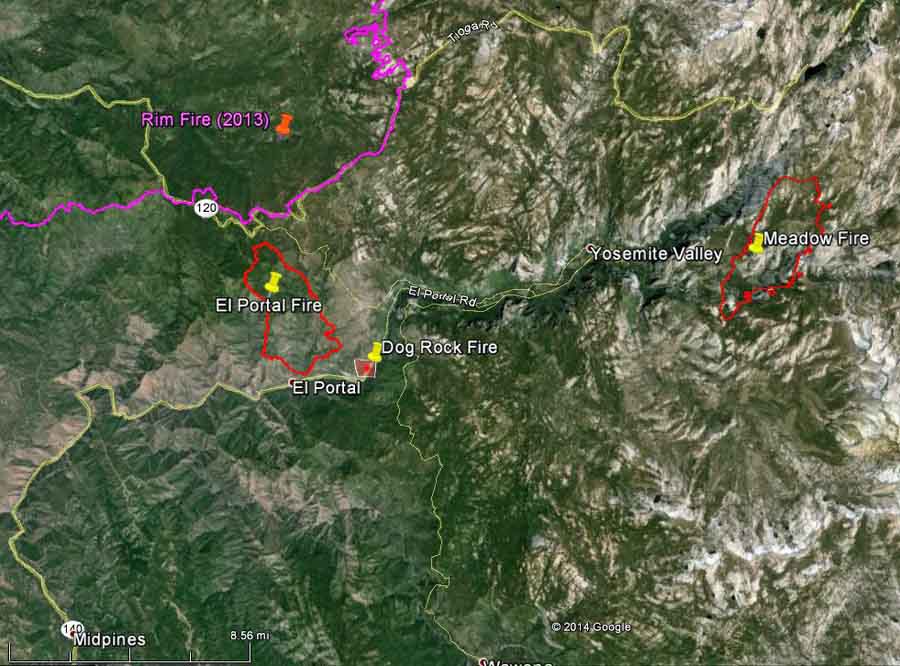
Map, showing heat detected on the Dog Rock Fire (the red square) by a satellite at 11:33 p.m. October 7, 2014. The location can be accurate to within a mile. The map also shows the perimeters of two other fires in 2013, the El Portal and Meadow Fires. The 2013 Rim Fire is also shown. (click to enlarge)
****
(UPDATE at 9:12 p.m. PDT, October 7, 2014)
There is still no news about the condition of the pilot in the crash of the S-2T CAL FIRE air tanker near Yosemite National Park late Tuesday afternoon.
Ken Yager heard a loud boom and took the photo below. The extreme terrain helps to explain why it is taking rescuers hours to reach the site.
S-2T air tanker crash. Photo by Ken Yager.
Below is an excerpt from an article at ABC30:
…A California Highway Patrol spokesman, Officer Steven Lewis, said CHP Sgt. Chris Michael witnessed the crash as he was helping to close state Route 140 where it enters the park.
“All the tourists and residents were being turned away,” Lewis said, when Michael reported that he had just witnessed “a bomber collide into the river canyon, the canyon wall, and watched it explode in flames and reported there was plane debris landing in the highway.”
The canyon wall is above the highway and the Merced River, Lewis said.
“It’s almost vertical canyon walls,” Lewis said, “and the road was cut in 100 years ago right along the river. Anything that falls from the top is going to fall right on the roadway.”
There were no reports of any injuries on the ground as a result of debris.
Don Talend, of West Dundee, Illinois, said he may have seen the plane go down. Talend and friends were vacationing at the park when they stopped to snap some photographs of the fire, which was several miles away.
He told The Associated Press by phone that he saw a plane flying low through heavy smoke near a burning ridge when a wing appeared to waggle or flip up.
The plane “disappeared into the smoke and you heard a boom,” he said.
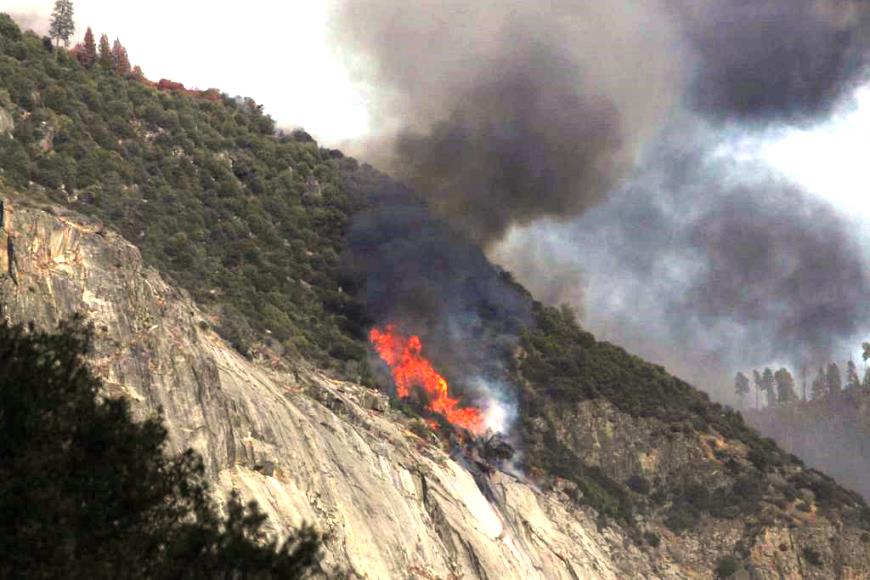
Dog Rock Fire, 5:31 p.m. PDT, October 7, 2014. Photo by Madison Sites.
****
(UPDATE at 7:35 p.m. PDT, October 7, 2014)
The Fresno Bee reported that Kari Cobb, spokesperson for Yosemite National Park, said, “We saw it crash. It was witnessed by park staff as well as some community members”.
Ms. Cobb was referring to the air tanker that crashed while fighting the Dog Rock Fire near the park. CAL FIRE announced earlier that they lost contact with an air tanker. At 6:21 p.m. PDT spokesperson Daniel Berlant said the aircraft was an S-2T air tanker.
The condition of the pilot, the only person on board, is not known. Emergency personnel are hiking to the crash site.
The 23 CAL FIRE air tankers, all S-2Ts which carry 1,200 gallons, are maintained and flown by a contractor, DynCorp. However, CAL FIRE hires their own pilots for their 11 UH-1H Super Huey helicopters.
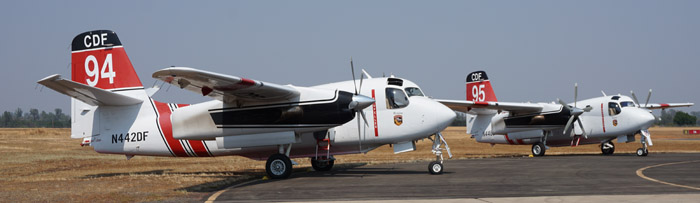
File photo of two S-2T air tankers, T-94 and T-95, at Redding, California, August 7, 2014. Photo by Bill Gabbert.
****
(Originally published at 5:54 p.m. PDT, October 7, 2014)
The California Department of Forestry and Fire Protection said they lost contact with an air tanker that was flying over a wildfire near Yosemite National Park. The aircraft was assigned to the Dog Rock Fire burning near Yosemite’s Arch Rock. The status of the aircraft and the pilot have not been determined.
CAL FIRE’s announcement was at 5:43 p.m. PDT, October 7. When more information is available, we will update this article.
The Dog Rock Fire began Tuesday afternoon at Dog Rock on the El Portal Road between the park boundary and Arch Rock Entrance Station. The fire was reported around 2:45 p.m. PDT at the last report was approximately 130 acres.
The community of Foresta has been evacuated. El Portal Road is temporarily closed to all through traffic from the park boundary near Yosemite View Lodge from the west and at the junction of the El Portal and Big Oak Flat Roads from the east.
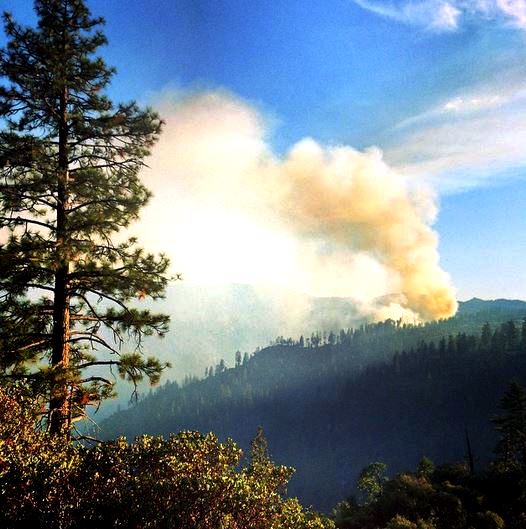
The Dog Rock Fire, as seen from Turtleback Dome at 6 p.m. PDT, October 7, 2014.
For a third year in a row the Federal Aviation Administration (FAA) presented CAL FIRE and DynCorp International with the FAA’s Diamond Award of Excellence for Aviation Maintenance. The award recognizes CAL FIRE’s aviation maintenance unit after all maintenance technicians pass a rigorous and specialized aircraft safety training program.
CAL FIRE’s current support contractors are DynCorp and Logistics Specialties Incorporated (LSI). DynCorp provides airtanker and airtactical plane pilot services, and all aircraft maintenance services. All CAL FIRE helicopters are flown by CAL FIRE pilots. LSI provides procurement and parts management services.
A judge has ordered the California Department of Forestry and Fire Protection (CAL FIRE) to pay more than $30 million in penalties, legal fees, and costs to Sierra Pacific and others for their actions related to a lawsuit over the 2007 Moonlight Fire. Retired Superior Court Judge Leslie C. Nichols in a 28-page order issued Tuesday accused CAL FIRE of “egregious and reprehensible conduct” in pursuing a lawsuit against the company.
The Moonlight fire burned about 65,000 acres in 2007, including 46,000 acres in the Plumas and Lassen National Forests in the northern part of the state. CAL FIRE and U.S. Forest Service investigators said the fire was started by a bulldozer operator for a company hired by Sierra Pacific, which denied any involvement in the fire.
In 2012 Sierra Pacific, in order to settle the suit presided over by U.S. District Judge Kimberly J. Mueller and prevent further actions by CAL FIRE, agreed to pay nearly $50 million and donate 22,500 acres of land to the USFS. The company thought CAL FIRE was ultimately seeking $1 billion, and they were aware that Judge Mueller had ruled earlier that the company could be liable even if it had nothing to do with starting the fire.
Below is an excerpt from an article in the Sacrameto Bee, which said Sierra Pacific…
…was a victim of stonewalling by Cal Fire in that agency’s Plumas County suit, including the alleged withholding of thousands of pages of key internal documents relevant to the legal struggle.
In a 28-page order issued Tuesday, retired Superior Court Judge Leslie C. Nichols essentially agreed with all of Sierra Pacific’s points, adopting a separate, 57-page order proposed by Sierra Pacific and the other defendants almost word-for-word, and excoriating the behavior of Cal Fire and two lawyers from the office of Attorney General Kamala Harris, which represented the agency.
“The court finds that Cal Fire’s actions initiating, maintaining and prosecuting this action, to the present time, is corrupt and tainted,” the judge wrote. “Cal Fire failed to comply with discovery obligations, and its repeated failure was willful.”
The agency withheld documents for months, “destroyed evidence critical (to the case) … and engaged in a systematic campaign of misdirection with the purpose of recovering money from (Sierra Pacific).”
Sierra Pacific, according to the Sacramento Bee, claimed there is evidence that a USFS employee in a fire lookout tower may have been smoking marijuana during the early stages of the fire, which delayed the detection, and they reported that “defense lawyers had to work hard to pry that information out of the Forest Service”.
CAL FIRE was also involved in questionable behavior before the case went to trial. In their billing sent to Sierra Pacific in 2009, they demanded the company make two payments; one for $7.7 million to the state, and another for $400,000 to an account belonging to a nonprofit organization administered by CAL FIRE. The funds in that account had been used for off the books purchases of items such as 600 digital cameras and 26 evidence sheds. In Sierra Pacific’s investigation into CAL FIRE’s demand for payment, they discovered the very unusual account, named “Wildland Fire Investigation Training and Equipment Fund”, sometimes referred to as “WiFiter”.
That account, as we wrote in January of 2013, was not exactly secret, however it was not commonly known that it was an off-the-books account not subject to the standard state regulations for managing and spending money. We found a memo from former CAL FIRE Director Walters, apparently written in 2009, summarizing the year’s fire season in which he mentioned the account:
Office of Program Accountability (OPA) finalized three audits (Volcan Incident, Wildland Fire Investigation Training and Equipment Fund, and Indirect Cost PCA 99200)…
The current Director of CAL FIRE, Ken Pemlott froze the fund in August, 2012 after, according to the LA Times, “receiving a briefing from his staff, said Janet Upton, a Cal Fire spokeswoman”.
Thanks and a hat tip go out to Dick, Sunil, and Kirk.
The California Department of Forestry and Fire Protection published their weekly situation report today, detailing the wildfire activity over the last week.