
Over on Wildfire Today we have the news about two former employees of Carson Helicopters being indicted by a federal grand jury over charges related to the crash of a Sikorsky S-61N helicopter on the Iron 44 fire in northern California in 2008 that killed nine people, including seven firefighters and two crew members.
Former employees of Carson Helicopters indicted over fatal Iron 44 Fire crash
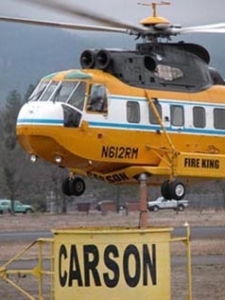
Two former employees of Carson Helicopters are facing 20 years or more in prison for charges related to the crash of a helicopter August 5, 2008 that killed nine people (seven firefighters and two crew members) as it attempted to take off from a remote helispot on the Iron Complex or Iron 44 Fire in northern California.
Last week a federal grand jury in Medford, Oregon indicted Steven Metheny, 42, former Vice President of Carson, and Levi Phillips, 45, the former maintenance chief of the company, for charges of conspiracy to defraud the United States which could earn them up to 20 years in prison if convicted.
Metheny was also indicted in 22 other counts of mail fraud, wire fraud, making false statements to the Forest Service, endangering the safety of aircraft in flight, and theft from an interstate shipment. In addition to the 20 years for conspiracy to defraud charges, he could get a maximum sentence of 20 years for every mail and wire fraud count, 20 years for each endangering the safety of aircraft in flight count, 10 years for the interstate theft count, and up to five years for each false statement count.
According to the findings of the National Transportation Safety Board in 2010, there was “intentional wrong-doing” by Carson Helicopters that under-stated the weight of the Sikorsky S-61N helicopter and over-stated its performance in the documents they provided to the USFS when bidding on $20 million in firefighting contracts for seven helicopters. As a result, when the helicopter attempted to take off from the helispot on the Iron 44 Fire with firefighters and a flight crew of three, it was over the allowable weight even before the firefighters boarded the ship. The helicopter crashed into some trees and caught fire, just after lifting off.
Killed in the crash were pilot Roark Schwanenberg, 54; USFS check pilot Jim Ramage, 63; and firefighters Shawn Blazer, 30; Scott Charlson, 25; Matthew Hammer, 23; Edrik Gomez, 19; Bryan Rich, 29; David Steele, 19; and Steven “Caleb” Renno, 21. The copilot and three other firefighters were seriously injured.
In March of 2012, a jury ordered the manufacturer of the helicopter’s engines, General Electric, to pay $69.7 million to William Coultas (the surviving pilot), his wife, and the estate of Roark Schwanenberg (the pilot who was killed).
After the crash, between September 26 and October 3, 2008, the USFS suspended the contract for some of Carson’s helicopters. On February 18, 2009, the USFS canceled their contract (copy of the contract) with Carson (copy of the termination letter) based on inaccurate claimed weights of the helicopters. The company then surrendered their FAA Certificate which is equivalent to an operating license. After that they received a contract for seven S-61s to fly for the military in Afghanistan as a subcontractor for the company formerly known as Blackwater Worldwide, which was renamed “Xe”. In February 2010, Sikorsky announced a joint venture with Carson to supply up to 110 modernized S-61T helicopters to the U.S. government, primarily for the State Department.
The U.S. Attorney’s office in Oregon is working with the Offices of Inspector General for both the Department of Agriculture and the Department of Transportation in Portland, Oregon and Seattle, Washington, and the FBI and the IRS in Medford, Oregon in the investigation and prosecution of this case.
- The mother of one of the firefighters killed in the crash reacts to the indictments.
- More information on Wildfire Today about the crash.
- The federal grand jury charges (the indictment)
Thanks go out to Joseph and Kelly.
NPS releases report on Lassen National Park’s Reading Fire

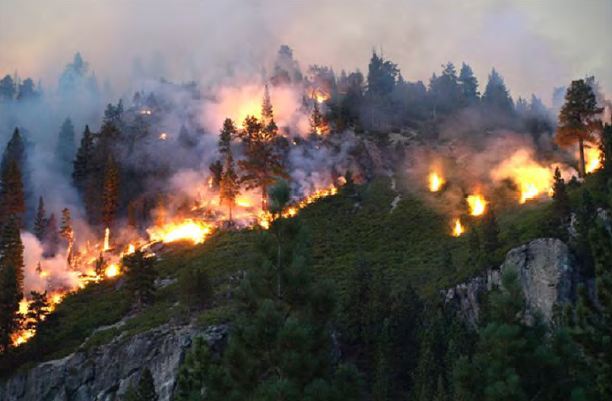
The National Park Service has released a report about last summer’s Reading Fire in Lassen Volcanic National Park in California which, after being monitored for two weeks and burning 95 acres, grew to 28,079 acres, escaping the park boundaries. The fire started from a lightning strike on July 23, 2012 and was contained on August 22. For the first two weeks it was managed under a “Wildland Fire for Resource Benefit” strategy.
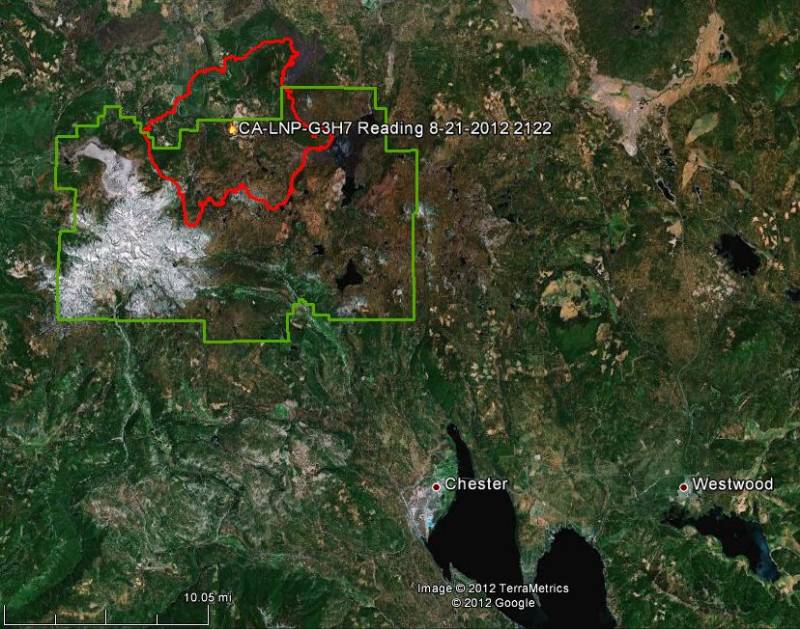
The expectation was that they could stop the fire when it reached the Lassen National Park Highway, about a mile north of the point of origin. On August 6 when the fire was 140 acres the Type 4 Incident Commander transitioned to a Type 3 IC. Later in the day the fire ran for about a mile and a half, blowing right across the 2-lane highway. Then a Type 2 Incident Managment Team was ordered, which eventually transitioned to a Type 1 IMTeam on August 13. When the fire was contained it had burned 11,071 acres of US Forest Service land outside the park boundaries and 75 acres privately owned, for a total of 28,079 acres. By August 23 the National Park Service had spent $15,875,495 observing, managing, and later suppressing the fire.
As we have stated before, managing a fire with your hands tied by utilizing little to no aggressive suppression action, is extremely difficult, requiring an extraordinary amount of skill, knowledge, expertise, experience, and luck. Especially if the fire starts in mid-July, leaving 6 to 12 weeks of weather ahead that is conducive to rapid fire spread. Few people can do this. It is impossible to predict accurately how weather will affect a fire more than 10 days ahead.
Here are some some excerpts from the 53-page report:
Continue reading
Old Fire arsonist receives death penalty


Rickie Lee Fowler received the death penalty today for starting the 2003 Old fire that destroyed 1,003 homes, burned 91,000 acres, and led to five deaths. He was convicted on August 15 of two arson charges and of murdering the five people who died of heart attacks after their homes burned or while they evacuated during the fire in San Bernardino County, California. When he was convicted, the jury recommended that Fowler be sentenced to death but the judge had the discretion to impose that or life in prison.
This morning Superior Court Judge Michael A. Smith, after hearing arguments by attorneys and statements by the victims’ families, confirmed the death penalty for Fowler. The sentence will automatically be appealed to the California Supreme Court.
In the trial, the State employed the same principle used when prosecutors in neighboring Riverside County won a death penalty conviction against Raymond Lee Oyler, an auto mechanic who set the 2006 Esperanza wildfire that killed five federal firefighters. Oyler is believed to be the first person in the U.S. to be convicted of first-degree murder and sentenced to death in a wildland arson case.

Before the trial Mr. Fowler said he and three men in a van had intended to rob John Aylward, a person he identified as his godfather, but realized they were too drunk or stoned to pull it off. Instead, they decided to start a fire, as one person testified before a grand jury, “to burn John’s house down”.
In an interview with investigators, Mr. Fowler said he ignited a road flare and threw it into the vegetation, but corrected himself and said one of the other men in the van struck the flare. In a later interview, he said he intended to strike and throw the flare, but Martin Valdez Jr. took it from him, struck it, and threw it into the brush.
While in prison before the trial, Mr. Fowler was convicted of sodomizing another jail inmate and for that was sentenced to three 25-years-to-life prison terms.
California: man convicted of assaulting a firefighter


A California jury convicted a man from Sage, California (map) Thursday of assaulting a firefighter with a deadly weapon. The incident occurred on the Buck Fire which burned 2,681 acres south of Hemet August 14, 2012.

Gregory Lance Good, 60, became angry with a Riverside County Fire Department captain and was accused of driving his vehicle at the captain and running over his foot. Due to a lack of evidence he was acquitted of a charge of shooting at three people that he thought were trespassing on his property earlier in the year.
He could face a maximum sentence of nine years for the assault on the firefighter.
The Buck Fire was more eventful than your typical fire. An inmate firefighter died after he became ill on the fire. In addition, two CAL FIRE firefighters were injured when they were struck by retardant dropped from a CAL FIRE air tanker. They were transported to a hospital where they were treated and released.
Below is video of a DC-10, tanker 910, dropping on the Buck fire.
CAL FIRE kept $3.6 million in off-the-books account
The California Department of Forestry and Fire Protection kept $3.6 million in a non-standard account without the approval of the state Department of Finance. Articles in the LA Times and Wall Street Journal spell out the details of the account that received settlement funds from companies responsible for wildfires. CAL FIRE’s regulations require that settlement money be deposited into the state’s general fund where it would be available to other state agencies in the regular budget appropriation process.
The account, “Wildland Fire Investigation Training and Equipment Fund”, sometimes referred to as “WiFiter”, was held by the California District Attorneys Association, a non-profit organization. Below is an excerpt from the LA Times article:
The department established the fund with the district attorney’s association in 2005. The association charged a fee to hold the money. The amount of that fee changed over the years. When it began, the prosecutors received 3% of the money when it came in and 15% when Cal Fire pulled money out for training or equipment.
The department used the fund to purchase equipment, such as 600 digital cameras and 26 evidence sheds for $600,000. According to the audits and emails, Cal Fire insisted that the equipment belonged to the association. That led [CALFIRE auditor Anthony] Favro to send an email to [former CALFIRE Director Del] Walters and Janet Barentson, the department’s current deputy chief director, asking, “Isn’t this a gift of public funds?”
The 18% interest taken out of taxpayer funds sounds almost like loan shark rates.
From the Wall Street Journal:
The account came to light as a result of lawsuits filed by Cal Fire and the federal government against Sierra Pacific Industries Inc., a Redding, Calif., lumber company. The suits claimed the massive 2007 “Moonlight Fire” was started by a bulldozer driver at a company hired by Sierra Pacific, which denies any involvement with the blaze.
In 2009, a Cal Fire investigator wrote to Sierra Pacific seeking reimbursement for the cost of fighting the fire, which consumed 65,000 acres of public and private lands in northeast California, according to Cal Fire. The letter asked for payment in two separate checks: one for $7.7 million to the state, and one for $400,000 to a nonprofit that administered WiFiter, according to Cal Fire.
Sierra Pacific refused to pay either bill. The federal government and California proceeded to sue Sierra Pacific in federal and state court, respectively. In the midst of discovery in the suits, the company uncovered the WiFiter account, according to lawyers and Cal Fire.
The account itself was not exactly secret, however it was not public knowledge it was an off-the-books account not subject to the standard state regulations for managing and spending money. We found a memo from former CAL FIRE Director Walters, apparently written in 2009, summarizing the year’s fire season in which he mentioned the account:
Office of Program Accountability (OPA) finalized three audits (Volcan Incident, Wildland Fire Investigation Training and Equipment Fund, and Indirect Cost PCA 99200)…
The current Director of CAL FIRE, Ken Pemlott signed a new agreement with the association in 2011 but froze the fund in August, 2012 after, according to the LA Times, “receiving a briefing from his staff, said Janet Upton, a Cal Fire spokeswoman”.
Wildfire briefing, January 25, 2013
Caylym continues to develop containers for dropping retardant

Since Wildfire Today last covered their disposable container for delivering retardant over wildfires,the Caylym company has continued to develop and promote their concept. The system consists of containers constructed of cardboard, plywood, a plastic bladder, and dozens of yards of straps. They hold 264 gallons each and are designed to be carried in military aircraft such as the C-130 or C-27 using the standard cargo system. The containers when empty weigh 100 pounds.
At Fire Aviation we have more photos and a video, as well the results of our interview with Rick Goddard, the Managing Director of Caylym
South Africa: Firefighter Man killed fighting a fire near Clanwilliam
(UPDATE January 26, 2013: It turns out the man that was killed was not a trained firefighter, volunteer or paid. As so frequently happens in remote areas of South Africa, he lived nearby and was doing what he could to fight the fire while hoping that firefighters might show up.)
A man has died fighting a wildfire near Clanwilliam in South Africa (map). Christo Fourie, a retired bank manager, had been missing since Wednesday and his body was found Thursday in a burned area near his vehicle. A police spokesperson said Mr. Fourie was caught in the fire but the exact circumstances of his death were being investigated. A news report described the man as a volunteer firefighter.
The fire has burned 24,000 hectares (59,305 acres) and is being fought by firefighters supported by helicopters and four air tankers.
Missouri: Fire destroys Mammoth-area home
A wildfire destroyed a home on County Road 527 off the T Highway near Mammoth, Missouri on Monday. The fire was fought by the Timber Knob and Pontiac VFDs for several hours but the home was a total loss.
Utah: fire baloons may become illegal

Proposed legislation in Utah would outlaw fire balloons, sometimes called Chinese lanterns or sky lanterns. These devices are small, lightweight, inexpensive hot air balloons powered by burning material at the base. They can be made out of common household materials or purchased in large quantities online.
We first wrote about fire balloons in November after seeing the concept promoted by Mercedes in a car commercial on network television. An article in the Deseret News quotes Coy Porter, the Utah State Fire Marshal, as saying, “The biggest problem is just if they’re slightly damaged, there’s a small rip, they don’t get the elevation, they can still come down while the flame is still going in there.”
These incendiary devices are sometimes released by the hundreds at weddings or in celebration of the Chinese New Year.
More information from the article:
During the wedding rehearsal for former BYU and current NBA basketball player Jimmer Fredette last May, hundreds of lanterns were released into the Denver sky. One of those lanterns landed in a neighbor’s yard and lit a tree on fire. Fortunately, it didn’t do too much damage.
Last summer, Porter said a wildland fire in St. George was also started as a result of a sky lantern.
Links to information about a few fires that have been caused by these devices: here, here, and here.
Los Angeles: law firm has Wild Land Fire Litigation Practice Group
I guess there should be no surprise that a law firm has a “Wild Land Fire Litigation Practice Group”. In our litigious society there are probably lawyers that specialize in every conceivable niche. The Murchison and Cummings law firm in Los Angeles has such a group chaired by Friedrich W. Seitz. They are representing the Bluebonnet Electric Cooperative in defending them against the numerous lawsuits that have been filed relating to the September 2011 fire in Bastrop County, Texas that burned 34,000 acres and destroyed 1,600 homes. In an effort to try to get in on the action, a law firm in Texas created a web site in order to recruit clients to sue Bluebonnet for another fire in Bastrop County, the Wilderness Ridge fire, which burned 26 homes, 20 businesses, and 1,491 acres in Bastrop County, Texas in February, 2009.
Murchison and Cummings has defended Southern California Edison and Breitburn Energy Partners against litigation arising out of wild land fires for many years.
California incident management teams reunion


This could be big. All of the past and present members of the Type 1 and Type 2 incident management teams in California are being invited to a reunion. It is the first time this has been attempted. I doubt if anyone knows how many people have been on all of those teams over the last, say, 20 years, but with five very large Type 1 IMTs, and quite a few Type 2 IMTs, we’re probably talking about thousands of people. Of course not all will attend, but they have a large base for possible attendees.
Below is an excerpt from the announcement. Clicking HERE will download Word document, and HERE is the registration form.
…The federal California Incident Management Teams Reunion 2013 is the first ever event to gather the past and present members of the Type 1 and Type 2 fire teams of Region 5 at the amazing Atlantis Casino Resort Spa in Reno, Nevada, where team members and guests can relax and visit. Each day will feature special meals, exhibits and guest speakers with ample time to connect with colleagues and lifelong friends. Headed by the steering committee of Denny Bungarz, Charlie Gripp, Sid Nobles, and Jim Hanrahan, the reunion has the support of ICs Tom Hutchinson, Dave Kohut, Jack Lee, Jerry McGowan, Jeanne Pincha-Tully and Ron Raley.
Is prescribed fire in chaparral “irrelevant”?
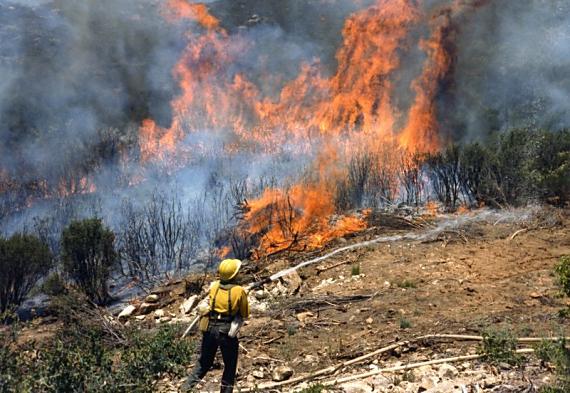
Some of the opinions of Jon Keeley, a fire ecologist with the U.S Geological Survey (USGS) at Sequoia-Kings Canyon National Park, are again in the news. A web site called OurAmazingPlanet has quoted him in a lengthy article about prescribed fire, titled “Fighting Fires: You’re Doing It Wrong”. While admitting that prescribed fire in Sequoia-Kings Canyon National Park “is extremely necessary”, he goes on to say:
In most of Southern California, [prescribed fire] is completely irrelevant. There is overwhelming evidence we’ve never come anywhere close to excluding fire on this landscape [through prescribed fire].
Mr. Keeley believes that manipulating the vegetation in chaparral-covered areas by masticating and prescribed fire, replaces the native vegetation with invasive species like cheatgrass. He thinks that instead, we should concentrate on planning and reduce the number of people that are put at risk.
This is not the first time Wildfire Today has written about Mr. Keeley’s opinions. In 2009 we covered his research that indicates it is unlikely that changing the age class of chaparral can prevent large fires. The details are in his papers HERE and HERE, and in a brief article by John McKinney HERE.
Conventional wisdom was that younger chaparral, less than 20 years old, had fewer tons-per-acre of vegetation than older stands, and also had a much different live/dead ratio, with fewer dead stems and plants. Less flammable fuels (higher green content with higher fuel moistures) meant fires would spread more slowly and should be easier to suppress.
Totally preventing or excluding fires in chaparral will never be feasible, but… it is hard for me to give up the idea that creating a mosaic of chaparral age classes does not have a significant effect on fire size and resistance to control.
Red Flag Warning for southern California

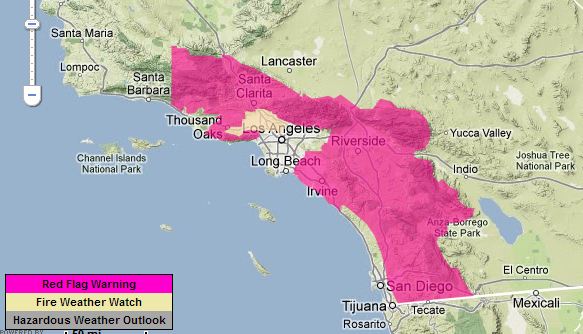
A Red Flag Warning is in effect for portions of the mountains and inland valleys of southern California Sunday night through Tuesday. The forecast calls for gusty northeast winds and low relative humidities. The strongest winds will be Sunday night and Monday with sustained winds of 15 to 30 with gusts up to 50 mph. The lowest humidities will occur Monday. The details vary across southern California — the specifics can be found at the National Weather Service.
The map was current as of 9:20 a.m. PT on Sunday. Red Flag Warnings can change throughout the day as the dozens of National Weather Service offices around the country update and revise their forecasts. For the most current data, visit this NWS site.