10 Tanker Air Carrier is retiring one of their three DC-10 air tankers, Tanker 910, the first DC-10 to be converted.
Its final flight after serving for 10 years was this Saturday when it flew from Castle Airport, 910’s base since last summer, to Oscota Michigan for dismantling. To honor the work the airplane has done on California fires, officials at Castle saluted the airplane as it took off for the last time.
The aircraft was converted to an air tanker in 2004, and began working in California under a CAL FIRE contract in 2006. Since that time Tanker 910 has dropped on over 500 fire missions in California, and over 750 across the country. It has been joined by two other converted DC-10s, with the third one being introduced to the fleet on August 30.
10 Tanker Air Carrier will replace Tanker 910 with a newer air frame that will carry the same “910” designation as the plane being retired this fall. The work on the replacement began in early September and now the aircraft is going through a “C” check at Kalitta Air in Oscoda, Michigan.
10 Tanker expects to have Tanker 910 Version 2.0 ready to go by April, 2015.
Air tankers 911, 912, and 910 (L to R) at Castle Airport near Merced, California, August 30, 2014. (click to enlarge)
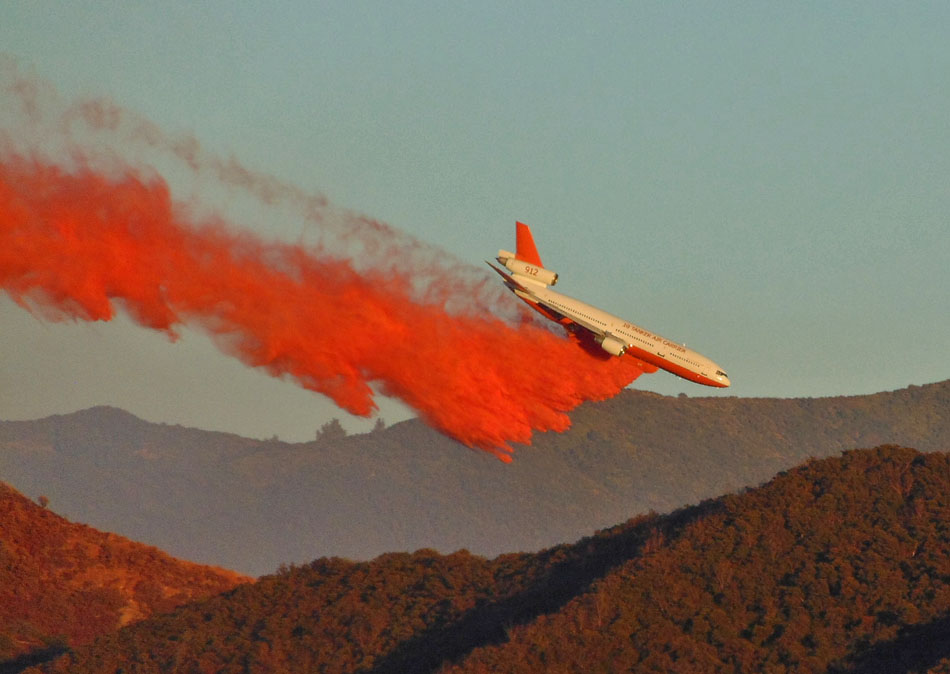
This video was shot on September 12 and is tagged Silverado Fire at LiveLeak. It may be the same drop made by Tanker 912, a DC-10, shown in the photo below which was taken on the fire the same day. We posted the photo and more information about the Silverado fire on Wildfire Today.
Tanker 912, a DC-10, drops on the Silverado Fire September 12, 2014. Photo by Initial Attack Fire Media. (click to enlarge)
On September 16 the air tanker base at McClellan Airfield near Sacramento set a record for the amount of retardant the base has loaded onto air tankers in one day, putting 187,761 gallons into the aircraft, according to William Appleton, Operations Manager for McClellan Jet Services. For most of the day the base loaded from one reload pit, Mr. Appleton said.
All of the retardant was used on the King Fire 43 miles east of McClellan near Placerville, California.
Two DC-10s, Tankers 911 and 912, each made eight trips to the King Fire, and smaller air tankers took a total of seven loads. 10 Tanker Air Carrier which operates the DC-10s that usually carry 11,600 gallons, said that was “by far the busiest day our company has ever had.”
Thi above video shot at the Courtney Fire three miles southeast of Oakhurst, California shows slow motion drops from a DC-10, P2V, S-2, and a couple of other aircraft that are too far away to determine the model. And, check out what appears to be an explosion at 0:29.
DC-10s, Tankers 910 and 911, at Medford. Photo by Kristin Biechler.
The U.S. Forest Service set up a portable air tanker base at the Medford Airport in southern Oregon to augment the existing air tanker base, enabling it to service Very Large Air Tankers in addition to the smaller tankers. Below is as press release from the agency:
****
“Release Date: Aug 25, 2014 Medford, Oregon
Contact: Virginia Gibbons, (541) 618-2113
During recent fire activity in the Rogue Valley, many residents have noticed larger aircraft flying in to support firefighting efforts than was possible in past years.
This increased capacity with aircraft is due to the Rogue Valley International Medford Airport and the US Forest Service working together to make improvements to the taxiway and the ramp, allowing for the larger planes. Starting in fire season 2014, two fire retardant airtanker bases are now in operation; the main base that is operated by the Rogue River-Siskiyou National Forest and the Oregon Department of Forestry, and also the new portable Very Large Airtanker (VLAT) base.
The Medford Airtanker Base (MATB) is now able to accommodate all types of airtankers, including “next generation” air tankers (MD87, BAE146, RJ85, Coulson C130Q), and Modular Aerial Firefighting Systems or “MAFFS”, which are military C130s equipped with slide-in retardant tanks.
Next Gen airtankers are newer, faster, less maintenance and provide more pay load compared to the piston-powered legacy fleet of airtankers. Next Gen airtankers have a cruise speed of at least 346 when fully loaded and can hold over 3,000 gallons of retardant. The VLATs hold up to 11,600 gallons of retardant.
“The new ramp improvements, along with the portable VLAT base, are quickly proving to be a significant asset to firefighting efforts across the state of Oregon and Northern California, as well as to Southwest Oregon,” said Medford Air Tanker Base Manager Lonnie Allison.
The two DC-10s (T-910 and T-911) using the Medford VLAT bases are the largest airtankers flying in the nation. The Medford VLAT base is the only base in Oregon that can reload the DC-10’s. Airtankers play an important role in wildfire suppression, particularly during initial attack, by reducing the intensity and rate of spread of wildfires so that firefighters on the ground can safely construct containment lines.
As an example of the increased capacity at MATB, On August 9, the two ATB’s were able to support two large fires in Northern California (Beaver and July Complexes) with the VLAT (T-911) and six other airtankers. Together, these two ATB’s delivered almost 90,000 gallons of retardant to the fires. Approximately 40,000 gallons of retardant were pumped out of the main ATB on 21 airtanker loads and 50,000 gallons out of the VLAT base on 7 airtanker loads.
Now that Medford has two ATB’s, they can reload both the VLATs and other airtankers at the same time. Between VLAT reloads, the ATB is able to divert airtankers from the main ATB to the VLAT base, making both bases more efficient, with quicker load and return times to the fires.
Another recent example of enhanced airtanker support was for the Rogue River Drive fire, which was threatening 130 homes between Sam’s Valley and Shady Cove. On August 11, approximately 20,000 gallons of fire retardant was dropped via seven loads provided by two airtankers. Later that afternoon, both air bases were used to deliver 70,000 gallons of retardant via 33 loads provided by six airtankers; with 21 loads out of the main base and 11 loads out of the portable VLAT base.
On the morning of August 12, 12,000 gallons of fire retardant was dropped via four loads provided by two airtankers to the Grey Back Complex. During the same afternoon, 6,000 gallons of fire retardant was dropped via five loads provided by two airtankers to the Delta Fire in California. The combined total of retardant delivered to fires in southern Oregon and northern California on August 12 totaled approximately 90,000 gallons via 42 loads provided by 8 airtankers delivered to three fires.
The total amount of fire retardant that has been pumped from the two airtanker bases in fire season 2014 is approximately 500,000 gallons; with approximately 420,000 gallons from the main airtanker base and approximately 75,000 gallons from the portable VLAT air base. The 10-year average at MATV for annual fire retardant use is 235,000 gallons per year. With the increased capacity, the Medford Airtanker Base has already doubled the average of retardant for fire season 2014 that is typically pumped for an entire fire season.
Airport Director Bern Case said, “I am thrilled with the tremendous relationship that has been developed with the Medford Airtanker Base and the Rogue Valley International Airport. Working together, we have made a great resource even better. These improvements benefit all in the region.” “
The Happy Camp Complex of fires in a remote area of northwestern California continued to chew up additional acres on Saturday, though at a somewhat slower rate than the previous two days. Now mapped at 62,626 acres, a 24-hour increase of 4,904 acres, it has reached Highway 96 near the small community of Seiad Valley. Several areas are under a mandatory evacuation order affecting 250 homes, and approximately 695 homes are threatened. The fire is being fought by 2,116 personnel, 52 crews, 137 engines, 19 helicopters and 18 dozers. The incident management team is calling it 15 percent contained.
The fire is burning in an area infamous for inversions that trap wildfire smoke, at times making it difficult for firefighting aircraft to fly, and firefighters and residents to breathe.
It is unfortunate that we don’t know who took the excellent photo posted above. Public Information personnel posting photos on InciWeb REALLY need to provide at least four pieces of information about each photo: 1) photographer’s name, 2) date taken, 3) location, and 4) a description.
Dust from wildfire causes traffic problems
Dust being blown off a recent wildfire close to Interstate 90 near Vantage, Washington resulted in a 20-mile stretch of the highway being closed on Thursday and Friday.
Fifteen cars and nine tractor-trailers collided in the area on Thursday, leaving nearly a dozen people injured and causing a pileup that snarled traffic on the main route across Washington state, authorities said. According to Trooper Darren Wright, it’s not yet known how the pileup started.
A third DC-10 joins the fleet
Tankers 910, 911, and 912 at Castle Airport, August 30, 2014. Photo by 10 Tanker.
A third DC-10 jumbo jet has been converted into an air tanker. 10 Tanker Air Carrier announced Saturday that Tanker 912 has been fully certified and has joined the other two DC-10s temporarily based at Castle Airport near Merced, California.
Report released on CL-415 accident
A report has been released on the CL-415 air tanker accident that occurred on Moosehead Lake in Newfoundland and Labrador July 3, 2013. Details are at Fire Aviation.
Tankers 910, 911, and 912 at Castle Airport, 8-30-2014. Photo by 10 Tanker.
On August 30 the latest DC-10 air tanker to be retrofitted, Tanker 912, joined its’ sisters, T-910 and T-911 at Castle Airport near Merced, California. It has been carded by the U.S. Forest Service and is ready to go, according to 10 Tanker Air Carrier.
Yesterday we wrote about the DC-10 air tankers and how they frequently work out of Castle Airport, a former U.S. Air Force bomber base near Merced, California. Today we have some photos from the base contributed by Stanley Bercovitz who is serving as a ramp manager and public information officer at the base.
Tanker 910, a DC-10, reloads with retardant at Castle Airport. Once the tanker is stopped and the chocks are set the parking tender waves in the retardant loaders. The side of the tank has three ports and at least two are always used to fill the tank at Castle. After loading has started a mechanic will climb a ladder and monitor the level of retardant, eventually giving a signal to stop loading. A mechanic talks to the flight crew through a wired headset, watching each engine as it starts. Once all three are running, he puts the headset into a compartment inside the nose gear and gives a thumbs-up to the pilot and the parking tender. Retardant mixing operation at Castle Airport. The flight crews prepares to receive a meal via a bucket on a rope.
Over its 73-year history Castle Air Force Base just northwest of Merced, California has hosted a variety of large aircraft on the 30 parking pads, including B-52 bombers and KC-135 refueling air tankers. After the base closed in 1995 it became known as Castle Airport, operated by Merced County.
In 2013 when the 257,000-acre Rim Fire was burning nearby, the airport started to host a different kind of air tanker, firefighting aircraft that drop retardant on wildfires. Last year and this year it was designated as a Call When Needed air tanker base, activated only when specifically needed. The taxiways, parking areas, and the 11,802-foot runway, all designed to support large bombers, make it a facility capable of handling quite a few Large and Very Large air tankers, including C-130s, MD-87s, BAe-146s, and DC-10s. The reloading base has been set up just northwest of the 30 B-52 parking pads. (map)
This year while hosting the 11,600-gallon DC-10s and other air tankers, the base has pumped almost half a million gallons of retardant into aircraft. A Very Large Air Tanker such as a DC-10 departing the airport in the center of the state could reach the Oregon or Mexican borders within about 45 to 50 minutes.
The two DC-10 Very Large Air Tankers at Castle today, Tankers 910 and 911, have been there often over the last several weeks, however they do move around to other bases depending on the need. Occasionally this year they have both attacked the same fire, placing over 23,000 gallons of retardant on the vegetation as the pair assisted firefighters on the ground. The two aircraft both dropped on the fast moving Oregon Fire near Weaverville, California shortly after it started late in the day on August 24. Their air drops along with efforts from other aircraft and of course boots on the ground held the fire to 580 acres. Today it is 85 percent contained.
Rick Hatton, President of 10 Tanker Air Carrier, said their third DC-10, Tanker 912, is in the process of being “carded” by the Interagency AirTanker Board at Albuquerque, New Mexico. Engineers are fine-tuning the computer programming for the three external retardant tanks. Next week, he said, it should be ready to go and will be brought on as an exclusive use air tanker under the “additional equipment” provision of the company’s contract with the U.S. Forest service.
The video below reports on the Junction Fire in California, and how air tankers played a vital role in minimizing the damage.
National Public Radio has an interesting article about air tankers. Below is an excerpt:
…Bill Hahnenberg, an incident commander with the Forest Service, was initially skeptical of this new generation of air tankers — he wasn’t sure how helpful they’d be in the fight against Western wildfires. Then, in August 2012, Hahnenberg was leading the fight against the Springs Fire in the Idaho mountains.
If firefighters hadn’t been able to get a handle on it quickly, there was a chance it would be unusually destructive: “There was a high likelihood we would have been managing that fire for, rather than a few more days, probably a few more weeks,” he says.
Hahnenberg says the fire was at risk of jumping over a mountain and burning into two small towns. He had just a few hours to get fire retardant on the ground.
“At that point we’re looking for the biggest, heaviest hammer we could bring to the table,” he says.
That hammer was sitting at the Boise airport, about 40 miles away. It was a giant DC-10 air tanker the government had just hired to fight such fires. Two retardant drops later, the fire was boxed in and ground crews began to get the upper hand. In the end, the Springs Fire turned out to be sort of a nonevent — a sign of success.
“Once an air tanker has contained that fire, we never see that, because it doesn’t show up on the news,” says Scott Fisher, who oversaw the Forest Service’s air tanker program until his retirement this summer.
The DC-10 used on the Springs Fire was part of the agency’s effort to grow and modernize the tanker fleet. In 2000, the government had more than 40 air tankers on contract. But many of those were built during World War II and the Cold War, and two crashes of so-called “legacy” air tankers led many to be parked for good. The number of air tankers would later fall to just nine.
Fisher says that number was simply too low. “Not having sufficient resources caused the system to be stretched,” he says. “And certainly because of that there were fires that we just did not get to.”