Photos of large air tankers working the Alisal Fire in SoCal

Tanker 101 dropping Alisal Fire
Tanker 101, an MD-87, dropping on the northwest side of the Alisal Fire, Oct. 13, 2021. Photo by SBCFD

Since the Alisal Fire started west of Santa Barbara, California on October 11 there have not been many opportunities for firefighting aircraft to work the fire due to the very strong winds. Helicopters have been able to sneak in a few times, but until yesterday and today, October 12 and 13, they have rarely been seen at the fire.

Thanks to a decrease in wind speed, today on FlightRadar24 I saw six large air tankers and two very large air tankers (DC-10s) either over the fire, flying to or from, or taxiing at the Santa Maria airport which is 31 miles northwest of the fire.

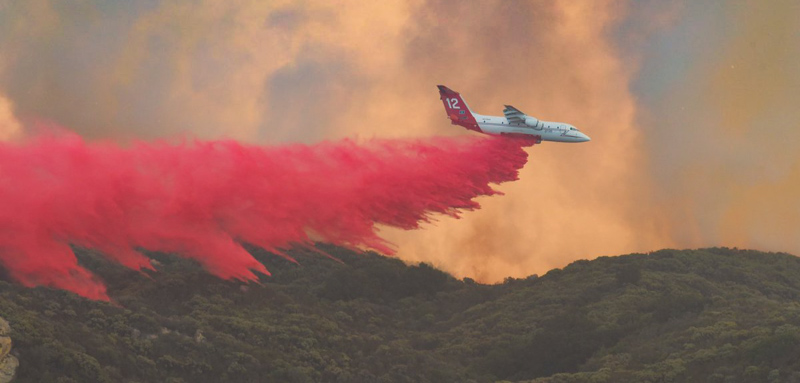
Tanker 12 dropping Alisal Fire
Tanker 12, a BAe-146, dropping on the northwest side of the Alisal Fire, Oct. 13, 2021. Photo by SBCFD

These photos are courtesy of the Santa Barbara County Fire Department.

Tanker 137 dropping Alisal Fire
Tanker 137, a 737, dropping on the northwest side of the Alisal Fire, Oct. 13, 2021. Photo by SBCFD

Wednesday morning the Santa Barbara County Fire Department said the Alisal Fire has burned 14,500 acres, an increase of 1,100 acres over the figure released Tuesday evening. The growth over the last 24 hours has been on all sides, with the exception, of course, where the fire was stopped by the Pacific Ocean on the south. Wildfire Today has more information about the fire.

Tanker 910 dropping Alisal Fire
Tanker 910, a DC-10, dropping on the northwest side of the Alisal Fire, Oct. 13, 2021. Photo by SBCFD
Alisal Fire map
Alisal Fire map 9:45 p.m. Oct. 12, 2021. The red line was the perimeter at 9:45 p.m. PDT Oct. 12, 2021. The white line was the perimeter at 4:12 a.m. Oct. 12. The red dots represent heat detected by satellites at 2:56 a.m. PDT Oct. 13.

A new FireHawk destined for Northern California

We are catching up on some photos recently received.

Enjoy.

CAL FIRE Helicopter 101
CAL FIRE Helicopter 101 after it went through flight tests at United Rotorcraft in Colorado. Its home base will be Howard Forest in Mendocino County, California. Photo by James Wattenburger, June 30, 2021.

(We removed a photo of a DC-10 after receiving additional information from the person who sent it to us, saying it was taken by someone else.)

Photos of air tankers attacking fire one mile from air tanker base

Tanker 103 drops fire Medford Oregon
Tanker 103, (an MD-87, N293EA) drops on a fire west of the Medford, OR airport Sept. 9, 2020. Photo by Tim Crippin.

Tim Crippin shot these photos of two air tankers dropping on a fire that had just broken out one mile west of the air tanker base at the Rogue Valley International Airport (MFR) at Medford, Oregon. Here is what he wrote:

I took these pictures of Tankers 103 and 910 dropping retardant on a fast moving brush fire that was racing up the Bear Creek Greenway near I-5 between North Medford and Central Point, OR yesterday (9-9-2020). This fire threatened multiple businesses and structures including a FedEx building and Costco. The city of Central Point was on a Level 3 evacuation shortly after it started due to the rapid spread of the fire.

The fire was only about 1 mile west of the Medford Airport and the tankers and helicopters that were working on the South Obenchain Fire were diverted to this fire. They had 3 air tankers do drops and they were Tankers 60 (missed their drop), Tanker 103 and Tanker 910. Along with multiple helicopters.

I took these pictures near Million Air at the Medford Airport.

The South Obenchain Fire has burned about 12,000 acres 12 miles northeast of the airport.

Tanker 910 drops fire Medford Oregon
Tanker 910, (a DC-10, N612AX) drops on a fire west of the Medford, OR airport Sept. 9, 2020. Photo by Tim Crippin.
Tanker 910 drops fire Medford Oregon
Tanker 910, (a DC-10, N612AX) drops on a fire west of the Medford, OR airport Sept. 9, 2020. Photo by Tim Crippin.

Air show over the Cave Fire

air tanker dropping Cave Fire Santa Barbara California
Tanker 910, a DC-10, drops on the Cave Fire Nov. 26, 2019. Photo by Mike Eliason for Santa Barbara County FD.

1:30 p.m. PST November 26, 2019

Mike Eliason of the Santa Barbara County Fire Department is one of the best Information Officers when it comes to providing information on social media about the status of wildfires. He is prolific on Twitter and judging from his production since the Cave Fire started at about 4 p.m. Monday, he may not have gotten much sleep in the last 24 hours. These five photos of air tankers were all taken Tuesday are just a sample of his work.

Check him out and follow him on Twitter:@EliasonMike

As of 11 a.m. PST on Tuesday the Cave Fire had burned 4,262 acres just northwest of Santa Barbara in Southern California. Additional information is at Wildfire Today including more of Mr. Eliason’s photography. Tuesday morning 10 air tankers and 9 helicopters were available for the fire.

air tanker dropping Cave Fire Santa Barbara California
An air tanker, either an RJ85 or BAe-146, drops on the Cave Fire Nov. 26,
2019. Photo by Mike Eliason for Santa Barbara County FD.
air tanker dropping Cave Fire Santa Barbara California
Tanker 12, a BAe-146, drops on the Cave Fire Nov. 26, 2019. Photo by Mike Eliason for Santa Barbara County FD.
air tanker dropping Cave Fire Santa Barbara California
Tanker 72, an S2-T, drops on the Cave Fire Nov. 26, 2019. Photo by Mike Eliason for Santa Barbara County FD.
air tanker dropping Cave Fire Santa Barbara California
An S2-T air tanker drops on the Cave Fire Nov. 26, 2019. Photo by Mike Eliason for Santa Barbara County FD.

Getting up to date on the DC-10 VLATs at Albuquerque

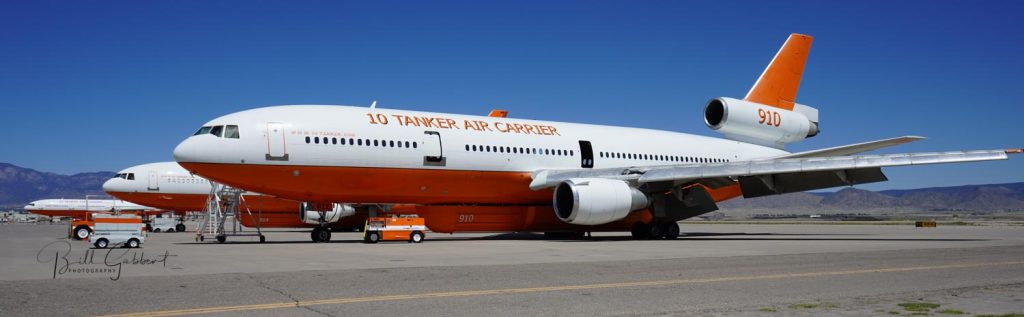
DC-10 air tanker
Air Tankers 910, 911, and 914 at Albuquerque, May 3, 2019.

On May 3 after the IAWF Fire Behavior and Fuels Conference I stopped by the headquarters of 10 Tanker Air Carrier at the Albuquerque airport. Not long ago the company moved into roomier facilities at the airport and it looks like they are settled into the new digs.

The company has four DC-10-30 Very Large Air Tankers (VLATs) now fully operational. The last one to be added to the fleet, Tanker 914, began service in 2018, joining Tankers 910, 911, and 912. T-910, the first DC-10 to be converted into an air tanker was originally a DC-10-10. In 2015 it was replaced with a DC-10-30 and now all four of the company’s aircraft are the same model, DC-10-30. The’30 series has more powerful engines and a much higher maximum take-off weight (MTOW) — 572,000 pounds which is far more than the earlier model.

When we were there one of the aircraft, T-912, had just left to start its exclusive use contract, and T-914 was going to depart in a few days to be based, for a while anyway, at Mesa, Arizona.

Two of the DC-10s spent much of February fighting fire in Chile. The original order called for just one, but on the first day at work in the country a tire failed in spectacular fashion, sending rubber shrapnel into one of the flaps, creating three holes. It took several days to fix it, working with the FAA and bringing mechanics with sheet metal expertise from the United States. John Gould, President and CEO of 10 Tanker, said the company told CONAF, the National Forest Corporation that handles wildland firefighting in Chile, that they could send a replacement DC-10 while the repairs were made. The CONAF representative said, in effect, You have more DC-10s? Bring another and we will use it along with the first one during the fire season. So a second was dispatched and they were based at opposite ends of the long, narrow country.

The Goodyear tire failed on its eighth landing —  which obviously is very unusual.

In the gallery below, mouse-over the photos below and a caption will appear. Click on a photo to begin a slide show of LARGE images, with the caption then at upper-left.

[envira-gallery slug=”dc-10-vlats-abq-5-3-2019″]

Mr. Gould said fully loaded the DC-10 VLATs weigh 405,000 pounds with a full load of retardant and 2.5 hours of fuel and 9,400 gallons of retardant, which gives the pilots a 167,000-pound margin when maneuvering for a retardant drop, compared to if it was loaded to MTOW.

The DC-10 operates with a crew of three, two pilots and a flight engineer who monitors the aircraft systems and inputs the specifications for the retardant drop.

The aircraft has five retardant tanks, three holding 2,700 to 4,000 gallons each, and two smaller fairing tanks at the front and rear. The fairing tanks are no longer used, which gives the VLAT a 9,400-gallon capacity.

En route to a fire it cruises at 340 knots, but when returning to reload it bumps the speed up to 380 knots. It drops retardant at 200 to 300 feet above the ground at 150 knots.

The first drop over a fire by a DC-10, Tanker 910, was on July 16, 2006 after being awarded a Call When Needed contract by the California Department of Forestry and Fire Protection, CAL FIRE.

Each DC-10 is followed by a support crew of seven maintenance technicians equipped with a four-door pickup and goose-neck trailer carrying spare parts and equipment.