
Wayne Wynick, the Assistant District Forester for Pennsylvania’s Moshannon State Forest, talks about the Air Tractor 802 single engine air tankers that will be based in Centre County through May.
Probationary firefighter in Pennsylvania charged with arson
A probationary volunteer firefighter in Pennsylvania has been charged with five counts of arson involving structure fires and is suspected of starting eight vegetation fires.
David Donnora’s most obvious mistake, other than deciding to become an arsonist, was responding to the correct address of a brush fire in Laflin even though the dispatcher mistakenly sent crews to an incorrect location. He found himself alone at the scene, which of course raised the eyebrows of other firefighters and the state police.
Here is an excerpt from an article in the Citizens Voice:
…Donnora, of 433 Highway 315 in Dupont, was a probationary member with the Laflin Volunteer Fire Department from June to September and worked with the Dupont Volunteer Fire Department from September until early December, when state police determined he was a suspect in a Main Street house fire, authorities said.
While Donnora was a fireman in Laflin, there were seven suspicious brush fires throughout the spring and summer, police said.
“He was with us for about four months. During that time, as you can see, we had a lot of brush fires. I immediately became suspicious and I turned it over to police,” Laflin Fire Chief Mark Malvizzi said. “I think it’s very possible this former member had an idea he was suspected, and stopped showing up.”
The fires continued when Donnora transferred to Dupont, except there all the blazes involved structures.
State police said Donnora once again raised suspicions of fellow firefighters when he was the first firefighter to arrive to suit up at the fire station following the report of a fire at 251 Main St. in Dupont at 6:50 a.m. Dec. 10.
Arrest papers say a state police fire marshal became suspicious of Donnora while investigating that fire because Donnora “was following him, taking interest in what he was doing.”
Wildfire briefing, November 16, 2012

Pennsylvania Firefighter sentenced for arson crimes
A 21-year old former volunteer firefighter pleaded guilty in October to conspiracy to commit arson after igniting a wildfire in July 2010 in Northampton County. Cory A. Praschyk suffers from anxiety and depression and has been diagnosed as a pyromaniac, according to a psychological evaluation completed prior to sentencing. He is already serving time for arson in Lehigh County. The new sentence for the Northampton County offense is one to 12 months in county prison to run concurrently with his Lehigh County sentence, which will conclude in about three months.
Kentucky man dies suppressing debris fire
Robert Childress, 64-years old, died in a Lexington hospital from smoke inhalation and burns over 95 percent of his body after he was found by a Kentucky Division of Forestry fire crew that arrived to suppress a vegetation fire reported by an aircraft. According to a report at Kentucky.com, Mr. Childress was apparently attempting to put out a fire that was called a debris burn by officials.
California fire crew accused of drug use and murder threats
Television station 17 KGET in central California has an article about their investigation into what appears to be serious problems last summer within the Rincon hand crew, a Sequoia National Forest Type 2 crew based out of Kernville, California. Here is how it begins:
Fire crew members say drug and alcohol abuse, fighting, and even murder threats were just some of the reasons a Forest Service fire crew was grounded over the summer. Those allegations came to light after a four-month investigation by 17 News.
We received hundreds of pages of previously secret government documents. 17’s Rob Martin broke the first story in June and has been digging ever since.
Rincon, a National Forest Service, Type 2 fire crew based in Kernville, was grounded for months this summer.
Rincon was rife with salacious allegations, including years of drug use on the team. It’s something the Forest Service refused to talk to us about, so we did the story without them.
Koalas injured in large vegetation fire in South Australia
Animal hospitals are caring for koalas that were injured in a massive brush fire in South Australia.
(the video is no longer available)
Summary of this year’s wildfires in the west
Bill Croke has written an interesting article at Spectator.org that nicely summarizes the wildfire season in the western United States. Here are some excerpts:
…There were notable named conflagrations in Colorado such as High Park near Denver and Waldo Canyon near Colorado Springs, and in Idaho (Hallstead near Stanley; Mustang near Salmon; Trinity Ridge near Boise). New Mexico saw the Whitewater-Baldy Fire on the Gila National Forest, at 465 square miles (297,000 acres) the largest in state history. The Waldo Canyon Fire took the grand prize for structures burned with 347. A hot, dry summer coupled with ongoing conditions of heavy fuel loads in pine beetle-infested forests (thanks to past fire suppression and little timber harvest on federal land) has brought us record fire seasons in the West for the last two decades.
According to a story in Montana’s Missoulian newspaper, recent seasons have seen a sevenfold increase in fires greater than 10,000 acres as compared to the 1970s, and five times more fires larger than 25,000 acres. Current seasons are an average of 75 days longer. Is this last the result of the factors noted above, or those factors and climate change proceeding in tandem? So goes the endless argument on the public lands in the West.
[…]
A young woman named Anne Veseth, 20, a U.S. Forest Service firefighter, was killed when a burning tree fell on her in Idaho’s Clearwater National Forest. She joined seven fellow firefighters (mostly air tanker crew members) who died in the field this year. In June a plane crash on a fire in Utah took the lives of two Idaho men, Todd Tompkins and Ronnie Chambers. Another crash in South Dakota this summer killed four, as a donated North Carolina Air National Guard C-130 went down. This brings to twenty the number of aircraft related fatalities recorded since 1987. An aging fleet of air tankers has become a chronic problem.
Fusees redesigned
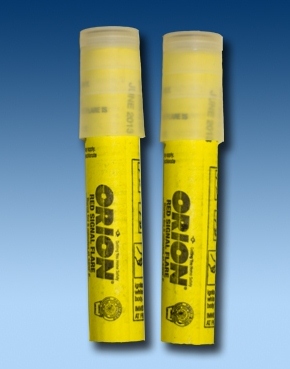
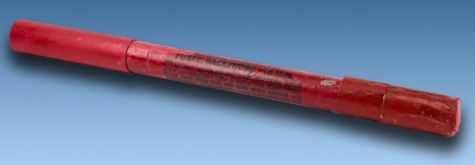
The Orion company is one of the companies that manufacture “fusees”, hand-held torches that wildland firefighters use to ignite prescribed fires, backfires, and burn outs. Now Orion is producing a modified version of the fusee that is designed to be a “signal flare/fire starter”.
It is much smaller than a fusee and does not have a handle. Apparently the entire device will burn up, so if someone is using it for signaling, they are cautioned to place it on the ground in an area where it will not start a wildfire. However, it can also be used to start a campfire while it burns for five minutes at over 3,400 degrees.
Thanks go out to Dick
11 IMTeams and 22 crews working on hurricane recovery

At least 11 Incident Management Teams and 22 hand crews are assigned in the eastern United States helping with the recovery from Hurricane Sandy. The numbers provided by various sources vary somewhat, and may be due to some of the resources not being dispatched through the National Interagency Coordination Center, such as an IMTeam from Maine that does not show up on the list below which is from the the Eastern Area Coordination Center. Click on the image to see a larger version.

The crews are working in Pennsylvania, New Jersey, New York, and Connecticut.
The Missoulian has an article about more crews headed that way today.
If you have photos of these firefighters in action, send them to us through our Contact Us page. Please include a brief description of the photo, the location, and the date. You can send one photo with each message; if you have lots of photos, send us a message through the Contact page and we’ll give you our email address.
Hurricane Sandy, firefighting resources update, November 1, 2012
The primary mission of these firefighters is debris removal and road clearance for electrical power personnel.
Hurricane Sandy Firefighting Resources Committed as of November 1, 2012 at 0600.
Connecticut
- Incident Management Team Type 2 (Grant)
- Two Type 2IA Crews (MI & MN)
New York
- Three Type 2 Crews
- Two Type 1 Interagency Hotshot Crews (Cherokee short IHC, and Augusta short IHC)
- Five 2 person Saw Crews
- Two Incident Management Team Type 2: (Pisarek) operating at East Farmingdale, and the Maine IMTeam (IC Jeff Currier) operating in Brooklyn.
- NIMO (National Incident Management Organization) (Quesenberry) assigned to support Nassau County NY.
- NIMO (Kleinman) assigned to NYC Mob Center in route
- NIMO (Hahnenberg) assigned to NY State Coordination Center in route
Massachusetts: Fort Devens
- Incident Management Team Type 2 (Kollmeyer)
Pennsylvania: Harrisburg
- Incident Management Team Type 1 (Wilder)
- Two Type 2 crews
- Five IHC Crews (Fulton, Breckenridge, Los Padres, Palomar, Laguna) arriving 11/1/12
West Virginia: Charleston
- Type 2 IA Crew
It is interesting that none of the Incident Commanders listed on the web site for the four NIMO teams are participating in this incident. At least one of them, Steve Gage, has moved to another job. There is no way to tell when the web site was last updated. We are checking on this and will have more information later about the NIMO teams.
HERE is a link to a five-minute podcast Jennifer Jones, a Public Affairs Specialist with the USFS in Boise did yesterday with Steve Gage, the new Assistant Director for Operations with the USFS at NIFC, about using IMTeams and fire crews to help with hurricanes and other non-fire emergencies.
Hurricane Sandy, firefighting resources update, October 31, 2012
Here is the latest information we have gathered from the National Interagency Fire Center and the Eastern Area Coordination Center concerning the firefighters and incident management teams that are assisting with the recovery from Hurricane Sandy.
This is a very fluid situation. Some resources are arriving at one location and being reassigned in another state. The list is probably not complete or 100 percent accurate, but it will give you an idea of how wildland firefighters are assisting with the recovery.
Firefighting Resources Committed:
Massachusetts:
- Team: one short Type 2 Incident Management Team (Grant), staged at Fort Devens, MA.
- Crews: two Type-2 IA fire crews (MI and MN); staged at Fort Devens, MA.
New York:
- Teams: One short Type 1 IMT (Pisarek) is operating a supply depot. Also en route or arrived are three National Incident Management Organization Teams (NIMO) (Quesenberry, Hahnenberg, and Houseman; Dan Kleinman is the IC on the Houseman team)
- Crews: Cherokee IHC Short Crew, Augusta IHC, and five 2 person Saw Crews
- Buying Team: one is assigned to work remotely supporting IMTs.
Pennsylvania:
- Team: one Type 1 IMT (Wilder) at Middletown, PA is operating a mobilization center.
- Crews: four crews are en route or have arrived in PA (Laguna IHC, Palomar IHC, Los Padres IHC, and Breckenridge IHC) ; two of them will probably be reassigned to NY
HERE is a link to a five-minute podcast Jennifer Jones, a Public Affairs Specialist with the USFS in Boise did yesterday with Steve Gage, the new Assistant Director for Operations with the USFS at NIFC, about using IMTeams and fire crews to help with hurricanes and other non-fire emergencies.
Update on wildfire resources responding to Hurricane Sandy recovery
Since our report yesterday about the wildfire resources being sent to the east coast to assist with the recovery from the impacts of Hurricane Sandy, there has been an increase in the numbers heading east. Yesterday there were 2 Incident Management Teams and 7 crews or portions of crews being mobilized. Today 5 incident management teams and 11 wildfire suppression crews or portions of crews, for a total of more than 200 personnel, are ordered, staged in, or en route to New York, Washington, DC, Pennsylvania, New Jersey, and Massachusetts. One of the IMTeams is a National Incident Management Organization, or NIMO team. (We need to come up with a better name for these teams. “National Incident Management Organization Team” is almost as bad a term as “fire for resource benefits”.)
The firefighters ordered, en route, staged, or on scene include:
- Two interagency hotshot crews, one 20-person Type 2 wildfire suppression hand crew, one 10-person saw crew, and one short Type 2 incident management team (Pisarek) are staged at or en route to Republic Airport, Farmingdale, New York (Long Island). The IMTeam will be operating a supply depot.
- Two 20-person Type 2 wildfire suppression handcrews are enroute to Washington, DC. A short Type 2 incident management team has been ordered for Washington, DC.
- Three 20-person Type 2 wildfire suppression handcrews en route to Pennsylvania. A short Type 2 IMTeam has been ordered for Annville, Pennsylvania.
- The Southwest National Incident Management Organization team (Houseman) has been sent to Lakehurst, New Jersey. Dan Kleinman will be the Incident Commander.
- Two 20-person Type 2 wildfire suppression hand crews and one short Type 2 incident management team (Grant) staged at Fort Deven, Massachusetts.
I expect that as responders switch from rescue to recovery and are able to gain access to the impacted areas through blocked roads to access the damage, there will be increasing demands for crews and perhaps IMTeams.
Exploding targets, an increasing wildfire problem
Originally published October 11, 2012, updated February 6, 2013
Targets that are designed to explode when shot with a rifle have become more popular in recent years, emerging as an increasing threat to our wildlands. The problem is, they sometimes start fires in spite of claims by the manufacturers saying they are safe.
The military has been using them for at least 20 years when training marksmen to hit targets hundreds of yards away, since it can be difficult to see if a target was hit at that distance. When struck with the bullet from a rifle, the explosion and smoke are easily seen and indicate that the shooter hit the target
They are sometimes called “binary exploding targets”, since they are completely inert until two powders are mixed at the site by the target shooter. After they are combined, the compound is illegal to transport. The manufacturers claim that the only way they can be detonated is by striking them with a high-velocity bullet fired from a high-powered center-fire rifle. At least one company has recently started offering targets that will explode when hit with a much less powerful .22 caliber rim-fire rifle.
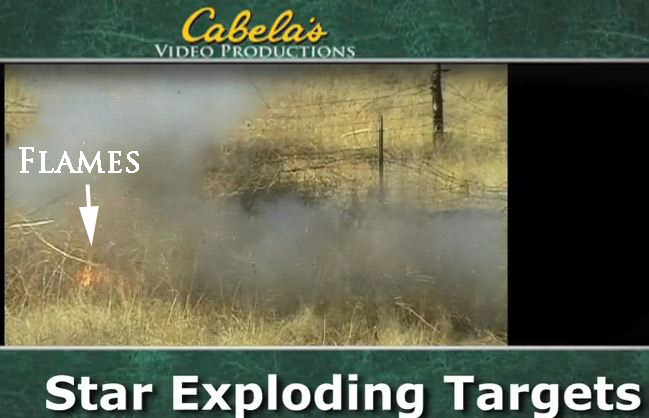
While the manufacturers claim they can’t start a fire, the screen grab (above) from a video shows flames in the grass just after a target advertised by Cabela’s and manufactured by Star Exploding Targets, explodes. The video is below, however we expect that eventually Cabela’s and Star will remove it from YouTube. The flames are visible three seconds into the video at the bottom left.
In a quick search, we found numerous reports of wildfires having been caused by exploding targets in a 5-month period. The dates below indicate when the information was published.
- June 17, 2012, Colorado. The Springer Fire in Park County on the Pike National Forest burned 1,045 acres. It was caused by exploding targets.
- June 13, 2012, Idaho. Four wildfires were caused by shooters using exploding targets up to that date in 2012.
- June 15, 2012, Washington. A small fire near the mouth of the Grande Ronde River was apparently started by someone shooting at exploding targets.
- June 16, 2012, Utah. The 300-acre Little Cove fire was caused by shooters using exploding targets.
- June 29, 2012, Utah. A fire investigator said eight wildfires in the previous three weeks were caused by shooters using exploding targets.
- July 2, 2012, Nevada. A five-acre fire in Elko was caused by shooters using exploding targets.
- August 19, 2012, Oregon. Five shooters were cited for starting a 35-acre fire using Tannerite exploding targets.
- September 6, 2012, Washington. The Goat Fire burned 7,378 acres 3 miles southwest of Pateros, WA. It was started by exploding targets. Forest Service officials previously said two smaller fires — a 120-acre blaze in Mud Creek Entiat and one on Deadman Hill near Cashmere — may also have been ignited by exploding targets.
- October 7, 2012, Pennsylvania. Two state Game Commission workers suffered injuries including burns, temporary blindness and hearing damage when an illegal exploding target blew up while the men attempted to put out a fire at a gun range in Pike County.
- October 11, 2012, California. A 364-acre fire was started by shooters using exploding targets. A news report (see video below) shows two pounds of the explosive being used to blow up a car.
- October 19, 2012, Utah. Two men have been charged with starting the Dump fire near Saratoga Springs, Utah that burned more than 5,500 acres and cost $2.1 million to put out. About 2,500 people were forced to evacuate. Investigators say the men were shooting June 21 when they hit an explosive target that started the fire in vegetation.
- October 23, 2012, Nebraska. Three men have been charged with starting a fire by using exploding targets in Nebraska, and starting the Spotted Tail fire that burned 83 acres south of Chadron October 23.
This is a total of 24 fires that were either confirmed or suspected to be caused by exploding targets since the first of June, 2012. And these are just the ones that we were able to find using Google.
In most areas in the western United States exploding targets are illegal to use if there is a law or temporary ban on open fires.
One of the primary manufacturers of the targets is Tannerite. The company has a patent on the devices and has said the fires are caused by other companies infringing on their patent and adding an additional incendiary component in order to produce a more spectacular explosion.
At an online forum for firearms enthusiasts, The Firing Line, some of the posters decry the lack of wisdom of target shooters who start fires with exploding targets. A person using the moniker “g.willikers” wrote:
It seems that we gun owners have two enemies. Those who would deprive us of our gun rights. And those who throw those rights away.
Others on the forum suggested some alternative targets that can produce an impressive display when hit with a bullet, such as:
- A milk jug filled with water
- Potatoes
- Pop can filled with water
- Fresh cow pie
UPDATE October 12, 2012:
Ken told us about this news report that appeared on television in southern California October 11, 2012, explaining and demonstrating the hazards of these explosive targets. They use two pounds of the explosive to blow up a car, and Chief John Hawkins of CAL FIRE provides his point of view on the problem.