TBT: dog discovers brush fire, alerts owner

For throwback Thursday:

From a post on Wildfire Today April 26, 2008:


Robert Lane and his dog, Max

In Ipswich, Massachusetts yesterday, a dog escaped from his leash, discovered a fire, then like Lassie, barked at his 13-year old master and led him to the fire.

Like a scene out of “Lassie,” Robert Lane, 13, followed his barking dog yesterday to a brush fire burning in the woods behind the family’s home, then ran to a vernal pool to soak his T-shirt in water to try to put out the 10-foot circle of flames.

“I just wanted to get it out as fast as possible,” Robert said.

Discovering the fire was bigger than he thought, Robert ran home to tell his mother, who called the Fire Department at 12:30 p.m. If not detected early by Robert and the family dog, Max, who had escaped its leash, the brush fire could have easily spread and damaged the home and construction business located on their property at 285 High St., David Lane said.

“It could’ve been 10 times worse,” David Lane said by phone last night. “If it wasn’t for the dog getting off the leash, we wouldn’t have a house.”

Firefighters from six communities were able to contain the fire to a 400-by-800 foot area of woods, about three-quarters of an acre, on property across from the Dow Brook Reservoir, said Ipswich firefighter Lee Prentiss. Lane’s antique horse-drawn manure spreader was destroyed, but an estimated 30 to 40 pieces of his equipment were not damaged.

From the Salem News. Photo courtesy of the Daily News.
Brush fire in Boston

A brush fire in a marshy area, or fen, in Boston received a lot of attention Thursday afternoon when dense black smoke affected much of the metropolitan area.

The fire was knocked down after a couple of hours. A police officer at the scene was transported to a hospital, but no information was provided about the officer’s condition or the nature of the injury.

Apparently reporters in the Boston area, and possibly fire department spokesmen, are not often tasked with covering vegetation fires:

From the Boston Herald:

According to Boston Fire spokesman Steve MacDonald, the fire was reported at about 2:15 p.m. and appears to have been caused by weeds and leaves that are burning along the Muddy River.

And from WCVB:

After the flames were knocked down, firefighters were seen trekking through the scorched brush with hoses.

Wildfire News, March 7, 2016

Alaska April wildfire potential
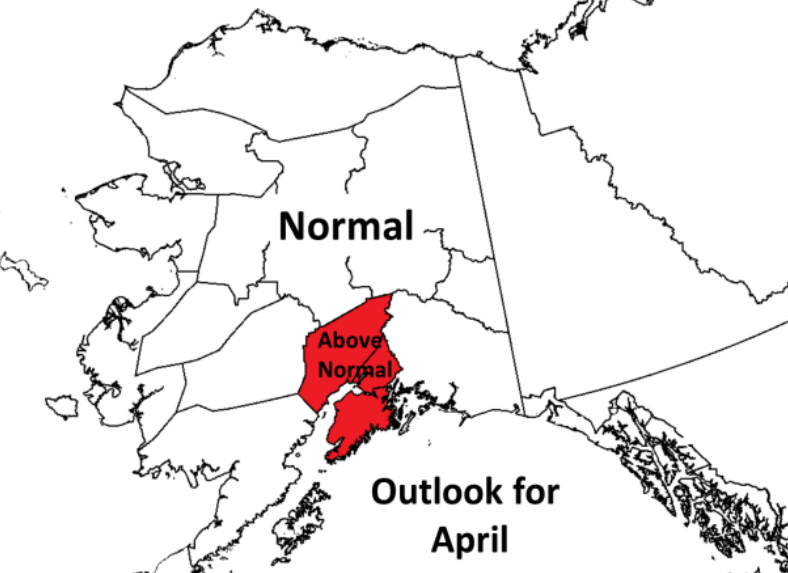
April wildfire potential in Alaska, based on vegetation conditions and weather predictions.

—Fire officials say to ‘expect an early start’ to Alaska wildfire season.

—Shooter’s tracer rounds ignite 2-day forest fire at Missouri gun range

–A proposed Utah law would enable police to shoot drones, but people have been arrested for doing so.

–A massive bushfire cut off and isolated the South Island town of Hanmer Springs, New Zealand on Tuesday (local time).

–The Arizona Wildfire Academy is taking place in Prescott this week.

—Hubbardston, Massachusetts gets military surplus truck to help battle brush fires.

Hubbardston Mass mil surplus truck
Hubbardston, Mass. military surplus truck. Photo: Hubbardston Fire Department.

Red Flag Warnings, April 6, 2013

wildfire Red Flag Warnings, 4-6-2013

wildfire Red Flag Warnings, 4-6-2013

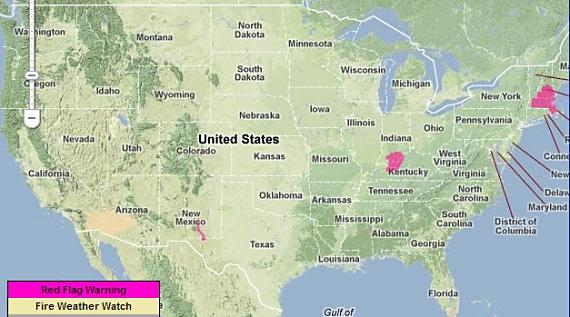
Red Flag Warnings for enhanced wildfire danger have been issued by the National Weather Service for areas in New Mexico, Kentucky, Indiana, Massachusetts, and New Hampshire.

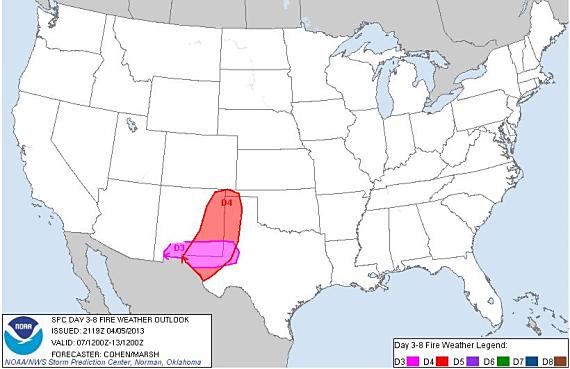
The NWS predicts there will be a Critical Risk for wildfire danger in New Mexico and western Texas for the next few days.

Critical fire weather
Critical fire weather April 7-13, 2013

***

The Red Flag Warning map above was current as of 9 a.m. MT on Saturday. Red Flag Warnings can change throughout the day as the National Weather Service offices around the country update and revise their forecasts. For the most current data, visit this NWS site.

Hurricane Sandy, firefighting resources update, November 1, 2012

The primary mission of these firefighters is debris removal and road clearance for electrical power personnel.

Hurricane Sandy Firefighting Resources Committed as of November 1, 2012 at 0600.

Connecticut

  • Incident Management Team Type 2 (Grant)
  • Two Type 2IA Crews (MI & MN)

New York

  • Three Type 2 Crews
  • Two Type 1 Interagency Hotshot Crews (Cherokee short IHC, and Augusta short IHC)
  • Five 2 person Saw Crews
  • Two Incident Management Team Type 2: (Pisarek) operating at East Farmingdale, and the Maine IMTeam (IC Jeff Currier) operating in Brooklyn.
  • NIMO (National Incident Management Organization) (Quesenberry) assigned to support Nassau County NY.
  • NIMO (Kleinman) assigned to NYC Mob Center in route
  • NIMO (Hahnenberg) assigned to NY State Coordination Center in route

Massachusetts: Fort Devens

  • Incident Management Team Type 2 (Kollmeyer)

Pennsylvania: Harrisburg

  • Incident Management Team Type 1 (Wilder)
  • Two Type 2 crews
  • Five IHC Crews (Fulton, Breckenridge, Los Padres, Palomar, Laguna) arriving 11/1/12

West Virginia: Charleston

  • Type 2 IA Crew

It is interesting that none of the Incident Commanders listed on the web site for the four NIMO teams are participating in this incident. At least one of them, Steve Gage, has moved to another job. There is no way to tell when the web site was last updated. We are checking on this and will have more information later about the NIMO teams.

HERE is a link to a five-minute podcast Jennifer Jones, a Public Affairs Specialist with the USFS in Boise did yesterday with Steve Gage, the new Assistant Director for Operations with the USFS at NIFC, about using IMTeams and fire crews to help with hurricanes and other non-fire emergencies.

Hurricane Sandy, firefighting resources update, October 31, 2012

Here is the latest information we have gathered from the National Interagency Fire Center and the Eastern Area Coordination Center concerning the firefighters and incident management teams that are assisting with the recovery from Hurricane Sandy.

This is a very fluid situation. Some resources are arriving at one location and being reassigned in another state. The list is probably not complete or 100 percent accurate, but it will give you an idea of how wildland firefighters are assisting with the recovery.

Firefighting Resources Committed:

Massachusetts:

  • Team: one short Type 2 Incident Management Team (Grant), staged at Fort Devens, MA.
  • Crews: two Type-2 IA fire crews (MI and MN); staged at Fort Devens, MA.

New York:

  • Teams: One short Type 1 IMT (Pisarek) is operating a supply depot. Also en route or arrived are three National Incident Management Organization Teams (NIMO) (Quesenberry, Hahnenberg, and Houseman; Dan Kleinman is the IC on the Houseman team)
  • Crews: Cherokee IHC Short Crew, Augusta IHC, and five 2 person Saw Crews
  • Buying Team: one is assigned to work remotely supporting IMTs.

Pennsylvania:

  • Team: one Type 1 IMT (Wilder) at Middletown, PA is operating a mobilization center.
  • Crews: four crews are en route or have arrived in PA (Laguna IHC, Palomar IHC, Los Padres IHC, and Breckenridge IHC) ; two of them will probably be reassigned to NY

HERE is a link to a five-minute podcast Jennifer Jones, a Public Affairs Specialist with the USFS in Boise did yesterday with Steve Gage, the new Assistant Director for Operations with the USFS at NIFC, about using IMTeams and fire crews to help with hurricanes and other non-fire emergencies.

Update on wildfire resources responding to Hurricane Sandy recovery

Since our report yesterday about the wildfire resources being sent to the east coast to assist with the recovery from the impacts of Hurricane Sandy, there has been an increase in the numbers heading east. Yesterday there were 2 Incident Management Teams and 7 crews or portions of crews being mobilized. Today 5 incident management teams and 11 wildfire suppression crews or portions of crews, for a total of more than 200 personnel, are ordered, staged in, or en route to New York, Washington, DC, Pennsylvania, New Jersey, and Massachusetts. One of the IMTeams is a National Incident Management Organization, or NIMO team. (We need to come up with a better name for these teams. “National Incident Management Organization Team” is almost as bad a term as “fire for resource benefits”.)

The firefighters ordered, en route, staged, or on scene include:

  • Two interagency hotshot crews, one 20-person Type 2 wildfire suppression hand crew, one 10-person saw crew, and one short Type 2 incident management team (Pisarek) are staged at or en route to Republic Airport, Farmingdale, New York (Long Island). The IMTeam will be operating a supply depot.
  • Two 20-person Type 2 wildfire suppression handcrews are enroute to Washington, DC. A short Type 2 incident management team has been ordered for Washington, DC.
  • Three 20-person Type 2 wildfire suppression handcrews en route to Pennsylvania. A short Type 2 IMTeam has been ordered for Annville, Pennsylvania.
  • The Southwest National Incident Management Organization team (Houseman) has been sent to Lakehurst, New Jersey. Dan Kleinman will be the Incident Commander.
  • Two 20-person Type 2 wildfire suppression hand crews and one short Type 2 incident management team (Grant) staged at Fort Deven, Massachusetts.

I expect that as responders switch from rescue to recovery and are able to gain access to the impacted areas through blocked roads to access the damage, there will be increasing demands for crews and perhaps IMTeams.