It’s not even August yet, and the National Interagency Coordination Center’s Incident Management Situation Report showed today that over 19,000 personnel are assigned to wildfires. On Sept. 19, 2020 there were 32,727, the highest number ever recorded.
Will the highest daily number this year be OVER or UNDER that record set last year?
Choose Over or Under in the poll below, then click on the hard to see VOTE button. The poll will close at the end of the day July 31, 2021.
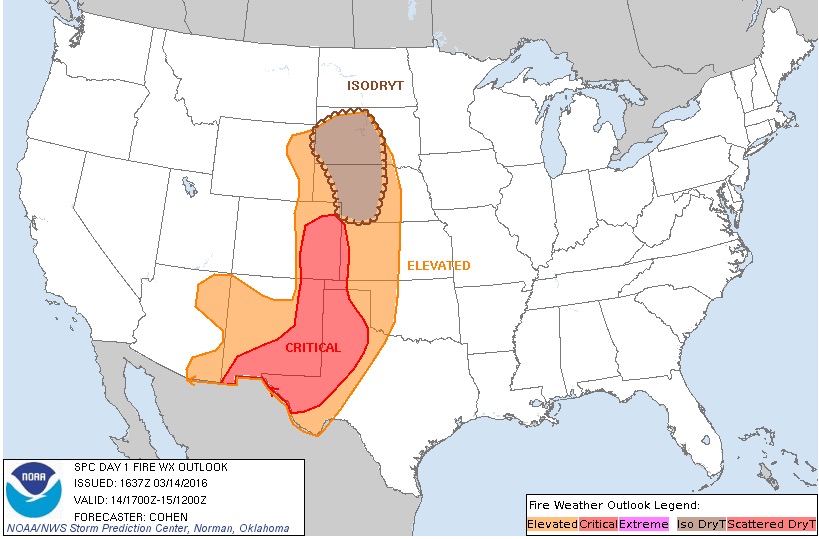
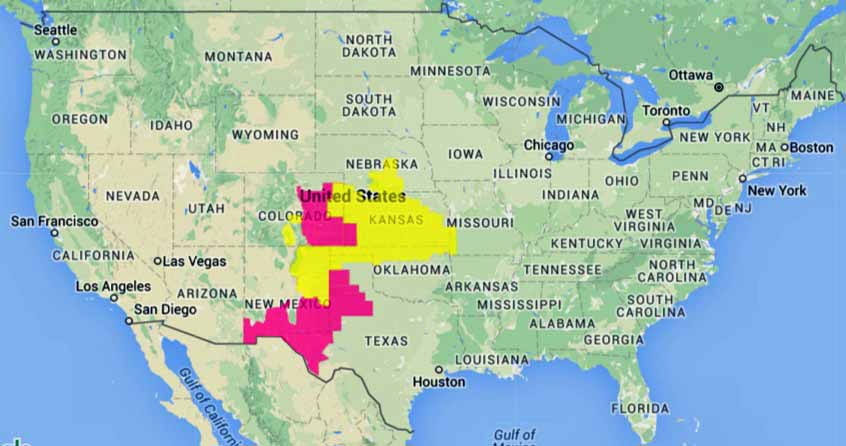
Today we have two very different fire weather mapping products. Both provide information about the predicted fire weather for today, March 14.
The map above is produced by the Storm Prediction Center in Norman, Oklahoma. It does not display Red Flag Warnings or Fire Weather Watches. Instead, it designates areas with “critical” and “elevated” fire weather forecasts. It also shows an area in South Dakota and Nebraska that has the possibility of “Iso DryT” — isolated dry thunderstorms. We checked the more detailed text fire weather forecasts for the Iso DryT areas and only found one that briefly mentioned that issue.
Below is the type of map that we have been using for years on Wildfire Today. It only provides information about Red Flag Warnings or Fire Weather Watches — which is good to know. Especially if you want to supply information to the public using just a few words that can convey an important message.
Both maps can be found HERE.
Which map do you prefer us to use on Wildfire Today? Let us know by choosing an answer in the poll below — then click on the hard to see “vote” box below.
There are many different ideas and opinions about air tankers, and which ones work better than others. We sometimes hear that firefighters need an assortment of tools in their toolbox, and that various types and sizes of air tankers can fill niches.
But for a moment, let’s forget about the tools in the air tanker tool box, and imagine that the very improbable happens — Congress says they will appropriate money to design and build a fleet of purpose-built fixed wing air tankers, and directs the land management agencies to develop a few broad specifications.
For this exercise, assume the aircraft must be affordable (which could eliminate new purpose-built very large air tankers) and there will be only one design, not an assortment of “tools”.
Take the poll below, and if you have further thoughts, let us know in a comment.
Be sure and click “Vote” after answering each question.
As we reported on June 10, President Obama has ordered that seasonal firefighters be offered the opportunity to purchase health insurance. According to the Wall Street Journal, quoting an unnamed administration official, access to the insurance will begin this month. Here is the poll:
The air tanker fleet managed by the U.S. Forest Service, NPS, BIA, BLM, and USFWS, has deteriorated over the last 10 years from 44 large air tankers on exclusive use contracts to the 11 we have today. As the climate changes, fire seasons are getting longer. Last year there were records set in Arizona and New Mexico for the largest fires in the states’ histories. In March of this year fires burning in Colorado and South Dakota competed for scarce air and ground firefighting resources. The number of unfilled orders for air tankers continues to increase. Congress regularly reduces the firefighting budgets of the land management agencies.
Vote on the most significant wildfire stories of 2011.
2011 was a busy wildfire year in some areas of the United States. In Texas, Arizona, and New Mexico, it was extremely busy, in fact several records were set for the largest fires in recorded history and number of acres burned.
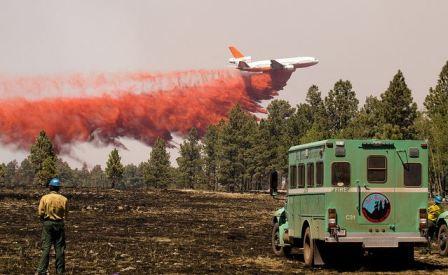
Tanker-911, a DC 10 airtanker, drops retardant on the Wallow fire above Greer, AZ; the Del Rosa Hotshots wait in a safety zone and watch the drop, June 11, 2011. USFS photo by Kari Greer
As we did for 2009 and 2010, we are conducting a poll, allowing our readers to determine which were the most significant wildfire events of 2011. We sifted through the 641 articles we wrote in 2011 and compiled the list below which includes a short description of each of the nominated topics. Below the list is the poll. The line of duty fatalities are not listed. While they are very significant of course, we don’t want to try to rank them, one over the other.
By the way, you can still vote, if you have not already, in the 2009 and 2010 polls.
Nominations for the most significant wildfire stories of 2011
January 13: Director of college fire program arrested. Retired Chief Jerry Austin was arrested for stealing $500,000 from students in the Fire Technology progam at Mt. San Antonio College in Walnut, California, east of Los Angeles.
April 30: Georgia swamp fire burns 309,000 acres. Honey Prairie fire in Georgia starts, eventually burns 309,000 acres in Georgia and Florida. In the December 15, 2011 update on InciWeb it was listed at only 76% contained.
June 13: USFS management of the air tanker fleet. This has been an onging story for years but came close to making it into the mainstream on June 12 when the Washington Post wrote an article titled “Firefighting planes have perhaps been too long on job”. At that time there were 18 large air tankers on exclusive use contracts. By late summer there were only 11, compared with 44 in 2002.
June 26: Las Conchas fire largest fire in New Mexico history. It burned 43,000 acres in the first 14 hours, ultimately blackened 156,593 acres, and burned 63 residences.
July 6: CAL FIRE budget cuts. The California Department of Forestry and Fire Protection suffered a $34 million budget reduction resulting in 730 fewer seasonal firefighters, reducing engine staffing from four to three, and cancelling the exclusive use contract with the DC-10 air tanker.
August 15: Aero Union closes their doors. Aero Union which owned 8 large P3 air tankers comprising 42% of the U.S. large air tanker fleet shut down after the U.S. Forest Service cancelled their contract saying certain required safety inspections were not completed. This left 11 large air tankers, down from 44 in 2002.
September 5: Fires in Texas. This was a year-long event due to drought, but especially notable were the fires on Labor Day weekend in Travis and Bastrop counties which burned over 1,600 homes.
September 12: Pagami Creek fire in Minnesota. After burning about 130 acres while being monitored for 12 days, the fire took off under strong winds and burned 92,000 acres, costing over $22.3 million to suppress.
October 5: Three engine burnovers on same day in South Dakota. On three separate fires on the same windy day, three engines and their crews were burned over by wildfires. At least four firefighters suffered burn injuries.
November 7: Santa Maria air tanker base to reopen. After almost 3 years of controversy and criticism over the 2009 closing of the Santa Maria air tanker base near Santa Barbara, California, the Forest Supervisor of the Los Padres National Forest decided to staff it again.
November 12: Congressman Rehberg drops suit against fire department. Facing an election for the U.S. Senate, congressman Denny Rehberg dropped his lawsuit against the Billings, MT fire department in which he sought monetary reimbursement for a wildfire that burned some undeveloped land owned by the congressman and his wife.
December 1: USFS to contract for 7 to 35 “next generation” air tankers. The U.S. Forest Service issued a request for proposals for “new generation air tankers”, saying they may contract for 7 to 35 turbine-powered large air tankers over the next several years.