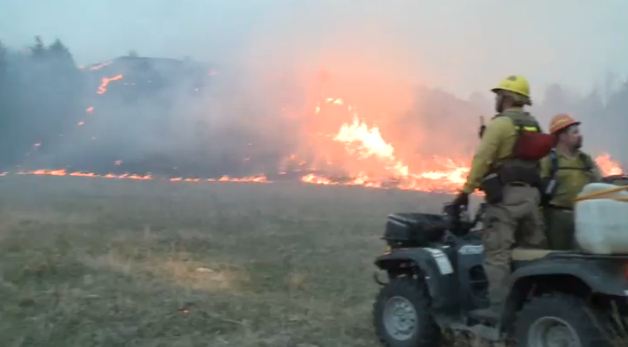
Nebraska prescribed fire academy, screen grab from Emily Kreutz video
The Nebraska Public Broadcasting System is reviewing their best stories of 2012, and among that group is their coverage of a prescribed fire academy sponsored by The Nature Conservancy near Gothenburn, Nebraska. The Nebraska PBS site has an interesting article as well as a video describing the training which occurred in March.
…More and more, field operations for controlled burns are dictated by knowledge gleaned from scientific research. It’s long been known fire behavior is influenced by weather, the amount and type of available fuel and the lay of the land.
Since so much knowledge has been passed from one generation to the next, there’s an unusual tension between new science and the traditional, often effective, methods of harnessing the benefits of fire.
“I think that prescribed burning is more of an art than a science, but you do have to understand fire behavior and use that,” said Doug Wisenhunt of the USDA’s Natural Resource Conservation Service. He admitted to mixed feelings about crews in the field relying too much on computer models and mathematical formulas.
“You can calculate some of that, but in general, it’s just kind of knowing how the fire is going to react when you are burning at that time.”
Firefighters in North Carolina’s Pilot Mountain State Park hope to have an escaped prescribed fire 90 percent contained by the end of the day on Monday. On Thursday the burn boss and New River State Park Superintendent Joseph Shimel supervised the ignition of the fire intending to burn 180 acres, but in the afternoon a dead tree near the fireline torched, sending burning embers into steep terrain outside the project’s perimeter, eventually blackening about 800 acres over the weekend.
According to the Winston-Salem Journal, Charlie Peek, public information officer for the N.C. Division of Parks and Recreation said the escaped fire:
…pretty much illustrated why we need prescribed burns, because any time fire hits this area — leaf litter, debris and brush — it’s much more difficult to control, and things can get out of hand much more quickly.
Previously the largest prescribed fire in the Park had been 35 acres. Small burns had been conducted in 2004 and 2009.
The caption for this photo on InciWeb reads: “Smoke from prescribed fires adds a special texture to the sunrise view from Mather Point.”
The Grand Canyon National Park employee who updated the InciWeb report for the Thompson prescribed fire put an interesting spin on the smoke visible from Mather Point, describing it as as adding a “special texture” to the view. The park is conducting two prescribed fires in the North Rim area, the Thompson and Range projects totaling 2,600 acres.
Range prescribed fire in Grand Canyon National Park. NPS photo Cape Royal in the Grand Canyon at sunset. NPS photo by Jessica Pope
Another claim against the USFS for escaped prescribed fire in Montana
Another land owner has filed a claim against the U.S. Forest Service for the 2010 Davis prescribed fire that escaped on the Helena National Forest and burned approximately 450 acres of private land belonging to multiple owners. In June Wildfire Today told you about three land owners who are suing the government seeking unspecified damages and a jury trial.
The latest claim is from Andy Skinner, who is asking for $137,770 for damage to his property. He is also asking for $50,000 for the time it has taken for him to research the damage and file the claim.
The Davis prescribed fire northwest of Helena, Montana escaped on August 26, 2010 and burned over 2,000 acres of private and U.S. Forest Service land.
Wildfire Today covered the Davis Fire extensively in 2010, and summarized some of the coverage on November 22, 2010 after the U.S. Forest Service released their report on the incident. We highlighted some of the issues that led to the escaped prescribed fire.
Minnie fire may burn for weeks
The Minnie fire in northwest Minnesota near Fourtown, between Upper Red Lake and Lake of the Woods, has moved into areas containing peat, and is now burning deep underground in the organic soil, making it extremely difficult to suppress. Unless the area receives a great deal of rain soon, it will most likely burn for weeks, or longer.
Extraordinary photo of vehicle fire
A motorist that had to stop when a vehicle fire in Missoula closed a road, took some photos of the burning car. One of them captured the moment a vessel inside the car exploded, demonstrating why firefighters need to employ proper tactics on these fires, and why adequate personal protective equipment should be worn.
The video features Thomas Swetnam, a tree ring expert, and fire historian Stephen Pyne talking about the history of fire in the Southwest, and how fire suppression has changed the forests.
St.Vincent Island prescribed fire USFWS photo by Brian Pippin
Today we have photos of prescribed fires in opposite corners of the United States, all are from U.S. Fish and Wildlife Service projects. The photo above is a prescribed fire on St. Vincent Island in north Florida (map). The entire 12,000-acre island is a USF&WS refuge. Brian Pippin took this photo from a helicopter during the the 1,150-acre burn.
The photos below show prescribed fires in Williamette Valley near Eugene, Oregon. More photos from similar projects can be found on their Facebook page.
Williamette Valley prescribed fire near Eugene, OR. USFWS photo
Junior firefighter killed while responding to wildfire
A 17-year old junior firefighter for the Dagsboro Volunteer Fire Department in Delaware was killed while en route to the fire station to respond to a wildfire. According to WBOC, Justin Townsend was a passenger in a vehicle driven by an 18-year old boy on September 27 when due to excessive speed the driver lost control on a curve causing the vehicle to strike a utility pole. Mr. Townsend died at the scene. The driver was treated at a hospital and released.
We extend our sincere condolences to Mr. Townsend’s family and the members of the Dagsboro Volunteer Fire Department.
TNC studies use of prescribed fire to remove red-cedar
The Nature Conservancy has released a study they conducted on the Niobrara Valley Preserve in Nebraska, looking at red-cedar, an invasive species that can reduce the productivity of grazing land. The trees occupy grassland areas shading out light, falling foliage covers the grasses, and the trees consume significant amounts of water, leading to dryer conditions for grass. Red-cedar also burns intensely, making wildfires more difficult to control.
Prescribed fire in Nebraska to help remove invasive red-cedar. Photo credit: The Nature Conservancy
The study looked at two methods used to remove red-cedar on the property — mechanical removal and prescribed fire. Fire can be useful for removing red-cedar until the trees become large. After that, only mechanical methods are effective, which may include cutting the trees, and then 1) chipping, 2) piling and burning, or 3) scattering them to be burned in a prescribed fire later.
Here are some excerpts from the report.
Red-cedar, a tree that reproduces by seed only, can be destroyed by fire if its growth points at the tip of the twigs are exposed to high temperatures. Cedar infestation will proceed steadily without intervention, and the periodic use of prescribed burning may be a more effective approach compared to periodic mechanical removal. Mechanical removal actually can contribute to spreading the seeds. Importantly, when applied early, burning is a significantly less costly method to eliminate young trees and to prevent re-infestation.
and…
Of more interest to ranchers, in areas where cedar was removed, the desirable plant species for grazers were on average 34% of groundcover compared to 12% in non-cleared areas (+22%) and the undesirable plant species were 13% in cleared areas versus 47% in non-cleared areas (-34%) but all save 3% of the difference in undesirable plant species is from cedar clearing.
Warmer temperatures in California may be leading to more wildfires
The LA Times has an article about how hotter temperatures in California along with “incredibly dry conditions” have resulted in a higher number of wildfires, especially in the northern part of the state. The traditional busiest part of the fire season in southern California is just beginning, when lower live fuel moistures combined with Santa Ana winds can result in very large fires.
Photos of fire in Columbia River Gorge
A wildfire in the Columbia River Gorge near Hood River, Oregon provided Richard Porter with an opportunity to capture some interesting nighttime images of the fire reflected in the waters of the Columbia River. Check them out HERE. Below is a sample.
Fire in Columbia River Gorge. Photo by Richard Porter
Sightings of a meteor grounded the air tankers working on the Springer fire west of Colorado Springs on Wednesday. There were numerous reports of the meteor from New Mexico, Colorado, and Kansas including the pilot of an air tanker making a drop on the fire. The Associated Press quoted Steve Segin, a spokesperson for the Springer fire, as saying the air tanker “landed as they normally do to reload, and for safety reasons they grounded themselves until they could figure out what it was they saw”.
A TV station in Denver, 7News, reported:
The Rocky Mountain Area Coordination Center said planes were grounded after the reports started coming in just after 2:30 p.m.
It was determined that the object was a meteor that broke up in the air over Kansas on a trajectory that would carry it to Florida.
None of the debris hit the ground in Colorado.
Aircraft were released to resume flying at 4 p.m., the Fire Coordination Center said.
This may be the first time that firefighting aircraft were grounded because of a meteor.
It is difficult to tell, when observing a meteor that is falling thousands of miles an hour, how far away it is. There were several reports from people in Colorado who thought it was nearby, but it was actually hundreds of miles away and there were no indications that any portions of it hit the earth. After grounding the air tankers for 90 minutes, let’s not even call this a near miss.
Wildland firefighter dies in Greece
The Associated Press is reporting that a firefighter working on a wildfire in Greece died Wednesday. A fire department spokesperson said the 28-year old felt unwell and was taken to a hospital where he was pronounced dead. The firefighter was battling a fire that was burning inside an air force base west of Athens primarily used by firefighting and transport planes.
Our sincere condolences go out to the firefighter’s family and coworkers.
Escaped prescribed fire in North Carolina burns 21,000 acres
A prescribed fire on the Croatan National Forest that escaped on Father’s Day, named the “Dad Fire”, has now burned over 21,000 acres ten miles south of New Bern, North Carolina. The fire is 60 percent contained and has run up costs of $400,000. Smoke from the fire is causing problems for some residents and air quality alerts have been issued for 12 counties.
Congressman Walter B. Jones, R-N.C., called for an investigation Tuesday.
“Our No. 1 priority is to get the fire contained,” said Jones, in a news release. “However, I share the concerns of many Eastern North Carolinians as to how this poorly planned ‘prescribed burn’ is negatively affecting tourism, public health and taxpayers who are being asked to pick up the tab to fight a fire that could have been avoided.”
District Ranger Pancho Smith says even though some prescribed fires do turn into wildfires like this one, he does not regret conducting them.
“One of the big advantages in this country of controlled burns, and on national forest systems across the country, is the reduction of fuel on the forest floor. If we leave it out, when we do get a fire start, a wildfire, there’s nothing we can do about it,” said Smith.
The fire is being managed by Cherry’s Type 3 Incident Management Team.
Texas Forest Service receives Pulaski Award
Congratulations to the Texas Forest Service. Following is the text from a news release:
June 21, 2012 – COLLEGE STATION, Texas – Texas Forest Service was presented last week with the Pulaski Award, a national honor for outstanding service in wildland firefighting.
The award, commending the agency for its response during the 2011 wildfire season, is presented annually by the National Interagency Fire Center. It was announced at the Southern Group of State Foresters annual conference in Louisville, Ky.
The coveted 30-inch bronze statue is named after U.S. Forest Service Ranger Ed Pulaski, who led a crew to safety during the Great Fire of 1910. First presented in 1998, this is the first time the Pulaski Award has come to Texas. It will stay with Texas Forest Service for one year then will be shipped to the next recipient.
Texas Forest Service Associate Director Mark Stanford said the recognition is an honor for the emergency responders who bravely served Texas during last year’s unprecedented wildfire season. More than 30,000 wildfires burned almost 4 million acres, destroying 2,946 homes across the state.
The wildfires were suppressed with assistance from more than 16,000 emergency responders from all 50 states, along with 239 dozers, 954 engines and 246 aircraft.
“We accept this award on behalf of all the local, state and interagency firefighters who participated in the 2011 wildfire season,” Stanford said. “They’re the ones who really earned this award.”
Gary Bowers, chairman of the National Interagency Fire Center Governing Board, wrote in a letter to Texas Forest Service that the agency demonstrated “exceptional work in interagency cooperation and coordination, safety of their firefighters and the public, the development of partnerships and group performance in fire management and suppression.”
“It is our hope that collaboration efforts such as this will increasingly inspire and inform new cooperative efforts across the country,” Bowers wrote. “Congratulations on this award and the excellent work that it recognizes.”
Three families in Montana whose property burned when a prescribed fire escaped on the Helena National Forest are suing the federal government, seeking unspecified damages and a jury trial. The Davis prescribed fire northwest of Helena, Montana escaped on August 26, 2010 and burned over 2,000 acres of private and U.S. Forest Service land. Approximately 450 acres belonging to multiple landowners burned. The three landowners in the suit own a total of 296 acres and claim “total destruction” of their property.
“The Davis Fire took place under extreme weather conditions consisting of gusty winds and very warm temperatures. In fact, the prescribed fire was set during a fire weather warning,” John Heenan, the attorney for the families, wrote in the lawsuit. “The Forest Service failed to follow its own guidelines for proper prescribed fire implementation in starting the Davis Fire.
“Had the Forest Service notified plaintiffs, they would have been able to take measures to protect their properties and/or ensured that the Forest Service took measures to do so.”
Wildfire Today covered the Davis Fire extensively in 2010. We wrote the following on November 22, 2010 after the U.S. Forest Service released their report on the incident: Continue reading