
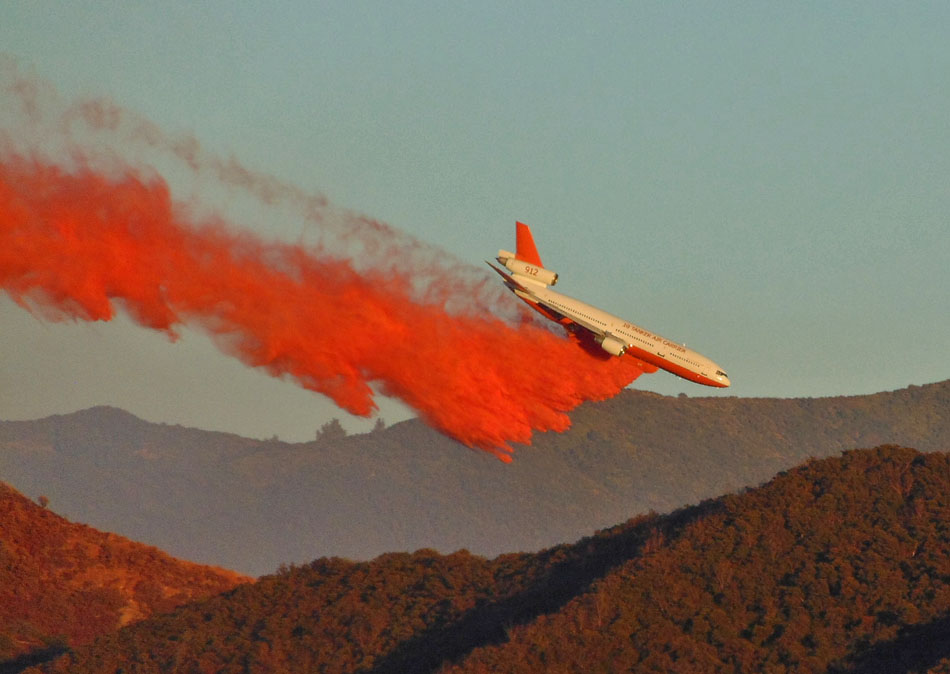
Bryan Reddish uploaded this video of Air Tanker 912, a DC-10, making a retardant drop prior to a backfiring operation on the Rocky Fire east of Clearlake, California.
Aircraft over the North Fire

I took these photos of the television screen as Los Angeles Channel 7 was covering the North Fire — the carmeddon fire that trapped scores of vehicles on Interstate 15 in southern California, burning 22 of them.
The temperature on the screen says 76 degrees, but that must have been at downtown Los Angeles, because about that time it was 88 degrees in San Bernardino, not too far from the fire.


DC-10 air tankers on the Washington Fire

Ryan Coulter took these photos of two of the DC-10 air tankers making drops on the Washington Fire, June 22, 2015, near Markleeville, California. The photo above is Tanker 911, and Tanker 912 is below. The DC-10s carry 11,600 gallons of retardant, compared to the 2,000 to 4,000 gallons other large air tankers can hold.
Click the photos to see larger versions.
Thanks Ryan!

Tanker 912 arriving in Medford, Oregon

Tim Crippin sent us this photo, along with a description:
Tanker 912 arriving in Medford just before noon today (June 17th) for the Buckskin fire. It worked along with Tanker 161 to drop retardant on the east and south containment lines in preparation for a planned burnout tomorrow.
The following morning, June 18, it was dispatched to the Lake Fire in southern California east of San Bernardino and had an ETA of noon. Air Attack on the Lake Fire requested for it arrive with a load of retardant. Air Attack said that fire has the potential to grow to 50,000 acres in two days.
Thanks Tim.
Very small people pose with very large air tanker

I love this photo that was posted today on the 10 Tanker Air Carrier Facebook page.
Below is a photo we took of the rest of a DC-10, Tanker 910, in 2013.

DC-10 dropping downhill on the Silverado Fire
This video was shot on September 12 and is tagged Silverado Fire at LiveLeak. It may be the same drop made by Tanker 912, a DC-10, shown in the photo below which was taken on the fire the same day. We posted the photo and more information about the Silverado fire on Wildfire Today.
Three DC-10 air tankers at Castle

On August 30 the latest DC-10 air tanker to be retrofitted, Tanker 912, joined its’ sisters, T-910 and T-911 at Castle Airport near Merced, California. It has been carded by the U.S. Forest Service and is ready to go, according to 10 Tanker Air Carrier.
A third DC-10 air tanker to become available

A third DC-10 air tanker is expected to become available in the very near future. 10 Tanker Air Carrier has announced that the conversion of their third Very Large Air Tanker is complete and they expect to receive it at their company headquarters this week in Albuquerque. The final step will be certification by the Forest Service, after which it will be dispatched where requested by fire managers. It will be designated as Tanker 912.
The DC-10s always carry 11,600 gallons of fire retardant unless a smaller load is requested by fire managers. That is three to six times more than conventional air tankers.
UPDATED: DC-10 damages wing while taxiing at Moses Lake

(UPDATED, July 25, 2014: excerpts from SAFECOMS are at the end of the article. UPDATED September 3, 2014: a lessons learned report can be found HERE.)
One of the DC-10 Very Large Air Tankers incurred some damage to a wing July 19, 2014 while it was taxiing at the air tanker base at Moses Lake, Washington. While relocating in the loading pit area Tanker 910 struck a portable “air stair”, a structure that can be pushed up to the aircraft door. Two people on the ground were marshaling the DC-10 as it slowly moved, directing it where to go and supposedly watching for obstructions.

The wing was damaged on the front and back sides –the aileron and the slats. Rick Hatton, the President of 10 Tanker Air Carrier, said on Sunday that parts to repair the damage were en route to Moses Lake. The company’s other DC-10, Tanker 911, was also at the tanker base when the accident happened.
Mr. Hatton said retardant systems tests on their third DC-10 which is being converted now into an air tanker will begin the week of July 28. In a month or two they hope to have it fully operational. It will be designated as Tanker 912.
Below is a copy of a portion of SAFECOM 14-0491 about the incident. Click on the image to see a larger version.

Below is a copy of a portion of SAFECOM 14-0446 about the incident. Click on the image to see a larger version.:
