Wildfire potential expected to remain above normal in parts of California

wildfire potential November

The National Significant Wildland Fire Potential Outlook issued November 1 by the Predictive Services section at the National Interagency Fire Center predicts wildfire potential will remain above normal in parts of California through November. The potential in the Southern Plains is likely to be above normal December through February.

The data from NIFC shown here represents the cumulative forecasts of the ten Geographic Area Predictive Services Units and the National Predictive Services Unit.

Below:

  • An excerpt from the NIFC narrative report for the next several months;
  • More of NIFC’s monthly graphical outlooks;
  • NOAA’s three-month temperature and precipitation forecasts;
  • Drought Monitor;
  • Keetch-Byram Drought Index.

“La Niña and current fuel conditions are the main drivers of significant fire potential through fall and winter. Drought conditions are expected to continue for much of California, the Great Basin, and the Southwest into the winter with drying expected to increase across portions of the southern Plains and Southeast. Offshore wind events will continue to be a concern across northern California in November and likely into December for southern California. Significant fire potential is forecast to be above normal in downslope and offshore wind favored locations in California during November. The focus will shift to southern California in December as precipitation is likely to quell large fire concerns across northern California by then.

“Over the winter, the expected warming and drying trend across the southern tier of the United States due to La Niña and other large-scale climate forcing will likely result in above normal significant fire potential in portions of the southern Plains. Drought intensification and expansion from the southern Plains into southern California is likely. Strong wind and low relative humidity events could occasionally increase fire activity in portions of the Great Basin and Southwest this fall into winter as well. However, outside of the southern Plains, significant fire potential will likely remain near normal for the rest of the United States.”

wildfire potential December wildfire potential January wildfire potential February

Temperature November, December, January
Precipitation November, December, January
Drought Monitor
Drought Monitor

KBDI

Very high to extreme fire danger in store for parts of California Sunday through Tuesday

October 24, 2020   |   6:46 p.m. PDT

Extreme fire danger
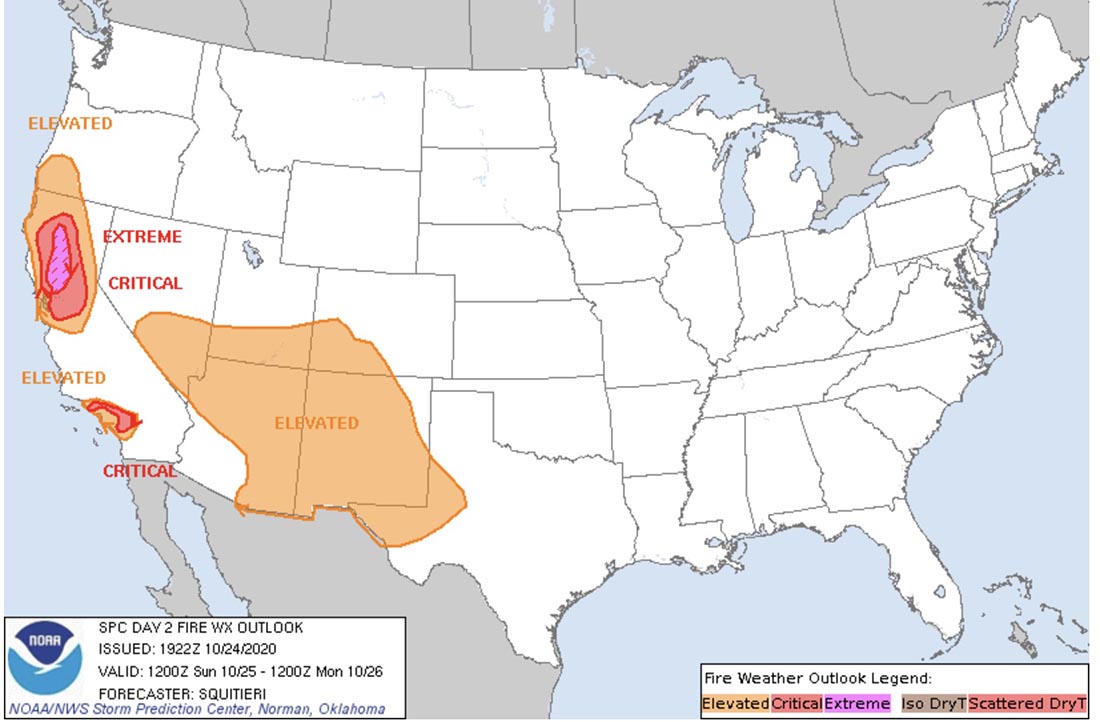
Storm Prediction Center forecast for Sunday. Extreme fire danger.

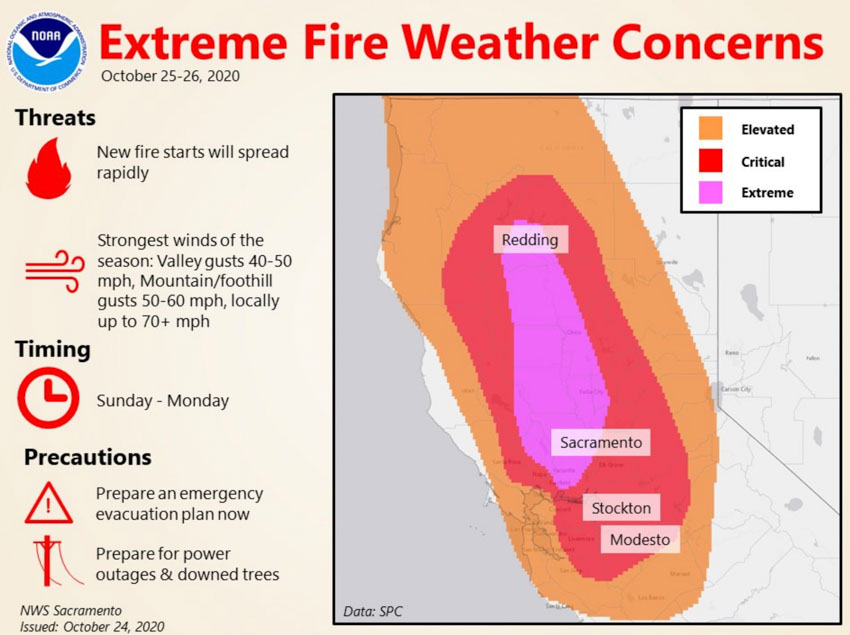
A major weather event that will affect wildland fire danger begins in California Sunday morning. NOAA’s Storm Prediction Center does not often predict extreme fire weather, but they have done just that to warn of a wind event with very low humidities for parts of California Sunday through Tuesday. At times the wind will be very strong and the relative humidity will drop below five percent in some locations.

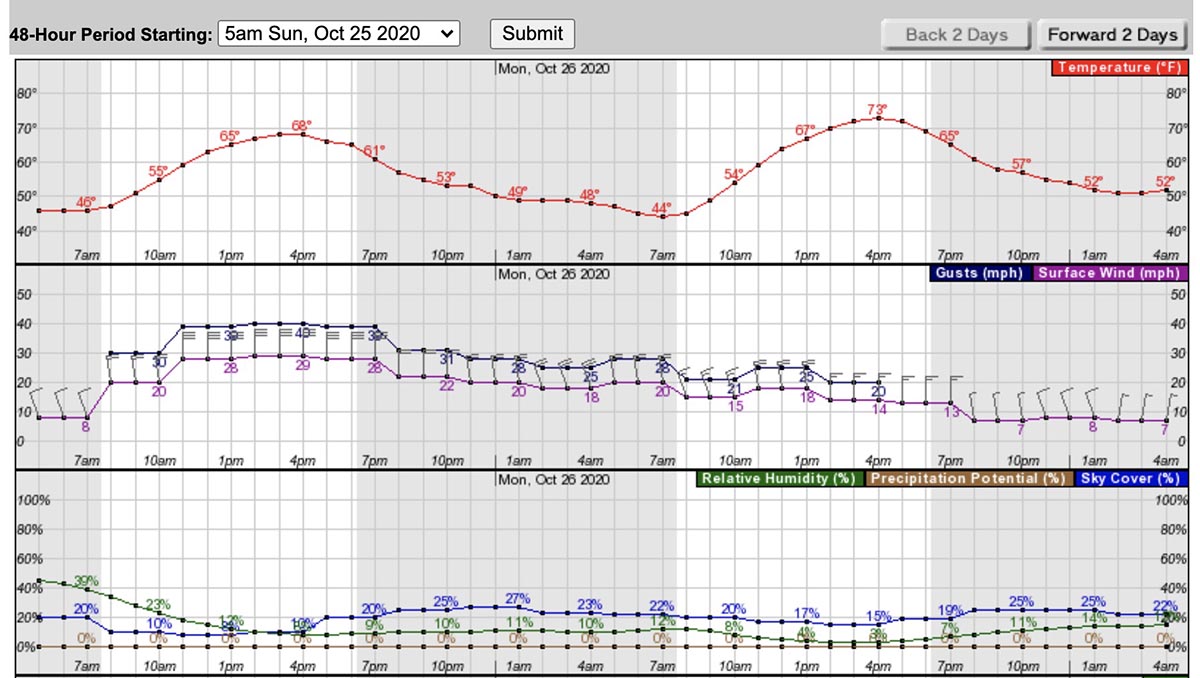
Check out the forecast for Red Bluff in Northern California —  on Sunday, 29 mph north winds with gusts to 40, and 10 percent relative humidity. On Monday, 18 gusting to 25 with 5 percent RH.

Weather forecast for Red Bluff, CA
Weather forecast for Red Bluff, CA Sunday and Monday

The extreme weather will begin in Northern California on Sunday then work its way to the southern part of the state on Monday and Tuesday.

Fire weather Sunday and Monday
Fire weather Sunday and Monday, Northern California

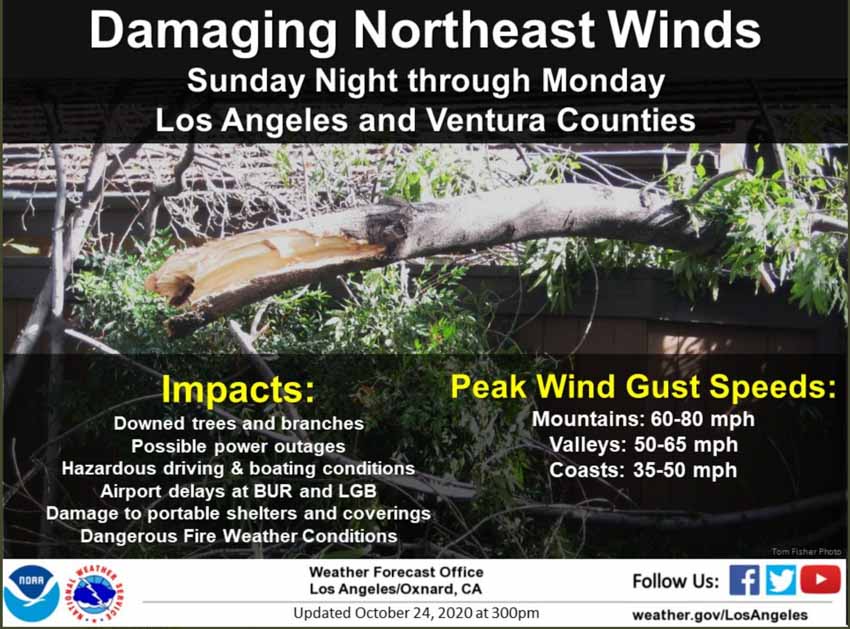
The forecast for Riverside in Southern California beginning early Monday morning: 26 to 30 mph north winds gusting to 45, with 8 percent RH; then Tuesday, 18 to 20 mph gusting to 30 with 10 percent RH.

Weather Forecast Riverside, CA
Fire weather Sunday and Monday
Fire weather Sunday and Monday Los Angeles and Ventura Counties.

With five to nine inches of snow beginning tonight on three fires in Colorado, I wonder if they can spare any crews or overhead personnel in case they are needed in California? Of course the 192,000-acre East Troublesome Fire after burning for 11 days only has 5 crews and 336 personnel, but the 206,000-acre Cameron Peak Fire next door has 42 crews and 1,903 personnel. The 10,000-acre Calwood Fire that has not spread for days now has snow, 10 crews, and 495 personnel. The National Multi-Agency Coordinating Group may have already made decisions along these lines.

As we wrote earlier today, of the 113 Interagency Hotshot Crews in the U.S., only about 35 are still funded and available for fighting fire. In two weeks that number drops to around 13 according to projections in a September 30, 2020 planning document compiled by an Area Command Team (ACT).

Wetter conditions in Australia may lead to a fire season very different from a year ago

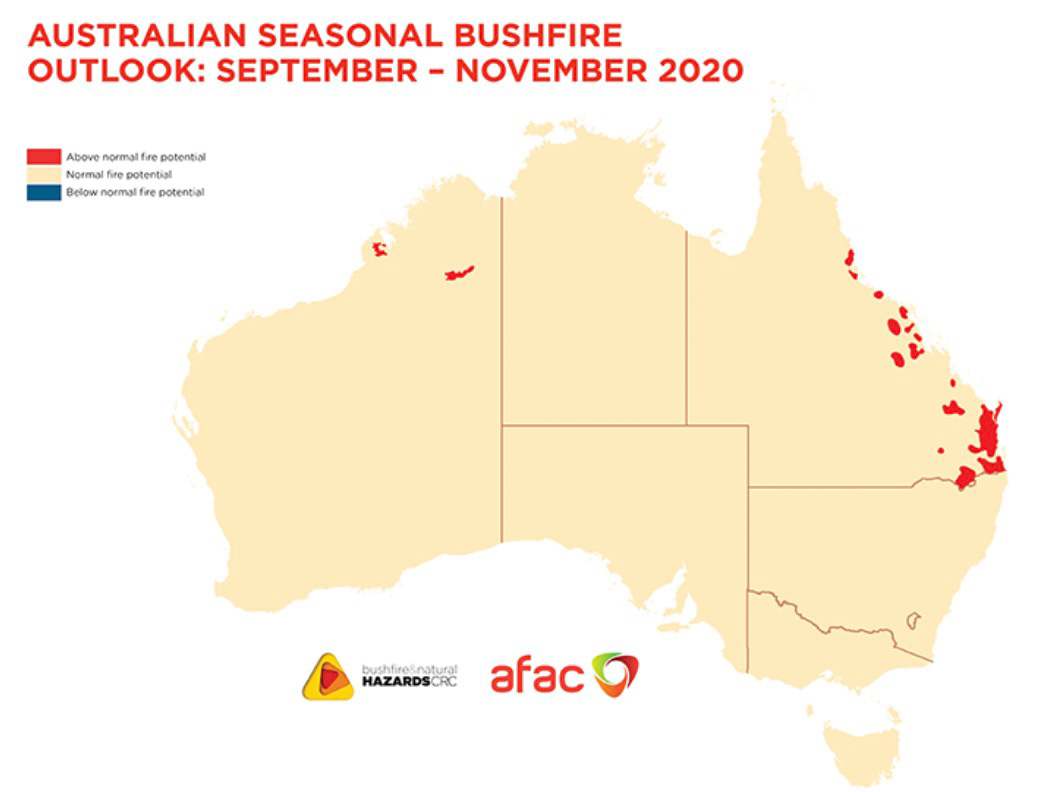
Australia fire outlook September through November, 2020

The 2020/21 fire season will be influenced by vastly different climate drivers than the previous two fire seasons, according to a September through November outlook from the Bushfire and Natural Hazard Cooperative Research Centre.

With a La Niña ALERT now active, large areas of eastern and northern Australia are expecting wetter than average conditions through spring. Despite the wetter climate signals, parts of Queensland face above normal fire potential in the south east and central coast, extending to the north.

While these wetter conditions in eastern Australia will help in the short-term, they may lead to an increase in the risk of fast running fires in grasslands and cropping areas over summer.

In contrast to the wetter conditions for the east, dry conditions persist in Western Australia, with above normal fire potential continuing to be expected in parts of the north.

Australia temperature outlook, October through December, 2020


Australia precipitation outlook October through December, 2020


Australia plans on having six large air tankers available during the 2020-2021 bushfire season.

Higher than normal wildfire potential predicted for much of the western U.S. in September

Wildfire potential September, 2020

The National Significant Wildland Fire Potential Outlook issued September 1 by the Predictive Services section at the National Interagency Fire Center for September through December predicts that most of the forested areas of the western states, with the exception of Montana, will have above normal potential in September. In October and November that is expected to shift to California and the southeast.

The data from NIFC shown here represents the cumulative forecasts of the ten Geographic Area Predictive Services Units and the National Predictive Services Unit.

Below:

  • An excerpt from the NIFC narrative report for the next several months;
  • More of NIFC’s monthly graphical outlooks;
  • NOAA’s three-month temperature and precipitation forecasts;
  • Drought Monitor;
  • Keetch-Byram Drought Index.

“A continuation of peak season activity into September is expected across much of the West as drought conditions continue to take hold. Most western regions will experience areas of above normal significant large fire potential as shown on the maps to the left. By mid-month, however, the seasonal transition to fall will begin. Cold fronts brining winds but also precipitation will begin providing relief to the critically dry fuels. Fire activity will begin to diminish as fuel moistures begin to recover. As the days get shorter, overnight humidity recoveries will become greater. This will add further relief to fuels, especially the finer fuels.

“Following a brief pause in activity in California and a cessation of seasonal activity elsewhere across the West, large fire potential is expected to increase in October and November in wind prone areas across the state. The expectation of drier than average conditions and a higher probability of more frequent Foehn Wind events suggests that significant large fire potential will be elevated until winter sets in during December. The fall fire season across the East is expected to be near average but above average across much of the Southern Area due to drier than average conditions associated with a developing La Niña.”


Wildfire potential October, 2020 Wildfire potential November, 2020 Wildfire potential December, 2020

Temperature and precipitation outlook, Sept., Oct., & Nov, 2020.
Temperature and precipitation outlook, Sept., Oct., & Nov, 2020. Forecast made August 20, 2020.

Drought Monitor, August 25, 2020 KBDI September 1, 2020

x

x

x

x