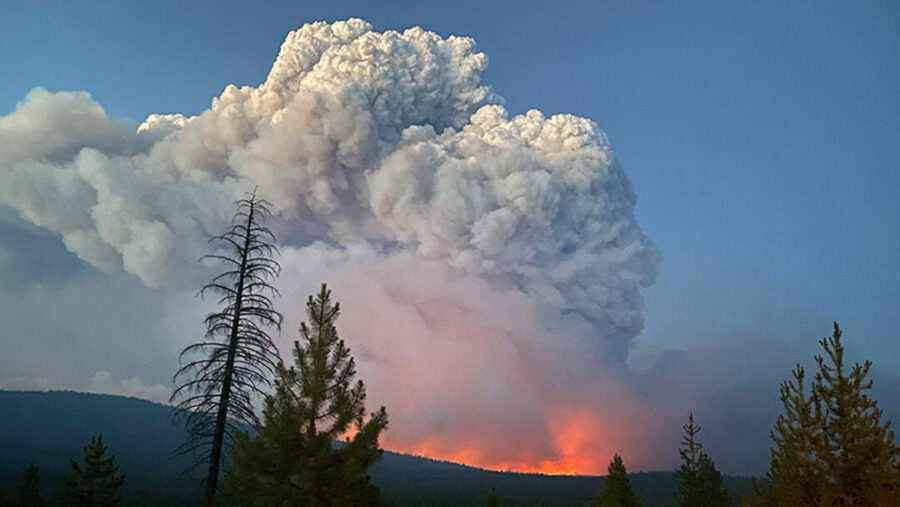
From: Mark Pieper Subject: Counter Rotating Vortex Pair Technology Transfer Video Message Body: Hello, I’m with the USDA Forest Service’s Innovation and Organizational Learning. We just released a 9 min. video about a fire behavior phenomenon called the Counter Rotating Vortex Pair. Investigators determined this occurred on the El Dorado Fire in 2020, killing Charlie Morton of the Big Bear Hotshots.
Here is the link to the video: https://bit.ly/3LB1b79
This QCODE will get you more info plus the video.
Editor’s note: The El Dorado Fire burned 22,744 acres in San Bernardino and Riverside counties of California in September to November 2020. It was ignited on September 5 by a pyrotechnic device at a gender reveal party in El Dorado Ranch Park, and quickly spread to the San Gorgonio Wilderness Area of the San Bernardino National Forest.
Burning over a 71-day period, the fire destroyed 20 structures and resulted in one firefighter fatality, for which the couple hosting the party were charged with involuntary manslaughter. Charlie Morton, an experienced squad boss from the Big Bear Hotshots, was killed by the Vortex Pair detailed in the excellent video linked above.
In a report by the Victorville Daily Press, Martin Estacio explained, “When asked by reporters in July how prosecutors will argue the couple’s actions were responsible for Morton’s death, San Bernardino County District Attorney Jason Anderson said the firefighter was “fighting a fire that was started because of a smoke bomb.”
“That’s the only reason he was there,” he said.
_______________________________________
A Superior Court judge in San Bernardino on Monday, Jan. 23, dismissed one felony count against the couple accused of setting the El Dorado Fire in 2020 but let stand 29 other charges, including the most serious, according to a January 23, 2023 report by the Mercury-News.
Air Tractor, Inc. has joined the United Aerial Firefighting Association (UAFA), an organization dedicated to advocating for aerial firefighting safety and standardization on the local, state, and federal levels. New Jersey had some help from an Air Tractor last week on its fires, and Slovenia is purchasing four new Air Tractor SEATs for firefighting after an awful season in 2022.
Air Tractor joined the UAFA as an Affiliate Member, according to an Aerial Fire Magazine story. The organization categorizes companies that support the aerial firefighting industry, including original equipment manufacturers (OEMs), insurance companies, and other associated for-profit entities.The UAFA was established in 2022 to foster and promote safety and standardization in the aerial firefighting community through education, advocacy, and collaboration.
Air Tractor photo
New Jersey fires:
Last week, according to ABC7 in New York, the New Jersey Forest Fire Service employed both helicopters and an Air Tractor fighting fires in the Pine Barrens. They have a little video news clip at that link with some Air Tractor shots and an interview with one of the pilots on the fire. The Air Tractor helped knock down the fires burning in West Milford and the Lakehurst area.
Pilot Dan Phillips of Coastal Air Strike said they sometimes fly the aircraft just 60 feet above burning treetops to drop water on fires. “The biggest challenge is putting this water around where the firefighters want it,” Phillips said.
Joining the UAFA:
Air Tractor President Jim Hirsch said wildfire seasons have become more complex, with increasing demands for aerial firefighting assets, and the UAFA offers manufacturers and contractors a unified voice. Hirsch said, “It has become clear that the aerial firefighting industry must unite its voices to achieve better outcomes for the people and property threatened by these fires. As the leading builder of firefighting SEAT aircraft, it only made sense that Air Tractor added its voice to this organization.”
Slovenia Acquires Four Fire-Bombing Air Tractors:
The new SEATs will be flown by the Slovenian Civil Protection Service to support aerial firefighting operations. The first two aircraft are scheduled for delivery in June of this year, with the remaining two anticipated in 2024, according to a story by AirMed&Rescue.
With full tanks, the Air Tractor can weigh up to 16,000 pounds. The single-engine turboprop planes are powered by Pratt & Whitney PT-6A engines, and can carry over 3,000L (almost 800 gallons) of water at a time.
“Geographically, from the Midwest to Alaska, to the Western states and Southern states, you’ve got a lot of different terrain and fire types,” said Jesse Weaver, Dauntless Chief Pilot, in a feature by AirMed&Rescue. “Some areas are more mountainous, so they definitely see the value of small, highly maneuverable planes. Others like Florida have a lot of retardant exclusion zones because of all the wetlands, so scoopers work well in those places.”
The Slovenia purchases were prompted by extreme wildfires in the country’s Kras region last summer, one of which burned over 8000 acres of farmland.
Opening arguments were heard yesterday in a lawsuit against PacifiCorp claiming that its negligence started several devastating 2020 wildfires that burned across western Oregon. KEZI-TV reported that the class action suit was filed in September 2020, not long after the fire’s containment, by Linn County residents who lost their homes in the Beachie Creek Fire. The suit grew to include plaintiffs from other Oregon wildfires.
The complaint alleges that Pacific Power and its parent company, PacifiCorp, did not deactivate certain powerlines during the heavy winds in the late summer of 2020. When those east winds brought down trees, they connected with live powerlines, igniting fires that destroyed hundreds of structures and killed several people.
“PacifiCorp chose not to protect Oregonians — it did not live up to its obligation, it didn’t take any action to prevent fires, and now, in this case, PacifiCorp should bear the consequences,” said Nicholas Rosinia, attorney for the plaintiffs. KOBI5 News reported that Pacific Power attorneys countered that a decision to de-energize powerlines is complex and can’t be based on fire risk alone. “The possibility of an ignition must be weighed against the dangers of de-energization when whole cities and towns can be blanketed in darkness just when they need power the most,” said Doug Dixon, an attorney for the defendants.
The attorneys acknowledged that both Portland General Electric and Consumers Power, Inc. decided to turn off power in parts of their service areas around the Labor Day storms.
The Beachie Creek Fire was reported August 16, 2020 in the Opal Creek Wilderness about six miles northwest of Detroit Lake in Oregon, some 38 miles east of Salem. According to records in the daily national Incident Management Situation Report and GIS data, the fire was:
10 acres August 26, 10 days after it was reported
23 acres August 31, 15 days after it was reported
150 acres September 3, 18 days after it was reported
469 acres September 7, 22 days after it was reported; (before the winds began that night).
Plaintiffs are asking for more than $1.6 billion in damages, according to court documents. The trial is scheduled to last until at least mid-June.
GOES-17 photo of smoke from wildfires in Washington, Oregon, and California at 5:56 p.m. PDT Sept. 8, 2020. This image was captured during a very strong wind event. NASA photo
The Oregonian reported that the Labor Day fires burned more than 1.2 million acres in Oregon, destroyed upwards of 5,000 homes and structures, and claimed nine lives. PacifiCorp is the primary defendant in litigation from the fires; the Portland-based utility, Oregon’s second largest, did not shut down power to any of its 600,000 customers during the windstorm. Its lines have been implicated in six separate fires, one of which started in its California service territory and burned across the state line into Oregon.
Jurors will determine PacifiCorp’s responsibility, if any, in four of those fires: the Santiam Canyon fires east of Salem, the Echo Mountain Complex near Lincoln City, the South Obenchain Fire near Eagle Point, and the Two Four Two Fire near the southwest Oregon town of Chiloquin. This is a historic trial and will likely reshape the way Pacific Northwest electric utilities respond to increasing wildfire risks influenced by climate change, persistent drought conditions, and increasing numbers of acres burned each year.
In November 2022, PacifiCorp settled another case out of court with two families who sued over the Archie Creek Fire, which burned more than 130,000 acres in Douglas County in 2020.
We got a note yesterday from Marty Parish, who knew Bill Gabbert years ago. He was amazed to see names here from his IHC days; he said he met Bill when he was with the Laguna Hotshots in the early 1980s, when Bill was working in Prevention and lived at Camp Ole, near the Laguna IHC camp.
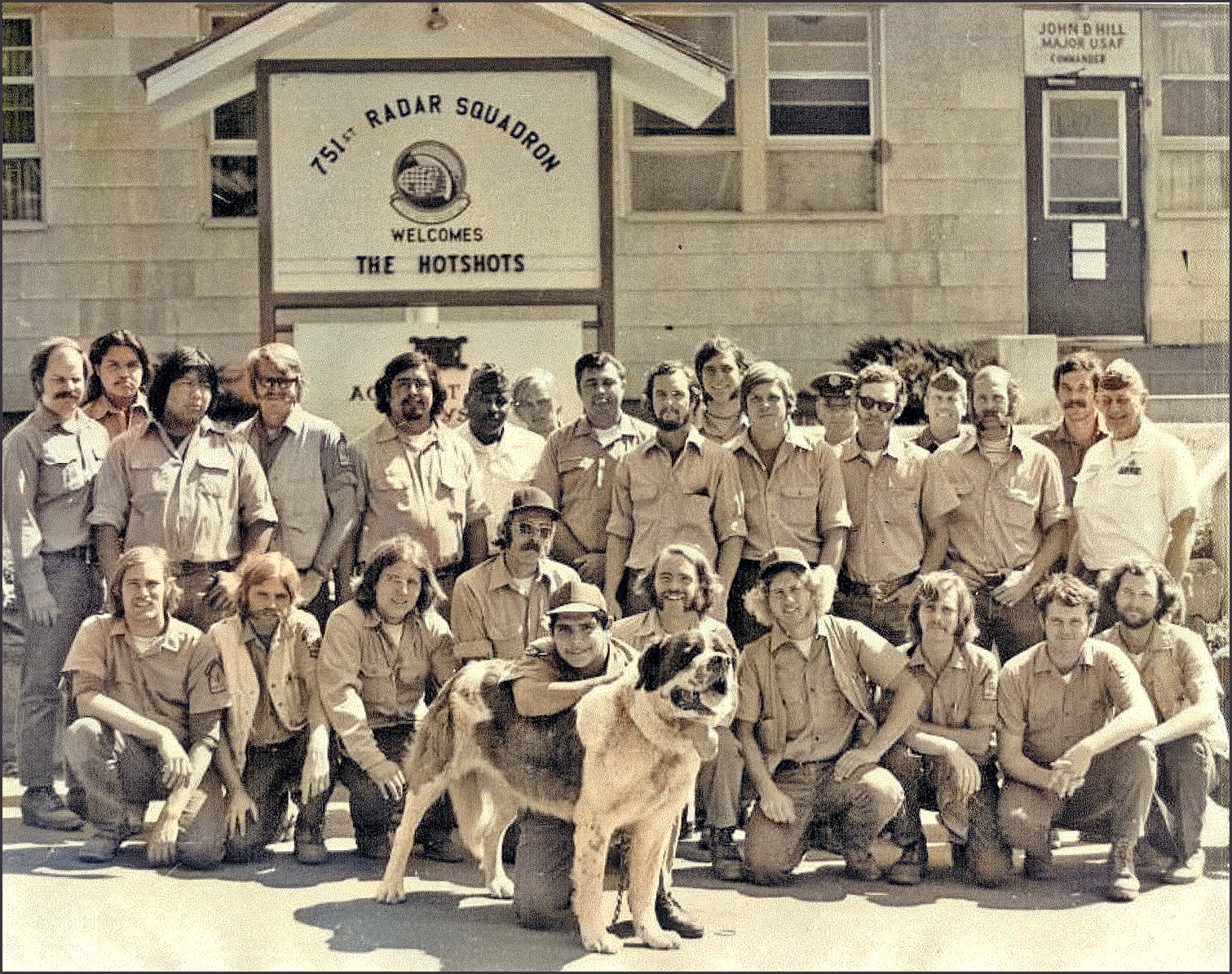
Marty sent us this photo that was sent to him by another firefighter. He does not know where or when it was taken. But that’s for sure Bill Gabbert at far left. Who can identify more of the guys in this photo?
Radar Squadron on Mt. Laguna
“At 17 I became a Young Adult Conservation Corps (YACC) member in late 1978,” wrote Marty. “We were based out of a work camp located off the same highway (Sunrise Hwy) about two miles north of Camp Ole (Al Bahr Shrine Camp, now gone after the 2013 Chariot Fire). We worked closely with the USFS as part of the program. I was hired in ’79 as an Engine Crewman (Corral Canyon) while working as a YACC with Mert Thomas in Recreation (Mert got me the job!) and I finished the second half of the season that year ending in early January of 1980. I returned in the spring to Camp Ole for my first Hotshot season.”
“I didn’t really know Bill well,” added Marty. “We had lived for a short time in the same USFS realm on the Cleveland National Forest-Descanso District; he had left suppression before we met and was working in Prevention. He lived in one of the USFS employee residences at Camp Ole (on Mt. Laguna, San Diego County).”
“I was a Laguna Hotshot for three years, but not sure he was there all three years (we relocated for a year to Descanso, then returned to Camp Ole, only to relocate back to Descanso permanently after I left for FHS).”
Marty, who was also with the Flagstaff Hotshots 1983-1985, added this. “Not sure who is in this photo, but that’s definitely Bill on far left side. Again, my condolences for your loss. A couple of others from that era recently passed too, including my dear friend Brian Connelly from LHS and MCB/Camp Pendleton Fire. Let me know if you pick up other names of people in the pic.”
Hit us up if you recognize any of the other guys in this photo or can provide other details — just click “Leave a comment” under the headline above. THANKS!
The Oregon Department of Forestry has cancelled an insurance policy that has over the years reduced the cost of fighting wildfires; it had acquired sky-high deductibles over the last few years.
ODF said it will not renew its policy with Lloyd’s of London, a UK-based insurance market, in the 2023-2024 policy year. Longer, more complex, and costlier fire seasons over the last decade have led to higher premiums and deductibles, which in turn made the policy less attractive to Oregon officials. The policy was first acquired in 1973, according to KEZI-TV, to reduce the impacts of wildland fire suppression costs for Oregonians.
The decision was made after an April 3 meeting of the Emergency Fire Cost Committee (EFCC), which oversees the Oregon Forest Land Protection Fund (FLPF). After an extensive review, the EFCC recommended to the State Forester Cal Mukumoto that he cancel the insurance policy, and he decided not to renew it, explaining that the funds that would have paid for the policy can be better used directly paying for wildfire suppression efforts.
According to the EFCC, the 2023-2024 insurance policy would have had a deductible of over $78.5 million – 57 percent higher than in the 2021-2022 policy. Oregon’s historic fire season costs did not meet that threshold, so the policy was very unlikely to actually trigger this year and provide any financial benefit to the state. The 2023-2024 premium was quoted at $4.1 million for $25 million in coverage.
Best-selling author and futurist Peter Diamandis became frustrated in recent years with the “craziness” of constant wildfire alerts he’d received. But unlike most people, Diamandis has a Rolodex full of wealthy benefactors and politicians, along with experience with a solution he had used before: Create a contest.
On April 21 his group XPRIZE launched its latest contest: finding new ideas to detect and suppress wildfires.
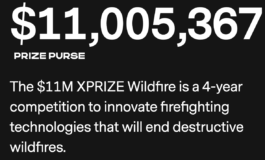
Pacific Gas & Electric (PG&E) said the prize threshold includes detecting and suppressing a high-risk wildfire in 10 minutes or less, and pinpointing from space all fire ignitions across multiple states or countries — in 60 seconds. These are the challenges for innovators in XPRIZE Wildfire, a four-year, $11 million competition to develop and demonstrate fully autonomous capabilities to find and fight wildfires.
The United Nations, the White House, and Congress recently have prioritized destructive wildfires as a major economic, environmental, and safety threat. Patti Poppe, CEO of PG&E, said they are co-sponsoring the project. “Today’s launch of XPRIZE Wildfire is a call-to-action to entrepreneurs, roboticists, artificial-intelligence experts, scientists, and innovators from across the globe to revolutionize wildfire detection and suppression,” she said.
XPRIZE Wildfire encourages teams from around the world to innovate across firefighting technologies in two different tracks designed to transform how fires are detected and suppressed.
In the Autonomous Wildfire Response track, teams will need to monitor at least 1,000 square kilometers (386 square miles), and autonomously suppress a wildfire within 10 minutes of detection.
In the Space-Based Wildfire Detection & Intelligence track, teams will have one minute to accurately detect all fires across a landscape larger than entire states or countries, and 10 minutes to precisely characterize and report data (with the fewest false positives) to two ground stations.
The Los Angeles Times reported that Palmer Luckey, a 30-year-old founder of Oculus, a virtual reality company that sold for $2 billion, announced that he was forming the first team to compete for the prize. He said he cares more about solving the problem than winning the money, but he believes the cash will motivate other contestants to form teams and compete.
“I sold my last company for billions of dollars so I can do whatever I want,” he said. “We started working on wildfire tech because I think it’s very, very important. The money in this prize to me is honestly immaterial.” Luckey said at the contest launch that he thinks software, not hardware, will make the difference in detecting and containing fires.
The four-year contest is not winner-take-all. Teams will compete for top prizes of as much as $3.5 million and a bonus $1 million prize to develop technology that can detect fires both from the ground and from space, and fight them using drones or other autonomous vehicles. They’ll compete, for example, to see which technology can accurately detect fires across a land mass the size of a state or country in one minute or suppress fires using an autonomous vehicle within 10 minutes.
Andrea Santy, who is running the competition for XPrize, also said the prize money may not be the most important driver. Teams will benefit from multiple rounds of live testing and validation that would be hard to organize independently. The group is spending an additional $11 million beyond the prize money to run the contest, she said; some of that money will fund a documentary about the competition.
XPRIZE Wildfire is offered in partnership with Co-Sponsors PG&E and Gordon and Betty Moore Foundation, Presenting Sponsor Minderoo Foundation, Bonus Prize Sponsor Lockheed Martin, Supporting Sponsor Conrad N. Hilton Foundation, and Benefactors Nichola Eliovits and Michael Antonov. Sixteen teams are already registered. For more information, to get involved, or to register a team to compete, visit the xprize.org/wildfire website.
YET ANOTHER TOILET PAPER ARSONIST: An 18-year-old volunteer firefighter allegedly started 21 wildfires over the last couple months; ABC-27 News reported that Adam Ewing, of Three Springs, was arrested by the Bureau of Forestry for setting wildland fires in February and March.
On Saturday, Feb. 11, a series of wildfires started in southern Huntingdon County. Just before 2:30 p.m., crews were called out to a fire near Captain Jack’s Road. This fire burned about a half acre in dead leaves and brush before firefighters could control the flames. About 20 minutes later, crews were dispatched to another fire along Old Tannery Road in the Saltillo Borough. Another third of an acre was burned before firefighters were able to control it, according to a criminal affidavit.
On Feb. 14, investigators from the Bureau of Forestry visited the locations of the two fires to determine a cause. They concluded the fires had been maliciously lit with the intention to burn or spread.
Adam Ewing, of Three Springs, was arrested by the Bureau of Forestry for setting 21 fires in Huntingdon County in February and March. Huntingdon County Prison photo
WTAJ-TV News reported that just before 2:30 p.m., crews were called out to a fire near Captain Jack’s Road; it burned .51 acres of dead leaves and brush before firefighters were able to extinguish the flames.
Investigators then learned that Ewing was the one who had called in the fire along Captain Jack’s Road. Later on Feb. 14, multiple fire crews were called out after two wildfires were reported near Hamman Road and Sugar Grove Road in Cromwell Township. Investigators from the Bureau of Forestry responded to the fires and were able to confirm again that these fires had been intentionally lit, according to the criminal complaint. The Three Springs Volunteer Fire Company’s Chief Chris Grace told the forestry investigators that Ewing — a volunteer firefighter — was the first to arrive at the fire station for the call. On Feb. 23 and 24, another 10 fires were reported — and also called arson by state Forestry. Police noted in the filed charges that at three of the fires, they found pieces of toilet paper with a rose pattern. Investigators went to Ewing’s home, where they confirmed that the toilet paper at the burn sites matched the rose pattern toilet paper at Ewing’s home. Ewing has yet to post his $500,000 bail. He’s facing 63 felony charges
Here’s a facebook post from three years ago. The “Forgotten Oregon” group on facebook is a treasure trove of photos and memories. Anyone with Cave Junction memories or memorabilia is welcome to contribute!
Don Basey at Cave Junction, early 1950s, photo from Allyson Basey Geary.
The Wisconsin Department of Natural Resources (DNR) and the National Weather Service have issued a Red Flag Warning for Thursday, April 13 from 11 a.m. to 8 p.m. for most counties in the southern two-thirds of the state — prompted by high temperatures, low humidity, gusty winds, and exceptionally dry fuels.
A Wisconsin Army National Guard UH-60 Black Hawk helicopter from the Madison-based Army Aviation Support Facility #2 in the process of filling a Bambi bucket to support fire suppression efforts near Necedah in Juneau County the afternoon of April 12. Wisconsin DNR photo
The Wausau Pilot and Review reported that Thursday was the second day in a row Wisconsin was faced with these conditions. Counties in the area will remain at Extreme fire danger and the DNR will prohibit burning.
The DNR just yesterday responded to 21 wildfires burning over 2,500 acres. Several fires burned in Juneau and Jackson counties, resulting in the mobilization of a DNR incident management team. The Jack Pine Fire burned an estimated 100 acres but has been contained. The DNR, under unified command with Fort McCoy, is also managing the 2,800-acre Arcadia Fire, which is nearly 50 percent contained. FOX 6 News reported that crews fought the fire overnight and operations were ongoing today. State patrol is monitoring smoke on the interstate and will shut it down again if visibility or fire conditions warrant it.
Wisconsin smoke. DNR photo
The Arcadia Fire, which started at the north end of Fort McCoy, resulted in some voluntary evacuations. Three structures were damaged; the cause of the wildfire is still under investigation. The fire is burning in oak and jack pine.
Nearly 80 wildfires have occurred in the last week.
Wisconsin Gov. Tony Evers yesterday declared a State of Emergency in response to elevated wildfire conditions; his executive order triggers wildfire suppression support from the Wisconsin National Guard, which will assist with Black Hawk helicopters in areas of the state in need of aerial fire suppression. Executive Order #191 also directs all Wisconsin state agencies to assist in wildfire prevention, response, and recovery efforts.
A Douglas County non-profit will receive $9 million in prevention grant funding, the second highest award in the state of Oregon. The U.S. Forest Service awarded $9,151,505 through its Community Wildfire Defense Grant program (CWDG) to the Douglas Electric Cooperative, according to a KEZI News report. The non-profit electric utility serves 11,000 meters in a 2,500-square-mile territory that includes Douglas, Coos, and Lane counties in western Oregon.
In Grant County, the town of John Day received two grants, including the state’s largest award of $9,907,344 earmarked for Grant County’s evacuation corridor and fuels management, Forest Service officials said. (This is the same Grant County that arrested a burn boss on a USFS prescribed fire last fall.) The Blue Mountain Eagle reported that Prairie Wood Products also was awarded a $1 million grant as part of an effort to strengthen the wood products economy and promote sustainable forest management. Through the Wood Products Infrastructure Assistance grant program, the Forest Service is providing funding to wood processing facilities to improve, establish, retrofit, or expand facilities that purchase and process byproducts from ecosystem restoration projects on federal or tribal lands.
The Forest Service’s CWDG program invests a total of $23.5 million to assist communities, and often partners with The Nature Conservancy. “In 60 years of working with wildland fire, The Nature Conservancy has learned that successful wildfire adaptation efforts are inevitably grounded in communities,” said Marek Smith, director of TNC’s North America Fire program. “The Community Wildfire Defense Grant program provides an important opportunity to deliver needed resources to communities that are doing the challenging work of living sustainably with wildfire.”
The 2021 Bootleg Fire on the Chiloquin Ranger District of the Fremont-Winema National Forest. South Central Oregon Fire Management Partnership photo
Some of the 100 funded projects — including the Chiloquin Wildfire Risk Reduction and Education project in Oregon — are led by TNC or its partners.
“We’re grateful for support of TNC-involved projects, and we’re deeply grateful to see a broad slate of funded projects that are diverse in terms of scope, communities represented, and geography,” said Smith. “A better future with wildland fire requires that outmoded ideas and approaches are transformed by the vision and experience of diverse communities.”
Forest Service officials said the CWDG program funding is made possible through the federal Bipartisan Infrastructure Law, part of which prioritized low-income communities at risk of a wildfire hazard. An additional round of funding will be announced later this year.