A fast-moving wildfire in southern New Jersey grew to nearly 4,000 acres in under 24 hours as record springtime heat has set in across the Northeast. CNN reported that the Jimmy’s Waterhole Fire had already burned more than half the average acres burned in New Jersey in an entire year, according to statistics from the New Jersey Forest Fire Service. The fire was 50 percent contained at 3,859 acres by Wednesday morning.
It was reported at just 500 acres at 10 p.m. Tuesday, according to the New Jersey Forest Fire Service.
WPVI-TV News reported Wednesday morning that the fire was at 50 percent containment, and by Wednesday afternoon it was estimated at 60 percent.
About 170 structures in the Manchester Township area were evacuated Tuesday night, but all residents have since been allowed to return home, Manchester Police Chief Robert Dolan said during a news conference Wednesday.
New Jersey Department of Environmental Protection photo
New Jersey has been dealing with a series of recent fires exacerbated by dry and windy conditions. The Washington Post reported a mandatory evacuation in Manchester, where residents were relocated to the Manchester Township High School, with support from the American Red Cross, Manchester Township EMS, Manchester Police Department, and Ocean County Sheriff’s Office.
The University of Oregon in Eugene is launching a new research program to study effects of wildfire smoke and examine options for reducing risks. UO research professor Cass Moseley told KGW News that the center’s launch is due in part to efforts by Oregon’s U.S. Senators Ron Wyden and Jeff Merkley, who secured $800,000 in funding from the U.S. Environmental Protection Agency.
Research will focus in part on new ways to protect homes from smoke infiltration, along with more efficient communication with communities in emergencies and developing community action plans tailored to different regions in the Northwest.
The new Wildfire Smoke Research and Practice Center builds on research already completed through the Ecosystem Workforce Program (EWP), a joint venture between the UO and Oregon State University. KLCC reported that the EWP’s senior policy advisor Cass Moseley will head up the new center; she said recent incidents in the Pacific Northwest, particularly the 2020 Labor Day fires, highlighted the need for new smoke research. Much of Oregon, particularly the southern Willamette Valley, was choked with wildfire smoke for weeks during the 2020 fire season.
Those fires and the severe levels of smoke really emphasized the need for new research, according to Moseley. “And we saw this fall in Oakridge, several weeks of highly dense smoke as the fire there settled into that valley and really stayed; that community spent a lot of time and energy responding to that smoke event.”
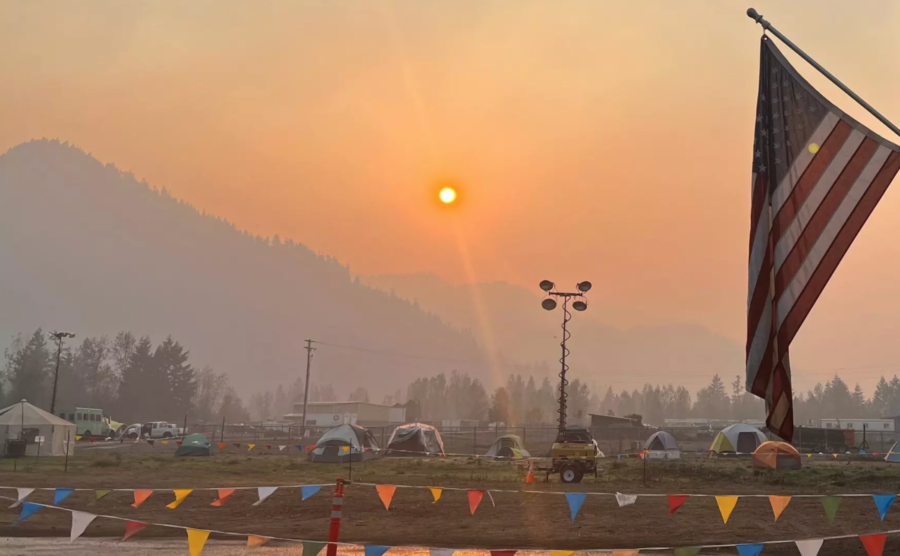
Cedar Creek Fire Incident Command Post in Oakridge, Oct. 15, 2022 — Inciweb photo
The center’s launch was announced by Merkley and Wyden, who secured the funding to help communities prepare for wildfire smoke. One area of interest is the toxins released when manmade structures burn, as these risks became obvious during western Oregon fires in wildland/urban interface areas over the last few years. Most smoke research has focused on burning timber and wooden structures, and part of the new planned research will study effects of smoke from burning plastics, glass, fuels, and other synthetic materials. Moseley said the center has three co-investigators and a principal investigator leading the group, along with research assistants and graduate and undergraduate student assistants.
Chairman of the California state’s Senate Governmental Organization Committee, Bill Dodd, D-Napa, will hold a hearing tomorrow to review “improvements to wildfire preparedness and prevention,” including legislation and investments undertaken over the past five years. The Daily Republic of Solano County reported that the committee will hear from state and local agencies including Cal Fire and the Legislative Analyst’s Office, and will take public comment.
Back in February, the Lake County News reported on Sen. Dodd’s announcement of legislation to create the Wildfire Mitigation Planning Act, to better prevent and contain wildfires. In the aftermath of the 2018 Camp Fire (which leveled the northern California town of Paradise and evacuated not just Paradise but also Magalia, Centerville, Concow, Pulga, Butte Creek Canyon, Berry Creek and Yankee Hill), Dodd co-authored AB 1054, which created a framework for electric utilities to evaluate their wildfire risk and plan for their wildfire mitigation investments and activities — overseen by the Office of Electric Infrastructure Safety within the California Natural Resources Agency.
“With this cycle of heavy rains and prolonged droughts, we cannot take our eyes off of the risks that major wildfires present to communities across the state,” said Dodd. “The Legislature made good progress on wildfire safety and we must ensure our proposals and investments do what they are intended to do,” he said in a statement announcing the hearing, which will be held tomorrow after Senate adjournment.
A North Carolina fire has spread across several thousand acres and had reached about 34 percent containment by late Sunday afternoon.
Last Resort Fire photo by North Carolina Forest Service
The News & Observer reported that the Last Resort Fire is burning on both private and federal lands in rural Tyrrell County. After firing operations on Saturday, the fire was estimated at 5,800 acres. That was revised downward late Sunday.
The North Carolina Forest Service said the fire’s burning near Columbia, just south of the Albemarle Sound. Joint command has been established with the U.S. Fish and Wildlife Service.
Light rain moderated conditions late yesterday, and crews are working on containment lines. Fire managers cautioned that smoke may impair driving conditions in the area; about 75 firefighters from both the state and U.S. Fish and Wildlife were assigned. A Type 3 IMT took over management Sunday.
13NewsNow reported that the fire may cause smoky conditions on the Outer Banks and was producing heavy drifting smoke to the east of the fire.
The string of near-misses in U.S. airspace continues, this time involving a Southwest Airlines 737 and a fire department helicopter at Hollywood-Burbank Airport in southern California. Matthew Klint with liveandletsfly.com reported that “Southwest Airlines flight 353 was on approach for landing at BUR airport when Air Traffic Control noticed a Los Angeles Fire Department Bell 505 helicopter practicing takeoffs and landings, right where the Southwest flight was to land. The Southwest flight, a Boeing 737-700 with registration N551WN, was ordered to abort landing and performed a go-around.”
NBC Los Angeles reported that just before 10 a.m., the 737 from Phoenix was on approach to Runway 8 for a landing; it was about a mile out when air traffic control noticed the LAFD helicopter doing touch-and-go’s on the same runway. The controller told the helicopter to remain in place and directed the Southwest pilot to go around. Ed Whisenant Aviation has a related video online.
This is yet another incident at Burbank; on January 22 two aircraft were cleared to use the same runway at the same time (a Mesa Airlines CRJ900 operating for American Airlines and a SkyWest Embraer 175 operating for United Airlines). In that incident, an automatic alarm onboard the CRJ900 sounded, which may have prevented a tragedy.
Secretary of the Interior Deb Haaland announced on Sunday more than $21 million in new funding for wildfire risk reduction; she spoke during a press conference with Senator Jeff Merkley at the Oregon Department of Forestry Southwest District headquarters, according to a report by KEZI-TV News in Eugene, Oregon.
She said fire management agencies plan fuel management work on more than 170,000 acres in Oregon this year.
District Forester Mike Shaw said there’s good news with better snowpack this year. “I do project that we’re going to have another challenging fire season,” he said. “All hands on deck is the approach that we’re taking and all wildland fire agencies are working together.”
Senator Jeff Merkley, chairman of the Subcommittee on Interior, Environment, and Related Agencies, joined Haaland and Shaw to emphasize their collaboration on wildfire prevention. “We’re really focusing on the front end of forest treatment and on the back end of having the resources to fight the fires,” Merkley said. “The key word here is collaboration.”
Aside from the millions in federal funding allotted from his bipartisan infrastructure law, Haaland said that President Biden is also supporting increased pay, better housing, and more full-time jobs for firefighters.
Vice President Kamala Harris joined other national leaders in the nation’s capitol to announce the new funding to help protect high-risk communities. “Our acres of burned land have doubled,” Harris said. “We need to change how we think about how we respond to fires. We need to prevent them, not just respond after they’ve started.”
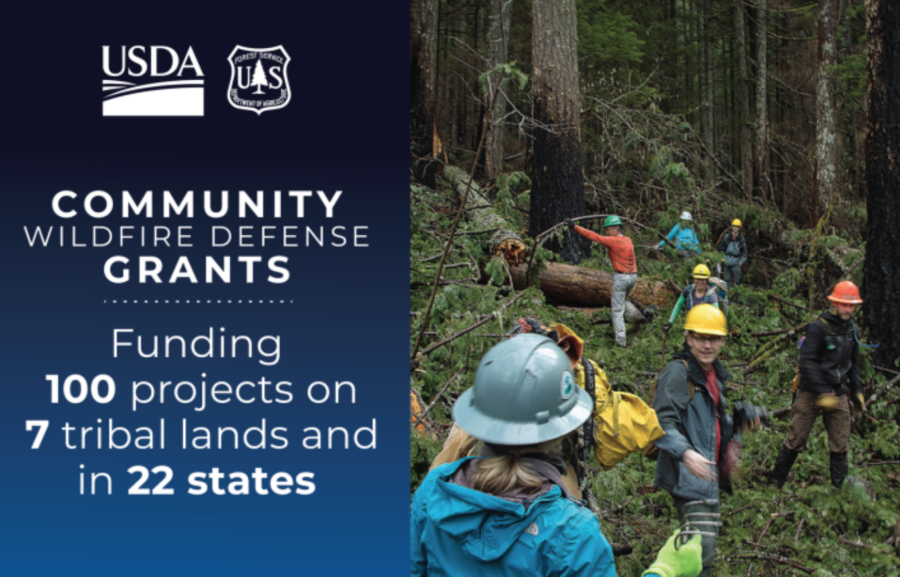
KRDO News reported that $197 million in federal funding will be made available this year to 100 communities in 22 states and 7 Native American tribes. “There were 36 states and 45 tribes that applied for the funding,” Harris said. “This is the result of legislation I started years ago while I was in the Senate.”
She said she was motivated by recent destructive fires in her home state of California. “This will be the first of many grants,” she said. “We’re committing $1 billion over the next four years and $7 billion over the next ten years.”
A 7-acre wildfire in the area of Highway 14 and Arrowhead, according to a report by 9NEWS-TV, resulted in evacuations for residents of Poudre Canyon in Larimer County on Sunday afternoon.
Voluntary evacuations were issued for a stretch of the canyon; the Arrowhead Fire was reported by the Canyon Lakes Ranger District at 50 percent containment by late afternoon.
The Coloradoan reported that the fire was burning near the U.S. Forest Service’s Arrowhead Lodge visitor center, 34 miles west of Ted’s Place along Colorado Highway 14, also known as the Poudre Canyon Highway. The sheriff’s office issued evacuation notices from the Lodge east to Riverside Drive, and residents were told to gather essential items and prepare to evacuate. A Red Cross evacuation site was established at Cache La Poudre Middle School in Laporte, and a portion of Highway 14 was closed between Arrowhead Lodge and Rustic.
Minnesota-based aerial firefighting company Dauntless Air recently announced that it’s starting the 2023 wildfire season with 17 Fire Bosses — nearly double the size of its fleet five years ago. The AT-802F Fire Boss is a water-scooping airtanker equipped with amphibious floats that is purpose-built for aerial firefighting. The company’s Fire Bosses are outfitted with thermal imaging to target hotspots, onboard gel mixing systems, and a custom fire gate to increase water load and match drop pattern to the fire type.
Fire Boss amphibious scooping airtanker
When near a water source, the Fire Boss can repeat continuous scoops and drops on a fire for 3½ hours.
The company used nine of its water-scooping planes during its 2-week annual training in Cleburne, Texas. Training involved every person in the company, and pilots new to the Fire Boss logged three times the industry standard for pre-season flight hours, flying roughly 25 hours each solo and with an experienced pilot in the company’s two-seat training aircraft. Company pilots completed 844 scoops and dropped over a half million gallons of water.
Pilots trained on radio communications with an Air Attack platform that flew above a training area; they also practiced initial attack on a simulated fire with the Texas Forest Service (TFS). Dozens of TFS incident commanders, along with a pump truck and dozers, participated in training.
U.S. Hotshot Association (USHA) representatives presented a session on the history of the hotshot community and its ties to aerial firefighting. Aviation Medicine Advisory Service (AMAS) President Quay Snyder led a workshop on pilot fatigue, mental health, and fitness for duty, and other training was conducted by the U.S. Office of Aviation Services (OAS), Bureau of Land Management (BLM), and Minnesota Department of Natural Resources (DNR).
Fire shelters that are not manufactured to specs are being advertised and sold as meeting Forest Service (FS) specification 5100-606 requirements. These shelters are made from unknown materials and components that have not been tested and certified, and the materials could affect the performance and safety of the non-specification fire shelter if deployed on a fire.
These shelters are sold as the M-2002 fire shelter. The National Technology and Development Program (NTDP) was alerted on February 22, 2023 about these fire shelters by a contractor who inspected their shelters upon delivery.
Subject matter experts with NTDP evaluated the shelters and determined they did not meet FS specifications that govern the materials and components deemed safe for fire shelter use. Specification fire shelter materials have been extensively tested for toxicity; they do not release toxicants that would harm a shelter occupant. Shelters constructed with materials that don’t meet requirements have not been tested and may release hazardous toxicants to a shelter occupant. NTDP has not yet completed testing of the thermal performance of these non-specification fire shelters, but a visual inspection shows deviations that will mean the shelter does not deploy as intended. Any non-FedMall (open market) fire shelter purchases should be inspected to verify that they are built to specification 5100-606.
Any non-specification fire shelter should be removed from service and NOT CARRIED ON THE FIRELINE. IN THE EVENT OF AN ENTRAPMENT OR BURNOVER, SERIOUS INJURY OR DEATH COULD OCCUR.
The noticeable differences between specification and the non-specification fire shelters can be identified by the following.
> Carry case:
• Absence of hard plastic liner
• Missing stenciling on Use Instructions pocket
• Missing sewn-in label
> Polyvinyl chloride (PVC) bag:
• For the Large fire shelter, the pull strap is missing LARGE stenciling (FYI the pull strap for Regular fire shelters is yellow and not labeled)
• Missing paper insert label
> Fire shelter:
• Missing LEFT HAND and RIGHT HAND stenciling on shake handles
• Uneven and loose folding of the shelter not in a brick shape
The non-specification fire shelters are made from unknown materials and components that do NOT meet specification 5100-606. Use of the non-specification fire shelter during an entrapment or burnover may result in serious injury or death. For federal agencies, the Interagency Standards for Fire and Aviation Operations (Red Book), Chapter 7: Safety and Risk Management specifies that firefighters must carry an M-2002 fire shelter built to FS specification 5100-606 while on the fireline.
All federal firefighters should purchase shelters directly from FedMall. State and local government firefighters may be able to register for FedMall access through the State and Local Government Purchasing Program. Those purchasing outside of FedMall should ensure they purchase fire shelters from reputable suppliers.
The fire shelters identified in this Safety Warning are the only known non-specification fire shelters currently sold on the open market, but that does not mean there aren’t others.
All fire shelters, regardless of supplier, should be inspected upon receipt to ensure that all components are accounted for, the shelter meets specification requirements, and that no damage has occurred during shipping or storage. Contact NTDP if you suspect you have purchased or stored a non-specification fire shelter.
Additional information on shelters is posted on the Fire Shelter and Personal Protective Equipment Subcommittee website.


 The