Lytton wildfire survivors want their lawsuit certified as a class action in British Columbia

Two survivors of a wildfire that destroyed much of Lytton, B.C. in the summer of 2021 say their lawsuit should be certified as a class action. The chief justice of the B.C. Supreme Court will decide whether the case, initially filed in October of 2021 by two residents who lost their homes, has a broader scope.

CBC News reported that on the hottest day of 2021, a fire in the Fraser Canyon burned more than 800 square kilometers, killed two people, and destroyed much of the village. Investigators found no evidence that a passing train caused the fire, but the lawsuit claims the fire was started by either a Canadian National or Canadian Pacific train on its way through the village. According to the Calgary Sun, lawyers for Christopher O’Connor and Jordan Spinks, the two representative plaintiffs in the case, argued in court that the fire was ignited as a result of a coal train owned by Canadian Pacific Railway passing through the village on June 30, 2021. Spinks is a member of the Kanaka Bar Indian Band and has said that he witnessed smoke and flames on CN Rail’s right of way, at or near CN Rail’s bridge that crosses the Fraser River. He had just finished his shift as a care aide at an assisted-living facility and lost his job as a result of the fire. O’Connor, a resident of Lytton, lost his home in the fire and had his vehicle damaged.

The railway companies deny any responsibility for the fire and cite a report by the Transportation Safety Board of Canada that concludes there was no link between train operations and the fire. But Tony Vecchio, a lawyer for the plaintiffs, said the report was deficient in a number of respects and should not be relied upon.

“They didn’t have any basis to make this finding at all, on their own evidence,” Vecchio told B.C. Supreme Chief Justice Christopher Hinkson. He pointed out errors in the report, including the number of railway cars on the train, and said investigators failed to interview a number of witnesses.

The British Columbia Wildfire Service said that in 2021 between April 1 and September 30, 1,610 wildfires had burned 868,203 hectares (2.145 million acres) across British Columbia. Moody’s RMS reported those numbers were in stark contrast to 2019 and 2020 when the total area burned in the province was less than 25,000 hectares (61,776 acres) per season.

On Sunday, June 27, the temperature in Lytton reached 46.6°C (116°F). On Monday it reached 47.7°C (118°F). And then on Tuesday, June 29, Lytton recorded the highest-ever temperature in Canada: 49.4°C (121°F). Extended drought conditions held through April and into June, meaning many areas were already on extreme fire hazard ratings when on June 29, 2021, the small town of Lytton made it into the record books for the third time in three days.

The Guardian has a photo essay of the Lytton fire online.

Coulson tanker down in Western Australia, pilots okay

Two pilots walked away from an airtanker crash on Monday while fighting bushfires in Western Australia. Initial reports indicate that Coulson’s 737 took off from Busselton about 3:25 p.m. and went down about 4:40 p.m. in Fitzgerald River National Park, about 460 kilometres southeast of Perth. According to news.com.au the Australian Maritime Safety Authority (AMSA) detected an emergency beacon activation from the airtanker approximately 185 kilometres west of Esperance. The agency issued a statement saying there were no other crew aboard the airtanker when it crashed. Both pilots were transported by helicopter to Ravensthorpe Health Service, and  ABC.net.au news reported that the pilots were not seriously injured. The Western Australia Department of Fire and Emergency Services (DFES) and the Australian Transport Safety Bureau (ATSB) are conducting separate investigations into the crash.

The Alberni Valley News (in British Columbia, where Coulson is based) reported the investigators will interview pilots and then examine the wreck. “Initially, investigators will interview the pilots and witnesses to understand the circumstances of the accident, and determine the accessibility of the accident site with the aim of conducting an on-site examination of the aircraft wreckage,” said the ATSB in a statement.

This is the second incident for Coulson Aviation during firefighting operations in Australia, after a C-130 heavy airtanker crashed in 2020, killing all three on board.

Tanker 139 — the 737 — had just been awarded a contract last month. This flight was the airtanker’s third drop of the day.

737 flight path
737 flight path, FlightRadar24 image.

A news report by aerotime.aero said the 737 flew for more than 40 minutes before it crashed in the Fitzgerald River National Park. According to flightradar24.com, its last recorded altitude was 675 feet (205.7 meters) at 4:13 local time (UTC +8). A report by samchui.com indicated the ATSB was assembling a team from its Perth and Canberra offices with experience in aircraft operations and maintenance, human factors, and data recovery to conduct the evidence-collection phase of the investigation.

Coulson 737 flight path
Coulson Flight Path: Twitter/ @flightradar24

This airtanker is a Coulson Flying Tankers 737-300 Fireliner registered as N619SW. The 737 was delivered new to Southwest Airlines in 1995 and was acquired by Coulson in 2019. It entered firefighting service in the U.S. after conversion in summer 2022, and it flew to Australia in December 2022.

The story of Higgins Ridge

Smokejumpers who survived a 1961 wildfire on Higgins Ridge in Idaho will recount their harrowing experience in a film on Monday on Montana PBS. The Daily Inter Lake in Kalispell reported that “Higgins Ridge,” named for the location of the fire in Idaho’s Selway Bitterroot Wilderness, will air January 30 at 8 p.m. Mountain Time.

The U.S. Forest Service sent 20 smokejumpers to what looked like a routine fire from the air, but an afternoon cold front blew the blaze to an inferno on the Nez Perce National Forest. The jumpers, 8 from Grangeville and 12 out of Missoula — many of them rookies — shifted from fighting the fire to fighting for their lives. They instinctively wanted to run to safety, but they remembered the fate of 13 firefighters who had tried to outrun a fire in Montana’s Mann Gulch 12 years before.

With that tragedy in mind, they decided to hold up. As the wind increased to 50 mph the supervisors of the two squads, Dave Perry and Fred “Fritz” Wolfrum, instructed the firefighters to remain calm and to clear an area for themselves in the black.

In the film, 12 of the 20 men who jumped the fire on August 4, 1961, share the story of how the fire surrounded them, showered them with embers, and forced them to shelter in place. After about three hours, helicopter pilot Rod Snider managed to land his Bell 47B-3 on Higgins Ridge, about 83 miles southwest of Missoula, despite heavy smoke and wind, and he shuttled the jumpers to safety. Snider, then a pilot with Johnson Flying Service who is now 92 years old, is featured in the documentary along with many of his original photos from 1961.

Bell 47 helicopter, USFS photo.
A Bell 47G helicopter, USFS photo.

“This is a story that, for 60 years, never was shared beyond a few smokejumper circles,” producer Breanna McCabe said. “I didn’t believe it when I first heard it. But when a dozen men who were there all corroborate the same series of unbelievable events, I knew it was time for the public to hear it.”

Many of the interviews were collected in 2019 as part of the National Museum of Forest Service History’s Higgins Ridge Oral History Project. The museum partnered with Montana PBS producer Breanna McCabe for technical assistance recording the interviews, and McCabe collected additional interviews and materials to weave the stories into one captivating hourlong film.

Details and a 1-minute trailer are posted at higginsridge.org and viewers can stream the show at watch.montanapbs.org/livestream or from the Montana PBS Facebook page.

Bill Gabbert wrote a detailed story on this fire three years ago.

About the producer: Montana PBS producer Breanna McCabe draws from 16 years of video storytelling throughout the West and beyond. She is eager to bring “Higgins Ridge” to audiences in 2023, a historical story that’s grounded at the Missoula Smokejumper Base in McCabe’s hometown. She remembers watching smokejumpers practice landing on the hill behind her childhood home, and today she enjoys hearing “silk stories” from her brother-in-law, an Alaska smokejumper. As a producer at Montana PBS, McCabe contributes stories to the program “Backroads of Montana.” Her last documentary, “Ghost Forests,” took viewers into high elevations to examine the threats facing whitebark pine. McCabe graduated from the University of Montana School of Journalism in 2009, and returned to earn her master’s degree in environmental science and natural resource journalism in 2020. In between, she worked as a broadcast news reporter for CBS News affiliates KPAX-TV in Missoula and KREM 2 News in Spokane. When she’s not asking senior smokejumpers to see their slide collections, she enjoys exploring trails, rivers and shores with her husband and their two pint-sized, high-spirited rescue dogs.

Two California counties sue PG&E over Mosquito Fire

A lawsuit was filed January 18 against Pacific Gas & Electric Co. by El Dorado County and Placer County seeking damages related to the 2022 Mosquito Fire, which burned almost 77,000 acres over 50 days in the Sierra Nevada foothills. The two counties, along with the El Dorado Water Agency, Georgetown Divide Public Utilities District, and Georgetown Divide Fire Protection District, filed the lawsuit in San Francisco Superior Court. The fire burned mostly on the Tahoe and El Dorado National Forests and caused evacuations of more than 11,000 people.

Mosquito Fire 09-13-22
An airtanker makes a retardant run over the Mosquito Fire after it jumped the American River and headed north toward Foresthill, California.   09-13-22 Inciweb photo.

The suit alleges that PG&E’s equipment caused the fire, which started on September 6 near the community of Foresthill, according to a report by CBS News.

“The lawsuit seeks to hold PG&E accountable and to help our community rebuild after this devastating fire,” said El Dorado County counsel David Livingston. The Mosquito Fire started near the Oxbow Reservoir at the Middle Fork American River, according to the Sacramento Bee, and it destroyed 78 structures, including dozens of homes in the Placer County community of Michigan Bluff and the El Dorado County town of Volcanoville. It was not contained till October 27.

Mosquito Fire Day #2
Extreme fire behavior on the second day produces a large column of smoke visible from Foresthill, California.
09-08-22 Inciweb photo

The county filed the lawsuit one day before PG&E officials were scheduled to appear in Shasta County Superior Court for a criminal case related to the 2020 Zogg Fire, which killed four people and which Cal Fire investigators have blamed on PG&E equipment. Shasta County prosecutors charged PG&E with four counts of involuntary manslaughter; the utility company in June pleaded not guilty.

The Mosquito Fire lawsuit follows a legal settlement earlier this week in which 10 public entities agreed to $24 million from PG&E for damages caused by the 2021 Dixie Fire, which started July 13 and burned over 963,300 acres across Plumas, Lassen, Butte, Shasta, and Tehama counties. Plaintiffs include the five counties, along with the City of Susanville, Plumas District Hospital, Chester Public Utility District, Honey Lake Valley Recreation Authority, and Herlong Public Utility District.

“Local government across the five affected counties came together to recover these significant funds to reimburse public and natural resources lost in the fire,” Gretchen Stuhr with Plumas County told The Plumas News. “The allocated portion of the settlement proceeds will in no way make the entities whole following the devastation caused by the Dixie and Fly Fires but will assist the County in its recovery.”


County commissioner in Glenwood Springs wants “climate” removed from wildfire agreement

Garfield County in west-central Colorado signed off this week on the new multi-agency Roaring Fork Wildfire Collaborative, but not without a little creative editing. The Post Independent reported that county commissioners signed a memorandum of understanding (MOU) joining 17 other local governments, fire districts, and state and federal agencies in the formation of the wildfire collaborative.

“The Roaring Fork Valley presents especially complex boundaries with the sheer number of agencies involved,” said Larry Sandoval with the BLM’s Colorado River Valley Field Office. He said the completion of this MOU is a major step toward effective collaboration in fire prevention and management.

The request for edits to the MOU originated with Garfield County Commissioner Tom Jankovsky. “A lot of the emphasis is coming from Pitkin and Eagle counties and the Forest Service to do more forest management,” he said, “which from my perspective is more than just prescribed burns.” Jankovsky wanted the MOU to include equal mention of logging, thinning, and other “more aggressive” forest management methods. “I find it ironic that this group talks about climate change, yet they look at forest management as burning the forest, which has the same effect as if we have a forest fire, just to a much smaller degree,” Jankovsky explained.

A third-generation native Coloradan, Jankovsky is serving his third term as Garfield County Commissioner. He is the public lands planning lead for the Board of County Commissioners and the former general manager of Sunlight Mountain Resort in Glenwood Springs. He asked that the word “climate” be removed from one sentence in the MOU where it stated that active management “… includes the use of the best available climate science that will help stakeholders understand how a changing climate will impact our landscapes and ecosystems, while also looking for opportunities to improve understanding through local research.” Jankovsky wanted the line to read “best available science” and not “best available climate science.”

Fire photo by Colorado State Forest Service

Because fires have no boundaries and don’t recognize jurisdiction lines, the valley-wide collaborative is meant to have everyone on the same page. The 18 local, county, state, and federal agencies involved in wildfire management formalized their working relationship through the Roaring Fork Valley Wildfire Collaborative; the Gunnison Times reported that talk of the collaborative started early 2022, when residents in the Roaring Fork River drainage discussed their interest in better fuels treatment. With several big fires in recent memory — the 2018 Lake Christine Fire, the 2020 Grizzly Creek Fire, and the 2021 Sylvan Lake Fire — valley stakeholders began discussing solutions. The collaborative’s goals include improving communication and identifying critical areas of fuels reduction and vegetation treatment.

Signatories to the MOU are Aspen, Snowmass Village, Basalt, Carbondale, Glenwood Springs, and Marble. County signatories are Pitkin, Eagle, Garfield, and Gunnison counties. Additional collaborators include Aspen Fire, Roaring Fork Fire and Rescue, Carbondale Fire, Glenwood Springs Fire, the U.S. Forest Service, and the BLM.

The 2002 Hayman Fire was the largest wildfire in Colorado state history for nearly 20 years, until the Pine Gulch Fire surpassed it in August 2020. The Cameron Peak Fire became the largest wildfire in Colorado history seven weeks later at 206,667 acres. With multiple record-breaking fires, the 2020 Colorado wildfire season became the largest in state history after burning 665,454 acres.

Large-scale wildfires are becoming increasingly common in the U.S. as climate change accelerates; since 2000 an annual average of 70,072 wildfires have burned an annual average of 7 million acres across the country. According to research by the College of Natural Resources at North Carolina State University, that’s more than double the annual average of 3.3 million acres burned in the 1990s, when a greater number of fires occurred annually. A 2016 study found that climate change had doubled the number of large fires between 1984 and 2015 in the western U.S., and a 2021 study supported by NOAA concluded that climate change has been the main driver of the increase in fire weather each season.

Maybe insurance will be the turning point

In Boulder, Colorado, Democratic State Rep. Judy Amabile says people are having difficulty finding affordable home insurance. “It seems like across broad areas certain companies have decided we are not going to insure in this area,” she told 9News-TV. “They are having to make a lot of calls and the prices have gone up a lot and they are having difficulty finding anything.”

Amabile plans to introduce legislation to create a “last-resort” insurance plan provided by the state of Colorado. “The plans on that program are going to be really bare-bones and they are going to be very expensive.” She said at least 30 other states now have last-resort homeowners’ insurance programs like this, as more companies are increasing rates or even refusing to insure wildland/interface homeowners at all.

“Across the board, we are seeing 20 to up to 50 percent increases in renewals,” said independent insurance agent Morgan Lloyd.

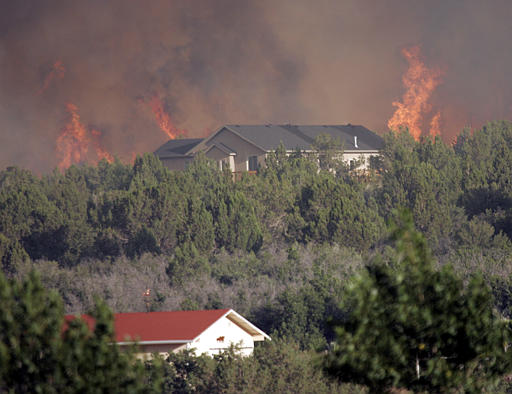
Homeowners have moved into and built homes in wildland/urban interface areas for decades with little regard for the multiplying fire risk (and evacuation dangers) posed by increased development and neglected fire-safety mitigation. In some areas of the West, homeowners (along with homeowners’ associations, insurance companies, and local governments) are now facing the realities of paying for this development. NBC Los Angeles reported that more and more homeowners in southern California are being dropped by insurance companies because of wildfire risk. They talked with homeowners near Pomona whose insurance companies canceled their policies even though no wildfires have burned near their homes for years. Others’ premiums increased by 800 percent.

Interface photo from Great Basin Coordination Center

The Insurance Journal reported last month that California, Florida, and Texas are the states with the highest number of homes at risk of wildfire, but that other states also are faced with large and increasing risk. Colorado and New Mexico, for example, have fewer homes overall, but project fires can wreak tragedy on a much larger proportion of their populations. New Mexico’s Santa Fe County counts nearly 34,000 properties at risk of wildfire, but the county housed a population of only 155,000 in 2020. This ratio of vulnerable homes to the overall population underscores the magnitude of population displacement assistance, reconstruction resources, and economic recovery expense required after a major wildfire.

With wildfire danger threatening the liquidity and solvency of insurers, the California Department of Insurance has proposed new regulations to incentivize risk reduction on covered properties and neighborhoods. In October, the state Insurance Department issued regulations to recognize and reward wildfire safety and mitigation efforts by homeowners and businesses. The InsuranceNewsNet reported that California’s “Mitigation in rating plans and wildfire risk models” regulation is the first in the nation requiring insurance companies to provide homeowner discounts under the “Safer from Wildfires framework,” which the California Department of Insurance and state emergency preparedness agencies created last year. The regulation requires insurance companies to submit new rate filings incorporating wildfire safety standards. The new rates must recognize the benefit of safety measures such as upgraded roofs and windows, defensible space, and community programs such as  Firewise USA and the Fire Risk Reduction Community designation developed by CAL-FIRE.

::: UPDATE: Highway to the Danger Zone :::
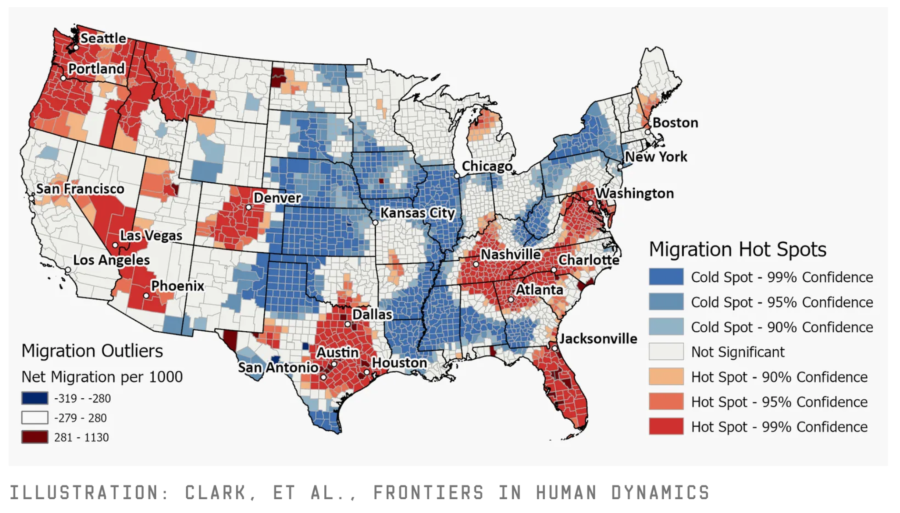
Matt Simon recently wrote an eye-opening piece for WIRED about a study examining numbers of residents moving into and out of fire danger zones (and hurricane regions) across the country. Wildfires in the West have grown increasingly devastating in part because of climate change, but also because more humans are moving deeper into areas that once were intact or contiguous forests. That overlap between development and wildlands, Simon noted, now exposes more people to fires and provides more opportunities to ignite them.

moving to the danger zone

Americans are “flocking to fire,” say the authors of a study published last month in the journal Frontiers in Human Dynamics. Using census data, the researchers found that people are increasingly moving to areas that are more prone to catastrophic wildfires or plagued by extreme heat. And though some affluent Americans are seeking the beauty of forested areas, economic pressures are forcing others there, too: Skyrocketing housing prices and cost of living are pushing people toward more rural places where homes are cheaper.

“As temperatures increase — as things get drier and hotter and prices for housing get more unaffordable — it’s definitely going to push people into these rural areas,” says Kaitlyn Trudeau, a data analyst at the nonprofit Climate Central. “Some people don’t have a choice.”

Increases in the number of people living in wildfire zones come at a huge cost: the 2018 Camp Fire that destroyed Paradise, California, resulted in an estimated $16.5 billion in losses.

Firefighter Cancer Awareness Month

January is Firefighter Cancer Awareness Month, and the International Association of Fire Fighters (IAFF) says that cancer is the leading cause of death among firefighters. Annual deaths from various forms of cancer account for more than 74 percent of the line-of-duty deaths added to the IAFF fallen firefighter memorial wall of honor each year.

The National Firefighter Registry program is finalizing its enrollment web portal, a voluntary registry of firefighters that collects occupational, lifestyle, and health information on firefighters to evaluate cancer rates and cancer risk factors in the U.S. fire service. The NFR was created by the Firefighter Cancer Registry Act of 2018 in response to growing evidence of carcinogenic exposures and increased risk for cancer faced by firefighters. The NFR is maintained by the U.S. National Institute for Occupational Safety and Health (NIOSH).

All U.S. firefighters, no matter their length of service, can participate in the Registry, including:

  • Active, former, and retired firefighters
  • Career, paid-on-call, and volunteer firefighters
  • Structural firefighters
  • Wildland firefighters
  • Industrial firefighters
  • Military firefighters
  • Instructors
  • Fire investigators
  • Other fire service members

The Firefighter Cancer Support Network (FCSN) provides public education on the issue of cancer risk for firefighters. For more than 16 years the FCSN has provided support for firefighters and cancer awareness logoEMS members who have been diagnosed with cancer. The firefightercancersupport.org website includes information to educate firefighters and raise awareness about why cancer cases are on the rise in the fire service and how to limit day-to-day exposures to carcinogens. Resources are available for firefighters diagnosed with cancer.

Since 2005, the nonprofit FCSN has provided assistance and one-on-one mentoring to thousands of cancer-stricken firefighters and their families. FCSN also delivers extensive firefighter cancer awareness and prevention training nationwide.

Bambi Buckets hit 40!

The very first Bambi Bucket was introduced back in 1982, and since then it’s become well-known in aerial firefighting operations around the world. Mark Tayler — general manager at manufacturer SEI Industries — says the bucket’s popularity is thanks to the company’s innovation. “It’s been a process of continuous evolution,” he told Vertical magazine.

The giant flexible bucket made from SEI’s iconic orange material was the breakthrough product in early development of helicopter-slung water loads. “The early tanks were bulky and rigid,” said Tayler, “and had to be either moved to the site of the fire by road, or flown there under the helicopter, and they weren’t reliable.” He said what they needed was a way that the tank could be transported to the site inside the helicopter, and then used to drop water reliably.

SEI's Bambi Bucket hits 40-year mark. SEI photo.
SEI’s Bambi Bucket hits 40-year mark. SEI photo.

In 1978 Canadian inventor Don Arney and his partner Mark McCooey started a company named after their founding principles: science, engineering, and innovation. While testing underwater airbags by suspending them filled with water, Arney wondered if something similar might be used as a firefighting bucket. Arney built a prototype in his garage and repeatedly tested it — there’s even an archive photo of him testing the damage resistance of the original design by whacking a filled and suspended bucket with a woodcutting axe. While still rigorous, the SEI’s testing methods are now somewhat more sophisticated.

Firefighting customers can choose from numerous custom options when purchasing Bambi Buckets. They range in size from 72 to 2,590 gallons (270 to 9,800 liters), which at the top end is just under ten tons of water, about as much as some airport fire trucks. Then there are options to add pumps that allow the bucket to be filled without submerging it, fire suppressing foam injection systems, and even floatation devices in case the bucket must be jettisoned in the water.

Since its entry into production 40 years ago, the Bambi Bucket has been used in over 100 countries and slung under a wide variety of aircraft, from light helicopters to the heavy Chinooks. Congratulations to SEI for hitting its 40th anniversary!

Judge dismisses lawsuit over Oregon’s new heat and smoke rules

When local residents who aren’t firefighters see summertime haze or clouds on the horizon, they often guess it’s smoke. Mid-summer they often think it’s wildfire smoke, and in the fall they suspect it’s a prescribed burn. This is a “common experience” with wildfire smoke, according to attorneys with Oregon OSHA, who successfully argued last week that it’s fairly easy to determine when the air is smoky and affecting air quality.

On Tuesday, according to the Salem Statesman Journal, a federal magistrate dismissed a lawsuit against Oregon OSHA in which plaintiffs claimed the state agency’s new heat and smoke rules somehow violated the 14th amendment of the U.S. Constitution and were unenforceable. Lawyers for Oregon Manufacturers and Commerce, Associated Oregon Loggers, and Oregon Forest Industries Council claimed that air quality fluctuations are caused by many factors, and not just wildfire smoke.

“Most times, it’s not obvious,” attorney James Anderson declared. “There’s no method to determine that air quality is due to wildfire smoke, or prescribed burn smoke, or other things that make up particulates.”

Magistrate Mark D. Clarke was not persuaded. “Why is it that complicated?” he asked. He said Oregonians are quite familiar with wildfire smoke. “I’m not sure any of us have any trouble knowing when wildfire smoke rolls in. I’m having trouble with that, factually.”

The lawsuit also claimed that OSHA’s rules to protect workers against extreme heat and smoke were too vague to be enforced. The new rules, as KGW-TV reported last July, took effect after recent heat waves in Oregon resulted in medical problems and deaths, prompting new requirements for employers to protect employees from heat-related illnesses. The new OSHA rules require, when the heat index hits or exceeds 80 °F, that employers provide shaded areas for workers to rest, more break time, and access to plenty of water. When temperatures exceed 90 then breaks must be longer, communication must be more frequent, and workers must be monitored more closely.

Dangerous heat exposure is risky especially for farm workers, according to Ira Cuello Martinez, policy director for Pineros y Campesinos Unidos del Noroeste (PCUN), Oregon’s farm worker union. “You’re constantly moving and doing repetitive motions, having to bend down, and there aren’t many shaded structures when it comes to the field or doing work in agriculture,” he said.

Got your six here

09. December, 2022 — Readers of FireAviation and WildfireToday have probably noticed that we have lately featured fewer-than-usual posts here by Bill Gabbert.

“That’s because I have developed an incurable disease,” says Mr. Gabbert. “I have pancreatic cancer. The symptoms started about September, and the diagnosis came in October. Basically there will be no major changes to either of these websites, but there will be a bit of a transition period that may take us a little while.”

BILL GABBERT
Bill Gabbert and the poster for ONLY THE BRAVE, photo by Wendee Pettis

The WildfireToday site was launched in January 2008 and FireAviation  followed four years later in 2012. “I have long had a passion for wildland fire,” says Mr. Gabbert, “and it requires continuous learning. I’ve always been a student of wildfire, and I wanted to create a venue for the fire community that encouraged students of wildfire. I am certain that I don’t want that venue squandered. I therefore have decided to give all rights to both websites to the International Association of Wildland Fire. The IAWF shares my values, and my commitment to preserving these two websites and 15 years of collected data, knowledge, and experience gathered from thousands of people who share our passion for wildland fire.”

REGARDING ADVERTISERS: Bill Gabbert wants you to know that we all appreciate your support for the last 15 years. “We couldn’t have done this without the advertisers,” he says. “We value your support over the years and someone with IAWF will be in touch in the near future about our upcoming plans. The intention is that both websites will continue on mostly without interruption. Our goal is that the knowledge accumulated over the years on these two sites will not be abandoned.”

“Things progressed a lot faster medically here than what was projected,” added Bill, “but we’re doing the best we can.”

REGARDING OUR READERS: Bill Gabbert and the IAWF are committed to maintaining the continuity and quality of both sites and the news and commentary that have made both WildfireToday and FireAviation trusted sources of wildland fire journalism for years.

Bill interviewed at the Washington Monument
Bill is interviewed about the Washington DC weather after he had interviewed retiring F&AM director Tom Harbour.

FROM THE IAWF:
Since 2008 Bill Gabbert has developed and published WildfireToday; his journalism and commentary expanded in 2012 to include the FireAviation site.

In these publications we have learned of changes in wildland fire operations and policy and have tracked how wildland fires affect our lives and communities.

Bill was often the first to tell us of fire tragedies and new developments in the field. It is the community he gathered — the experts and sources he knew and depended on and the readers and businesses who supported both sites — that makes these sites what they are.

Bill Gabbert photo by Kari Greer
Bill Gabbert enjoyed the photo exhibit at the Continuum Conference at Missoula in the spring of 2018 and Kari Greer made this portrait of Bill in the gallery.

Today the IAWF honors Bill as a key to both the history and the future of wildland fire in the U.S. and beyond.

As Bill moves on here, he has asked us to manage the future of these publications; it’s an honor and a  challenge to steward his legacy.