
A Lexus drifted over the yellow line into oncoming traffic
Continue reading28 fuel geyser incidents reported in 2018
Fuel and vapor can be expelled with force from a chainsaw fuel tank
Continue readingReport: 27 wildland firefighters killed in China
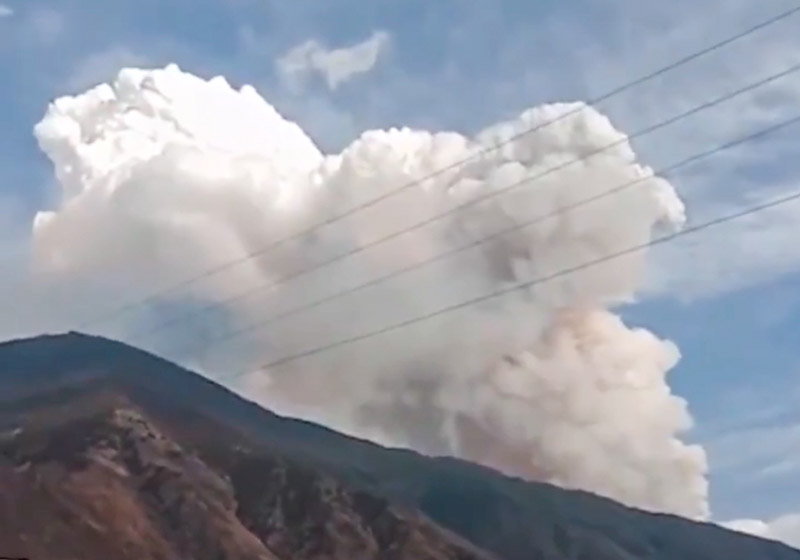
Early reports are that at least 27 firefighters were killed while fighting a wildfire in China on March 31. The BBC said 30 firefighters died, while the China Xinhau News reported it was 27 firefighters and 3 civilians that perished.
(Update 9:15 a.m. MDT April 2: China’s state new agency Xinhua confirmed Tuesday that 27 firefighters and 3 locals lost their lives.)
From the BBC:
Thirty firefighters have died while tackling a huge forest fire in south-western China, officials say.
Fire crews had been battling the blaze in the mountains of Sichuan province on Sunday when a change in wind direction caused “a huge fireball”, trapping them, the emergency ministry said.
Contact with 30 firefighters was lost. All were confirmed dead on Monday and their bodies were retrieved from the mountain, state TV said.
China Xinhua News had different numbers — 30 killed but 27 of those were firefighters.
#Breaking: 30 people, including 27 firefighters and three local people, have been confirmed dead while battling forest fire in southwest China’s Sichuan Province pic.twitter.com/KHbIiDWDjE
— China Xinhua News (@XHNews) April 1, 2019
An earlier report had the number at 26 firefighters:
26 firefighters are confirmed to have died while battling a forest fire in Sichuan, China pic.twitter.com/vmXUxGhOGN
— China Xinhua News (@XHNews) April 1, 2019
The New York Times was not specific about how the numbers broke down:
A forest fire in southwestern China turned deadly over the weekend when winds shifted unexpectedly, trapping firefighters and local officials in a maelstrom. The bodies of 30 people who could not escape were found on Monday, officials announced, even as the fire continued to burn out of control.
Among those who died were the chief of a regional forestry bureau in Liangshan Yi Autonomous Prefecture in Sichuan Province, and his deputy, state media reported. The officials had traveled to the scene of the fire, which broke out on Saturday in a remote location at altitudes nearing 13,000 feet, and had not been heard from since.
Our sincere condolences go out to the families, friends, and coworkers of the deceased.
Thanks and a tip of the hat go out to Paula. Typos or errors, report them HERE.
21 issues frequently identified in firefighter entrapment reports
Can lessons actually be learned?
Continue readingReport: CAL FIRE prevented insurance company fire engines from accessing customers’ homes during Woolsey Fire
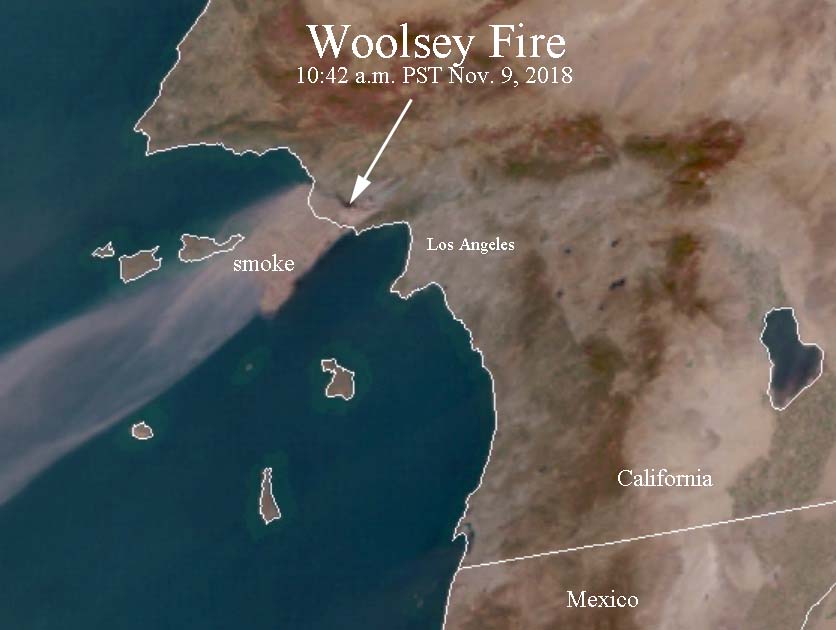
For the last 12 years we have been aware of insurance companies sending fire engines to protect high-valued homes covered by their policies when a wildfire approaches. Companies such as Chubb figure keeping a multi-million dollar home from burning is less expensive than paying to rebuild it, so they contract with Wildfire Defense and other companies to send firefighters to their customers properties when smoke is in the air.
The tricky part is intermixing the private crews with the existing incident management organization. Some jurisdictions view the insurance company crews as personnel that need to be protected, rather than fellow firefighters engaged in the fire fight. This became very evident during the Woolsey Fire in November when CAL FIRE prohibited the private engine crews from accessing their customers’ homes, including mansions in Malibu, California.
Below is an excerpt from the Malibu Times:
…While benefits seem obvious for insurance companies, statewide fire officials point out they complicate firefighting efforts for central command, since they cannot communicate readily with rank-and-file crews. Now, in the fallout of the Woolsey Fire—where resources were spread so thin many homes did not see any fire engines at all—questions are being asked about why private crews were turned away.
Malibu resident Ron Krisel, who is insured by USAA (only available to active, retired and honorably discharged members of the U.S. military), was eligible for the services of a private firefighting crew. However, he was notified by USAA that when their crew checked in with the joint command for the Woolsey Fire, they were told by CAL FIRE that they would not be allowed to come into Malibu and, something to the effect that, if they disobeyed, they would never be allowed in during a fire from now on.
Krisel’s house burned down the day after the fire came through—a casualty of still-blowing embers. He feels strongly that if the private crew contracted by USAA had been allowed to come in, his house would’ve been saved—they would’ve kept an eye on the burning embers and hot spots and put them out before the house caught fire. County firefighters never showed up.
When The Malibu Times contacted Scott McLean, public information officer for CAL FIRE Woolsey Fire, to ask why, he said he wasn’t familiar with this particular incident, and would only be able to talk about their policy in general.
McLean verified that private fire companies must check in with the authorities at the joint command to show documentation from the insurance company and the address of the specific house.
“It’s a common thing—no big deal. We rarely turn them away,” McLean said. “But if there’s an evacuation order for the area the house is in, they cannot come in.” That’s the most obvious reason why the crew coming to Krisel’s house was turned away—the Malibu evacuation order must have already been in effect.
Our opinion:
Private engine crews can be helpful in keeping certain high-value structures from burning during a rapidly spreading wildfire when there are not enough government resources to protect every home. However, if they have no communication with the incident management organization which does not have any knowledge of their location, mission, or capabilities, it can throw a monkey wrench into an already chaotic situation.
CAL FIRE, the U.S. Forest Service, and the other large organizations involved in wildfire suppression need to sit down with the insurance companies and agree on some standard operating procedures. The Incident Management Team needs to know what the private crews are doing and where, and the private crews need to have direct communication with the Team.
One day, when all firefighting resources are carrying equipment that makes it possible to track their location, this will become much easier — and safer. The federal and state agencies need to get off their butts and implement these tracking systems.
Report released for rescue and extraction of water tender rollover victim
It happened on the Cougar Creek fire in Washington
Continue readingReport released on fatality of Oklahoma grader operator
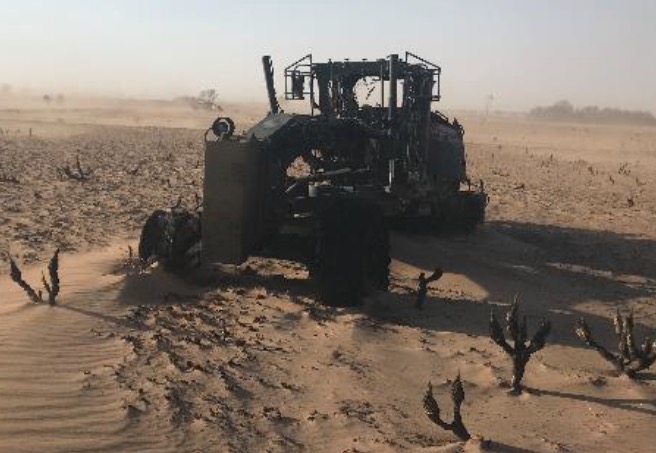
The Wildland fire Lessons Learned Center has released a Facilitated Learning Analysis on the fatality of Jack Osben, the grader operator who was burned over while working on the Shaw Fire in Western Oklahoma April 12, 2018. The tragedy occurred during extreme conditions — extended drought, 100 degrees, 5 percent relative humidity, 45 mph winds, and the fire was burning in thick grass that had not been grazed or hayed in seven to eight years.
The executive summary is below. The entire document can be downloaded (4 MB file).
*Except for Jack Osben, all names are pseudonyms
On April 12th, 2018, 61-year-old Jack Osben, a motor grader operator for Roger Mills County in Oklahoma and volunteer firefighter died as a result of thermal burns while providing initial attack to the Shaw Fire. The wildfire grew to approximately 3,500 acres in a mixture of grass and shrubs during a Red Flag Warning day. The employees of Roger Mills County were in a state of readiness due to a mixture of prolonged drought, extreme heat, and gusting winds that had created extremely dangerous wildfire conditions.
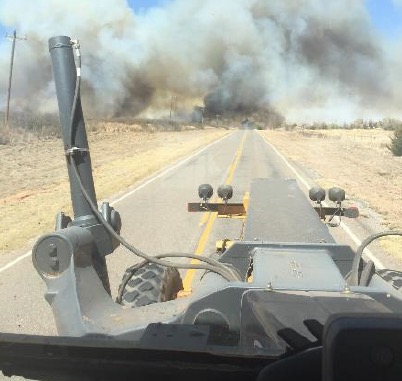
Jack was performing progressive line construction using a motor grader on the Shaw Fire. While he had been working as a grader operator for a few years, he had limited experience using the grader related to fire suppression activities. Between 1400-1430 hours Jack met up and began working with Alex, a fellow grader operator who had more than two decades of experience fighting fire.
Although they entered the field at different locations, they converged almost immediately. Alex instructed Jack to fall in line behind him to improve the initial grader line. After working together to establish line for about 4,000 feet, Alex lost sight of Jack’s grader in the smoke and flames, which had grown significantly and shifted directions quickly.
Due to the fire’s shift in direction, Alex was forced to abandon his grader. He began to walk toward a nearby road when he spotted Jack, who was also on foot emerging from the smoke. They spoke briefly when they met. Alex observed that Jack had visible burns to his arms and was possibly suffering from smoke inhalation. The reality was that Jack’s injuries were much worse than they appeared. He died as a result of thermal burns either during transit in the ambulance or right after arriving at the hospital.
This accident took place in Western Oklahoma where the tactical use of motor graders for wildland fire line construction is common. Additionally, there is different emphasis on values at risk, namely that firefighters in Western Oklahoma commonly protect grass for cattle grazing. Other regions may rank grass as a low value-at-risk but it is absolutely a consideration for how people in this region fight fire and manage land1.
This is the first Facilitated Learning Analysis (FLA) to emerge from the State of Oklahoma. In brief, the FLA process is meant to facilitate learning from unintended outcomes by interviewing people who were involved in the event, and sharing a collective story of their experiences. We also offer lessons learned from those involved and with their help, generate recommendations that may be useful for people within and outside of the region.
For many readers, this analysis will serve as an introduction to a different way of fighting fire with some of these methods appearing unconventional. But, in the words of one of the grader operators, “you make do with what you have.” Even if the methods and context are different, this statement ties together the ethos of wildland firefighters everywhere. It is also important to note that the men and women of Roger Mills County are exceptional at what they do and have an impressive record of doing it safely.
Report released for injuries to several smokejumpers on wildfire in Utah
Three of the seven jumpers were injured and evacuated by two helicopters
Continue readingReport released for multiple smokejumper injuries on wildfire in Utah
Three of the seven jumpers were injured and evacuated by two helicopters
Continue readingReport released on burnover of two fire engines
The incident occurred on the North Eden Fire which burned in Utah, Idaho, and Wyoming. No firefighters were injured.
Continue reading