
The DC-10 delayed by a tropical storm and a maintenance issue is expected to arrive in Australia the evening of January 23 local time
Continue readingDOI reports that they exceeded fuel treatment goals in FY 2019
Reduced wildfire risks on 1.4 million acres
Continue readingReport released on the entrapment of firefighter and two civilians on Kincade Fire
The three people shared one fire shelter as the fire burned around them
Continue readingDraft report released for the Woolsey Fire has 94 recommendations
The fire burned over 96,000 acres and destroyed 1,600 structures in southern California in November, 2018
Continue readingReport that a fire recon plane made forced landing in Oregon
 File photo (not the aircraft that crashed) of a Cessna 206.
Little information is available about a reported forced landing made last week by the Oregon Department of Forestry (ODF) air attack plane, 52 Uniform.
The Cessna 206 was on a fire recon mission when the pilot reported a mechanical malfunction and was forced to set down in the Black Bear Swamp northeast of Butte Falls. Both occupants of the aircraft escaped injury, but the plane was severely damaged.
There is a report that both men walked away, literally hiking out to meet personnel on the way to assist them.
The accident occurred around August 9. We will update this article when personnel at the ODF return our calls.
Report released for a firefighter fatality in Texas
Occurred on a wildfire in March, 2018
Continue readingFirefighters report “surprising” fire behavior in beetle-attacked lodgepole forests
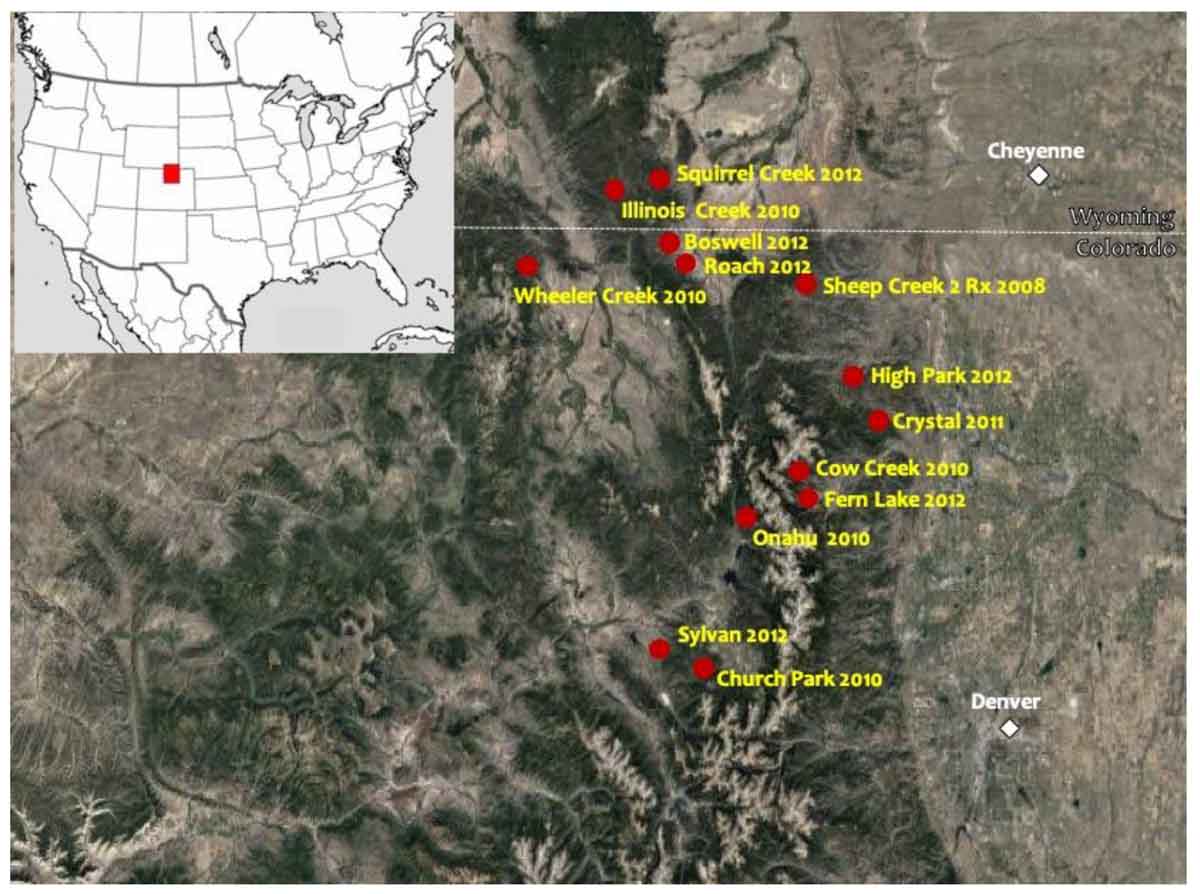
In 28 interviews of experienced wildland firefighters of seven different agencies in Northern Colorado and Southern Wyoming researchers asked them about their observations of fire behavior in beetle-attacked lodgepole pine forests, with a focus on what they considered surprising from a fire behavior standpoint and how this in turn affected their suppression tactics. The interviews focused on 13 wildfires that occurred during the 2010 through 2012 fire seasons.
Below is an excerpt from a paper written by the researchers:
“The surprises in fire behavior experienced by firefighters during the red phase of post-outbreak forests included an elevated level of fire spread and intensity under moderate weather and fuel moisture conditions, increased spotting, and faster surface-to-crown fire transitions with limited or no ladder fuels.
“Unexpectedly, during the gray phase in mountain pine beetle-attacked stands, crown ignition and crown fire propagation was observed for short periods of time. Firefighters are now more likely to expect to see active fire behavior in nearly all fire weather and fuel moisture conditions, not just under critically dry and windy situations, and across all mountain pine beetle attack phases, not just the red phase. Firefighters changed their suppression tactics by adopting indirect methods due to the potential fire behavior and tree-fall hazards associated with mountain pine beetle-attacked lodgepole pine forests.”
Report released on 120,000-acre fire in Utah
Bald Mountain and Pole Creek Fires south of Provo in 2018
Continue readingAbout a quarter of lightning-caused fires that grow large are not reported within first 7 days
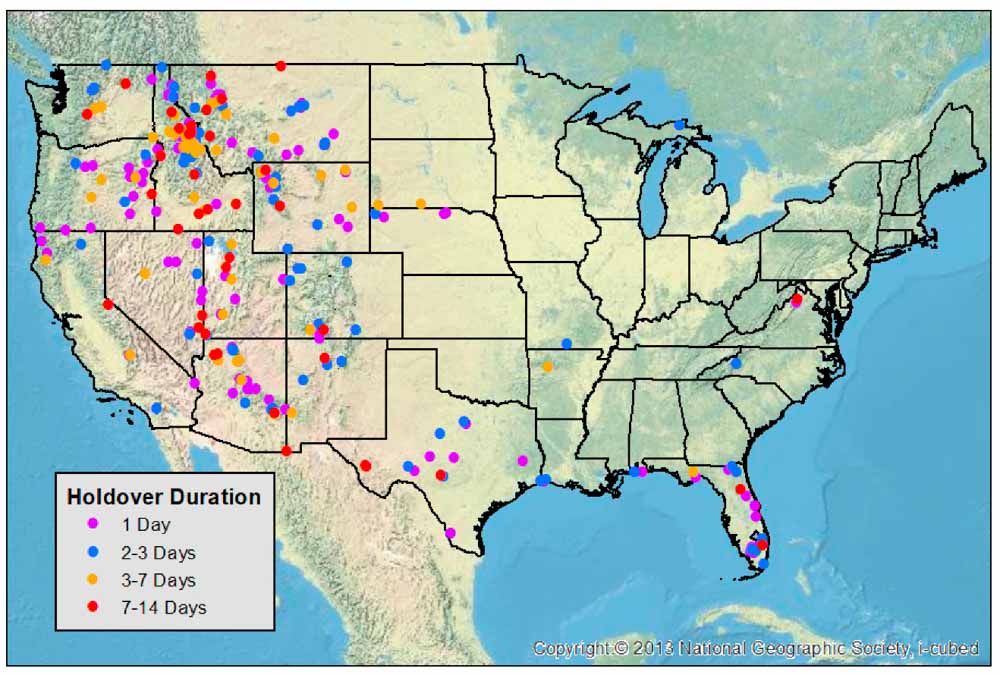
Researchers have found that about a quarter of the fires caused by lightning that grow to more than 4 km² (988 acres) are reported more than a week after they are ignited.
A paper published in the Fire Open Access Journal describes how the National Lightning Detection Network (NLDN) and U.S. Forest Service fire data were used to determine the correlation between lightning strikes and the reported location of lightning-caused wildfires.
The NLDN, which has been used operationally for several decades, consists of 113 sensors across the continental United States and has a reported flash detection efficiency of cloud to ground flashes between 90–95%, with spatial errors that are typically less than 500 meters for the flash data used in the study.
The researchers found, of lightning-caused fires that grew to more than 4 km² (988 acres):
50% reported the same day
71% reported within 3 days
73% reported within 5 days
77% reported within 7 days
Holdover fires that are not reported for days or weeks after the lightning occurs can be problematic for land managers. Shortly after a thunderstorm has left the area, fire detection efforts are often ramped up and may continue in that mode for a few days. Fires that smolder in duff or under snow and suddenly grow can be unexpected. Firefighting resources that may have been staged in anticipation of emerging fires could be released or assigned to active incidents, complicating efforts at quick initial attack with overwhelming force.
Authors of the paper: Christopher J. Schultz, Nicholas J. Nauslar, J. Brent Wachter, Christopher R. Hain, and Jordan R. Bell.
Report released for tree strike fatality on the 2018 Ferguson Fire

The National Park Service has released the Serious Accident Investigation Factual Report for the accident in which Captain Brian Hughes of the Arrowhead Hotshots was killed last year. Captain Hughes died when a 105-foot tall Ponderosa Pine fell in an unexpected direction during a hazardous tree felling operation. It happened July 29, 2018 on the Ferguson Fire on the Sierra National Forest near Yosemite National Park in California.
Captain Hughes, number two in the chain of command on the crew, was in charge of the crew at the time since the Superintendent was at the Ferguson Fire Helibase at Mariposa Airport.
You can download the Factual Report and the Corrective Action Plan. Below are excerpts from both.
Excerpt from the Executive Summary:
…Brian returned to California in 2015 and became a captain of the Arrowhead Interagency Hotshot Crew. As a captain, Brian was a trusted leader and mentor who led by example, inspiring others to train hard and develop their skills. His crew looked up to him and loved him as a brother.
The Ferguson Fire was reported July 13.
[…]
The Arrowhead Hotshots arrived on scene July 16, having spent the previous month and a half working prescribed and wildland fires ranging from one to ten days long. The crew spent the next eight days working alongside other highly experienced hotshot crews to build and prepare a fire containment line for burnout operations designed to burn away the available fuel in a given area and keep the original fire from spreading.
By July 28, the day before the accident, the Ferguson Fire had grown to 53,657 acres and was burning across multiple jurisdictional boundaries. Hughes and IHC-1 Squad Leader were working along the edge of a spot fire on steep, rocky terrain in Division G and identified several hazard snags—dead trees that posed falling and fire risks. One stood out: a 57-inch wide, 105-foot tall ponderosa pine burning approximately 10 feet below its top and producing a steady stream of embers. With winds expected the next day, they agreed the snag posed a significant risk to keeping the fire contained and agreed it needed to come down.
The Arrowhead Hotshots lead sawyer started cutting the tree down on the morning of July 29 with help from Hughes, who temporarily stepped in for the sawyer’s less-experienced swamper. The rest of the crew staged in an area safely uphill.
Hughes and the sawyer intended for the tree to fall uphill into an opening between trees. Instead, the tree fell downhill, hitting the ground approximately 145 degrees from the intended lay. It grazed another standing dead snag as it fell and then rolled and/or bounced farther downhill, coming to rest against other snags and brush.
Hughes and the sawyer had discussed the felling operation in detail. Warnings were issued prior to cutting. They also identified two escape routes in case something went wrong.
As the tree began to fall, the sawyer saw which direction it was going and instinctively ran directly downhill, escaping injury.
Hughes however, had moved about 20 feet downhill before the tree fell and then ran into the primary escape route as the tree started falling and was fatally struck. He was found lying underneath the tree in a space between it and the ground.
Efforts to save Hughes’ life were made on scene by the sawyer, fellow firefighters, and paramedics on the ground and in the air. Despite these efforts, Hughes was pronounced dead as he was being flown to the Mariposa Helibase.
Excerpts (Actions) from the Corrective Action Plan: (The full plan includes responsible parties and due dates)
- Propose to NWCG that beginning in Fiscal Year 19 the Hazard Tree and Tree Felling Subcommittee (HTTFSC) conduct an evaluation of the “Forest Service Chainsaw, Crosscut Saw and Axe Training-Developing a Thinking Sawyer” course for applicability within the interagency community as an updated NWCG S-212, Wildfire Chain Saws, course. Based on the evaluation NWCG could adopt the course as is or with modifications for S-212 and individual agencies could adopt and use as appropriate.
- Propose to NWCG that beginning in Fiscal Year 19 the Hazard Tree and Tree Felling Subcommittee conduct an evaluation and gap analysis of tree falling options, felling procedures, training and current best practices and update applicable supervisory operations position training and position task books as appropriate, i.e. Single Resource Boss, Strike Team and Task Force Leader, and Division Supervisor.
- Propose to NWCG the development of an Advanced Wildland Fire Chain Saws training course beginning in Fiscal Year 19 unless need negated by adoption of “Forest Service Chainsaw, Crosscut Saw, and Axe Training-Developing a Thinking Sawyer” course on interagency basis.
- Propose to NWCG a Fiscal Year 19 review and revision, if necessary, to FAL3, FAL2, and FAL1 competency and currency evaluation processes managed by NWCG.
- Propose USDA Forest Service National Technology and Development, in collaboration with the Western States Division of the National Institute For Occupational Safety and Health (NIOSH), conduct a study on effects of acute and cumulative fatigue on wildland firefighters and Incident Management personnel to include fatigue mitigation recommendations.
- Complete assessment of effects of fatigue, stress, and sleep management on wildland firefighters and incident management personnel to include methods to prepare for and mitigate the effects of fatigue, cumulative stress, and traumatic stress.
- Propose all wildland fire tree and chainsaw related accident reports since 2004 be reviewed, associated recommendations evaluated for redundancy or conflict, and the current implementation status of recommendations to assist in setting priority actions to reduce similar incidents.
- Evaluate how changing environmental conditions, such as extensive tree mortality in the west, and more extreme wildfires, are being factored into procedural practices and implementation of wildland fire policy, strategies, and tactics by agency administrators and Incident Management Teams.
- Assess and consider adoption of USDA, Forest Service Risk Informed Trade Off Analysis process incorporating geographically specific information on topography, fuels, and expected weather to inform decision makers during initial response and extended attack of wildfires.