Investigation report released for Black Forest Fire

Origin of the Black Forest Fire

The El Paso County Sheriff’s Office has released a summary report on the investigation of the Black Forest Fire which started June 11, 2013 near Colorado Springs, Colorado. The fire killed two people and burned 489 houses and 14,280 acres, resulting in $420 million in insured losses.

The investigators eliminated natural causes, such as lightning. That left human-related ignitions.

Below are excerpts from the report:

…Given the known devastation of the fire at that point, an Investigation Team was formed consisting of recognized experts in the area of Wildland fire investigation from agencies including the USDA Forest Service, the Aurora Fire Department, the US Bureau of Alcohol, Tobacco, Firearms and Explosives (ATFE), the 4th Judicial District Attorney’s Office and others. This team was assisted by surveyors from the El Paso County Public Services Department.

…

The only clearly established fact was that no natural causes existed and thus the fire was human caused. A potential cause associated with the metal particles can not be ruled out, or positively identified. A potential cause associated with an intentional ignition is not supported by the evidence or circumstances, but can not be completely ruled out. The origin of the fire is in an area that is not readily accessible from a roadway, allowing an easy escape, as is typical in intentionally set Wildland fires. There was no evidence of any other miscellaneous cause such as blasting, fireworks, welding, target shooting, etc.

…

Upon the completion of the investigation, the entire case was reviewed by the Sheriff’s Office Investigations Division and the District Attorney’s Office to determine if any additional leads remained. It was the determination of the El Paso County Sheriff’s Office and the District Attorney’s Office that there was not sufficient evidence to warrant criminal prosecution at this time. None of the investigation or forensic examination supported any one possibility to the extent needed to pursue criminal charges. Additionally, no additional recommended follow-up work could be identified at this time.

Three other reports have previously been released about the Black Forest Fire:

  1. Report on how the fire was managed on the first day, issued by the Black Forest Fire District Board on February 19, 2014. The complete report can no longer be found on the District’s web site.
  2. A 2,000 page, 345 megabyte report, released March 14, 2014, commissioned by the Black Forest Fire District which evaluated how the fire was managed, including the performance of Fire Chief Bob Harvey during the first hours of the fire. Sheriff Terry Maketa had been extremely critical of the Chief in numerous interviews with the media. The complete report can no longer be found on the District’s web site.
  3. After Action Report, by the El Paso County Sheriff’s Office, May 15, 2014. We preserved this report on the Wildfire Today web site.


Colorado County Sheriff releases report on Black Forest Fire

Black Forest Fire
Black Forest Fire. Photo from EPSO report.

Terry Maketa, the sheriff of Colorado’s El Paso County, has released a report about the Black Forest Fire, the third report about the fire by agencies in the county. In June of 2013 the fire claimed two lives, 14,000 acres, and 486 homes near Colorado Springs, Colorado.

The state is one of a few that make the local county sheriff responsible for fire suppression on non-federal lands, and Sheriff Maketa made sure that his photograph was prominently displayed at the top of page two in the report.

The Sheriff has been extremely critical of Black Forest Fire District Chief Bob Harvey who was the Incident Commander during the early stages of the fire. Sheriff Maketa has given several blistering interviews to the media criticizing Chief Harvey’s actions that day. His main point was that he thinks the Chief should have turned over the fire to him or the county much earlier. Two other reports have been commissioned and released by the Black Forest Fire District Board. One of them concluded that about two hours after the initial dispatch Chief Harvey turned over the fire to County Deputy Fire Marshall Scott Campbell, a Type 3 Incident Commander. The second report by the Fire District contained more than 2,000 pages and can be downloaded, but it is a HUGE 345 MB file.

The Sheriff’s 127-page report points out a number of areas for improvement, including

  • communications,
  • non-interoperable radio systems, (has a fire report ever NOT listed communications as a problem?),
  • fire radio traffic and dispatching overwhelming routine dispatching,
  • management of information technology, and
  • reconnaissance.

Apparently there were two Incident Commanders — one for the fire and one for law enforcement. This was a violation of a core Incident Command System principle. The report suggested additional ICS training and incorporating law enforcement into the fire command structure in future incidents, such as making them a functional Branch.

The Sheriff’s report took several shots at the handling of the fire by the Black Forest Fire Protection District during the first two hours, including the report on conditions and the transition to the County.

When Sheriff Maketa introduced his fire report at a news conference this week, he deflected several questions from reporters about the recent unanimous vote by the El Paso County commissioners to ask him to resign over allegations of sexual impropriety, discrimination, creating a hostile workplace, violating civil rights, and more. The commissioners can’t force the sheriff to resign since he is an elected official. Maketa has said in spite of the allegations, he will serve out the remainder of his term which ends later this year.

An interesting side note from the report:

The Food Unit utilized Yellow Stone Kelly’s catering starting on June 13, however they had difficulties meeting the contract serving requirements and requested to be replaced. Interim meals were provided for dinner on June 16 and breakfast and lunch on June 17, with the assistance of local restaurants. On June 17, Big Sky #4 catering arrived at the [Incident Command Post] and began providing meals throughout the duration of the incident.

Incident Management Team personnel helped serve those three meals on June 16 and 17.

Black Forest Fire
Black Forest Fire. Photo from EPSO report.

Colorado sheriff who battled with fire chief asked to resign

Sheriff Terry Maketa.
Sheriff Terry Maketa. El Paso County Sheriffs office photo.

The Colorado Springs Gazette is reporting that the El Paso County commissioners voted unanimously, 5-0, Thursday requesting that Sheriff Terry Maketa resign immediately amid recent allegations of misconduct. Sheriff Maketa’s name may be familiar to Wildfire Today readers, since he initiated a very public campaign of criticism against Bob Harvey, the Fire Chief responsible for the first two hours of the initial attack of the Black Forest Fire in Colorado Springs, Colorado. The media campaign the Sheriff launched was unprecedented, in our experience.

Colorado is one of a few states that give the local county sheriff the responsibility for fire suppression on non-federal land, regardless of the individual’s knowledge or experience in fire suppression.

The reports we have read about the effort to push the Sheriff out of his job do not mention his vendetta against Chief Harvey, but refer to allegations of sexual impropriety, discrimination, creating a hostile workplace, violating civil rights, and more.

When one of the commissioners asked the Sheriff to resign on Tuesday, Maketa issued a statement saying he intends to serve the seven months remaining in his term.

Report released for the Black Forest Fire

(Originally published at 3:02 p.m. MDT, March 14, 2014; updates are below))

Today the Board of Directors of the Black Forest Fire/Rescue Protection District released the report of its independent investigation into the performance of Fire Chief Bob Harvey during the first hours of the Black Forest Fire. The investigation was conducted to respond to Sheriff Terry Maketa’s allegations that Chief Harvey had mismanaged command during the first day of the fire. In June of 2013 the fire claimed two lives, 14,000 acres, and nearly 500 homes near Colorado Springs, Colorado.

The report contains more than 2,000 pages and the files are ridiculously huge. It is absurd to think that 345 megabites and 2,000 pages will be downloaded and read by the average citizen. A cynic might think they wanted to reduce its impact by releasing it on a Friday afternoon, and purposefully made the report as user unfriendly as possible in order to deter people from reading it. The Black Forest Fire/Rescue Protection District needs to provide a version of the report that is easily downloaded and read by their taxpayers.

–To download the complete report, including all exhibits and photographs:
Click here to download the complete report in one file. This file measures 345 megabytes.

–To download the report and exhibits separately from the photographs:
Click here to download the report and exhibits only – File #1 of 2. This file measures 109 megabytes.
Click here to download just the photographs – File #2 of 2. This file measures 236 megabytes.

(UPDATE at 3:06 p.m. MDT, March 14, 2014)

The Denver Post read at least some of the report:

On the first night of the Black Forest fire, four firefighters and a piece of key equipment were ordered on a “secret special assignment” to watch and protect the home of an El Paso County Sheriff’s Office commander while other nearby houses burned, according to a report released Friday…

(UPDATE at 5:56 p.m. MDT, March 14, 2014)

We downloaded the report and found some other interesting sections.

A report was filed on a safety issue on the fire, through the SAFENET reporting system. It involves the Type 3 Incident Commander (ICT3) who assumed command of the fire from Fire Chief Harvey. Below is an excerpt from the SAFENET. The ICT3 referred to apparently is the ICT3 from the El Paso County Sheriffs Office.
Continue reading

Colorado: Fire Board releases report on Black Forest Fire

Black Forest fire
Black Forest Fire. Photo by Bill Gabbert.

Today the Black Forest Fire District Board released a report on how the Black Forest Fire was managed on the first day. Starting on the northeast side of Colorado Springs, the fire killed two people, destroyed 486 homes, and damaged 37 others in June of 2013.

The local county Sheriff, Terry Maketa, has been extremely critical of Fire Chief Bob Harvey,who was responsible for the initial attack. Sheriff Maketa has given several blistering interviews to the media criticizing Chief Harvey’s actions that day. His main point was that he thinks the Chief should have turned over the fire to him or the county much earlier.

The documents released today, a statement from the Board and a summary of the report, show strong support for Chief Harvey and generally appear to disprove some of the charges leveled by Sheriff Maketa.

One of the Sheriff’s main contentions was that the Chief waited many hours before turning over the management of the fire to the County or the Sheriff, which the Sheriff said occurred at 8:23 p.m..

The report concluded that the fire was reported at 1:42 p.m. on June 11. The first engine arrived about six minutes later. At 2:14 p.m. a strong wind of 25 to 35 mph developed, increasing the rate of spread and pushing the fire into the crowns of the trees. Firefighters were then forced into defensive positions for their own safety. Between 3:45 and 3:55 p.m. Chief Harvey verbally turned over command of the fire to County Deputy Fire Marshall Scott Campbell, a Type 3 Incident Commander. At 4:08 p.m. Mr. Campbell signed a document confirming the transfer of command. Other signatures on a Delegation of Authority document were obtained over the next several hours, with the last occurring at 8:23 p.m.

The Board commissioned retired Greenwood Village Police commander Dave Fisher to direct the inquiry. Mr. Fisher retired in October after a 29-year career at the suburban Denver department. He was assisted by Dave Daley, an operations executive officer at South Metro Fire Rescue in Centennial.

The statement of the Board criticized the attacks by the Sheriff and the media:

…This misadventure started because one elected official saw fit, for whatever personal or political reason, to make unsubstantiated allegations about our Chief’s performance following the onset of the Black Forest fire. We say unsubstantiated because the investigation has proven the facts, and what’s been established is very, very far from what was alleged. We have no way of knowing the motive in making these allegations and we are certain we will never know.

We also must acknowledge how disappointed we are in the conduct of some Colorado Springs media outlets in simply running with the allegations, and broadcasting the untruths, without a speck of legitimate journalistic enterprise to establish their validity. The media accepted the allegations at face value, further damaging this department’s reputation, and continued to repeat the damaging suppositions – again, leading us to hire our own investigator to get at the heart of the matter.

Colorado is one of a few states that have the policy of assigning the suppression of wildfires in unincorporated areas to the county employee with law enforcement responsibilities in those areas — the County Sheriff — rather than a person with expertise in fire suppression.

Documentary — The Black Forest Fire

Last year’s Black Forest Fire was the most destructive fire in Colorado’s history, claiming two lives, 14,000 acres, and nearly 500 homes. Why did some neighborhoods survive and how do fire fighters determine which homes can be safely defended? This excellent 13-minute video answers those questions and shows many success stories.

Residents in the wildland-urban interface need to see this. It illustrates that clear cutting or removing all trees around a house is not necessary to prevent it from burning when a wildfire approaches — just thinning, reducing ground fuels, and fire-safe home construction is required.

After the video starts, click on full screen at the bottom-right to take advantage of the very good photography.

The Black Forest Fire – PPWPP.Org from Andy Lyon on Vimeo.


Thanks and a hat tip go out to Allen

Wildfire briefing, January 23, 2014

Island fire to be allowed to burn out

A wildfire on an island in Suisun Bay east of San Francisco Bay will be allowed to burn out, according to Contra Costa County Fire Protection District Capt. Robert Marshall. Wednesday afternoon U.S. Coast Guard and fire protection district equipment responded to the fire on Winter Island (map) , which is mostly uninhabited, having just one structure that was not threatened by the fire. They figured it could take anywhere from a few hours to a few days for the fire to burn out. The island is two miles long and about 0.3 mile wide.

Three men charged for Colby Fire

The three men that were arrested January 16 soon after the Colby Fire started above Glendora, California east of Los Angeles, have been charged in federal court. The men, who allowed an illegal campfire to escape, were identified as Jonathan Carl Jerrell, 24; Clifford Eugene Henry Jr., 22; and Steven Robert Aguirre, 21, according to a statement from the U.S. Attorney’s Office for the Central District of California. Aguirre and Henry were ordered to remain in custody without bail, while Jarrell was scheduled for a Friday detention hearing. All three are scheduled to be arraigned Feb. 11.

Two of the men seen hurriedly moving away from the fire were apprehended by a Glendora police officer. The third was found and taken into custody by an employee of the U.S. Forest Service. The fire destroyed five homes, damaged seven, and burned 1,952 acres.

Mike Wakoski’s incident management team is calling the fire, which has not spread since January 17, 98 percent contained.

After the men were arrested there were discussions between the Glendora PD and the U.S. Attorney’s office whether to charge them with state or local crimes or use federal statutes, since the fire burned both U.S. Forest Service land as well as private property within the city. But the decision was made to charge them in federal court.

Black Forest fire department hires PR firm

The fire-rescue district that managed the Black Forest Fire during the first hours has hired a public relations firm to deal with the fallout caused by the intense criticism directed at the district by El Paso County Sheriff Terry Maketa. The Sheriff has been carrying on a war in the media against the fire district, saying they should have turned the fire over more quickly to the Sheriff. Colorado is one of a few states that still have the elected county sheriff responsible for suppressing wildland fires in unincorporated areas. The fire killed two people, destroyed 486 homes, and damaged 37 others in June.

The sheriff’s office has been investigating the cause of the fire, in addition to a separate investigation by the fire district, which, according to the Chieftain, has paid an investigator $13,000.

Researchers test new firefighting gel

Researchers with Texas A&M recently tested a new gel that can be used for suppressing active structure or wildland fires, and may have the potential to be effective if used for pre-treating fuel in advance of a fire.

Called TetraKO, it is claimed by the company to be “biodegradable and non-toxic to water, fish, plants and mammals by independent research organizations”.

In a MyFoxAustin video report on the test, the reporter seemed to be surprised that gel applied the day before to the vegetation was not effective in stopping the spread of the fire. However it did keep some treated fence posts from igniting.

Colorado politician wants to modify firefighting chain of command

Black Forest Fire
Firefighters on the Black Forest Fire, June 15, 2013, cut down a hazardous tree that was partially burned through on the other side. Photo by Bill Gabbert

The campaign of the County Sheriff in Colorado’s El Paso County against the fire chief responsible for the initial attack of the devastating Black Forest Fire is having an effect. Sheriff Terry Maketa has been EXTREMELY critical of Bob Harvey, the Fire Chief responsible for the first two hours of the fire.

The Colorado Springs Gazette reports that state Senator Kent Lambert of Colorado Springs is drafting a bill that “would empower county authorities to take over command during an emergency without permission or a request from the local jurisdiction”. Sheriff Maketa has complained that Chief Harvey did not turn over the management of the fire to him early enough.

Several states, including Colorado, Wyoming, and Montana, stipulate that on state and private land in unincorporated areas the County Sheriff is responsible for fires. Texas also has an archaic system, and puts a County Judge in charge of fires in some areas. These systems date back to a time when areas with sparse populations had very few government officials and little firefighting capacity of any kind. But the Sheriff was one of the first government positions filled. Now fire protection districts have sprung up in many areas that have firefighters and chief officers with far more knowledge, skills, training, and abilities related to fire suppression than the typical elected County Sheriff. Yet the laws are still on the books.

How about an alternative to Senator Lambert’s proposal. Make the local fire chief responsible for all law enforcement incidents. That would be just as logical as the current situation where the Sheriff is responsible for fires. (kidding, of course)


Thanks and a hat tip go out to Bean and Rick

Wildfire briefing, January 6, 2014

January wildfires in northern California

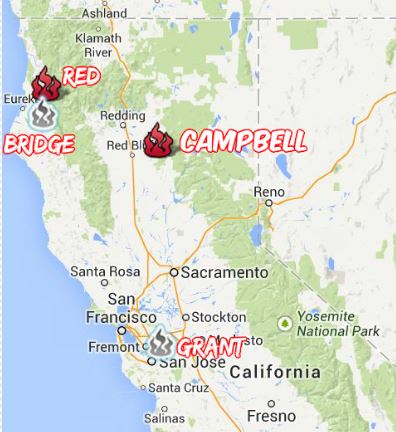
Map northern California fires

Even though a major winter storm has caused 4,121 flights to be cancelled and another 11,284 to be delayed today across the United States, northern California has experienced four medium to large fires already this year.

  • The Campbell Fire, which started January 2 on the Lassen National Forest 24 miles southeast of Red Bluff, according to the U.S. Forest Service has burned 600 acres and is 40 percent contained. No structures are threatened and no evacuations are planned for this fire that is burning in the proverbial “steep, rugged terrain”. Minton’s NORCAL Incident Management Team 1 is assigned.
  • The Red Fire, south of Berry Summit in Humboldt County, has burned 350 acres and is 40 percent contained. It started January 4.
  • The Bridge Fire, near Bridgeville in Humboldt County, started January 3 and burned 18 acres. It is 100 percent contained.
  • The Honcut Fire, started January 1 in Butte County near Honcut and burned 60 acres before it was contained.
  • The Grant Fire, started December 31 and burned 40 acres in Santa Clara County near Grant Ranch County Park before it was contained.

On Sunday the U.S. Forest Service activated one large air tanker, Minden’s Tanker 48. CAL FIRE has been using multiple helicopters and air tankers on these fires.

Timeline released for Colorado’s Black Forest Fire

The El Paso County Sheriff’s Office has released their own timeline for the early stages of the Black Forest Fire near Colorado Springs that burned 486 homes beginning on June 11, 2013. Below is an excerpt from an article at The Denver Channel:

The El Paso County Sheriff’s Office has released its own timeline of events for the Black Forest Fire which indicates the fire was first reported nearly two hours earlier than the Black Forest Fire/Rescue District reported.

In a Dec. 10 news release, the Black Forest Fire/Rescue District said the fire was first located at 1:45 p.m. on June 11.

However, the sheriff’s office timeline released Monday shows callers to 911 started reporting a haze and the smell of smoke at 11:54 a.m.

At 1:40 p.m., emergency radio traffic is heard saying, “you might start getting more call of localized smoke,” but they blamed it on the Royal Gorge wildfire burning in Canon City, saying”looks like there is a fire in Canon City.”

However, in the same report, the person says, “pretty good column on Hodgen Rd.,” which is near the Black Forest area.

County Sheriff Terry Maketa has been EXTREMELY critical of Bob Harvey, the Fire Chief responsible for the first two hours of the initial attack of the fire.

Prescribed fire workshops in Nebraska

Prescribed fire workshops will be held in eight locations across Nebraska between January 21 and March 19, 2014. Hosted by Pheasants Forever, Nebraska Game and Parks, and several other organizations, the one-day sessions are broken down into basic and advanced classes.

The workshops for landowners will discuss benefits of prescribed fire and how to safely conduct a project. Topics covered include equipment and safety, environmental factors, techniques for conducting prescribed fires, briefings, items to consider when writing a burn plan, possible funding sources, and how to factor in weather conditions. There will also be an exercise on how to write a burn plan. The registration fee of $10 includes lunch and training materials.

In order to conduct a prescribed fire in Nebraska, a landowner needs to have a burn plan and a permit from the local fire department.

More information, including dates and locations.

Recent articles at Fire Aviation

Here is what you may have missed at Fire Aviation: