Bill Gabbert sat down with Brendon McDonough and Miles Teller the day of the red carpet screening in Phoenix of “Only the Brave”, which is about the Granite Mountain Hotshots. In 2013, 19 members of the crew perished in the Yarnell Hill Fire south of Prescott, Arizona.
Mr. McDonough was the only member of the 20-person crew to survive. Miles Teller played him in the movie.
On Thursday October 19 you will be able to see the interview with country music star Dierks Bentley who co-wrote “Hold the Light”, a song featured in the film.
In “My Lost Brothers” Brendan McDonough writes about his journey of becoming a wildland firefighter, and the loss of his 19 “brothers” in 2013 on the fire in Arizona.
It has been two years since Brendan McDonough lost his 19-member firefighter family. On June 30, 2013 the Yarnell Hill Fire claimed their lives when a firestorm roared through brush 90 miles northwest of Phoenix, leaving McDonough the only survivor of the 20-man Granite Mountain Hotshot crew.
The day before, he had been sent home sick by Jesse Steed, Captain and second in command of the crew. The next day on the fire near Yarnell, Steed, as the acting Superintendent may have thought that McDonough was not quite 100 percent recovered when he assigned him to serve as a lookout for the crew – staying in one spot observing the fire, taking weather observations, and updating the rest of the crew on the status of the fire and where it was in relation to their location.
As the other 19 firefighters inexplicably left the safety of an already burned area and hiked through unburned brush toward a ranch – previously identified as a safe place – a sudden wind shift turned the fire in their direction. Pushed by strong winds created by a passing thunderstorm, the fire burned over the crew, killing them all, even though they sought protection inside their emergency fire shelters.
McDonough, in a different location, escaped uninjured after getting a ride out of the area in autility task vehicle (UTV) driven by a firefighter from another hotshot crew.
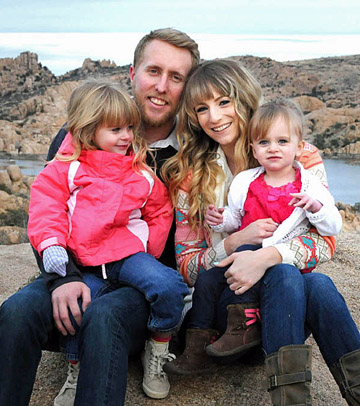
He now lives in Prescott, Arizona with his girlfriend, his four-year-old daughter, and the girlfriend’s three-year-old daughter. He likes Prescott, he says, but acknowledges that it’s tough for him to live there. “Every sticker, every shirt, every corner is a memory,” he says. “But Prescott is such a loving town that I couldn’t leave. I’m really rooted here; I love it here.”
L-R: Brendan’s daughter Michaela, Brendon, Ali, and her daughter Zoe. Photo courtesy of Brendon McDonough.
HIRED ON WITH THE GRANITE MOUNTAIN HOTSHOT CREW
McDonough was not a first-round pick when he was hired on with the crew. “Three guys washed out,” he says, “Eric Marsh told me, ‘If you can keep up, we’ll keep you.’”
“The hotshot crew was the best thing that ever happened to me. It saved my life. I probably would have continued doing drugs, I probably would have ended up in prison or with an overdose – or dead. I was a dad before I got hired. I felt like a failure because I couldn’t support my daughter, because no one wanted to hire a felon. I couldn’t even get a job at McDonald’s flipping burgers. It was a dark period in my life.”
McDonough says he’s thankful for the others on the crew who taught him about being both a dad and a hotshot. “They taught me all they knew, and they also taught me how to be a man, a well-rounded man. Family life. That’s what the brotherhood is really about.”
“That is what I lost that day,” he adds. “Not just a hotshot crew or nineteen fire brothers. I lost my family.”
Superintendent Eric Marsh had been assigned as Division Supervisor that day, in charge of the part of the fire that included the Granite Mountain crew, temporarily supervised by Steed. When the fire shifted and moved toward McDonough, the rate of spread increased dramatically. “Hey, it’s about time for you to get out of there,” said Steed over the radio. McDonough agreed.
He said his evacuation from the area was a close call but not chaotic. Walking out, he met up with a member of the Blue Ridge Hotshots, who gave him a ride out.
Do you know why the crew left the safety of a previously burned “black” area and decided to walk through unburned brush toward the ranch?
Some of the families of the deceased Granite Mountain Hotshots settled their lawsuit the day before the second anniversary of that tragic day. On June 29 the families of 12 of the crewmembers settled a wrongful-death suit for $50,000 each along with some reforms they hope will help to prevent similar catastrophes. Two years ago today 19 members of the crew were killed on the Yarnell Hill Fire south of Prescott, Arizona when they were entrapped and overrun by a wildfire that later burned into the community of Yarnell, destroying 127 structures.
The resolution was announced Monday at a news conference. In addition to the $50,000 for each of 12 families, the state of Arizona will give $10,000 to each of the seven families that did not participate in the lawsuit.
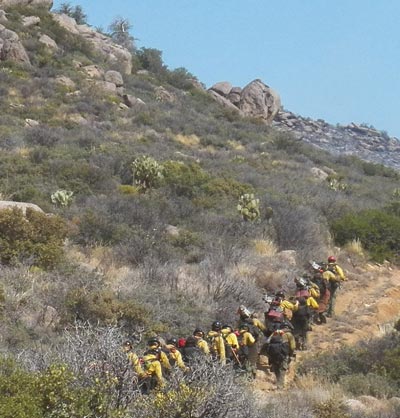
Granite Mountain Hotshots hiking to their assignment, June 30, 2013. Photo by Joy Collura.
The settlement also stipulates that the state will make a “good faith effort” to implement reforms suggested by the families of the hotshots, but their implementation is not binding and will be up to the sole discretion of the agency director.
The state Forestry Division will ask the National Wildfire Coordinating Group to do a question-and-answer session and a staff ride so that firefighters can better understand what happened that day two years ago.
The state will recommend additional training for initial attack of new fires.
State Forestry will volunteer to participate as a testing site for new wildfire technology, including radios and GPS tracking devices. One of the issues on the Yarnell Hill Fire was that it is possible that few if any other firefighters on the fire were aware of the location of the crew and the danger that they were in.
The $220 million lawsuit was settled for a total of $670,000, plus the “good faith” concessions.
The agreement occurred without any testimony from Brendan McDonough, the only survivor from the 20-person crew. Attorneys for State Forestry repeatedly sought his information about the fire under oath, but a deposition never occurred. Mr. McDonough has said he suffers from post-traumatic stress disorder since the fire.
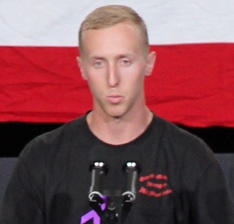
Brendan McDonough. Photo by Bill Gabbert.
At the time of the fatalities he was in a different location serving as a lookout, providing intelligence to the crew about the location of the fire. The largest remaining question about the Yarnell Hill Fire is why the 19 firefighters left the safety of a previously burned area and hiked through unburned brush where they were overrun by the fire. Nothing in the two official reports shed any light on this important question.
An article in the April 3 edition of the Arizona Republic includes information that was previously unknown to the public. The newspaper reported that Mr. McDonough overheard a radio conversation between the Division Supervisor, Eric Marsh, and Jesse Steed who was temporarily serving as the Hotshots’ crew boss. Supposedly Mr. Marsh who normally was the Crew Boss or Superintendent of the crew, told Mr. Steed to have the crew leave the safety zone and to join him at a ranch.
The question of why the crew was in that location may never be answered, unless Mr. McDonough elaborates on the issue in the book he is working on. In April it was announced that he signed a deal with New York Times bestselling author Stephan Talty to write “the untold story from the lone survivor of the Yarnell Hill Fire”.
Below is an excerpt from a June 29, 2015 article in the Arizona Republic:
Attorney Pat McGroder said the goal of the 12 families was to prevent future tragedies and improve wildland-firefighting safety. He emphasized they were not out to make money and said the minimal compensation and promised firefighting improvements underscore that point.
McGroder had strong words for the federal government, which banned the Blue Ridge Hotshots from talking publicly about what they may have heard over the radios that day.
“At sometime, Mr. McDonough may or may not choose to publicly describe what he saw, what he heard that day,” McGroder said. “The idea that the federal government is withholding information … speaks to the lack of understanding and empathy that they should have for these families. So, we would publicly call for … the national Forest Service to let their people talk.”
The Republic is reporting that the only survivor of the Granite Mountain Hotshots will be questioned under oath later this month. This will be the first time that Brendan McDonough, who was serving as a lookout when the other 19 members of the crew were entrapped by fire and killed in 2013, will undergo a sworn deposition.
The testimony may provide more information about why the crew left the safety of a previously burned area on the Yarnell Hill Fire and walked through unburned brush where they were overrun by the fire. The deposition is scheduled for 9 a.m. May 28 at a Phoenix law office.
As we wrote on April 4, an article in the April 3 edition of the Arizona Republic included information that was previously unknown to the public. The publication reported that Mr. McDonough who was serving as a lookout away from the crew during the tragedy, overheard a radio conversation between the Division Supervisor, Eric Marsh, and Jesse Steed who was temporarily serving as the Hotshots’ crew boss. Supposedly Mr. Marsh who normally was the Crew Boss or Superintendent of the crew, told Mr. Steed to have the crew leave the safety zone and to join him at a ranch.
Brendan McDonough speaks at the memorial service for his 19 fellow crewmembers killed on the Yarnell Hill Fire. Photo by Bill Gabbert, July 9, 2013.
The only survivor of the Granite Mountain Hotshots’ tragedy during the 2013 Yarnell Hill Fire in Arizona has signed a book deal with a best-selling author. Brendan McDonough was serving as a lookout when the other 19 members of his crew were entrapped by the fire and killed.
Publisher’s Marketplace provides this teaser about the book:
Firefighter Brendan McDonough with NYT bestselling author Stephan Talty. The untold story from the lone survivor of the Yarnell Hill Fire.
A Prescott wildfire lookout who lived through the deadly Yarnell Hill blaze of 2013 signed a book deal at about the same time his sworn testimony was canceled based on concerns from his therapist that a deposition would jeopardize his treatment for post-traumatic stress.
Former Granite Mountain Hotshots member Brendan McDonough has been working with best-selling author Stephan Talty to produce a book that, according to online promotional materials, will reveal “the untold story from the lone survivor of the Yarnell Hill Fire.”
McDonough, who has retained a private attorney and an agent, barely escaped flames that killed 19 fellow hotshots June 30, 2013. Reached by phone Monday, he declined to explain why his treatment precluded sworn testimony but did not prevent participation in a book. He referred calls to his legal representative and his agent.
In an interview last week, Los Angeles-based agent Steve Fisher confirmed that a book is in the offing…
The largest remaining question about the Yarnell Hill Fire that killed 19 members of the Granite Mountain Hotshot crew in 2013 south of Prescott, Arizona, is why the crew left the safety of a previously burned area and hiked through unburned brush where they were overrun by the fire. Nothing in the two official reports shed any light on this important question.
An article in the April 3 edition of the Arizona Republic includes information that was previously unknown to the public. The newspaper reports that the lone survivor from the Granite Mountain Hotshots, Brendan McDonough who was serving as a lookout away from the crew during the tragedy, overheard a radio conversation between the Division Supervisor, Eric Marsh, and Jesse Steed who was temporarily serving as the Hotshots’ crew boss. Supposedly Mr. Marsh who normally was the Crew Boss or Superintendent of the crew, told Mr. Steed to have the crew leave the safety zone and to join him at a ranch.
While moving vehicles with the Blue Ridge crew, McDonough allegedly overheard radio traffic between Marsh and Steed, who was with 17 crew members atop a ridge that had burned days earlier.
In the radio call, Marsh told Steed to leave the “black,” which was safe, and join him at the ranch. Steed protested, saying such a move would be dangerous. The radio exchange turned into a dispute.
“My understanding of the argument between Eric Marsh and Jesse Steed … was that Steed did not want to go down,” Paladini said.
According to Paladini’s account, Steed objected until Marsh gave him a direct order to descend.
As the back-and-forth conversation continued, it became apparent that Steed, a U.S. Marine veteran, consented to the command to relocate the team. But he told Marsh he thought it was a bad idea.
As the article goes on to explain, there is a dispute over the accuracy of the report.
Brendan McDonough, Yarnell Hill Fire survivor, speaks in Prescott, Arizona at the July 9, 2013 memorial service for the 19 firefighters that died on the fire. Vice President Joe Biden and Arizona Governor Janice Brewer are on the left and right, respectively. Photo by Bill Gabbert.
Brendan McDonough watched from a distance as the other 19 members of the Granite Mountain Hotshots became entrapped and died June 30, 2013 on the Yarnell Hill Fire south of Prescott, Arizona. Now, according to an article in the USA Today, he still struggles with stress-related problems. No longer a firefighter but working for the Wildland Firefighter Foundation, he wants to “create a non-profit organization to fulfill a dream of building a “healing center” in Prescott where first-responders, including troubled wildfire crews and their families, can seek treatment.”
The article’s main focus is a topic that rarely gets discussed in the world of wildland fire — the day to day psychological strains that firefighters face which are similar to those experienced by warfighters. The military has a highly developed program for treating post-traumatic stress disorder (PTSD), but the land management agencies, with a primary focus of growing trees, cleaning campgrounds, and managing visitors and non-native plants, have done little, effectively, to deal with a shocking suicide rate, for example.
The excellent article gives several examples of how stress is negatively affecting some of our firefighters. Below is an excerpt:
…Wildland Firefighter Foundation Executive Director Vicki Minor — Burk Minor’s mother — estimates that as many as one in four such firefighters struggle with emotional trauma.
She says her organization counted six firefighter suicides during 2013. If accurate, it suggests a rough suicide rate of 17 per 100,000, far higher than the national average and similar to the pace of these deaths in the military.
“Our government, our fire officials, the Forest Service, Bureau of Land Management, they’re really good at taking care of the land and they know how to fight fire,” Vicki Minor says. “They don’t know how to take care of their people.”
Federal workers get free visits to a contracted private counselor, but many firefighters complain these providers are not schooled in PTSD treatment, Vicki Minor says. “I’ve had several of these men say that they had to pay for a therapist out of their own pocket,” she says.
The Forest Service recently published pocket-sized pamphlets with tips on traumatic stress and resilience. But the guides offer nothing about where to seek help if necessary, except to cite websites from the Department of Veterans Affairs and private suicide support groups.
Forest Service Fire Management Director Harbour says the deaths of the 19 Prescott firefighters were a wake-up call on the emotional stress firefighters may incur. “How do we deal with what we carry after we go through a traumatic incident?” he asks.
He and his staff have turned to the Marine Corps for ideas about building emotional resilience in firefighters. He urged in a briefing paper to senior officials that “we have developed wonderful new tools to help physically protect firefighters. Now is the time to ‘build a better brain!'”
He and his staff have turned to the Marine Corps for ideas about building emotional resilience in firefighters. He urged in a briefing paper to senior officials that “we have developed wonderful new tools to help physically protect firefighters. Now is the time to ‘build a better brain!'”
The land management agencies should consider developing an experimental program with the Department of Veterans Affairs that would take advantage of their existing PTSD treatment facilities, such as the one at the VA Hospital in Hot Springs, South Dakota, the “Post Traumatic Stress Disorder Residential Rehabilitation Program”. Send a few firefighters with PTSD symptoms to a facility such as this and then evaluate the possible benefits.
On July 7, 2013, 19 hearses carried the remains of the Granite Mountain Hotshots back to Prescott, Arizona. Photo by Bill Gabbert.
The Prescott Daily Courier spent about an hour talking with Brendan McDonough, the only member of the Granite Mountain Hotshots to survive the Yarnell Hill Fire; 19 of them died on June 30 in Arizona when they were overrun by the fire.
In these two videos, each about eight minutes long, he seems to be dealing pretty well with the life-changing tragedy he is still experiencing. In them, and in the article at the Daily Courier, he provides a few more details than were previously known about the events that occurred before the entrapment. He talked about how he got to his lookout location (he was closer to the fire than the crew), his interaction with the Blue Ridge Hotshots, the warning they received about the weather changing, and moving the crew’s vehicles to a safe spot.
In the second video he said:
There was no bad decision made. No one’s at fault for what happened. And I’ll never forget that day… I was there. I know what happened. And there’s a lot of other people that were there that knew what happened — and it was just an accident. These things happen. It’s horrible that it happened, but it happened. This isn’t the first time a storm has come over and killed multiple firefighters.
The first video is about the fire. The other is more about his personal story.
In a related story, a video at Arizona Central describes the tense relationship between the families of the Granite Mountain 19 and the City of Prescott.