
Emergency Management Victoria will have two large air tankers from North America under firefighting contract again during their down-under summer.
Continue readingTanker 132 arrives in Indonesia

Coulson’s Tanker 132, known in Australia as “Thor”, has arrived in Palembang, Indonesia with a lead plane (in smoky conditions) to assist with the numerous large fires in the area. Local crews are preparing it for water dropping missions northeast of Palembang.
The photos were supplied by Commissioner Shane Fitzsimmons and the New South Wales Rural Fire Service, which has the air tanker under contract during the Australian summer but has loaned it to Indonesia for a week or so.


Air tankers at La Grande, Oregon

Josh Annas took these photos of air tankers that were working out of Union County Airport in La Grande, Oregon (map) between July 20 and 24. The aircraft were working the Blue Creek Fire in the southwest corner of Washington.
Aaron tells us that on July 23, 13,000 gallons of Jet A fuel was used.


Video of Tanker 131 dropping water on wildfire in Florida
In this video, Air Tanker 131, a C-130Q, is seen making two drops with water — instead of fire retardant — on the Mud Lake Complex of fires in Big Cypress National Preserve in south Florida. This is an unusual tactic for most large air tankers that normally drop retardant. It was a direct attack on the edge of the fire, rather than being offset as they would usually do with retardant. In the United States, federal policy does not allow retardant to be dropped near water. Many areas in the Mud Lake Complex were near wetlands.
Air tankers that can skim over the surface of a lake, scooping water to refill their tanks, usually drop water instead of retardant. Those aircraft include the Air Tractor Fire Boss, CL-215/415, and the Martin Mars.
Coulson Aviation attached a GoPro camera to the belly of their C-130Q to record the video in May, 2015.
If you are wondering how far water dropped by an air tanker spreads out laterally, check out this video of a scooper dropping on a vehicle fire in Canada.
The first USFS HC-130H air tanker to arrive at McClellan in mid-June
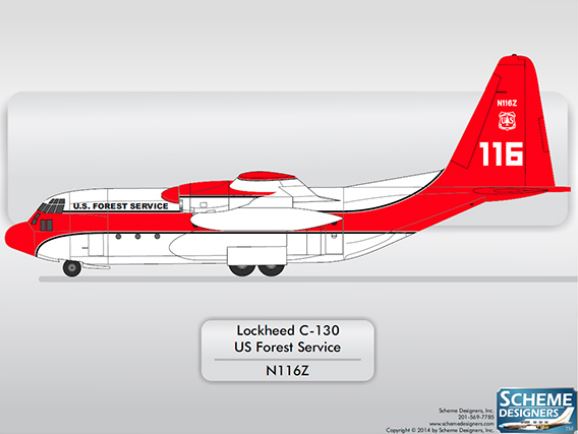
The first of the seven HC-130Hs that are being transferred from the Coast Guard to the U.S. Forest Service will arrive at Forest Service Air Station McClellan (FSAS MCC) in mid-June, not mid-May as originally planned. And yes, that is what the Forest Service is calling their facility at McClellan Airport in Sacramento, California.
The aircraft will still be a work in progress when it lands at MCC. It will not have the paint job as seen above, but will be gray and white with U.S. Forest Service Modular Airborne Fire Fighting System MAFFS markings, according to Jennifer Jones, a USFS spokesperson for the USFS. The gravity-based retardant tank will not have been installed, so it will be temporarily operating with a MAFFS pressurized 3,000-gallon tank. It will also need to depart at some point for scheduled Programmed Depot Maintenance, painting, and retardant tank installation…
(The rest of the story is at Fire Aviation.)
The first Coast Guard HC-130H converted to an air tanker for USFS to be available in August
The first of the seven HC-130Hs that are being transferred from the Coast Guard to the U.S. Forest Service will arrive at Forest Service Air Station McClellan (FSAS MCC) in mid-June, not mid-May as originally planned. And yes, that is what the Forest Service is calling their facility at McClellan Airport in Sacramento, California.
The aircraft will still be a work in progress when it lands at MCC. It will not have the paint job as seen above, but will be gray and white with U.S. Forest Service Modular Airborne Fire Fighting System MAFFS markings, according to Jennifer Jones, a USFS spokesperson for the USFS. The gravity-based retardant tank will not have been installed, so it will be temporarily operating with a MAFFS pressurized 3,000-gallon tank. It will also need to depart at some point for scheduled Programmed Depot Maintenance, painting, and retardant tank installation.

The USFS expects that it will be available to fly firefighting missions by August. It will usually be be restricted to fires within 500 nautical miles (575 miles) of MCC so that it can return there each day where both the USFS contract maintenance and U.S. Coast Guard support crews will be located. Missions at a greater distance and staying away from the base will be considered on a case-by-case basis.

A second HC-130H is expected to arrive at MCC in August and will only be used for flight crew training. It will also be a work in progress but should be sporting the new USFS paint scheme. Its Programmed Depot Maintenance will have been completed but it will still need to have a gravity-based retardant tank installed.

We are now using the model name “HC-130H” for these aircraft originally purchased by the U.S. Coast Guard. The first “H” indicates that it is an extended-range, search and rescue variant of the C-130 Hercules. It cruises slightly faster than the C-130H and has twice the range, capable of flying from Missoula, Montana to London non-stop. According to Wikipedia, the HC-130H has the following performance characteristics:
Maximum speed: 330 knots (380 mph, 611 km/h)
Cruise speed: 290 knots (333 mph, 537 km/h)
Range: 4,500 nm (5,178 mi, 8,334 km)
Service ceiling: 33,000 ft (10,000 m)
The first two aircraft to arrive at MCC this summer are 27 and 31 years old. If, after various federal government agencies invest up to $130 million in the conversion of the aircraft, and if the USFS keeps them for 20 years, at that point they will be about the same age as the P2Vs that have been falling out of the sky at an alarming rate over the last 15 years.
We are not sure which HC-130H will arrive first (we are guessing T-118) but here are more details:
- Air Tanker 118
- Coast Guard #1721
- Lockheed Martin SN 5121
- Transferred from Lockheed to the USCG 6/16/1988
- Hours: 5,194
- The center wing box will not be replaced at the Programmed Depot Maintenance due to the low number of hours
- Air Tanker 116
- Coast Guard #1708
- Lockheed Martin SN 5002
- Transferred from Lockheed to the USCG 9/17/1984
- Hours: 22,807
- The center wing box will be replaced at the Programmed Depot Maintenance
Contract for air crew
A $6 million contract for air crews to fly the aircraft was awarded April 27, 2015 to CASS Professional Services Corp, headquartered in Temecula, California. The following jobs will be initially filled for a nine month period with options to extend the term of the contract for an additional two years.
- 1 C-130H Qualified Contractor Aircrew Project Manager
- 2 MAFFS II Qualified Instructor Pilots,
- 1 US Coast Guard Qualified Flight Engineer Instructor, or US Air Force Qualified FE Instructor
- 2 MAFFS II Qualified Load Master Instructors
Retardant tank
The Air Force has issued a solicitation for gravity-based fire retardant tanks:
…design, manufacture, and installation of a 3,500 gallon Retardant Delivery System (RDS) for seven (7) HC-130H aircraft. There will be a basic contract with one (1) trial kit/install, one (1) verification kit/install, and three (3) production kits/install. There will be an option for two (2) additional production kits/installs. Effort includes but is not limited to: RDS development, manufacture and installation, structural modifications, and maintenance and inspection plans.
The upper portion of the tank above the floor will be removable and have the ability to disperse 3,500 gallons.
Contract for maintenance
A contract for maintenance of the aircraft is being advertised now with a response date of May 29, 2015. The contractor must provide a total of 17 mechanics and avionics/electrical technicians in the Primary, Secondary, and Back Shop crews. The contract will initially be for a nine month period (June 1 through January), with options to extend for an additional two full years. Services will be provided five days a week during the non-fire season, and seven days a week during the fire season.
The other five HC-130H aircraft
Most of the work on the one or two aircraft that will initially be operated as MAFFS is being done at Robins Air Force Base in Georgia and at the U.S. Coast Guard Aviation Logistics Center in North Carolina.
Jennifer Jones told us that the location of the work that will be done on the other five HC-130Hs will be determined once the U.S. Air Force has awarded a contract for it. Work that needs to be done on these aircraft includes demilitarization; performing wing and airframe modifications; designing, contracting for, manufacturing and installing retardant tanks; and equipping them with radios, Aircraft Flight Following, and other equipment. The U.S. Air Force will perform center and outer wing-box replacement modifications, programmed depot-level maintenance, and modifications necessary to procure and integrate a gravity fed aerial fire retardant delivery system (RDS) in each aircraft before they can be brought into U.S. Forest Service operation for firefighting missions.
If you want to know more about what is involved in replacing wing boxes, check out the article we wrote last year, Wing box replacements in the USFS C-130s.
Coulson’s L-382G going through static and grid testing

The L-382G that Coulson is converting into an air tanker will be at McClellan on April 27 for static testing of the tank system and in Lancaster, California on May 4 for grid tests.
The L-382G is the civilian version of Lockheed’s C-130H-30, which is the stretched H model.
The tank has a capacity of 36,000 pounds. There is not much agreement about the exact weight of retardant, but Britton Coulson said they expect to carry about 4,250 USG.
“Even with a full tank and 3 to 4 hours of fuel”, Mr. Coulson said, “we are still almost 20,000 pounds under our max gross weight so we are still no where near maxing out the airplane.”


Coulson’s C-130Q air tanker began their fire season this year on April 1, the start of their Mandatory Availability Period.
Neptune gears up for the fire season
In this video, Neptune Aviation’s Dan Snyder and Representative Ryan Zanke talk about the upcoming wildfire season.
“I’ve flown a lot of planes in my military career, these are great”, said Rep. Zanke, referring to the BAe-146. “They are also specialized planes, so for fighting forest fires they are a lot more efficient than a C-130 because they are specialized and they are the right tool for the right job.”
In the edited interview, he did not specify if he was referring to the pressurized Modular Airborne FireFighting System or MAFFS that can be carried in a military C-130, or a C-130 that has been converted into an air tanker by installing a conventional gravity-based tank, which is as “specialized” as a converted BAe-146.
Skies Magazine features large air tankers in Australia

Skies Magazine has devoted about 10 pages to the two large airtankers that just finished their contracts in Australia. Conair’s RJ-85 and Coulson’s C-130Q arrived in Victoria in early December, and by mid-February had made a total of 81 retardant drops.
The aircraft are covered on pages 36-48 and 60-61 in the magazine.

USFS advertises for C-130 flight crew

The U.S. Forest Service has issued the solicitation for a flight crew to operate the C-130H air tanker that they expect to have available at McClellan at Sacramento, Calilfornia beginning in mid-May. They intend to fill the following jobs initially for a nine month period with options to extend the term of the contract for an additional two years.
- 1 C-130H Qualified Contractor Aircrew Project Manager
- 2 MAFFS II Qualified Instructor Pilots,
- 1 US Coast Guard Qualified Flight Engineer Instructor, or US Air Force Qualified FE Instructor
- 2 MAFFS II Qualified Load Master Instructors
The requirements for the two pilots:
- Must be current and qualified as a MAFFS Instructor within the last two years
from the closing date of the solicitation. - C-130J pilots must have been previously qualified as instructors in the C-
130H, and must be a MAFFS IPs (AC/IP) with the following minimum experience:- (A) 1,500 hours flight time in a C-130H aircraft,
- (B) 30 drops on fire,
- (C) 4 seasons conducting MAFFS II Missions,
- (D) 6 Deployments (Fire Deployments)
- (E) Instructor status in respective crew position.
- (F) 100 instructor hours.
The closing date for the solicitation is April 10 — about a month before the C-130H arrives at McClellan.
A few weeks ago the USFS changed their plans about how many of the seven C-130H aircraft that are in the process of being retrofitted and transferred from the Coast Guard, will be operational this year as air tankers. On February 4 their intent was to have two of the C-130Hs this summer, both outfitted temporarily with the MAFFS pressurized internal retardant tanks, rather than a conventional gravity-based retardant tank. One would be used on fires within 500 nautical miles (575 statute miles) of McClellan, California, and the other aircraft would have been used as a training platform until it departed for programmed depot-level maintenance in the Fall of CY 2015.
Their revised plan is to have only one C-130H operational this summer and it would still be used only on fires within 500 nautical miles of McClellan. Aircraft 1721 is scheduled for delivery to Warner Robins Air Force Base for “MAFFS panel installation” around March 13, and should arrive at McClellan by mid-May. There appear to be no other changes to the schedule. The last of the seven C-130Hs are expected to be delivered, with internal gravity-based retardant tanks, in FY 2019. More details are in our February 9 and March 11 articles.