A C-130 Hercules from the 302nd Airlift Wing drops a load of water April 22, 2013 near Fairplay, Colo during training. (U.S. Air Force photo/Staff Sgt. Nathan Federico) Click to enlarge.
Two of the four military units that provide military C-130 aircraft configured to serve as air tankers are conducting their annual training, certification, and recertification. Peterson Air Force base in Colorado Springs had their’s April 19-23 and Warren Air Force Base in Cheyenne has chosen the week of May 5. The military Modular Airborne FireFighting System (MAFFS) can help fill a need for a surge capacity when all of the privately owned contract air tankers are committed.
The 302nd Airlift Wing at Peterson is the only Air Force Reserve organization that has an aerial fire fighting mission. The wing’s MAFFS program added one pilot, two navigators, two flight engineers and four loadmasters to the aerial fire fighting roster this year. Reserve aircrew members who support the MAFFS mission are volunteers, with each working to incorporate aerial fire fighting training into their required airdrop and tactical flying skill sets.
White Draw Fire June 29, 2012. Photo by Bill Gabbert.
Plans are underway to construct a memorial to honor the aerial firefighters killed in South Dakota July 1, 2012 when a military Modular Airborne FireFighting System (MAFFS) C-130 aircraft crashed while dropping retardant on the White Draw Fire. Four members of the six-person air crew died when strong winds out of a thunderstorm caused the air tanker to impact the ground on a ridgetop northeast of Edgemont, South Dakota.
The aircraft that crashed was MAFFS #7 from the North Carolina Air National Guard’s 145th Airlift Wing based at Charlotte-Douglas International Airport. Killed were Lt. Col. Paul Mikeal, 42, of Mooresville; Maj. Joseph McCormick, 36, of Belmont; Maj. Ryan David, 35, of Boone; and Senior Master Sgt. Robert Cannon, 50, of Charlotte. Two survived but were seriously injured — Chief Master Sgt. Andy Huneycutt and Sgt. Josh Marlowe of Boiling Springs.
MAFFS 7. Department of Defense photo.
The memorial will be approximately 6.5 miles northeast of Edgemont on Highway 18 near the point of origin of the fire (map), where the motor home that started the blaze caught fire while pulling the grade between Edgemont and Hot Springs. During May and June workers will construct a parking area and make room for interpretive signs that will tell the story of the fire and the fatal accident. Visitors at the memorial may be able to see the ridge which was the site of the crash. The construction is being coordinated by the South Dakota National Guard, according to Scott Jacobson, Public Information Officer for the Black Hills National Forest.
The dedication of the memorial is scheduled for July 1, 2013, exactly a year after the accident. There are reports that some family members of the victims from North Carolina will attend.
Archive photo of Coulson’s C-130 taxiing before the conversion. Coulson photo.
The Press-Enterprise has an article about the air tanker conversion that Coulson is working on at the San Bernardino, California airport, converting into an air tanker what the article identifies as a C-130Q. According to the article test flights are scheduled to begin in April. Coulson is hoping to receive a next-generation air tanker contract for the aircraft.
The Santa Maria Public Airport 55 miles north of Santa Barbara, California has reduced the landing fees charged to air tankers using the airport. An article in the Santa Maria Times says the fees will be reduced from $1 per 1,000 pounds to 50 cents per 1,000 pounds. In addition to this fee, firefighting aircraft have to pay ramp handling fees and fuel flowage fees.
After being downgraded to a call-when-needed air tanker base for three years, the Los Padres National Forest in October, 2011 restored it to full-time status during the fire season.
Contracts for next-generation air tankers
Late in the day last Wednesday the U.S. Forest Service announced contract awards for eight “legacy” air tankers, which included seven P2Vs and one BAe-146. Some people within the agency thought contracts for next-generation air tankers would also be announced last week, but that did not happen. The USFS is probably bending over backwards this time in an attempt to minimize the chances of the awards being protested again. Last summer after the awards were announced but not yet finalized, two companies that were not slated to receive contracts filed protests, which sent the agency back to the drawing board, starting the process over again after making dozens of changes in the solicitation.
It has been 487 days since the USFS began the solicitation process for next-generation air tankers.
Archive photo of Coulson’s C-130H and Firewatch 76. Photo by Coulson.
Most of the work on Coulson’s project to convert a C-130H into an air tanker is taking place at the San Bernardino, CA airport. Workers are making good progress, according to Brit Coulson. When it is complete, the internal tank will be able to be easily removed using the attached wheels so that the aircraft can be used at night, with a double crew, to transport cargo, such as fire trucks or other wildland fire equipment. More information about the project was in an April 9, 2012 article at Wildfire Today.
The Associated Press has a recent story about the conversion. Below is an excerpt from the article, in which Wayne Coulson has been promoted to “tycoon”. Congrats Wayne!
SAN BERNARDINO, Calif. — A Canadian tycoon is converting a 30-year-old ex-military plane into a high-tech firefighting aircraft, hoping to win a federal contract before the onset of this year’s wildfire season.
The Navy C-130 owned by Wayne Coulson is undergoing a nose-to-tail renovation at San Bernardino International Airport, the regional air tanker base for the U.S. Forest Service.
When finished, it will boast a 3,500-gallon tank for fire retardant, night-vision equipment and a GPS system that will make pinpoint drops when guided by a laser device mounted in an accompanying helicopter, the Riverside Press-Enterprise reported Wednesday.
Test flights are scheduled for next month, and Coulson hopes to win a Forest Service contract by June.
[…]
Coulson, a timber and aviation tycoon, also owns a converted World-War II-era Martin Mars seaplane that has fought fires throughout California..
It has been 470 days since the U.S. Forest Service issued a solicitation for next-generation large air tankers, but no contracts have been awarded. Coulson is hoping to receive one of the new contracts.
Caylym system dispersing a liquid after exiting an aircraft. Screen grab from Caylym video.
Since Wildfire Today last covered their disposable container for delivering retardant over wildfires,the Caylym company has continued to develop and promote their concept. The system consists of containers constructed of cardboard, plywood, a plastic bladder, and dozens of yards of straps. They hold 264 gallons each and are designed to be carried in military aircraft such as the C-130 or C-27 using the standard cargo system. The containers when empty weigh 100 pounds.
Caylym system containers exiting an aircraft. Screen grab from Caylym video.
After they leave the aircraft the container lids, attached by four straps, separate, and act like a parachute. The straps then put pressure on the plastic bladders, ripping them open, allowing the liquid to be dispersed. The 100 pounds of the other components, the plywood, and cardboard, fall to the ground tethered by the nylon straps. The plastic bladder, hopefully empty, falls separately.
The company says 16 units fit inside a C-130. We estimate that each one weighs 2,212 pounds, and 16 of them would hold 4,224 gallons for a total weight of 35,392 pounds. They claim a C-27J can carry 6 units, which would be 1,584 gallons with an estimated weight of 13,272 pounds. A C-130 with a Modular Airborne FireFighting Systems (MAFFS) usually carries 2,200 to 3,000 gallons of retardant, depending on the density altitude and the amount of fuel on board. Last summer the MAFFS were dropping an average of 2,394 gallons per flight.
In November the Romanian Air Force tested the Caylym system using a C-27J Spartan to drop the containers. According to the company:
…Expectations from testing were surpassed — all aspects of safety, handling and deployment of the Guardian System by the C-27J are anticipated to achieve certification from the Alenia test and evaluation team. Follow-up training is planned for the spring of 2013 in Romania.
The C-27J Spartan is an ideal aircraft for the aerial firefighting mission,” said Rick Goddard, managing director of Caylym. “The versatility and responsiveness of the C-27J in a firefighting mission, using the Guardian System gives the Romanian Air Force the ability to drop more than 1,500 gallons (6000 L) per mission, from a safe altitude over all types of terrain, day and night.”
We talked with Rick Goddard, the Managing Director of Caylym, who told us that in their tests the system could deliver six to eight gallons per 100 square feet and even more if the containers were loaded in two rows so that they would exit the aircraft two at a time. Mr. Goddard said they do not expect to spend $100,000 to conduct a standard cup test to determine the exact uniformity and quantity of the retardant coverage until the U.S. Forest Service expresses more of an interest in using the system.
Below is a video that was uploaded by Caylym on January 22, 2013. It shows their containers being assembled, filled, and then dropping from an aircraft.
If these were ever actually used on a wildfire, there would have to be an even greater emphasis than usual on removing firefighters and other personnel from the target area than there is now when only liquids fall from the sky. In addition, the owner of the land would either have to be OK with leaving the debris from the containers in place after the drop in perpetuity, or crews would have to search the area and carry it out for disposal in a landfill. Debris removal would need to be included in the estimated costs of using a system like this, which could be difficult or even impossible in some areas, complicated by topography and vegetation. Depending on the climate, it could take many years or decades for the plastic bladder, plywood, cardboard, and straps to decompose if it were not removed.
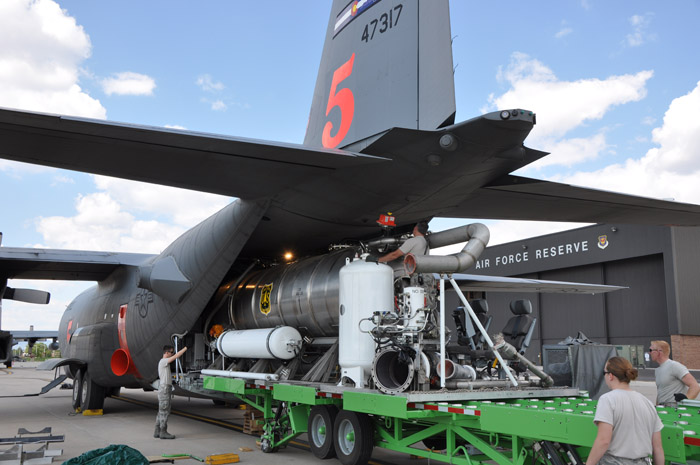
File photo of a MAFFS II unit being loaded into a C-130 at Peterson Air Force Base in Colorado, September 9, 2011. Air Force Reserve photo.
Military and civilian officials are considering making it possible to activate military air tankers earlier than has been done in the past to help suppress wildfires. C-130 aircraft from the Air National Guard and Air Force Reserve have access to eight Modular Airborne FireFighting Systems (MAFFS) that can be loaded into their cargo holds. These units can carry up to 3,000 gallons of fire retardant which can be pumped out by compressed air over wildfires.
According to an Associated Press article by Dan Elliott, General Charles H. Jacoby Jr., head of the U.S. Northern Command at Peterson Air Force Base in Colorado Springs, said on Wednesday that making the C-130s available more easily is being weighed.
Under current regulations, privately owned air tankers have to be committed to fires before the military aircraft can be activated. This would have to be changed for General Jacoby’s suggestion to be implemented.
When the fire season ended last year there were only nine large air tankers under conventional exclusive use contracts. But those contracts expired over the winter and the U.S. Forest Service is evaluating new proposals for old “legacy air tankers” as well as what the agency calls “next generation” air tankers that are faster and can carry more retardant. The USFS needs to award the new contracts very soon, since some of them begin their mandatory availability periods in mid-February.
At least four companies are in the running to supply a total of seven or more next-gen air tankers on this next contract. The list includes Neptune, Minden, Aero Air, and Aero Flite, and possibly Coulson and 10 Tanker Air Carrier.
Since the USFS has allowed the air tanker fleet to deteriorate from 44 in 2002 to 9 in 2012, it is imperative that something be done to make up the shortfall of this important fire suppression tool. Having only 9 is a pretty low threshold for having all of them committed, which should technically make it legal to activate the military C-130s much more frequently than we have seen in recent years. Especially if you consider that it is important to have an adequate number of air tankers standing by at air tanker bases ready for a quick response to new fires — in addition to any air tankers that may be committed to going fires. Fast, aggressive, initial attack by ground and air resources can minimize the size and the expense of wildfires.
Air tankers don’t put out fires, but aerial retardant can under the right conditions slow them down making it possible for firefighters on the ground to move in closer and stop the spread. The use of aircraft can keep fires smaller while saving taxpayers money, in addition to reducing the threats to lives, homes, and private property.
MAFFS C-130 crash, July 1, 2012 in South Dakota. US Air Force photo.
The US Air Force has released information about the cause of the July 1 crash of the C-130 Modular Airborne FireFighting System (MAFFS) air tanker in South Dakota. More details are at Fire Aviation, but basically it was caused by strong microburst winds out of a thunderstorm.
File photo of a MAFFS II unit being loaded into a C-130 at Peterson Air Force Base in Colorado, September 9, 2011. Air Force Reserve photo.
The military C-130 air tanker that crashed in South Dakota Sunday, killing four and injuring two crewmembers, was carrying one of the nine Modular Airborne FireFighting Systems II (MAFFS II) that exist. The MAFFS II hold 3,000 gallons of fire retardant which is pumped out the left side paratroop door using compressed air generated by an air compressor built into the system. The U.S. Forest Service had these and the eight first generation MAFFS built by a contractor, Aero Union, which had been converting aircraft into air tankers for decades.
But after the USFS cancelled their contract for the company’s eight P3 air tankers over a safety inspection issue, Aero Union closed their doors, laid off their employees, and a bank took over their assets, including the aircraft and everything related to manufacturing the MAFFS. The bank attempted to sell them at an auction in February, but the aircraft and the MAFFS items were not bought.
The MAFFS units are very specialized, complex systems. Without Aero Union around to provide repairs and parts, now there is a question about how to maintain and repair the systems.
Mead Gruver, a reporter for the Associated Press working out of Cheyenne, Wyoming, has been closely following what I am calling the Air Tanker Crisis and the management of what is left of the air tanker fleet, down to nine full time large air tankers after being cut by 80 percent since 2002. Here is an excerpt from an article he wrote today about the MAFFS:
…Forest Service officials insist the system is and will remain viable for years to come.
Meanwhile, the Forest Service has contracted technicians in California, Wyoming and Idaho to maintain the MAFFS. An in-house engineer at the National Interagency Fire Center in Boise, Idaho, can help troubleshoot any bugs, Fisher said.
“In any new system you’re going to have some issues come up, and we’ve been able to work through them,” [Scott Fisher, MAFFS coordinator for the Forest Service] said.
Aero Union’s last chief executive, Britt Gourley of Seattle, declined to comment on the system’s continued viability.
“I may have my personal opinions, but I keep them to myself. I don’t know. I wish the Forest Service well and wish all the folks involved well,” Gourley said.