Wildfire briefing, January 23, 2014

Island fire to be allowed to burn out

A wildfire on an island in Suisun Bay east of San Francisco Bay will be allowed to burn out, according to Contra Costa County Fire Protection District Capt. Robert Marshall. Wednesday afternoon U.S. Coast Guard and fire protection district equipment responded to the fire on Winter Island (map) , which is mostly uninhabited, having just one structure that was not threatened by the fire. They figured it could take anywhere from a few hours to a few days for the fire to burn out. The island is two miles long and about 0.3 mile wide.

Three men charged for Colby Fire

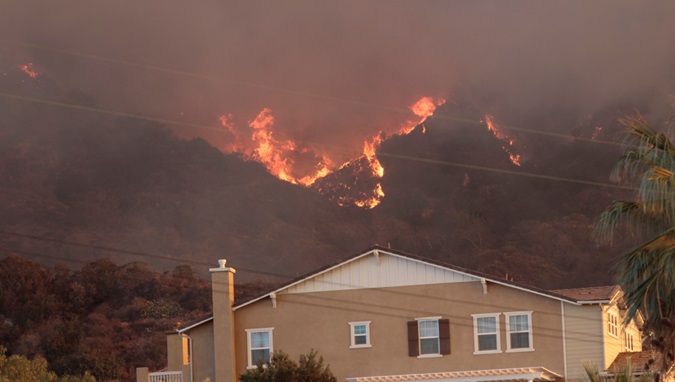
The three men that were arrested January 16 soon after the Colby Fire started above Glendora, California east of Los Angeles, have been charged in federal court. The men, who allowed an illegal campfire to escape, were identified as Jonathan Carl Jerrell, 24; Clifford Eugene Henry Jr., 22; and Steven Robert Aguirre, 21, according to a statement from the U.S. Attorney’s Office for the Central District of California. Aguirre and Henry were ordered to remain in custody without bail, while Jarrell was scheduled for a Friday detention hearing. All three are scheduled to be arraigned Feb. 11.

Two of the men seen hurriedly moving away from the fire were apprehended by a Glendora police officer. The third was found and taken into custody by an employee of the U.S. Forest Service. The fire destroyed five homes, damaged seven, and burned 1,952 acres.

Mike Wakoski’s incident management team is calling the fire, which has not spread since January 17, 98 percent contained.

After the men were arrested there were discussions between the Glendora PD and the U.S. Attorney’s office whether to charge them with state or local crimes or use federal statutes, since the fire burned both U.S. Forest Service land as well as private property within the city. But the decision was made to charge them in federal court.

Black Forest fire department hires PR firm

The fire-rescue district that managed the Black Forest Fire during the first hours has hired a public relations firm to deal with the fallout caused by the intense criticism directed at the district by El Paso County Sheriff Terry Maketa. The Sheriff has been carrying on a war in the media against the fire district, saying they should have turned the fire over more quickly to the Sheriff. Colorado is one of a few states that still have the elected county sheriff responsible for suppressing wildland fires in unincorporated areas. The fire killed two people, destroyed 486 homes, and damaged 37 others in June.

The sheriff’s office has been investigating the cause of the fire, in addition to a separate investigation by the fire district, which, according to the Chieftain, has paid an investigator $13,000.

Researchers test new firefighting gel

Researchers with Texas A&M recently tested a new gel that can be used for suppressing active structure or wildland fires, and may have the potential to be effective if used for pre-treating fuel in advance of a fire.

Called TetraKO, it is claimed by the company to be “biodegradable and non-toxic to water, fish, plants and mammals by independent research organizations”.

In a MyFoxAustin video report on the test, the reporter seemed to be surprised that gel applied the day before to the vegetation was not effective in stopping the spread of the fire. However it did keep some treated fence posts from igniting.
Air tanker fleet beefed up in California

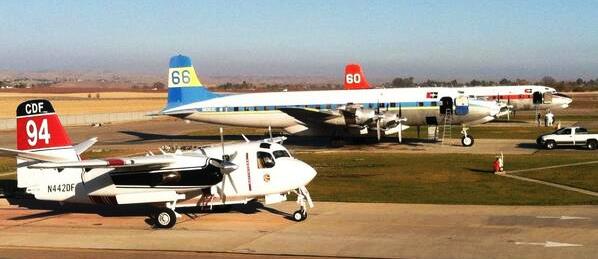
DC-7 air tankers at Paso Robles Air Tanker Base
Two DC-7 air tankers and an S-2T air tanker at Paso Robles Air Tanker Base, January 19, 2014. CAL FIRE photo.

There is an extremely rare site in the photo above, at least in recent years — two DC-7 air tankers on active duty at an air tanker base in California. CAL FIRE has arranged for them to be on contract so that their 23 S-2T air tankers can rotate in for their annual maintenance. The wildland fire season in the state does not appear to be ending, so they had to do something to provide the needed maintenance for their airborne firefighting fleet while the fire danger remains high.

The state of Oregon routinely uses DC-7 air tankers, but the federal government stopped contracting for them a number of years ago.

Air Tanker 66 at Paso Robles Air Attack Base
Air Tanker 66, a DC-7, at Paso Robles Air Attack Base, January 19, 2014. CAL FIRE photo.

Meanwhile, the U.S. Forest Service in recent days has had a couple of P2V air tankers on duty. Yesterday Tanker 910, one of the two DC-10 11,600-gallon air tankers operated by 10 Tanker Air Carrier, was brought over from Albuquerque to be available at Santa Maria, California.

DC-10 air tanker landing at Santa Maria Air Tanker Base
DC-10 air tanker landing at Santa Maria Air Tanker Base January 18, 2014. USFS cell phone photo.

Water scooping air tankers dropping on the Colby Fire

CL 415 on Colby Fire

Jeff Zimmerman was kind enough to send us these photos he took of CL-415 water-scooping air tankers dropping on the Colby Fire east of Los Angeles on January 16. The Canadian air tankers are leased every year during the fall by the Los Angeles County Fire Department. Their 2013 contract was scheduled to end in December, but was extended due to the extremely dry conditions in southern California.

You can see more of Jeff’s photography at his site. Thanks Jeff.

CL 415 on Colby Fire CL 415 on Colby Fire CL 415 on Colby Fire. Photo by Jeff Zimmerman.

More information about the Colby Fire.

Earlier we posted some extraordinary photos and videos of the CL-415s scooping water at Santa Fe Dam.

Additional photos and information about air tankers can be found at FireAviation.com

Video of CL-415s scooping, up close and personal

CL-415 scooping at Santa Fe Dam

CL-415 scooping at Santa Fe Dam

CL-415 scooping at Santa Fe Dam

The images above are screen shots from the videos below, which were shot at Santa Fe Dam on Thursday. In addition to being the Incident Command Post for the Colby Fire at Glendora, California, east of Los Angeles, it has been the scooping point for the two CL-415 water-scooping air tankers working the fire. Los Angeles County Fire Department has been contracting for scoopers every fall for many years. In 2013 the contract was scheduled to end in December, but because of the drought and very dry fuel moistures the County extended the contract.

Being directly below the aircraft just after they lifted off the lake with full loads was not the safest place to be. Probably the pilots were wishing the folks with the cell phones were not there.

Below is one more screen shot from one of the videos.

CL-415 very close Colby Fire

Colby Fire, near Glendora, California

Colby Fire. Photo by Jessica Parker.
Smoke from the Colby Fire, as photographed by a NASA satellite

(Originally published at 8:20 a.m. PST, January 16, 2014)

(UPDATED at 12:42 p.m. January 20, 2014)

The incident management team reports that the Colby fire is 46 acres larger than it was yesterday, at 1,952 acres now, and they are calling it 84 percent contained.

The team reported today that resources assigned to the fire include 1,112 personnel, 45 hand crews, 100 engines, 3 helicopters, 5 dozers, 8 fixed wing aircraft, and 3 heli-tankers.

(UPDATED at 11:18, January 19, 2014)

Firefighters are gaining a stronger hold on the Colby Fire east of Los Angeles. The incident management team is now calling the 1,906-acre fire 78 percent contained.

Evacuations were lifted for the Community of Mountain Cove at 6:00 PM. January 18, 2014. No evacuation are currently in place. Highway 39 remains closed and is only open to residents.

The Colby Fire is being fought by 1,112 personnel, 26 hand crews, 100 engines, 3 helicopters, 5 dozers, 8 fixed wing aircraft, and 3 heli-tankers.

Six residences have been destroyed and five have been damaged.

Some excellent photos of the water-scooping air tankers dropping on the Colby Fire are HERE.

firefighters Colby Fire
Firefighters put in a hose lay on the Colby Fire. InciWeb Photo.
Cleveland NF engine crews Colby Fire
Cleveland National Forest engine crews after a shift on the Colby Fire. InciWeb photo.

****

(UPDATE at 10 a.m. PST, January 18, 2014)

The Incident Management Team has revised the mapped size of the Colby Fire to 1,863 acres, and they are calling it 30 percent contained. Today’s high temperature is expected to reach 87 degrees with relative humidity in the single digits. They anticipate a “medium” potential for additional fire spread. The area continues to be under a Red Flag Warning until 6 p.m. for elevated wildfire danger. Today’s fire operations will be primarily focused on reinforcing containment lines along the fire’s northern perimeter and cooling hot spots.

Firefighting resources assigned include 1,112 personnel, 33 hand crews, 140 engines, 9 helicopters, 1 dozer, 4 and fixed-wing aircraft.

****

(UPDATE at 1:15 p.m. PST, January 17, 2014)

CL-415 scooping at Santa Fe dam

The photo above is a still image from an amazing video of the Super Scooper CL-415 air tankers scooping water at Santa Fe Dam yesterday. One of the videos is below, others are at Fire Aviation.

****

(UPDATE at 12:25 p.m. PST, January 17, 2014)

Below we have a map showing the official perimeter of the Colby Fire. The perimeter data was produced by the Incident Management Team as was current as of 5:04 PST January 16. Reportedly, the fire has not spread much since then. Click on the map to see a larger version.
Continue reading

It’s dry in the West

Minimum humidity 1-15-2014

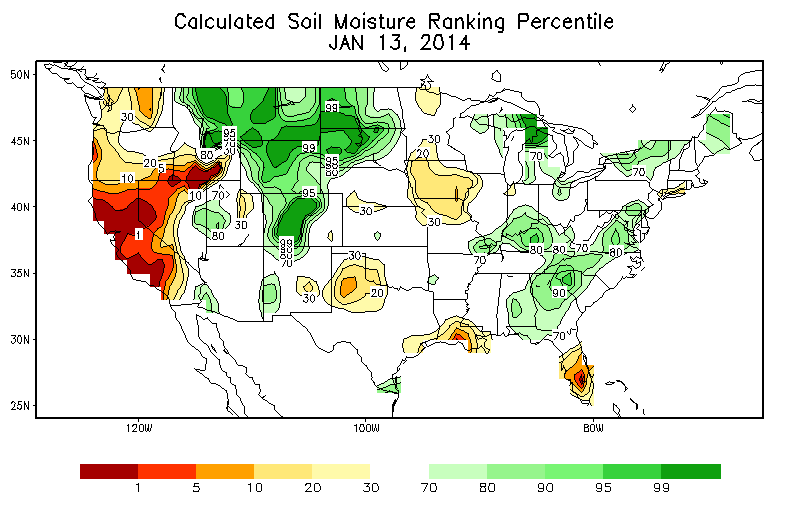
It is extremely dry in much of California, southern Idaho, and Nevada.

Soil moisture

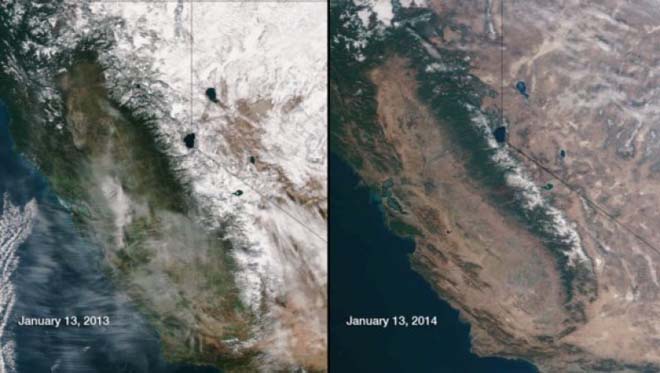
Snow comparison, California
A comparison of snow visible from a satellite in California and western Nevada, January 13, 2013 and January 13, 2014.

Minimum humidity 1-15-2014

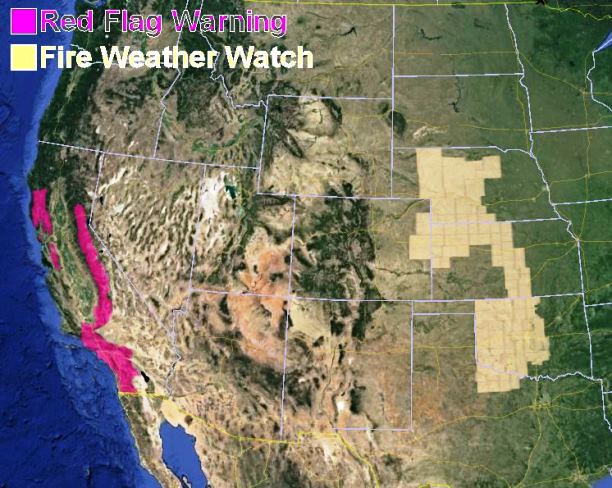
Red Flag Warnings, January 15, 2014

Investigators used GPS tracking device to nab firefighter-arsonist

Zane Wallace Peterson

Investigators used GPS tracking devices to gather evidence about a former firefighter who is accused of setting several wildfires in California, including the Clover Fire that killed one resident, burned 8,073 acres, and destroyed 60 homes.

Zane Wallace has been charged with over 200 arson-related counts, including 60 for arson to occupied structures. The fires occurred in September and October of 2013 in Shasta County.

According to information uncovered by the Redding Searchlight, investigators interviewed Mr. Wallace the day after the Clover Fire started, and later placed the tracking devices on two of his vehicles, which were later recorded at the location of some of the fires that started after the GPS devices were in place.

The U.S. Forest Service confirmed that Mr. Peterson was a former employee on the Mendocino National Forest. He worked as a firefighter (Forestry Technician) and fire engine operator from May 15, 2005 until October 22, 2012.


Thanks and a hat tip go out to Dick

Wildfire briefing, January 6, 2014

January wildfires in northern California

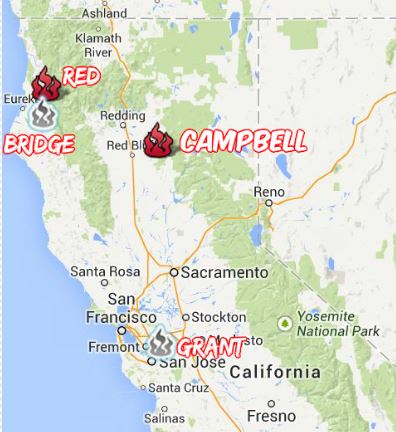
Map northern California fires

Even though a major winter storm has caused 4,121 flights to be cancelled and another 11,284 to be delayed today across the United States, northern California has experienced four medium to large fires already this year.

  • The Campbell Fire, which started January 2 on the Lassen National Forest 24 miles southeast of Red Bluff, according to the U.S. Forest Service has burned 600 acres and is 40 percent contained. No structures are threatened and no evacuations are planned for this fire that is burning in the proverbial “steep, rugged terrain”. Minton’s NORCAL Incident Management Team 1 is assigned.
  • The Red Fire, south of Berry Summit in Humboldt County, has burned 350 acres and is 40 percent contained. It started January 4.
  • The Bridge Fire, near Bridgeville in Humboldt County, started January 3 and burned 18 acres. It is 100 percent contained.
  • The Honcut Fire, started January 1 in Butte County near Honcut and burned 60 acres before it was contained.
  • The Grant Fire, started December 31 and burned 40 acres in Santa Clara County near Grant Ranch County Park before it was contained.

On Sunday the U.S. Forest Service activated one large air tanker, Minden’s Tanker 48. CAL FIRE has been using multiple helicopters and air tankers on these fires.

Timeline released for Colorado’s Black Forest Fire

The El Paso County Sheriff’s Office has released their own timeline for the early stages of the Black Forest Fire near Colorado Springs that burned 486 homes beginning on June 11, 2013. Below is an excerpt from an article at The Denver Channel:

The El Paso County Sheriff’s Office has released its own timeline of events for the Black Forest Fire which indicates the fire was first reported nearly two hours earlier than the Black Forest Fire/Rescue District reported.

In a Dec. 10 news release, the Black Forest Fire/Rescue District said the fire was first located at 1:45 p.m. on June 11.

However, the sheriff’s office timeline released Monday shows callers to 911 started reporting a haze and the smell of smoke at 11:54 a.m.

At 1:40 p.m., emergency radio traffic is heard saying, “you might start getting more call of localized smoke,” but they blamed it on the Royal Gorge wildfire burning in Canon City, saying”looks like there is a fire in Canon City.”

However, in the same report, the person says, “pretty good column on Hodgen Rd.,” which is near the Black Forest area.

County Sheriff Terry Maketa has been EXTREMELY critical of Bob Harvey, the Fire Chief responsible for the first two hours of the initial attack of the fire.

Prescribed fire workshops in Nebraska

Prescribed fire workshops will be held in eight locations across Nebraska between January 21 and March 19, 2014. Hosted by Pheasants Forever, Nebraska Game and Parks, and several other organizations, the one-day sessions are broken down into basic and advanced classes.

The workshops for landowners will discuss benefits of prescribed fire and how to safely conduct a project. Topics covered include equipment and safety, environmental factors, techniques for conducting prescribed fires, briefings, items to consider when writing a burn plan, possible funding sources, and how to factor in weather conditions. There will also be an exercise on how to write a burn plan. The registration fee of $10 includes lunch and training materials.

In order to conduct a prescribed fire in Nebraska, a landowner needs to have a burn plan and a permit from the local fire department.

More information, including dates and locations.

Recent articles at Fire Aviation

Here is what you may have missed at Fire Aviation:

Wildfire briefing, January 3, 2014

Drought Monitor 12-31-2013

Drought Monitor

The Drought Monitor shows that most of California, Nevada, and southern Idaho are in either a severe or extreme drought. This could be an interesting winter fire season if it continues.

Drought Monitor 12-31-2013

Arizona State Forestry Division wants to almost double budget

The state organization responsible for managing the Yarnell Hill Fire is requesting a budget for the Arizona State Forestry Division that is nearly double what they received in the fiscal year that ends June 30. According to an article at Azcentral, State Forester Scott Hunt wants to add $6.2 million to this year’s budget of $7.3 million. The additional funds would be used to hire 15 additional staffers, replace firefighting and communications equipment, and allocate $2 million to remove hazardous vegetation on state and private lands. The budget request was filed in October, after 19 firefighters died on the Yarnell Hill Fire but before the state Division of Occupational Safety and Health issued their report on the fire and recommended a $550,000 fine be imposed on the Arizona State Forestry Division as a result of the fatalities on the fire.

Retired smokejumper interviewed on Montana Public Radio

Retired smokejumper Wayne Williams is featured in an interview on Montana Public Radio. In the 11-minute recording Mr. Williams speaks eloquently from his decades of experience. It is refreshing to hear someone interviewed about wildland fire in the media who knows the subject matter. The audio is HERE, and a short article with his photo is HERE.

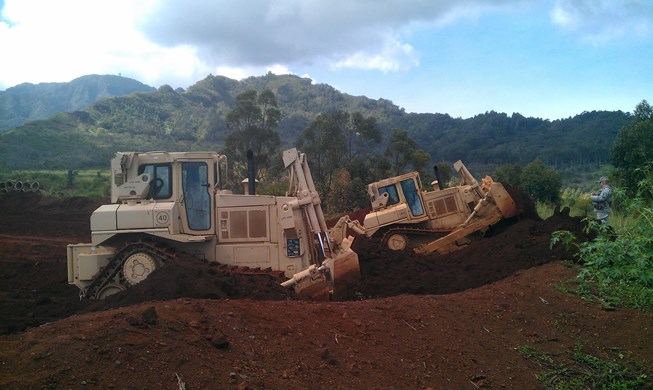
Army attempts to prevent wildfires at Schofield Barracks

Raising the berm at Schofield Barracks
A soldier with 2nd Platoon, 523rd Engineer Company, 84th Engineer Battalion, 130th Engineer Brigade, 8th Theater Sustainment Command, uses a D7 bulldozer to increase the size of the berm so it is a 20 feet by 20 feet dimension. (U.S. Army photo by: 1st Lt. Lucian Myers, 2nd Platoon, 523rd Engineer Company, 84th Engineer Battalion, 130th Engineer Brigade, 8th Theater Sustainment Command)

In October and November two wildfires started at a range used for controlled detonations to dispose of unexploded ordnance at Schofield Barracks west of Honolulu, Hawaii. The fire that started October 15 burned more than 250 acres. It was fought for five days, then two days later rekindled and was finally extinguished October 28. Another fire in November burned about 30 acres.

In order to reduce the chances of vegetation fires igniting from the explosions, soldiers are using dozers to increase the height of the dirt berm surrounding the range from 7 feet to 22 feet. During the project, which was conducted 24 hours a day between December 9 and 13, they moved 5,800 cubic yards of dirt.

Wildfire Tweets

Below are a couple of messages on Twitter that had photos of fires — at Valparaiso, Chile and Lake Tahoe, California (which may be a prescribed fire).


Thanks and a hat tip go out to Dick and Chris