
The airport has a relatively short runway
Continue readingC-130 air tanker brought to Ramona for crew training
 Tanker 118, during training flights at Ramona, CA February, 2022. Photo by Ryan Grothe.
The California Department of Forestry and Fire Protection brought air tanker 118, a C-130, to the airport at Ramona, California last week. Ryan Grothe who shot these photos said, “They conducted training flights in the area, including some touch and goes on the runway and pattern work.”
The seven Coast Guard C-130s will not be officially transferred to CAL FIRE until all of the maintenance and conversion to air tankers is complete, or close to it. That is expected to happen in 2023. No retardant delivery systems have been installed in any of the aircraft. Some of them may still need depot level maintenance.
 Tanker 118, during training flights at Ramona, CA February, 2022. Photo by Ryan Grothe.
Mr. Grothe said one of the C-130s is expected to be based at Ramona.
The relatively short runway restricts which types of aircraft can use the facilities at Ramona. When the U.S. Navy built the airport in 1945 as an emergency landing field it was only 4,000 feet long and remained that length well after it was conveyed to the County of San Diego in 1956.
CAL FIRE established an Air Attack Base there in 1957 and the U.S. Forest Service followed three years later.
 Tanker 118, during training flights at Ramona, CA February, 2022. Photo by Ryan Grothe.
In 2002 the runway was lengthened to 5,001 feet but it is difficult for most large air tankers and impossible for very large air tankers to work at the base.
In August of 2019 one of Coulson’s C-130s under contract to CAL FIRE was spotted at Ramona.
 Tanker 118, during training flights at Ramona, CA February, 2022. Photo by Ryan Grothe.
 Tanker 118, parked during training flights at Ramona, CA February, 2022. Photo by Ryan Grothe. Two S-2Ts were also there, Tankers 71 and 88.
Wildland firefighter to compete in Winter Olympics
Robby Burns — parallel giant slalom
Continue readingStrong winds expected in Northern California
8:46 a.m. PST, February 1, 2022
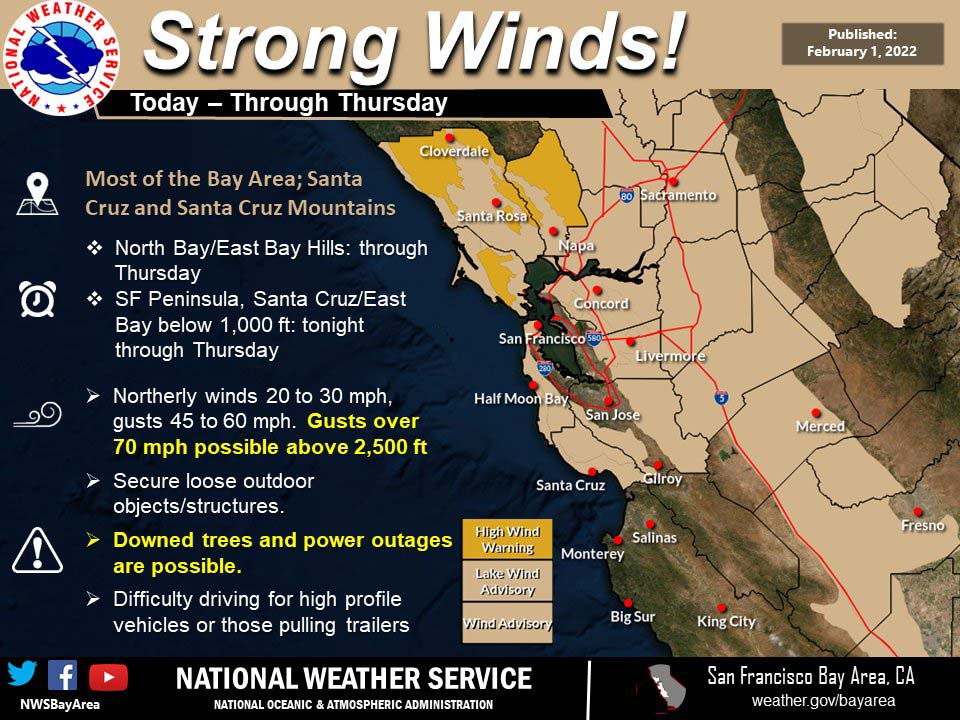
The National Weather Service predicts strong winds in areas of Northern California Tuesday and Wednesday, lasting into Thursday in the Bay area.
There are no Red Flag Warnings in effect, but the wildland fire danger for today, February 1, ranges from low in the higher elevations to severe in portions of the Bay and North Bay areas. It will also be very high to severe in some locations between San Francisco and Santa Barbara.
The forecast for Sacramento on Tuesday calls for sunny skies, 58 degrees, 33 percent relative humidity, and afternoon winds of 23 mph winds out of the north-northwest at 23 mph gusting to 32 mph. On Wednesday the wind and temperature will be similar, but the RH will drop to 21 percent. The Thursday forecast has the wind decreasing to 5 mph with 18 percent RH.
 Wildland fire danger, Northern California, Feb. 1, 2022.
The map below shows wind gusts at 8:12 a.m. PT, Feb. 1, 2022
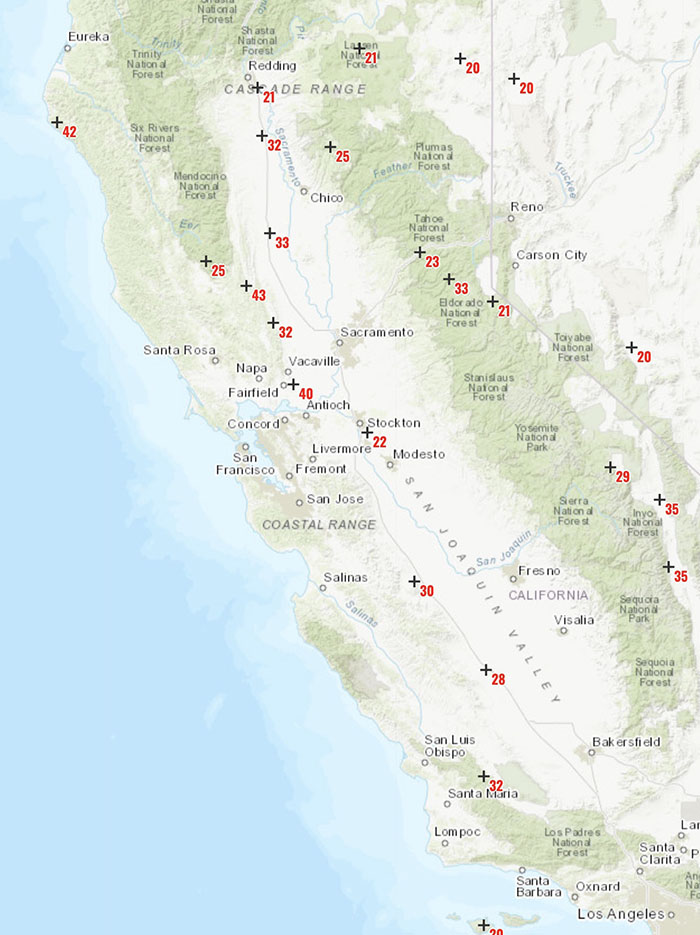 Wind gusts at 8:12 a.m. PT, Feb. 1, 2022. NWS.
The Hot-Dry-Windy index on Tuesday for the North Bay area is above the 90th percentile, but it does not take into account the condition of the vegetation, i.e., fuel moisture.
Data shows building codes can reduce vulnerability of homes in wildfires
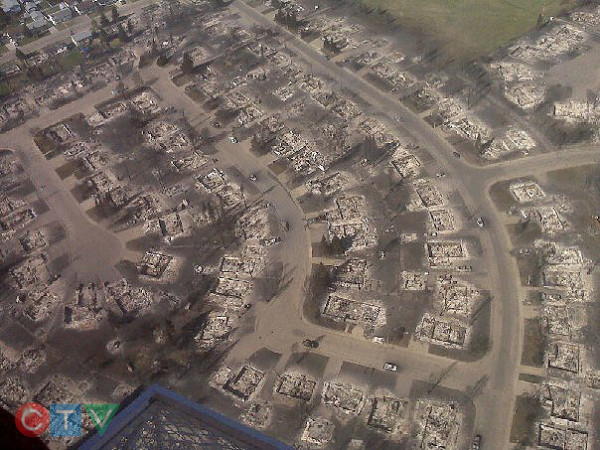 Burned homes in Slave Lake. May 16, 2011. Alberta, Canada. CTV.
Researchers have found that building codes based on lessons learned during the deadly 1991 Tunnel Fire in the Oakland Hills of California can reduce the vulnerability of homes to wildfires.
In a paper titled Mandatory vs. voluntary adaptation to natural disasters: the case of U.S. Wildfires, authors Patrick W. Baylis and Judson Boomhower describe how they scoured property and wildfire records to identify which homes were constructed under building codes requiring enhanced resistance to wildfires.
Chapter 7A of the California Building Code which went into effect in 2008 requires certain fire resistance measures, including exterior construction materials used for roof coverings, vents, exterior walls, and decks. It applies to new construction of residential and commercial buildings in designated fire hazard severity zones.
The researchers discovered that a 2008 or newer home is about 16 percentage points (40%) less likely to be destroyed than a 1990 home experiencing an identical wildfire exposure. There is strong evidence, they concluded, that these effects are due to state and local building code changes – first after the deadly 1991 Oakland Firestorm, and again with the strengthening of wildfire codes in 2008. The observed vintage effects are highly nonlinear, appearing immediately for homes built after building code changes. There are no similar effects in areas of California not subject to these codes or in other states that lack wildfire codes.
Their findings are similar to those in a paper published October 4, 2021 in which researchers analyzed the structures that were destroyed and those that survived the Camp Fire that ran through the city of Paradise, California in 2018. They considered at least four primary characteristics of structures:
- Were they built before or after the adoption in 2008 of Chapter 7A of the California Building Code.
- Distance to nearest destroyed structure.
- Number of structures destroyed within 100 meters.
- Pre-fire overstory tree canopy within 100 meters
They found that the last three criteria were the strongest predictors of survival. Homes more than 18 meters (59 feet) from a destroyed structure and with less than 53 percent pre-fire overstory canopy within 30 to 100 meters (98 to 328 feet) survived at a substantially higher rate than homes in closer proximity to a destroyed structure or in areas with higher pre-fire overstory canopy. Most fire damage to surviving homes appeared to result from radiant heat from nearby burning structures or flame impingement from the ignition of near-home combustible materials. The researchers concluded that building and vegetation modifications are possible that would substantially improve outcomes. Among those include improvements to windows and siding in closest proximity to neighboring structures, treatment of wildland fuels, and eliminating near-home combustibles, especially within 1.5 meters of the structure.
(The video below was shot December 31, 2021, the day after the Marshall Fire destroyed more than 1,000 homes in Boulder County, Colorado. Notice that most of the surviving homes seen in the video had fewer homes in close proximity.)
The authors noted that while Chapter 7a includes requirements not found in many building codes, a few other codes are more complete incorporating multiple construction classes based on anticipated radiant heat, flame, and ember exposure levels. For example Chapter 7A does not consider the interaction between components such as siding, window, and the under-eave area on an exterior wall.
California is embarking on a pilot project in which owners of vulnerable homes in lower income neighborhoods will be given grants up to $40,000 to retrofit the structures, making them more resistant to wildfires.
Home Ignition Zone
This data helps to illustrate that the condition and characteristics of the Home Ignition Zone should be an extremely high priority in preventing structures from burning as a wildfire approaches.
There is an opportunity for much needed improvement in both current building codes and how we live in wildfire prone WUI areas.
Thanks and a tip of the hat go out to Gerald.
Report released about entrapment of 15 firefighters on the 2020 Dolan Fire
The Nacimiento guard station, two fire engines, several personal vehicles, and two dozers burned — there was one very serious injury
Continue readingVice President Harris speaks about the pay of firefighters
At Del Rosa fire station in Southern California the VP was introduced by a wildland firefighter
Continue readingWildfire north of Big Sur prompts evacuations
The fire named “Colorado” has burned about 700 acres near Highway 1 near the California coast
Continue readingCalifornia proposes to purchase more Firehawks and expand real time wildfire mapping capability
They also want to add 54 surge engines, 4 more Firehawks, 10 contract helicopters, and 10 additional dozers
Continue readingReports released about fatality on the 2020 El Dorado Fire
“The system was not designed to handle this”
Continue reading