Coulson Aviation announced on August 31 that the company had secured a contract with the Bolivian Ministry of Defense to provide three Type 1 helicopters to assist the firefighters that are battling wildfires.
Shortly thereafter two of the company’s S-61 helicopters departed from California to begin a multi-day flight to South America.
On September 4 the third helicopter began its journey on a very large cargo plane from the airport at San Bernardino, California. Here’s what the company wrote on their Facebook page, along with these photos they posted:
The Coulson Unical CH-47D, N47CU, was loaded onto the Antonov An-124 this afternoon after a long night and morning of teardown. To fit in the airplane the blades, both the forward and rear drivetrain, and the rear pylon needed to be removed. This is a huge task to accomplish in such a short time but the team came through and will get some well deserved rest on the flight down.
Coulson photo.
Coulson has partnered with Unical Air, a new unit of the Unical Group of Companies to create a heavy lift helicopter joint venture company that will build and operate Boeing CH-47 and Sikorsky UH-60 Blackhawk aircraft for aerial firefighting and other markets. We interviewed Britt Coulson about this venture at the HAI Heli-Expo in Atlanta, March 5, 2019.
Britt Coulson with one of their recently acquired Blackhawks.
The Vice President of Coulson Aviation describes the new Chinook and Blackhawk program they are undertaking with Unical. He also updates us on the firefighting aircraft they have working in Australia during the 2018-2019 bushfire season. It was filmed at the HAI Heli-Expo in Atlanta, March 5, 2019.
Helimax’s N949CH at Sierra Vista, Arizona. Photo by Jerry Messinger.
Jerry Messinger sent us this photo of N949CH, one of HeliMax’s CH-47’s at Sierra Vista, Arizona. He said it is on an exclusive use contract and has already flown about 75 hours on fires in the Southwest this spring. It is very dry there, he said.
Those large rotor blades can provide a little shade on a hot day.
The weather prediction for Sierra Vista today, 96 degrees, 6 percent RH, with southwest winds gusting to 27 mph. For Friday, Red Flag Warning with winds gusting to 45 mph. And zero percent chance of rain.
Above: the Air Tractor display at the Aerial Firefighting conference.
Here are a few notes that I scribbled in a notebook at the Aerial Firefighting conference in Sacramento this week. This is Part One — I will post Part Two later.
Air Tractor
Mike Schoenau, an Air Tractor dealer out of Tulare, CA, said a new single engine air tanker is being flight tested now. The model name is AT-1002 and will hold up to 1,000 gallons. You will be able to purchase one for yourself for about $2.5 Million.
Fire Boss The Bureau of Land Management has not released their list of SEATs on contract this year, many of which will be the amphibious Fire Boss, a variant of the Air Tractor 802. Fire Boss doesn’t know if they will be converting the new AT-1002 1,000-gallon SEAT to use floats.
10 Tanker
RIck Hatton of 10 Tanker Air Carrier.
Their fourth converted DC-10, Tanker 914, will be ready to fight fire this summer. Rick Hatton, the President and CEO of 10 Tanker Air Carrier, said their approval by the Interagency Airtanker Board came to the end of its six-year term, so they retook the grid test in December. Their three DC-10s averaged about 300 hours on fires in 2017, which is more than usual.
I got into a long detailed conversation with Mr. Hatton about how their retardant delivery system can maintain a constant flow, adjusting for the amount of retardant in the tank, drop height, and speed. It usually drops at 150 knots and 200 feet.
Hours per CL-415
As we reported yesterday, Shawna Legarza, the USFS Director of Fire and Aviation, said the two CL-415 scooping air tankers that were on USFS contract in 2017 each had over 400 hours of fire flight time. Due to a reduction in the firefighting budget, the two scoopers had to be cut this year from the exclusive use list. At least a couple are still on a CWN contract, but they may or may not be available if the USFS Calls them When Needed.
Columbia Keith Saylor, Columbia’s Director of Commercial Operations, said the company will have three Type 1 helicopters, CH-47 Chinooks, on exclusive use contract this year. Two have internal tanks and one will use an external bucket.
Conair Shawn Bethel, Conair’s Director, International Business Development, said the external tank on the Q400 can be removed in about three hours by 9 to 12 workers. They recently received a contract to supply six Q400’s to France’s Securite Civile (Department of Civil Defense and Emergency Preparedness).
The Q400 MR can carry up to 10,000 liters (2,600 gallons) of water or retardant. In addition to the nine S-2’s and two Q-400’s, France also has twelve CL-415’s and 40 helicopters.
Above: Before it was repainted and shipped to Australia, Helimax’s N948CH, seen in the background here, was photographed in Sacramento March 23, 2016. Photo by Bill Gabbert.
(Originally published at 11:05 a.m. MST November 16, 2017)
One of Helimax’s CH-47D’s has been shipped to Australia and will be working for the New South Wales Rural Fire Service during their summer bushfire season.
According to the Wollondilly Advertiser, which has photos and more information, it will be working out of Camden, NSW southwest of Sydney (map) using an external water bucket carrying about 2,000 gallons.
An aircraft resembling the Chinook was spotted in a shipping box it shared with one of Coulson’s S-61’s in a photo posted November 3, 2017 by Coulson.
The video below from the Wollondilly Advertiser, shows the Chinook taking off near Camden, NSW.
Another one of Helimax’s CH-47D’s photographed by Bill Gabbert March 23, 2016 in Sacramento, Calif.
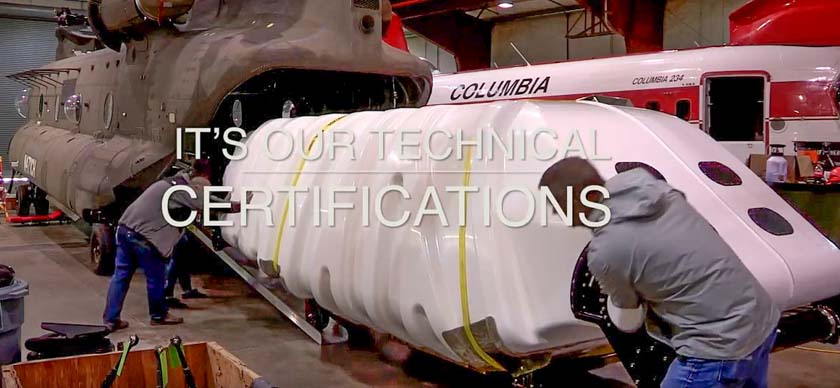
Above: A 2,800-gallon internal water tank in a Columbia CH-47D Chinook. Screen grab from Columbia video.
The last time we wrote about the 2,800-gallon internal water tank for Columbia Helicopters CH-47D Chinooks was April 6, 2016 as Simplex was developing the system soon after they had been granted a supplemental type certificate by the FAA. The tank can be filled in 60 seconds using a pump on a 12-foot-long 10-inch hose. Foam concentrate can be added to the water from a 140-gallon reservoir. The water tank can be rolled onto the helicopter and attached with four bolts. Multiple drops can be selected by the pilot and it has an emergency drop feature.
The tanks were fully operational during the 2016 wildfire season and were used by two of Columbia’s CH-47D’s for a total of 740 hours.
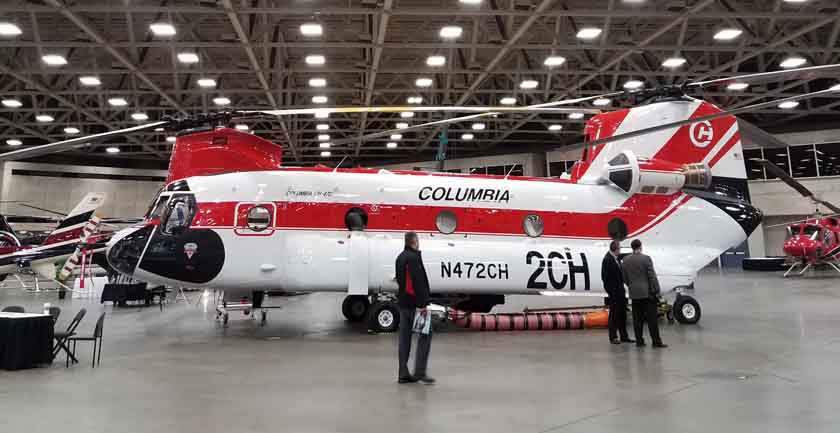
One of their ships was on display during the HAI HELI-EXPO conference in Dallas earlier in March. Thanks go out to Mark Johnson at Columbia for the photo and videos.
Columbia CH-47D Chinook at the HAI HELI-EXPO 2017 conference in Dallas earlier in March. Columbia photo.
When the National Interagency Fire Center started mobilizing aircraft to the central plains after a million acres burned in Kansas and Oklahoma, they dispatched the helicopter you see in the photo above while it was at the conference.
Keith Saylor, Director, Commercial Operations, for Columbia explained that transitioning the helicopter from a static display to a mission-ready firefighting aircraft involved removing the rotor blades, exiting the convention center, then reinstalling the rotor blades. This was followed by a flight to a nearby airport for refueling and overnighting. Called up on March 9, the helicopter was deployed the following day to Ardmore, Oklahoma with two pilots, five mechanics and ground support equipment drivers.
A 2,800-gallon internal water tank being loaded into a Columbia CH-47D Chinook. Screen grab from Columbia video.
The video below shows one of the CH-47D’s making a water drop.
The next video is a Columbia promotional video, but it has some brief interior shots of the internal tank system.
Above: One of Billings Flying Service’s CH-47D Chinooks, at Custer Airport, April 3, 2016.
On Friday Billings Flying Service unveiled their new 24,000 square-foot hangar and maintenance facility near the airport in Billings, Montana (map). It has enough room for four to five of their Chinook helicopters, depending on if rotors are installed on the aircraft.
The company has at least six Chinooks and in 2014 became the first non-military owner of CH-47D’s when they purchased two from the U.S. government. Gary Blain, a co-owner of the company, and another pilot flew the two helicopters from the Redstone Arsenal in Huntsville, Alabama to the company’s facilities south of Billings, Montana near the Yellowstone River.
Anything you do with aircraft is expensive. Mr. Blain told us at the time that they spent $32,000 for fuel during their two-day trip, with an overnight stopover in Norfolk, Nebraska.