The U.S. Forest Service has scheduled an “Airtanker and Water Scooper Forum” to be held in Boise November 19-20, 2013. Today they posted a notice about it at the GSA site that is normally used for solicitations about contracts and requests for proposals, fbo.gov — an odd way to advertise a conference. It even has a Solicitation Number (SN-2014-01). But, almost everything the federal government does concerning fire aviation is odd.
This is rather short notice for a meeting like this.
The topics include:
Questions (preferably submitted in advance) and answers.
Review of accidents.
Future strategy for airtankers, VLATs, and water scoopers: next-gen, legacy, budgets, fleet design, aerial supervision, policy and operational changes, pilot practical test standards.
Contracts Q&A.
Aviation audits.
Technology: ATU, AFF, AFUE.
Aviation program updates: FAS-AVID report, night flying, public aircraft operations, retardant avoidance areas.
Speaking of aviation, I checked into air fares between Rapid City and Boise and was shocked — $858 was the lowest. Holy Crap. RAP is expensive to fly out of because of a lack of competition.
Thankfully, as far as I know there is no admission fee to attend the Forum.
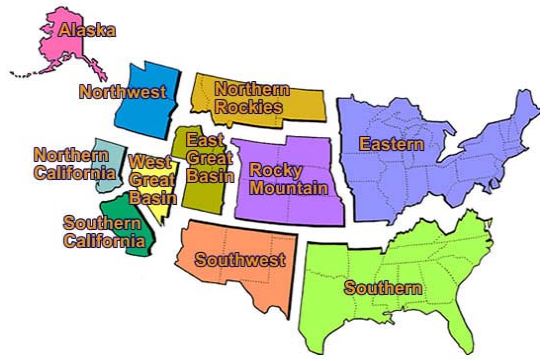
The Eastern Great Basin and Western Great Basin Coordination Centers will merge and be located in a new facility in Salt Lake City. The federal agencies involved say the consolidation will save money and improve response time in getting resources to wildfires and other incidents. The centers, currently located in Salt Lake City and Reno, are responsible for mobilizing resources for wildland fire, prescribed fire and other all-hazard incidents primarily in Nevada, Utah and southern Idaho, plus small portions of California, Wyoming and Arizona.
The decision to consolidate was made after a study by the participating agencies that examined criteria including the safety of the public and firefighters; providing services at the same or higher level than the two existing organizations; proximity to other offices and an airport; minimal disruption to employees; technological capabilities; and overall efficiency. The consolidation will save about $305,000 a year after one-time moving expenses and will affect up to five employees in Reno, all of whom will be offered positions at the new center.
The coordination centers are two of eleven such organizations throughout the country. The centers also provide intelligence and meteorological products to wildfire personnel. Participating agencies include the states of Nevada, Utah and Idaho; BLM; the Forest Service; Bureau of Indian Affairs; National Park Service; and the Fish and Wildlife Service.
Five options were considered, ranging from status quo to consolidating facilities in Salt Lake City, Reno or Boise.
The target start-up date for the new Great Basin Geographic Area Coordination Center is April 2014.
****
Our thoughts
I always thought it was strange that the Great Basin was divided into basically two Geographic Area Coordination Centers — and, that California is broken up into two as well. How long do you think it will before California’s North Zone and South Zone merge?
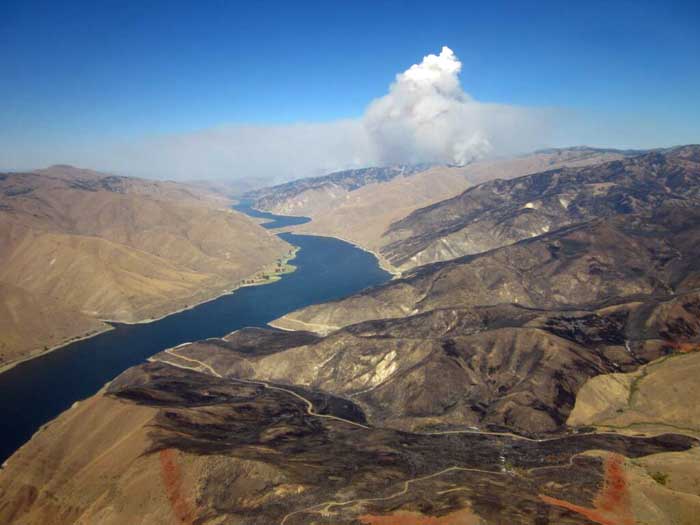
Hells Canyon Fire in foreground, Raft Fire in the distance. Photo by Keith Lannon.
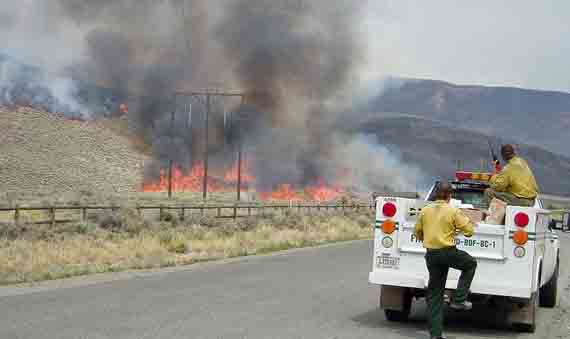
Firefighters are beginning to get a handle on one of the two fires burning 70 miles northwest of Boise, Idaho. The Raft and Hells Canyon fires are three miles from each other on the east side of Brownlee Reservoir.
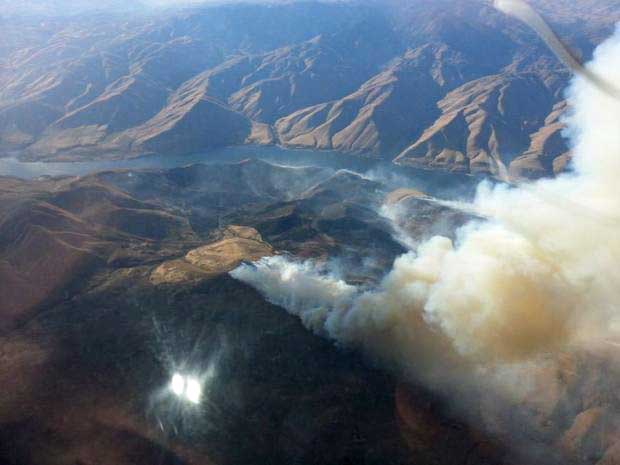
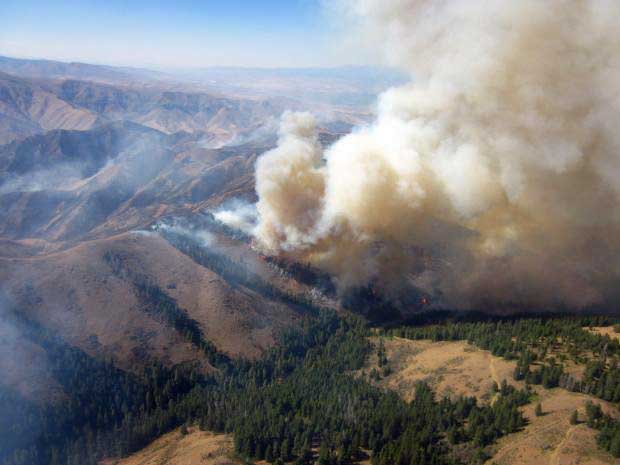
The Hells Canyon Fire only grew by 10 acres Saturday, bringing the total to 9,373 acres. It is 85% contained. The Raft has burned 12,000 acres, is only 8% contained, and is actively burning within Benton Creek on the Payette National Forest.
A Type 2 Incident Management team with Mike Whalen as the Incident Commander will assume command of the fires Sunday. They will be managed as the Weiser Complex.
Hells Canyon Fire August 29, 2013. InciWeb photo. Raft Fire burning in Benton Creek August 31, 2013. InciWeb photo.
Jake Niece sent us some photos tanken at the Beaver Creek Fire southwest of Ketchum, Idaho. This is just a sample of his excellent photography, more of which can be seen at his web site.
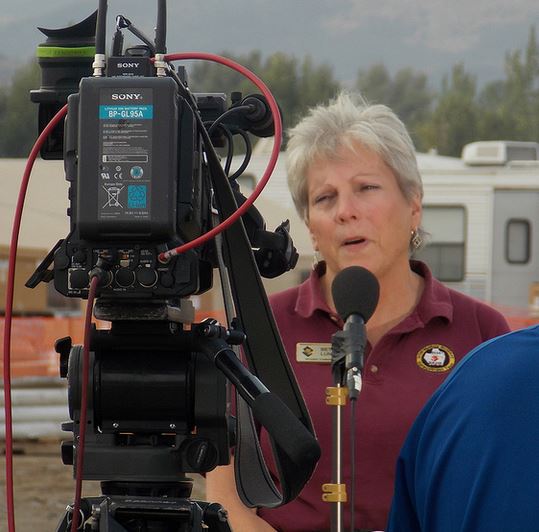
Beth Lund, Incident Commander. Incident Management Team photo.
Beth Lund is one of two female Incident Commanders on Type 1 Incident Management Teams, the largest and most capable teams that run large incidents. Jeanne Pincha-Tulley is the other.
Ms. Lund’s Type 1 Team has been managing the Beaver Creek Fire near Ketchum, Idaho which is one of the fires getting a lot of national media attention due to the number of acres burned, 111,000, and the movie stars homes that have been threatened by the fire. The Idaho Mountain Express has an article about her. Here is an excerpt:
In the modern world of firefighting, mavericks are discouraged, a strong and flexible mind excels and only quiet competence is rewarded.
It’s in this world that a 58-year-old woman, who is halfheartedly eyeing a retirement in which she will learn to quilt, has risen to become the face of fire news at its best and worst.
She is one of only two women in the already tiny national cadre of 16 U.S. Forest Service Type I incident commanders—the people who try to tame the most complicated wildland fires.
“My policy is to tell what I know and to tell the truth while being mindful that we don’t want people to hear it from the news first,” says Beaver Creek Fire Incident Command Leader Beth Lund.
She’s been the calm center in a relentless stream of media and public inquiry since arriving nearly two weeks ago to manage and expand the efforts to repel the fire that threatened the length of the Wood River Valley.
Even in the diciest moments as she bounces from gathering recon to live TV on demand, to fielding questions from strangers, with nearly every step she takes, she remains unflustered—even when she delivers unsavory news.
Traci Weaver and Beth Lund accept a card from the Wood River community. Incident Management Team photo. Burnout operation on the Beaver Creek Fire. Incident Management Team photo.
It’s just a guess, but what you see in this photo of Tanker 910 over the Beaver Fire in Idaho may be evidence of what led to the replacement of the number two engine last week. The image is a screen grab from the video below which has many excellent still images from the Beaver Creek Fire.
This video has some excellent photos of the Beaver Creek Fire southwest of Ketchum, Idaho. If you look closely, you’ll see evidence of what required the replacement of the number two engine on air tanker 910, a DC-10.
This video of scenes from the Beaver Creek Fire has some excellent fire and aviation footage. It’s a little over-edited, but you won’t be bored during the three minutes.
Here is the description from SCVP Cordovano Video & Production:
I shot this video before, during and after being evacuated from my home due to the Beaver Creek Wildfire. I am taking this chance to celebrate the power of nature and its natural cycles as well as celebrating the power of modern technology.
An arrangement has been made to write a movie script for John N. Maclean’s book The Esperanza Fire: Arson, Murder, and the Agony of Engine 57. Legendary Pictures has closed a deal with Sean O’Keefe to adapt the book about the 2006 entrapment and deaths of the five firefighters who were working on U.S. Forest Service Engine 57.
We talked with Mr. Maclean in February when he signed the movie rights deal with Legendary Pictures. He told us then that while the contract had been signed, including the stipulation that he will serve as a consultant, there are many steps that have to be completed before it appears on the big screen. The producers must arrange for someone to write the screenplay, financing has to be arranged, and actors have to be signed — just to name a few. So, the first of those three important steps has begun. But many scripts never become movies, Mr. Maclean said.
The arsonist who started the fire, Raymond Oyler, was found guilty of five counts of first-degree murder, 20 counts of arson, and 17 counts of using an incendiary device to start fires. He was sentenced to death.
The firefighters who died were engine Capt. Mark Loutzenhiser, 44, of Idyllwild; engine operator Jess McLean, 27, of Beaumont; assistant engine operator Jason McKay, 27, of Phelan; firefighter Daniel Hoover-Najera, 20, of San Jacinto; and firefighter Pablo Cerda, 23, of Fountain Valley.
Numerous lightning strikes, some of them without rain, started several dozen new fires in the Sierras and in southern California. On Sunday 24,681 strikes were recorded in the state, but so far firefighters have kept the fires small. Scattered mostly dry thunderstorms are predicted to continue through Monday followed by widespread thunderstorms with wetting rain in the Sierras Tuesday through Thursday.
The National Weather Service has issued a Red Flag Warning due to the possibility of dry lightning in combination with gusty winds for most of the foothills and mountains of Northern California.
Aviation
There are three new articles over at Fire Aviation.
Tanker 910, a DC-10 Very Large Air Tanker, experienced an engine failure coming off of a drop on the Beaver Creek Fire in Idaho on Thursday, August 15.
Minden Air Corp has made a video available of the takeoff for the first flight test of their Tanker 46, a converted BAe-146, which occurred June 9, 2013.
An Air Tactical Group Supervisor (ATGS) has completed a detailed comparison of the use of a DC-10 Very Large Air Tanker (VLAT) and P2V Large Air Tankers to complete the same task of creating 4.6 miles of retardant line on the Colockum Tarps Fire,
Atlanta evacuated (not THAT Atlanta)
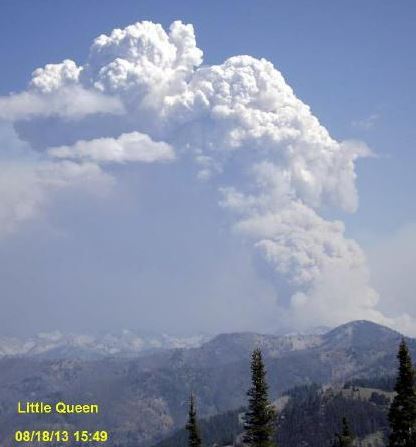
Residents of Atlanta, Idaho have been ordered to evacuate by noon today, Monday, because of the 2,000-acre Little Queens Fire burning about four miles north of the town. The majority of the fire is in the Sawtooth Wilderness and Sawtooth National Forest.
The Great Basin Type 2 Team 5 (Wilde) is being reassigned to the fire.
From InciWeb, on August 17:
Jason Greenlee is the Incident Commander, “We will manage the Little Queens Fire as a long term fire. We will monitor the fire to ensure that it does not burn into Atlanta, Idaho and plan and prepare to defend the community if the fire changes direction and moves to the south”. This strategy is being used due to the shortage of resources to fight the fire due to other fires in the area.
In case you’re not familiar with Atlanta, it is 37 miles northwest of Ketchum, ID, and 23 miles northwest of the 104,000-acre Beaver Creek Fire.