The arrow points to the approximate location of the March 4, 2021 fatality in Kansas.
A report has surfaced showing that a property owner died while conducting a controlled burn on their property in Kansas.
It occurred March 4, 2021 on the “1400 and Julinn Road Fire” in Linn County about 8 miles north-northwest of Mound City.
An Incident Status Summary, ICS-209, for the fire completed March 15, 2021 shows that a report from the local Fire Department did not indicate if the person was killed directly by the fire or if there was a medical incident that led to the fatality.
Preliminary information from the Office of the Kansas State Fire Marshal said, “The victim was badly burned in the fire, and it was believed that he was [conducting the controlled burn], and the fire over took him…When he started the burning, winds were calm. They then [increased] with gusts to 24 MPH.”
The victim was found about two feet away from a shovel.
The weather at the time, according to the ICS-209, was 69 degrees, relative humidity 25 percent, with winds out of the southwest at 15 to 20 mph. The fire was burning in grass.
The name of the victim has not been released and the autopsy report has not been completed.
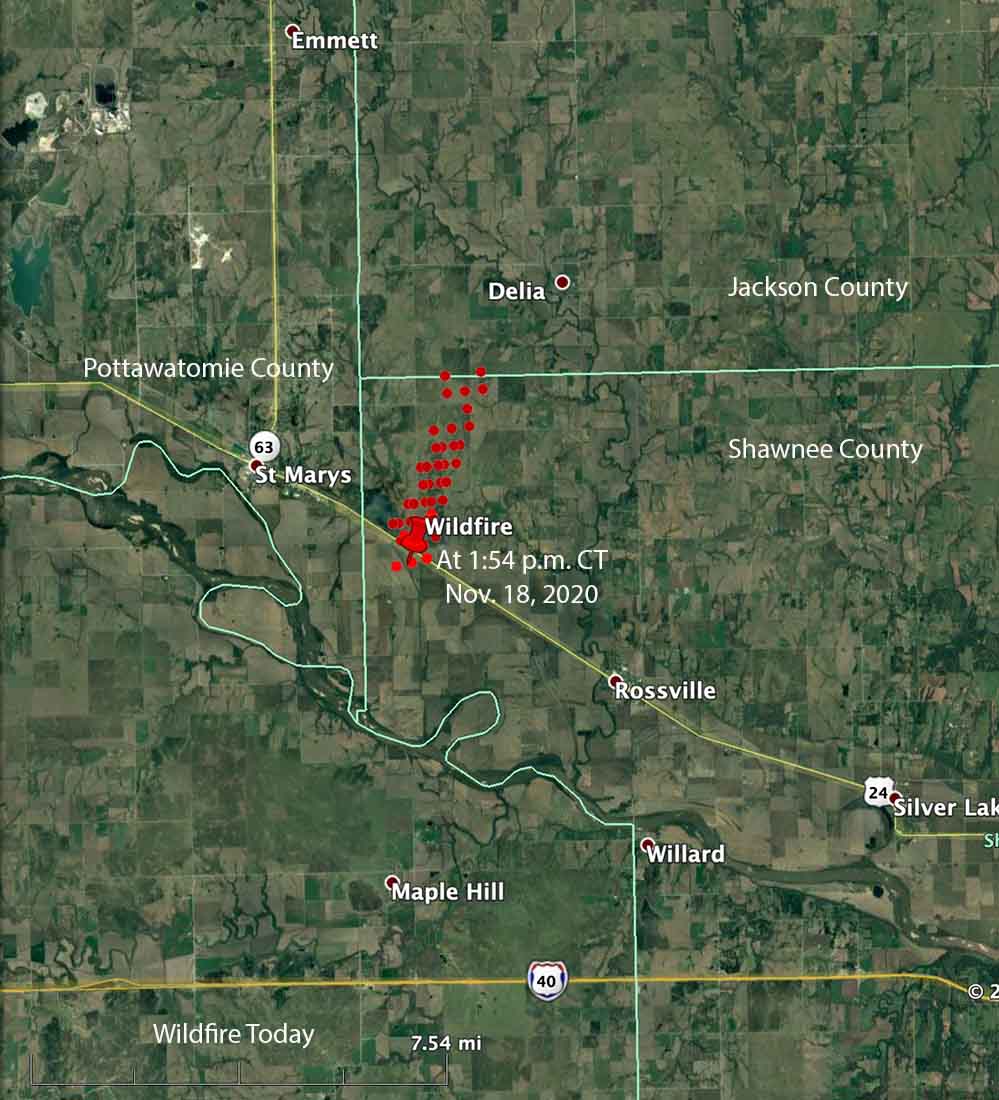
Map showing heat detected by satellites at the wildfire east of St Marys, Kansas at 1:54 p.m. CT, Nov. 18, 2020.
Firefighters in Kansas are battling a large wildfire that started about 17 miles northwest of Topeka, southeast of St Marys near highway 24. Strong winds out of the south-southwest have pushed the fire toward Delia which is under an evacuation order.
Smoke and poor visibility may have contributed to a vehicle collision on Highway 24 which injured one person and totaled the car.
At 1:54 p.m. Wednesday the fire had burned from Shawnee County into Jackson County.
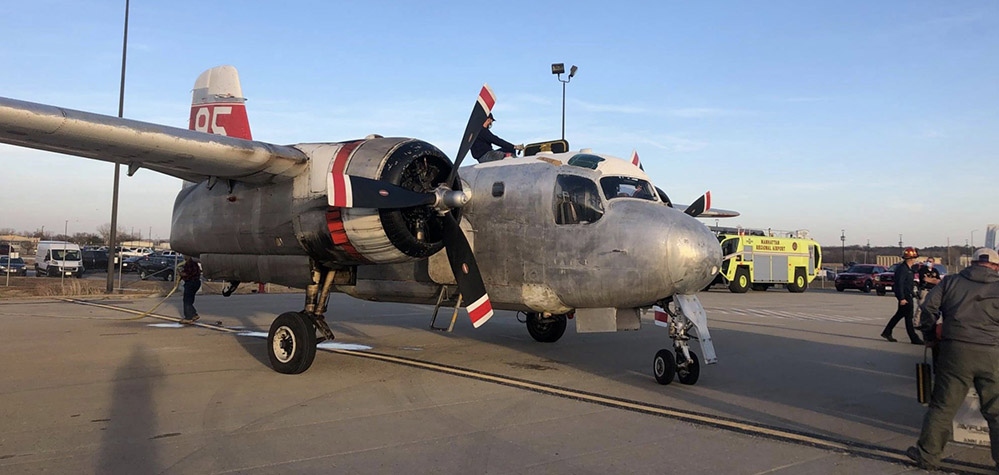
An S-2 Air Tanker, T-95, is assisting firefighters by dropping water. Personnel from the Manhattan Fire Department have been refilling it at the airport.
Personnel from the Manhattan Fire Department refill Tanker 95 with water at the Manhattan Regional Airport in Kansas, November 18, 2020. The air tanker was assisting firefighters at the wildfire east of St Marys. Photo by the Fire Department.
The area is under a Red Flag Warning for strong winds and low humidity. Wednesday afternoon at St Marys the wind was out of the south-southwest at 20 to 24 mph gusting at 27 to 39 mph, with the relative humidity around 30 percent. The forecast is for breezy conditions to continue through Thursday but the humidity will rise into the 40s Thursday.
Wildfire Today’s very rough and unofficial estimate is that the fire had burned at least 1,000 acres at 1:54 p.m. CT, Nov. 18, 2020. KSNT reported it started just before 1 p.m.
Personnel from the Manhattan Fire Department refill Tanker 95 with water at the Manhattan Regional Airport in Kansas, November 18, 2020. The air tanker was assisting firefighters at the wildfire east of St Marys. Photo by the Fire Department.
Bill Garrison’s S-2 air tanker. Screenshot from the KWCH video below.
The owner of a crop dusting service in Kansas has acquired an S-2 air tanker formerly operated by the California Department of Forestry and Fire Protection (CAL FIRE).
Bill Garrison, owner of Ag Air Service out of Nikerson, Kansas, said that after he used his crop dusters in 2017 to aid firefighters by dropping water on wildfires, he decided he wanted a bigger airplane.
KWCH reported that the Kansas Forest Service has a call when needed agreement to use the plane on fires for $4,000 an hour.
The aircraft was constructed as an S-2A, according to aerialvisuals.ca, with the BuNo 136508. CAL FIRE operated it as Tanker 81 and 93 with registration number N477DF. At some point the tanker number changed to 95, the number still used today, and was owned by Yesterday’s Flyers and later, Cactus Air Force, both in Nevada. The current registration number is N508JR under the ownership of Mr. Garrison, with a certificate issue date of February 14, 2019.
The aircraft can carry up to 800 gallons and still has the radial engines, unlike the S-2s operated by CAL FIRE today that have been converted to turbine engines.
Mr. Garrison said he used one of the company’s planes in 2017 to drop 20,000 gallons of water on the Highlands Fire in Reno County, chipping in to help when the Kansas National Guard Blackhawk helicopter pilots ran out of duty time. Below is an excerpt from Hutch News published March 12, 2017:
Because of the high winds he was forced to fly into – the same winds whipping the fire out of control – he had to fly as close to the ground as possible, or the wind would blow the water off the fire, he said. “At times, I had fire above the aircraft,” Garrison said. “We were pushing the upper limits with the wind Monday night.”
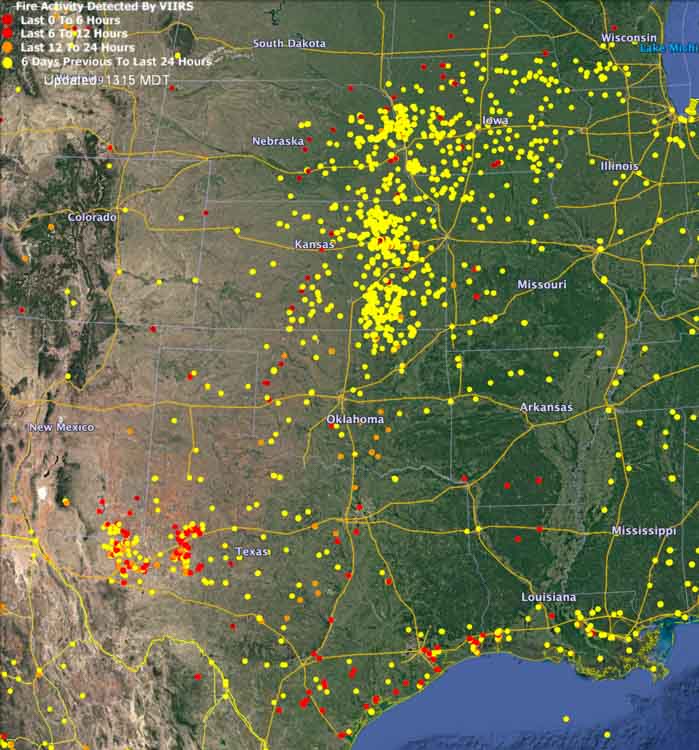
Map showing heat detected by satellites during the last seven days. Updated at 1 p.m. CDT April 19, 2019.
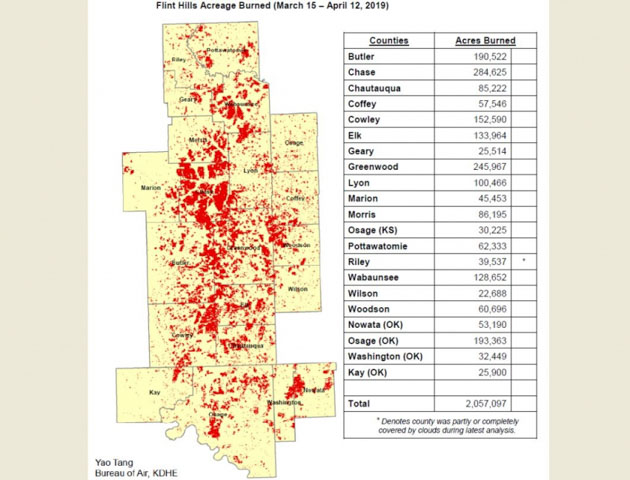
The Kansas Department of Health and Environment (KDHE) says the average annual acreage burned in the Flint Hills during the prescribed fire season was almost matched over the past month. Most of the burning is related to agriculture, improving pastures or preparing crop lands.
Almost 2.1 million acres of grassland were treated with fire between March 15 and April 12. KDHE said roughly 2.5 million acres are burned annually.
The reporting time period includes 21 counties in Kansas and Oklahoma.
KDHE said burns from April 8-9 caused six air quality exceedances across parts of Kansas, Missouri and Oklahoma. There were no air quality exceedances due to burns last year.
Thanks and a tip of the hat go out to Matt. Typos or errors, report them HERE.
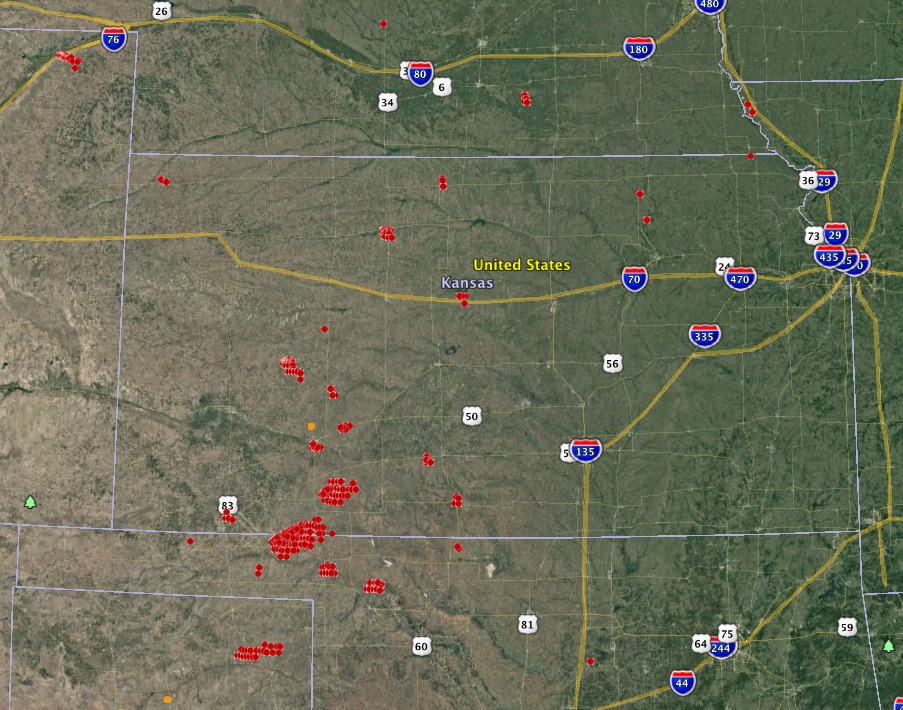
The red areas represent wildfires in Kansas detected by a satellite at 4:07 p.m. MST March 6, 2017.
After numerous devastating wildfires in 2017 the Kansas Forest Service began a program to make more single engine air tankers (SEAT) available to assist firefighters on the ground.
Below are quotes from a KSN interview of agricultural pilot Bill Garrison, one of the seven pilots that Kansas can draw upon to operate a SEAT as needed now that they have gone through a day of field and tactical training.
The quicker you are on top of the fire, fighting it, the better results you have.
When we get a phone call, we go dump water on the fire.
Flames were over the cockpit of the airplane. I was flying at night.
Fires raced through grasslands in Kansas this week, drawing the National Guard, which captured this photo.
A series of wildfires have burned thousands of acres of grasslands in Kansas this week, and while relief might be in sight, there’s still a full day of volatile conditions ahead, officials say.
“Friday will be a very dangerous day for fire weather in many areas of the state. Some areas will see catastrophic fire weather conditions,” the Kansas Division of Emergency Management said.
Most of the state is under red flag or high wind warnings with forecast to gusts up to 40 mph in some areas Friday. Temperatures around 70 degrees are expected to drop into the 50s this weekend, with rain in the forecast, according to the National Weather Service.
Fires erupted Wednesday. Kansas Gov. Jeff Colyer made an emergency declaration for three of the fires burning in Rice County and deployed Black Hawk helicopters from the Kansas National Guard to assist in the response.
According to The Wichita Eagle, state officials tracked 45 fires across the state on Thursday alone, with several breaking out in the Kansas City area. The fires burned an estimated 13,000 acres, and many remained active or out of control.
One of the farms we visted today was the site of the incredible wall of fire in this photo. I am amazed at the resiliency of Kansans and our ability to come back stronger after facing adversity. #kslegpic.twitter.com/UT8STBrfcX
— Archive: Governor Jeff Colyer, MD (@GovJeffColyer) March 15, 2018
More detailed assessments of acreage or causes were not immediately available.
About 20 percent of the state is classified as being under an “extreme drought,” according to the latest report from the U.S. Drought Monitor.
A series of wildfires raced through grasslands in rural Kansas Wednesday, scorching swaths of land and drawing local firefighters and the Kansas National Guard.
The fires began midday Wednesday, primarily in Rice County in central Kansas. Fanned by gusty winds, the fire quickly became visible on radar imagery and the GOES-16 Satellite, as shown in these images from the National Weather Service’s Wichita bureau.
At 5:15pm, the large grass fire in Rice county continues to burn. This fire is evident on both radar and satellite images. #kswxpic.twitter.com/dMZhSy1IVg
“Wind is the huge factor in the tall grass,” Rice County Emergency Management Director Greg Kline told reporters at the scene of one of the fires. “Access to some of these locations is very tough at times.”
Details about the estimated number of acres burned were not immediately available. But Kline said the three separate fires in Rice County were estimated to be about 2 miles wide and about 4 miles long at their farthest points.
— Hutchinson Fire Dept (@Hutchinson_Fire) March 14, 2018
Kansas Gov. Jeff Colyer on Wednesday morning made an emergency declaration for three of the fires burning in Rice County and deployed Black Hawk helicopters from the Kansas National Guard to assist in the response.
Plus, the entire state is currently classified as “abnormally dry” with a large pocket of southern Kansas categorized as being in an “extreme drought,”
Drought monitor, March 1, 2018. National Drought Mitigation Center.
Very high and extreme fire danger is anticipated for Thursday and Friday, with forecasted temperatures in the 70s and wind gusts up to 30 mph. Cooler temperatures and rain could be on the way for the weekend, according to the National Weather Service.