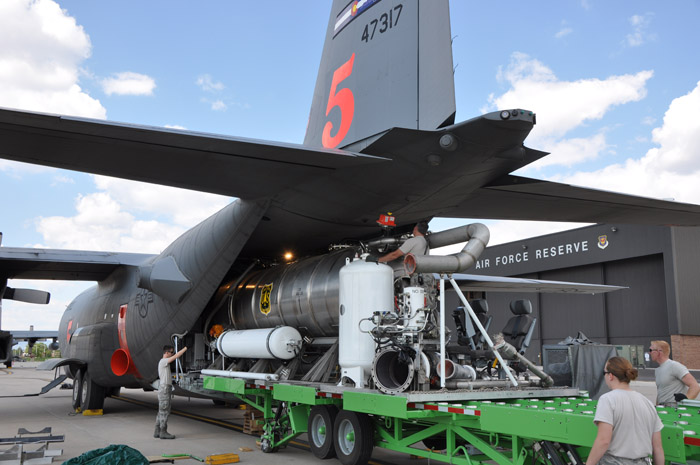
I spent part of the day Tuesday at the refresher training and recertification for the crews of four military C-130 Modular Airborne FireFighting System (MAFFS) aircraft at Cheyenne, Wyoming. Let’s see… what time was I there?

MAFFS can be activated to provide surge capacity when the small feet of contracted federal air tankers is tied up on going fires or initial attack.
Earlier we posted some additional photos of the aircraft.
The training incorporated some of the changes to the system that were influenced by the crash of one of the MAFFS air tankers, MAFFS 7, last year in South Dakota. It appeared to be very thorough. Here is the training — by the numbers:
- 4 — MAFFS C-130 aircraft plus one for backup
- 6 — Lead Planes
- 160 — people from the two Air National Guard units, plus one or two dozen ground support personnel mostly from the U.S. Forest Service
- 49 — missions
- 373 — drops
- 80 — flight hours

At Cheyenne we talked with the Air National Guard MAFFS managers from the two units participating in the joint training, Major Jeremy Schaad from Wyoming’s 153 Airlift Wing, and Lt. Col. Brian Rachford from North Carolina’s 145 Airlift Wing.
One of the changes that has been implemented is the development and use of standardized written pilot qualifications for all four military bases that can each activate two aircraft and crews. When four people on the MAFFS #7 crew were killed last year no such uniform guidelines existed. Until 2013, each Air National Guard and Air Force Reserve MAFFS base used their own criteria for determining the requirements to serve on a MAFFS aircraft. The new standards specify how many base flight hours and hours spent on previous MAFFS missions are required to be the pilot in command and the copilot. They also formalize across the four MAFFS bases procedures, training, and written manuals.
There is now an increased focus on taking the time to analyze the specific scenario for each mission, including the weather conditions and the influences of the fire.
The Air Force report about last year’s MAFFS 7 crash on the White Draw Fire said a microburst of turbulent air out of a thunderstorm was one of the causes. During a previous retardant drop on the fire about five minutes earlier, the aircraft experienced a drop in airspeed despite operating under full power. Before the second drop the crew discussed the air speed problem but decided they could adjust to the conditions. The plane crashed on the second drop. Firefighters on the ground reported very strong wind speeds about the time of the fatal drop. One estimate was 50 mph.
The MAFFS 7 flight crew obtained a detailed weather forecast for the fire they expected to fly that day in 2012, the Waldo Canyon fire at Colorado Springs, but they did not have one for the fires in South Dakota, nor did they request one when they were diverted from the Arapaho Fire in Wyoming to fires in South Dakota.
The last time the four MAFFS bases sent their eight aircraft and crews to one location for joint training was in 2010. In 2012 all four bases conducted the training on their own. This year the California and Colorado bases each did their training independently, and the Wyoming and North Carolina bases joint-trained in Cheyenne.
The crash report did not specifically state that the lack of joint training the year of the accident was an issue, but it did say this:
Local training did not include different terrain conditions, density altitudes and congested pit operations, all of which are essential components in order to comprehend what live MAFFS operations entail. Additionally, all four MAFFS units were not integrated in order to provide a more realistic learning environment for new and seasoned MAFFS crewmembers.
More information: