

By Anton Beneslavskiy
I fought my first peat fire in 2020 while working as a volunteer firefighter. We poured a lot of water onto it. Despite repeatedly spraying the blackened area, the peat continued to smoulder. That was my first encounter with the trickiest wildfire.
This article is first published in Wildfire Magazine – read the full edition.
Later, while working for Greenpeace Russia’s fire prevention programme, I fought peat fires in Siberia and the European part of Russia, from Buryatia in the east to the radioactive marshes of the Bryansk Oblast. In 2016, we launched a similar programme in Greenpeace Indonesia, where I tackled some of the most impressive peatlands I have ever seen.
What have I learned? Peat fires are tricky, hard to detect and suppress, and it’s difficult to be sure the work is done properly. Peat fires can pop up weeks after fire crews have left the scene, convinced that there is no burning in the soil.
Greenpeace Russia has now been banned, and I fled my country to settle in the United Kingdom. What I see now is so similar to what I saw previously.
Wildfires across Europe are breaking records. France, Spain, Greece, Germany, Austria, Belgium, the UK and Ireland are affected. Lives lost, nature destroyed, people evacuated, houses burned. The media is full of images of terrifying flames.
In the flood of fire information, we overlook a threat that is less spectacular but no less terrifying: many UK and Irish fires, including the biggest ever in Belgium, are burning in peatlands, creating a high risk of long-term smouldering peat fires.

The emissions
Peatlands are incredible wetland ecosystems that can accumulate up to 600 gigatons (Gt) of carbon in their soil, making them crucial for climate regulation; they can be found in the boreal zone and throughout the tropics. Peatlands are an integral part of Northern European natural landscapes and are critical to some of the world’s most important forest ecosystems. Peatlands are home to a wide variety of species. However, peatlands can present a significant challenge in the event of a wildfire.
Human activities are damaging peatlands through drainage, peat harvesting, and conversion into agricultural land and plantations; this leads to the emission of 1.3-1.9 Gt of carbon dioxide equivalent (CO₂e) each year. Peat fires also emit 0.2-1.5 Gt CO₂e annually. In the UK, peat fires have been responsible for 90 per cent of annual wildfire-related carbon emissions since 2001. Peat accumulation is a slow process, taking centuries, so even if burned peat could be restored, it would take far more than the time available for climate mitigation.
In addition to fuelling climate change, large-scale peat fires cause severe damage to public health by producing smoke haze. The peat fires in Indonesia in 2019 are estimated to have caused 87,000 excess deaths.
Today, more peatlands are at risk of burning, while the effectiveness of peat fire suppression is far beyond what is necessary.
After working on the issue of peat fires for more than 10 years, both as a firefighter and an environmentalist, I have concluded that a peat fire is the trickiest enemy a wildland firefighter can face: it is not the most terrifying or the most powerful, but it is undoubtedly the trickiest.
The fuel
What makes peat fires so special? The fuel. Peat is formed in specific conditions in peatlands from sphagnum moss and other species. Limited oxygen during formation slows decomposition, but its high carbon content makes it highly flammable.
Peat can smoulder underground without oxygen. Even with a 5:1 water-to-peat ratio, smouldering can continue. During smouldering, peat converts into a solid substance that prevents wetting. Suppression requires large amounts of water (at least one ton per 1 m2) and a high-pressure water jet to destroy smouldering peat conglomerates.
The relative flammability of peat depends on multiple factors. Long-term droughts, a lack of humidity and intensive surface fires altogether create ideal conditions for peat ignition. Therefore, we can expect an enormous number of smouldering peat spots in areas where the fire has passed through the peatland surface.
Once ignited, peat smoulders often without visible flames, and in the early stages of small-scale burning spots, it produces a very low amount of smoke, making it hard to detect without special technical devices such as portable thermal infra-red or special thermometers.
The challenge
Although peat fires spread slowly, they still present a serious challenge to firefighters because they’re difficult to detect, size up, control, and monitor post-fire. In addition, there are hot caves filled with smouldering peat and ash, toxic smoke, high carbon monoxide levels, and fires that can start again in random places. Fighting peat fires requires application of specific LACES protocols (lookouts, anchor points, communication, escape routes, safety zones).
Even a small particle that continues to smoulder can reignite a peat fire days or weeks after firefighters have left the scene. In the most basic terms, peatland firefighting is 90 per cent mop-up. It is dirty, hot and unglamourous work. While for most wildland firefighters mop up is only the last stage of battling flames and is definitely the least fancy one, the mop up is the main and sometimes the only way to put out a peat fire.
Climate change now ruins usual fire dynamics and assumptions, and this is true also for peat fires. For a long time, most peat fires occurred only in drier drained peatlands where the peat was exposed to surface vegetation fires; today even undrained peatlands in their natural state are catching fire.
When peat fires cease to be a rare, exotic phenomenon and become a regular occurrence – as has long been the case in Russia and Indonesia – they will become a real disaster for many countries in Northern Europe.
The situation
Ireland is an interesting study case in point: Peatlands in Ireland cover an area of around 1.66 million hectares (approximately 23 per cent of the country’s territory), and their depth varies considerably depending on the type of bog – raised bogs have an average depth of 7.5 metres (with maximum depths of up to 12 to 13 metres), while blanket bogs in mountainous and lowland areas have an average depth of between two and four to six metres.
By contrast, Peatlands in the United Kingdom cover around three million hectares (approximately 12 per cent of the country’s land area). The depth of the peat layer varies considerably: in mountainous blanket bogs it ranges from one to five metres, while in lowland raised bogs it reaches five to 10 metres or more.
Peatlands comprise an enormous amount of fuel that is potentially exposed for ignition due to climate change, and emissions from these fires become a climate change contributor in their own right. Again, Ireland becomes a useful study point – according to EFFIS (European Forest Fire Information System) between July 15 and Aug. 14, 2026, more than 2220 hectares of mainly peat-based wildfires produced almost 170,000 tonnes of carbon dioxide, that was previously sequestered within the peat fuels affected by these fires. This represents a significant increase on expected average annual levels of approximately 90,000 tonnes arising from wildfire activity.
Recent fires in Ireland also prove that the new reality has come: if fires of this scale are possible in the country with traditionally humid and cool weather, then what should we expect elsewhere? There are no large-scale wildfires in peatlands reported in Germany, Belgium, Netherlands and Scandinavian states, but we are still in the middle of the season, and drought conditions continue to climb daily.
So, we are dealing with fires that come to the new areas due to climate change, that are easy to start, hard to detect and size up, hard to suppress, and hard to control. At the same time these fires are out of the scope of many fire services. There is no significant experience of managing this type of wildfires outside of a very few countries, and even regions within these countries, and as a result there are no internationally standardised methods, no strategies, no guides and no special equipment.
We are a little more than halfway through the fire season, but the total area affected by wildfires on peatlands in Ireland in 2026 has already reached approximately 2950 hectares, of which 2200 hectares is the area affected by problematic peat fires – that is, fires that were thought to have been extinguished but have flared up again. A similar situation exists in Scotland.
The fire services carried out the operations in accordance with current standards. However, these standards do not consider the specific nature and suppression requirements of underground peat fires.
Reignition is caused by active and widespread underground peat burning. Small pockets of fire can survive initial extinguishing efforts, even when water is used, and cause the fire to reignite once the surface fire has been deemed extinguished. Detecting a peat fire at an early stage is difficult, but particularly so in recently burned areas while firefighting efforts are ongoing. Smouldering vegetation in the wake of the fire masks the peat fires, which emit relatively little smoke. However, even at an early stage, extinguishing a peat fire is difficult – it requires a large volume of water, delivered under pressure directly into the centre of the fire. Simply spraying the burning peat with a mist of water will certainly not be enough – after all, peat has evolved to absorb and hold water.
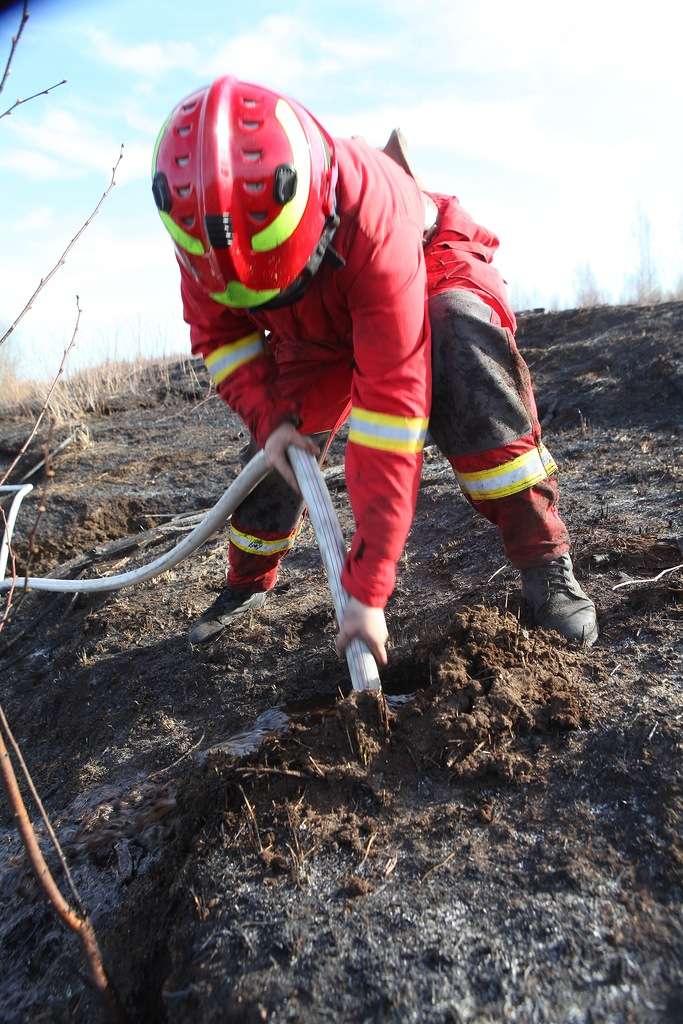
A special team of Greenpeace firefighters fights a peat fire in a radioactively contaminated marsh in Bryansk Oblast in 2019. Strategies used to fight peat fires in Russia and Indonesia could be implemented by firefighters in Northern Europe if and if a proper peatland firefighting culture can be developed and adapted.
The tools
My experience fighting peat fires in Russia and Indonesia shows we must adapt to deal with this threat. Greenpeace fire crews have developed technologies and skills for early detection, effective triage, proper use of resources and comprehensive post-fire control. This meant our small team could respond to and prevent multiple peat fires.
GIS systems and software allowed us to identify surface fires and prioritise potential fires. This enabled us to react quickly with small crews and provide on-ground reconnaissance with infrared-vision drones and portable infrared systems to identify all the burning spots. If this work was done in early spring, each burning spot required limited resources and time to be suppressed. Specialised thermometers and infrared devices allowed us to effectively control post-fire reignitions.
Our teams were small, mobile and properly equipped, and had relevant experience. This gave them serious advantages over regular fire units.
If the way we fought peat fires in Russia and Indonesia could be implemented by firefighters in Northern Europe, and if a proper peatland firefighting culture can be developed and adapted, we will be better prepared when peat fires became a regular occurrence in this part of the world.
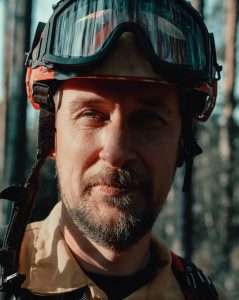
Anton ‘Benny’ Beneslavskiy is a certified forest fire incident commander, author and educator.


