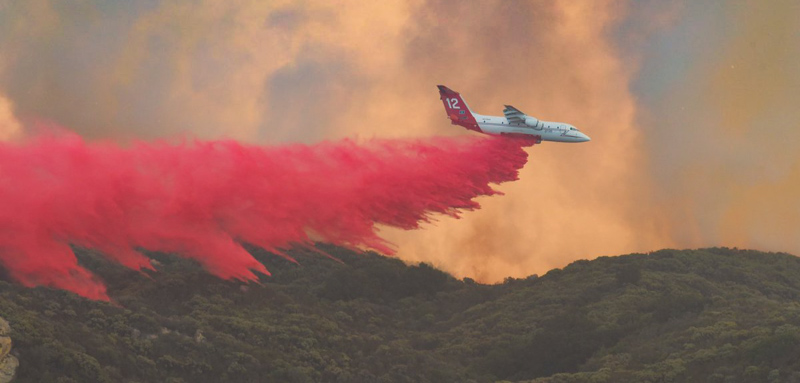
Tanker 12 moves to National Museum of Forest Service History

Neptune Aviation and the National Museum of Forest Service History in Missoula have announced a partnership to provide Tanker 12 a new permanent home. Neptune Aviation retired its Lockheed P2V airtankers in September of 2017, closing the final chapter on the world’s last active fleet of former maritime patrol aircraft, dating back to the Cold War era, which  served for years as national aerial firefighting assets.

Tanker 12 drop
Tanker 12 drop, Neptune Aviation photo

“The Museum is a perfect home for Neptune’s T-12,” said Jennifer Draughon, president of Neptune Aviation Services. “The Forest Service has a long history of aerial firefighting operations and Neptune’s T12 will help the museum tell the story of how aircraft play a role in protecting our communities.”

Before Tanker 12 began its history as an aerial firefighting aircraft, the P2V served the U.S. Navy in anti-submarine warfare missions.

NewsTalk KGVO reported that from 1993 Neptune operated a fleet of Lockheed Martin P2V aircraft, and its ships put in about 47,000 firefighting missions, dropping a total of 97 million gallons of retardant.

Tanker 12
Neptune’s Tanker 12 during her days as a firefighter — Neptune Aviation photo

Moving Tanker 12 from Neptune’s ops base at the Missoula airport to the museum facilities is a project that’s been in the works for some time. “Our mechanics have been hard at work getting the aircraft ready for display,” said Draughon.

While T-12’s final “flight” will be just under a couple of miles, the work behind the scenes has been intense, according to Lisa Tate, the museum’s executive director. She said the P2V will be parked along the museum’s Forest Discovery Trail near the planned National Conservation Legacy Center, a new interactive and participatory part of the museum. She said the cooperation of the Missoula International Airport will help in moving T-12 to the museum.

“Moving the aircraft is no simple task,” she said. “We need to remove fences, shore up bridges, and make sure the soil is dry enough to handle the weight of a 49,500-pound plane.” She said the airport team is making sure that the historic airtanker’s journey is safe. Tate added that Knife River and Morrison- Maierle have also helped in preparations for this project.

The National Museum of Forest Service History is a 501(c)(3) nonprofit organization with a mission of sharing the history of America’s conservation legacy. Neptune Aviation Services is based in Missoula, Montana.

Photos of large air tankers working the Alisal Fire in SoCal

Tanker 101 dropping Alisal Fire
Tanker 101, an MD-87, dropping on the northwest side of the Alisal Fire, Oct. 13, 2021. Photo by SBCFD

Since the Alisal Fire started west of Santa Barbara, California on October 11 there have not been many opportunities for firefighting aircraft to work the fire due to the very strong winds. Helicopters have been able to sneak in a few times, but until yesterday and today, October 12 and 13, they have rarely been seen at the fire.

Thanks to a decrease in wind speed, today on FlightRadar24 I saw six large air tankers and two very large air tankers (DC-10s) either over the fire, flying to or from, or taxiing at the Santa Maria airport which is 31 miles northwest of the fire.

Tanker 12 dropping Alisal Fire
Tanker 12, a BAe-146, dropping on the northwest side of the Alisal Fire, Oct. 13, 2021. Photo by SBCFD

These photos are courtesy of the Santa Barbara County Fire Department.

Tanker 137 dropping Alisal Fire
Tanker 137, a 737, dropping on the northwest side of the Alisal Fire, Oct. 13, 2021. Photo by SBCFD

Wednesday morning the Santa Barbara County Fire Department said the Alisal Fire has burned 14,500 acres, an increase of 1,100 acres over the figure released Tuesday evening. The growth over the last 24 hours has been on all sides, with the exception, of course, where the fire was stopped by the Pacific Ocean on the south. Wildfire Today has more information about the fire.

Tanker 910 dropping Alisal Fire
Tanker 910, a DC-10, dropping on the northwest side of the Alisal Fire, Oct. 13, 2021. Photo by SBCFD
Alisal Fire map
Alisal Fire map 9:45 p.m. Oct. 12, 2021. The red line was the perimeter at 9:45 p.m. PDT Oct. 12, 2021. The white line was the perimeter at 4:12 a.m. Oct. 12. The red dots represent heat detected by satellites at 2:56 a.m. PDT Oct. 13.

Two air tankers activated on CWN contracts

air tanker Medford Klamthon Fire
T-102 at Medford July 5, 2018. Photo by Tim Crippin.

Two large air tankers were activated on June 9 on Call When Needed (CWN) contracts. The administrative  base for Tanker 102, an MD-87, will be San Bernardino, California. For Tanker 12, a BAe-146, it will be Redding, California. These are guaranteed 90-day contracts, not the typical CWN arrangement when they can work a few days and then be sent home.

The aircraft may or may not spend any significant amount of time at those bases; it just designates who is responsible for keeping track of their paperwork.

More large air tankers will be brought on later this month using the same guaranteed 90-day contract process.

Range Fire air tanker
Air tanker 12 on the Range Fire, August 27, 2016. Photo by Kern County Fire Department.

Two other tankers were activated at the end of May, T-104 (MD-87) and T-137 (B-737).

These 4 CWN tankers added to the 13 on exclusive use contracts brings the temporary total up to 17. It is unknown when the four CWN ships will be let go.

Not your ordinary parade float

Neptune Christmas parade Float
Neptune Christmas parade float. Neptune photo.

This photo was taken December 7 on South Higgens Avenue in Missoula, Montana. It was sent to us by Kevin McCann of Neptune Aviation who said it was designed and constructed this year by a group of very talented Neptune Aviation employees and volunteers.

It’s quite an engineering feat!

Thanks Kevin.

Air show over the Cave Fire

air tanker dropping Cave Fire Santa Barbara California
Tanker 910, a DC-10, drops on the Cave Fire Nov. 26, 2019. Photo by Mike Eliason for Santa Barbara County FD.

1:30 p.m. PST November 26, 2019

Mike Eliason of the Santa Barbara County Fire Department is one of the best Information Officers when it comes to providing information on social media about the status of wildfires. He is prolific on Twitter and judging from his production since the Cave Fire started at about 4 p.m. Monday, he may not have gotten much sleep in the last 24 hours. These five photos of air tankers were all taken Tuesday are just a sample of his work.

Check him out and follow him on Twitter:@EliasonMike

As of 11 a.m. PST on Tuesday the Cave Fire had burned 4,262 acres just northwest of Santa Barbara in Southern California. Additional information is at Wildfire Today including more of Mr. Eliason’s photography. Tuesday morning 10 air tankers and 9 helicopters were available for the fire.

air tanker dropping Cave Fire Santa Barbara California
An air tanker, either an RJ85 or BAe-146, drops on the Cave Fire Nov. 26,
2019. Photo by Mike Eliason for Santa Barbara County FD.
air tanker dropping Cave Fire Santa Barbara California
Tanker 12, a BAe-146, drops on the Cave Fire Nov. 26, 2019. Photo by Mike Eliason for Santa Barbara County FD.
air tanker dropping Cave Fire Santa Barbara California
Tanker 72, an S2-T, drops on the Cave Fire Nov. 26, 2019. Photo by Mike Eliason for Santa Barbara County FD.
air tanker dropping Cave Fire Santa Barbara California
An S2-T air tanker drops on the Cave Fire Nov. 26, 2019. Photo by Mike Eliason for Santa Barbara County FD.

35-minute turnarounds for Tanker 12 at Sunshine Fire

Sunshine Fire

Above: Sunshine Fire near Boulder, Colorado. Boulder Office of Emergency Management photo.

Tanker 12, the BAe-146 air tanker working the Sunshine Fire near Boulder, Colorado on March 19, was dropping retardant about every 35 minutes, according to Rob McClure of the CBS TV station in Denver.

After a million acres burned in Kansas and Oklahoma on March 6 and 7, the National Interagency Fire Center mobilized three large air tankers on March 10, a little earlier than usual, sending Tanker 12 to the Jeffco Air Tanker base at Rocky Mountain Metropolitan Airport and two others to the OK/KS area.

It turned out that Jeffco was only 12 miles southwest of where the Sunshine Fire started on March 19 near Boulder, Colorado. Rob McClure of CBS4 in Denver timed the interval between drops made by the BAe-146, determining it to be about 35 minutes.

Sunshine Fire Boulder
The Sunshine Fire was 12 miles northwest of Rocky Mountain Metropolitan Airport (in the foreground).

From the air tanker base the pilots could probably see the fire soon after it started. If they took off from runway 30R they would be heading straight at the fire.

In addition to Tanker 12, four helicopters and Colorado’s Multi-mission aircraft were working the incident.

Three National Guard helicopters were made available by a verbal executive order by Colorado Governor John Hickenlooper hours after the fire started. The aircraft, from Buckley Air Force Base, included two UH-60 Black Hawk helicopters, one CH-47 Chinook helicopter, as well as a refueling truck.

Firefighters limited the wildland/urban interface fire to about 74 acres according to the Boulder Office of Emergency Management. We were not there but this appears to have been a pretty aggressive initial attack, an aspect of firefighting along the Front Range that has improved in the last couple of years.

The video below was shot March 19 from the Multi-mission aircraft, showing normal and infrared images.

Three Neptune air tankers activated

On March 9 and 10 the U.S. Forest Service activated three large air tankers, apparently in response to the wildfire situation in the central plains and Colorado.

A wildfire siege involving hundreds of thousands of acres began March 6 in Kansas, Oklahoma, and the northern part of the Texas panhandle. Shortly thereafter fires started popping up in northwest Colorado and the state’s very dry front range. On March 8 when a fire began in the Black Hills of South Dakota that threatened structures and eventually burned 249 acres of timber, the Incident Commander requested an air tanker but was told it would take 24 hours to get one to the fire.

Neptune Aviation announced that three of their BAe-146’s have been deployed. Tanker 12 went to Rocky Mountain Metropolitan Airport (Jeffco) at Broomfield, Colorado, and Tankers 03 and 02 will be working in Texas, Oklahoma, and Kansas. Of course they could be moved around from those locations as needed.

The video below is about the Santa Fe fire on Friday near Idaho Springs, Colorado and includes a good view of T-12 making a drop.

Neptune’s T-03 that had been working in Chile for a month began its return flight home on March 5.

Neptune's T-03 Chile
Neptune’s T-03 before departing from Chile. Neptune photo.

Thanks and a tip of the hat go out to Bean.
Typos or errors, report them HERE.