Power outage hits Hong Kong trains, sky lantern seen as culprit

Sky lantern
Sky lantern release in Chiang Mai, Thailand. Photo by Takeaway.

A sky lantern is suspected of causing a power outage on a railroad in Hong Kong, causing four trains to be disrupted for 25 minutes until repairs were made.

Below is an excerpt from an article at ejinsight.com:


Passengers aboard the trains were forced to wait in the cars before services gradually resumed about 25 minutes later after repairs were carried out.

MTR personnel investigating the incident found the remains of a sky lantern on top of one of the trains, although the railway operator did not confirm whether it had triggered the power failure, the Hong Kong Economic Journal reported.

Earlier that day, the Leisure and Cultural Services Department (LCSD) reminded the public that it is an offense to fly sky lanterns.

Under the law, people who fly sky lanterns could face a maximum fine of HK$2,000 and up to 14 days of imprisonment.

These dangerous devices use burning material to loft a small paper or plastic hot air balloon into the air. The perpetrator has no control over where it lands. Usually the fire goes out before it hits the ground, but not always. Sometimes the envelope catches fire while in flight. Numerous fires have been started by sky lanterns. Even if they don’t ignite a fire, they leave litter on the ground. Metal parts have been picked up by hay balers causing serious problems when fed to livestock. They are banned in most U.S. states and many countries.

Roosevelt Fire approaches Highway 189/191

(UPDATED at 8:29 a.m. MDT September 25, 2018)

With the Roosevelt Fire approaching to within a quarter-mile of Highway 189/191 firefighters are again planning to conduct a burning operation on the southwest side of the road on Tuesday. They had hoped to start it Monday, but decided to postpone it.

The fire started September 15 and is 6 miles south of Bondurant, Wyoming.

Weather conditions Tuesday should be much more favorable than on Monday. After below freezing temperatures overnight, the forecast calls for 59 degrees, relative humidity in the teens, and west winds of 5 to 9 mph.

map Roosevelt Fire
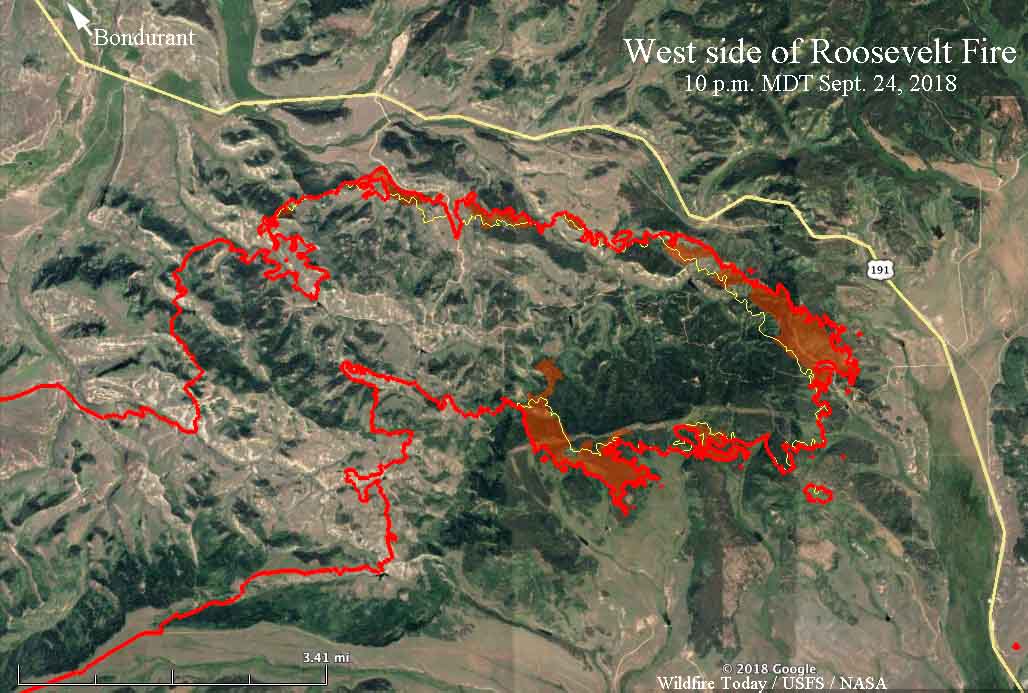
Map of the east side of the Roosevelt Fire. The red line was the perimeter at 10 p.m. MDT on September 24. The red shaded areas indicate intense heat. The white line was the perimeter about 24 hours before. Click to enlarge.

The fire grew by approximately 1,500 acres Monday to bring the total up to 49,805 acres. This was a smaller increase than in recent days, with most of the growth occurring on the east side where the perimeter roughly parallels Highway 189/191.


(Originally published at 6:27 p.m. MDT September 24, 2018)

Firefighters on the Roosevelt Fire 30 miles south of Jackson, Wyoming are attempting to fight fire with fire. Their goal Monday through Wednesday of this week is to use a backfire on the southwest side of Highway 189/191 to burn off the vegetation ahead of the fire, hoping it will serve as a barrier as the main fire spreads into the already burned vegetation.

On Monday it was a very difficult task, with 10 to 12 mph winds out of the west and northwest gusting at 20 to 26 mph. These conditions could increase the chance of spot fires across the highway from burning embers lofted by the strong winds.

map Roosevelt Fire
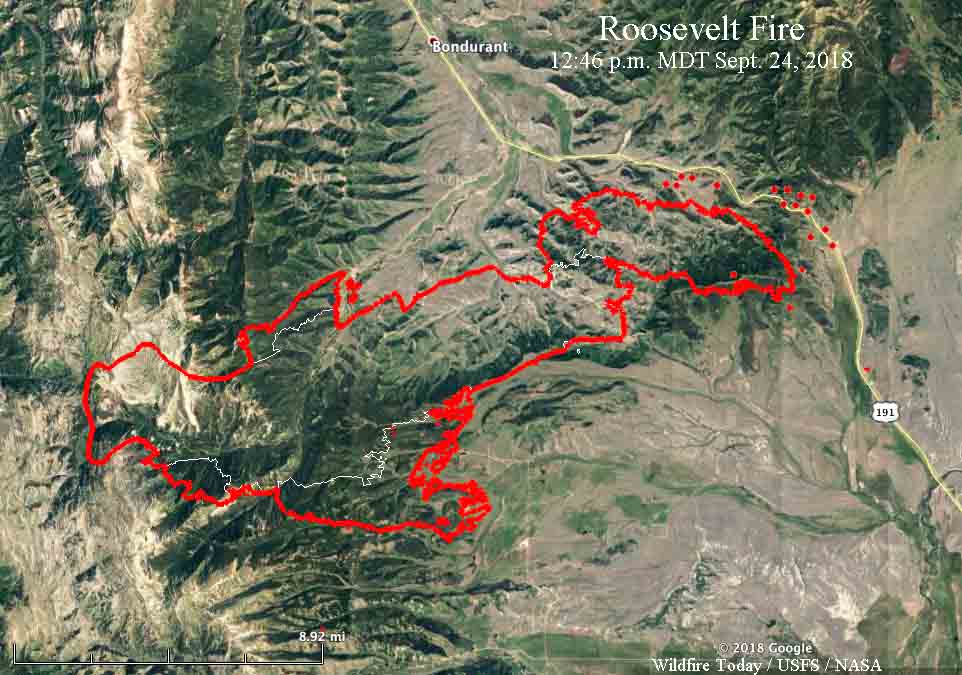
Map of the Roosevelt Fire. The red line was the perimeter at 9:20 p.m. MDT on September 23. The white line was the perimeter on Sept. 19. The red dots near Hwy. 189/191 represent heat detected by a satellite at 12:46 p.m. MDT September 24, 2018.

A Red Flag Warning is in effect for the area until 8 p.m. Monday. For Tuesday through Thursday the wind will decrease significantly. The temperatures will range from the teens at night to the 60’s during the day with little chance of precipitation. Those conditions should give firefighters a chance to make progress against the fire.

The fire is five miles south of Bondurant.

A mapping flight Sunday night at 9:20 determined that the fire had burned 48,348 acres.

How fighting wildfires works

how fighting wildfires works
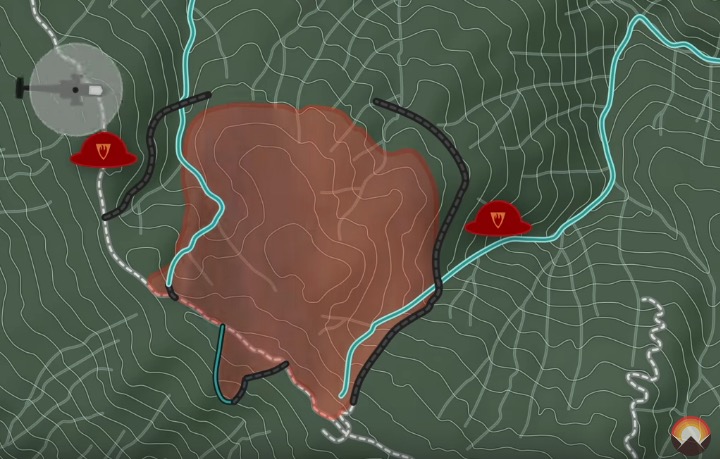
Screenshot from the video below.

This video, intended for those unacquainted with the subject, explains how firefighters control wildfires.

Winners announced for contest to build deployable device to monitor wildfire smoke

Wildland fires produce significant air pollution, posing health risks to first responders, residents in nearby areas, and downwind communities.

The existing air quality monitoring hardware is large, cumbersome, and expensive, thereby limiting the number of monitoring stations and the data that is available to help officials provide appropriate strategies to minimize smoke exposure. They can’t be easily moved to the latest areas that are being affected by wildfire smoke.

Last year the Environmental Protection Agency in association with the U.S. Forest Service, National Park Service, and other agencies issued a Wildland Fire Sensors Challenge to spur the development of a transportable device that could measure some of the byproducts of combustion produced by vegetation fires. They offered prizes for the first and second place entries of $35,000 and $25,000.

The goal was a field-ready prototype system that could be set up near a fire that was capable of measuring constituents of smoke, including particulates, carbon monoxide, ozone, and carbon dioxide over the wide range of levels expected during wildland fires. It was to be accurate, light-weight, easy to operate, and capable of wireless data transmission, so that first responders and nearby communities have access to timely information about local air quality conditions during wildland fire events.

The winners have been announced:

Sensor Challenge Winners
EPA

Jason Gu of SenSevere/Sensit, a co-developer of the first place winning system, said they have a number of units in the field now being tested under real world conditions. They also want to install them near existing air quality monitoring stations to ensure that the data from the new design is comparable to data from the old-school stationary equipment that has been used for decades. When they are satisfied with the results, manufacturing will be the next step.

smoke monitor air quality sensors
SenSevere/Sensit

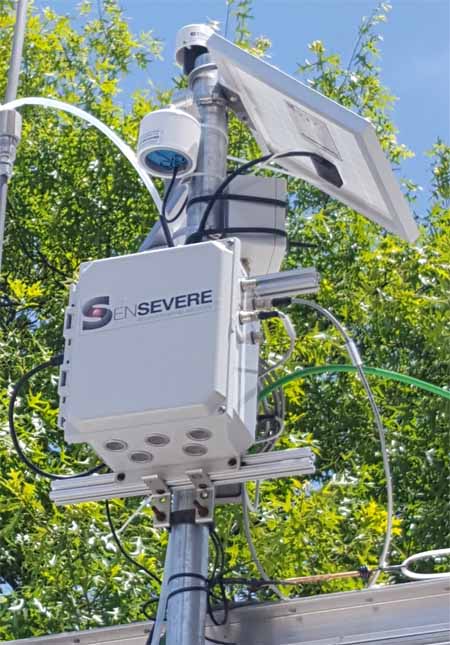
The SenSevere/Sensit unit has a battery that can last for three weeks but will have a solar panel to keep it charged. The device can transmit the data via a cellular connection or a radio. All of the sensors are made by SenSevere/Sensit. Their smoke sensor uses a blower that pulls air through a filter which removes the larger particles, and then a light beam detects the remaining very small PM2.5 particles, the ones that can be ingested deep inside a person’s lungs.

The video below has more information.