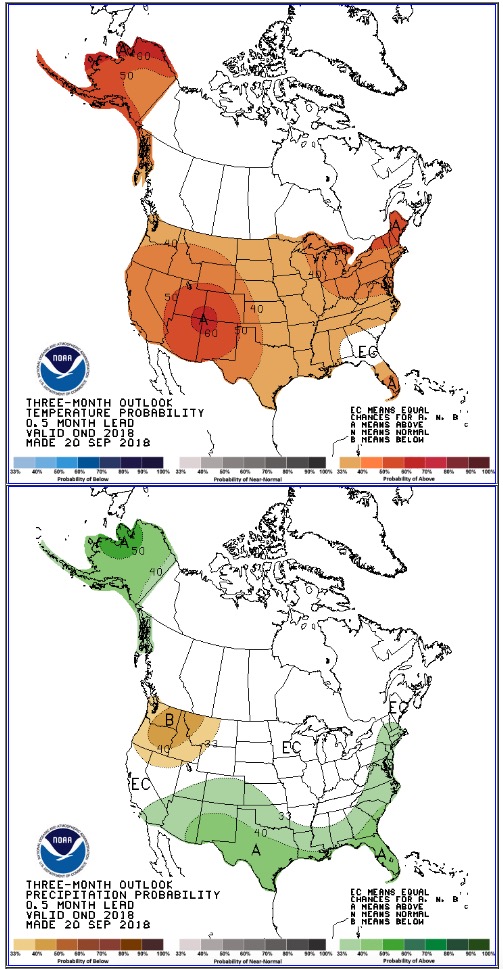
Today the National Weather service issued their long range temperature and precipitation outlooks for October through December. If their forecast is correct almost all of the United States is likely to have higher than normal temperatures the rest of this year. The precipitation outlook is more varied, with the Northwest expecting below normal amounts, while the Southwest, Southern Plains, the Gulf Coast and East Coast should receive above normal precip.
On Tuesday four U.S. Senators signed a letter urging federal officials to resume publication of wildfire training materials in Spanish as well as English.
The letter from Senators Ron Wyden, Jeff Merkley, Dianne Feinstein, and Kamala Harris follows a report that the National Wildfire Coordinating Group no longer publishes training materials in Spanish for wildland fire crews.
“Given that a significant number of these brave wildland fire crews speak Spanish as their native language, it would be wiser and safer to provide bilingual training materials,” the senators wrote in their letter to National Wildfire Coordinating Group Chairman Garth Fisher. “The alternative is to risk danger and harm by requiring that all firefighters rapidly attempt to understand training materials that are only available in English.”
The senators urged the NWCG to begin producing bilingual versions of key manuals like the Incident Response Pocket Guide.
“Firefighters must be provided with clearly understandable, updated training materials so that they can operate safely and respond to wildfires expeditiously and efficiently,” the senators wrote.
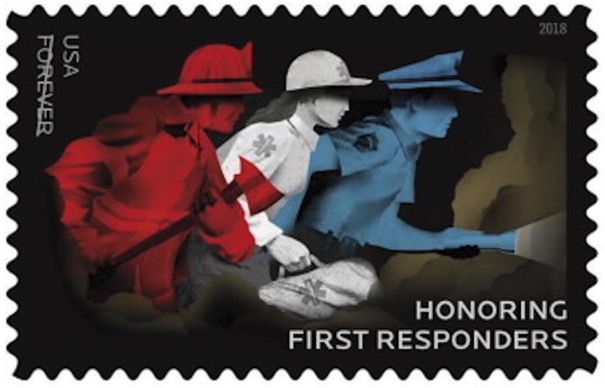
The U.S. Postal Service went to the Aerial Fire Depot and Smokejumper Center in Missoula, MT on September 13 for the first-day-of-issue ceremony for a stamp that honors first responders.
“Our nation’s first responders rush into life-threatening situations for the benefit of others,” said Guy Cottrell, the Postal Inspection Service’s Chief Postal Inspector and dedicating official. “The Postal Service is pleased to honor their skill, dedication and unfailing bravery with this stamp.”
Artist Brian Stauffer worked with art director and designer Antonio Alcalá and designer Ricky Altizer to create this stamp. As a contributing artist to The New York Times, Time magazine, The New Yorker and other publications worldwide, Stauffer’s illustrations are best known for bridging traditional and digital realms to create a conceptual take on social issues.
Our take:
It is wonderful that the Postal Service is honoring first responders. They don’t receive enough credit and recognition. Congrats, USPS. However, I doubt if the Postal Service personnel saw anyone at the smokejumper base outfitted like the folks on the stamp.
By the way if you have not bought any stamps lately, these babies will set you back $0.50.
Google Earth, the software that has aerial imagery from all over the world, now has satellite photos of the Thomas Fire. The photo above is from December 13, 2017. To see the fire images you will need to zoom in fairly close and select imagery from December, 2017 (View/Historical Imagery). The photos are from December 4 through 18, 2017.
The Thomas Fire burned 281,893 acres in December, 2017 near Ventura, California, making it for a surprisingly short time, the largest wildfire in recent California history. It destroyed 1,063 structures, damaged 280 more, and set in motion the factors that led to a series of flash-floods and landslides that killed 21 residents. Seven months later the Ranch Fire east of Ukiah became the largest in the recent history of the state, burning 410,000 acres.
Thanks and a tip of the hat go out to Robert. Typos or errors, report them HERE.
In 2009 we first started hearing about concepts for unmanned air tankers when John A. Hoffman applied for a patent for UAVs that would be transported by a mother ship and released near the fire. They would fly to the fire and drop retardant, and then intentionally crash, or in another variant, fly to an airport and land.
In 2013 Nitrofirex developed the idea further by producing a video. Their UAVs would also be transported in a large mother ship and released through the rear cargo door. The folded wings would deploy and the aircraft would glide autonomously to the target then “automatically and with great precision” release the water or retardant. The small engine which had been idling would power the ship back to the tanker base where it would be reloaded and inserted back into a mother ship.
But we have not heard of anything real being built or flown.
Next up: Faradair. They have advanced the concept of an unmanned air tanker by producing a photoshopped image of a tri-wing UAV dropping water on a vegetation fire (at the top of this article). The website says it would carry up to 2,200 gallons and would have a hybrid propulsion system, electric and an internal combustion engine. This would be a variant of a model they are considering that is intended to carry six to 10 passengers in a quiet aircraft with short takeoff and landing capability.
Concept aircraft by Faradair.
Faradair’s main goal apparently is to produce an inexpensive small passenger aircraft for commuters or quick flights that could takeoff and land from short runways and be quiet enough to operate in areas with noise restrictions — hence, the electric motor option. It would takeoff with the electric motor then switch to the internal combustion engine. The air tanker variant is derived from the goal of the basic design to be multi-role.
Here is an excerpt from their website:
“To date, former WWII era bombers and converted civilian jets have been used to deliver large scale firefighting capability, but that scale increases costs and pilot risk. The 11 meter wingspan BEHA M1-AT with a 10 tonne payload capability offers the operator an opportunity to acquire a fleet of aircraft, for a fraction of the acquisition and operational costs of helicopters, flying in rotation to combat the smaller fires and to prevent them becoming larger fires.
“The aircraft’s unique ‘triple box-wing’ configuration allows extremely short take-off and landing capability whilst also allowing the aircraft to lift large payloads with hybrid flight capability if required. BEHA can operate from any surface, in confined spaces with protection of the propeller in the rear duct, lessening the risk of Foreign Object Damage (FOD) during payload delivery runs. The all carbon composite airframe is lightweight and extremely strong, allowing for larger payloads to be carried, making it perfect for anti-fire operations.
“ ‘We have always said that our new BEHA aircraft platform is focused more on multi-role functionality than specific focus in one class of flight (Urban Air Mobility) and this firefighting drone configuration really highlights that capability. Obviously the ability to carry retardant also opens the opportunity for refuelling in the military environment, possibly negating the need for resupply fuel tracks or even low cost air to air refuelling option for the F35B from carriers without ‘cats n traps’. It is a genuinely exciting aircraft and we are now tweaking the design of the airframe to ensure the most volume can be achieved from the payload capability’, Managing Director of Faradair® Neil Cloughley said.”
Above: German Army Sikorsky CH-53G Super Stallion (reg. 84+99, sn V65-97) at ILA Berlin Air Show 2016. By Julian Herzog.
There is discussion underway in Germany about the need for additional aircraft for battling vegetation fires. Their military presently has access to numerous CH-53G Sea Stallion helicopters after having purchased 110 in the early 1970s. The huge aircraft can carry water in an external bucket but not all of the military pilots are trained in dropping water on wildfires.
Below are excerpts from a very rough automatic computer translation of an article at the Cockpit website in Germany.
“…According to the European Commission, in 2016 it burned 777 times in Greece, 608 times in Germany. Portugal had 13,261 fires in most European fires, with 8,717 fires behind Spain. According to the German Fire Brigade Association (DFV) was a situation, such as in Greece, but hardly possible. This is because of the different type of vegetation and the preventive measures such as fire cutting. In international comparison, Germany also has a very strong fire brigade with over one million firefighters. There are also more access roads and hydrants in the forest than in Greece, for example. That’s right. But Harald Ebner, Greens Bundestag spokesman for forest policy, nevertheless pleads for extinguishing aircraft, although they may not be needed as often as in other states. “For the possible case of large forest fires it needs sufficient specialists and good equipment, for example with airplanes,” he said.
“Harald Ebner is pushing for a speedy deployment of a squadron with multiple surface aircraft, not only to protect German forests and agricultural areas, but also to provide other countries with the necessary support if needed. Experts even assume that countries like Sweden and Poland could share the costs of a permanent task force with Germany. A service water airport in Brandenburg or Mecklenburg-Vorpommern seems to be the most suitable. The only current handicap: amphibious aircraft may only take off and land in a few German waters. Here, the legislature would first be obliged to make special arrangements, even if it is a matter for the Länder.
“Soon CL-515 in use?
“An airfield in British Columbia is home to eleven used but under-used CL-215 aircraft, which will now receive new Pratt & Whitney turboprop engines and new avionics. The first so-called CL-415EAF Enhanced Aerial Firefighter is to be delivered before the forest fire season 2020 to Bridger Aerospace in US state of Montana. The aviation service provider Viking Air, which specializes in fighting forest fires, has ordered six aircraft. But since most of the CL-415’s, which have been in operation for a long time, are also used in the Mediterranean countries, Viking Air now wants to decide on possibly introducing a new edition of the Canadair firefighting aircraft at the end of this year to be named CL-515.”
Jim Watson shot this video from the cockpit of Air Tanker 850, a single engine air tanker, as it made a retardant drop on the Boone Draw Fire in the northwest corner of Colorado, September 14, 2018.
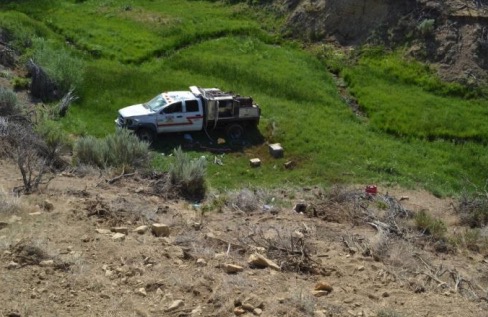
A Lessons Learned Review has been released for an engine that rolled over while working on the Fawn Fire near Meeker, Colorado July 8 ,2018.
The entire document is HERE. Below is the Executive Summary:
On July 8th at approximately 2325, on the Fawn Fire near Meeker Colorado, a cooperating fire department engine (Engine 1) rolled off the roadway as they were travelling from the fire back to Incident Command Post (ICP). Due to a high volume of fire traffic and very dry conditions, the road surface was extremely dusty and visibility was often severely reduced.
As Engine 1 was departing the fire area, they were the second to last vehicle in a convoy of 5 vehicles. Approximately a half mile after leaving the fire and headed back down County Road 29, Engine 1 encountered near zero-visibility due to dust and started to slow down. This reduction in visibility occurred in a short section of the road where the road bed narrowed due to erosional sloughing. Unable to see the upcoming road bed hazard, the engine operator continued driving straight as he was slowing the engine down. The front passenger [-side] tire travelled off the roadway, and the engine rolled off the embankment and down about 75 feet before coming to rest in the creek bottom back on its tires.
Although there was substantial damage to the cab of the engine, all the vehicle occupants were wearing their seat belts and only sustained minor injuries (bruising, chest and back pain). Due to the heavy dust, none of the other convoy vehicles knew immediately that the rollover had happened. A rapid response from other vehicles in the convoy occurred after it was discovered that Engine 1 had rolled off the road.
The three crewmembers of Engine 1 were assessed for injuries and then driven back to the ICP. At the ICP, an ambulance that had been called to respond met the Engine 1 crew and transported them to a local medical facility in Meeker. After a thorough medical assessment, it was determined that no serious injuries had occurred, and all 3 were released from the hospital at approximately 0630 on the morning of July 9th.
Thankfully there were no serious injuries.
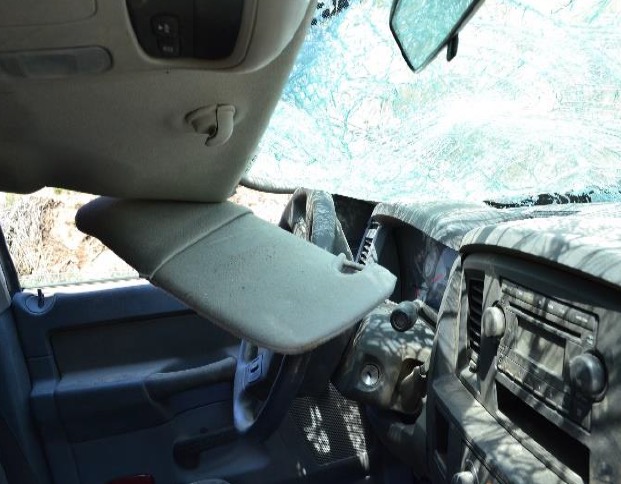
Photo from the LLR.
The report stated, “The Headache Rack saved the cab from crushing worse than it did.” A body-mounted “headache rack” is only designed to prevent cargo from entering the passenger compartment during a sudden stop and is far to weak to provide serious rollover protection.
This is the 59th article on Wildfire Today that is tagged “rollover”. These accidents are common, and wildland fire engines should be designed with real frame-mounted roll bars, not cheap-ass expanded metal grates protecting the glass in the rear window.