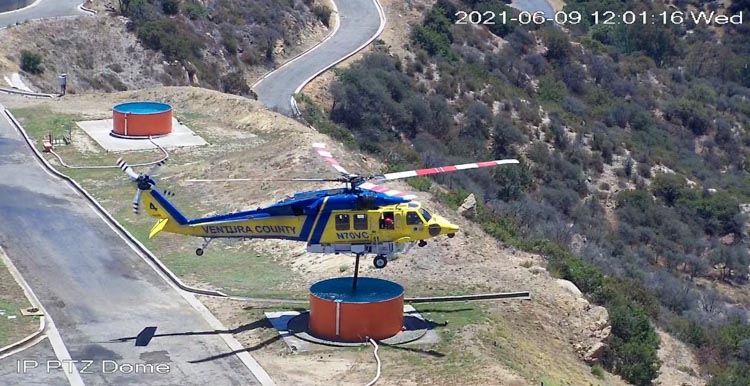
Ventura County FireHawk tests new tanks at 69Bravo water facility

Ventura County FireHawk
Ventura County FireHawk testing new tanks at 69Bravo, June 9, 2021. Photo from 69Bravo camera.

Earlier this month the four old 6,000 gallon vinyl/rubber pumpkins at the 69Bravo helicopter water source in the Southern California Santa Monica Mountains were replaced with new 8,000 gallon metal tanks.

On June 9 the web camera at the facility captured one of Ventura County Fire Department’s “new” FireHawk helicopters testing the reconfigured tank system.

Ventura County has two helicopters that are former military HH-60L Blackhawks originally configured by United Rotorcraft as dedicated MEDEVAC helicopters with medical equipment and patient litter systems, some of which was repurposed in the new FireHawk configuration. The helicopters recently received new navigation and communication systems, cabin interiors, and a 1,000 gallon external fixed water tank with a retractable snorkel system. The landing gear was replaced with higher gear to allow clearance for the installation of the belly tank.

Called 69Bravo Helistop, the facility on one of the highest peaks in the Topanga area has been an excellent source for virtually unlimited water for helicopters fighting wildfires in the area. It has four dip or snorkel tanks which enable helicopters with external buckets or fixed tanks to quickly refill with water. The buckets are lowered into the tanks, while helicopters with “snorkels” lower a hose with a pump into the water.

There are also two landing pads where helicopters that must land to refill can obtain water from fire hoses connected to the tanks by on-scene firefighters. Or, pilots can land and take a break if needed. The system keeps the tanks full automatically by using water from an on-site well.

The 69Bravo site was built by the very generous land owner and has been used with his permission. Several years ago Los Angeles County arranged to purchase the 34-acre property at a price reportedly less than half the market value, making payments over a seven-year period ending in 2024.

Ventura County FireHawk
Ventura County FireHawk dropping water while testing new tanks at 69Bravo, June 9, 2021. Photo from 69Bravo camera.

Thanks and a tip of the hat go out to Simon.

Federal government has 201 fire aircraft on exclusive use contract this year

Federal fire aircraft on contract, 2021
Federal fire aircraft on contract, 2021. Where there is no CWN entry, there ARE some on contract, but the number that could be activated is not clear.

The five federal land management agencies have 201 aircraft on exclusive use contract this year for assisting wildland firefighters, according to the information we received from spokespersons for the agencies.

In 2016 the FS hired 34 Type 1 helicopters on EU contracts but starting in 2017 reduced the number to 28. The fleet remained at that level until the COVID-19 pandemic hit in 2020 when they added an additional 22 ships for a total of 50. The agency felt the “surge” helicopters were necessary to mitigate a possible decrease in the effectiveness or numbers of their ground forces — engines and hand crews. In addition, the federal land management agencies said last year they were going to limit the number of less-than-full-suppression fires and attack new ignitions aggressively.

This year there will be 20 Type 1 helicopters on surge contracts, for a total of 48. These are the largest-capacity helicopters used for firefighting, capable of carrying 700 to 3,000 gallons of water.

Over the last 10 years the average number of large multi-engine air tankers (LAT) on exclusive use (EU) US Forest Service contracts was 14.0 for the United States. The average number on EU contracts from 2000 through 2009 was 28.3. This year there are 18, which is 5 more than last year.

Tanker 131 drops on the Cloud Fire
Tanker 131 drops on the Cloud Fire in Southern California June 12, 2021. USFS photo.

Due to the pandemic last year the FS gave about seven companies hybrid surge Call When Needed (CWN) LAT contracts that were basically EU, but for 90 days, rather than the typical 160-day EU Mandatory Availability Period. The rates they negotiated were generally less than the typically high CWN rates. For a while they also activated four additional LATs on a true CWN basis, with no guarantee of days worked.

This year there are 18 LATs on EU contracts and 8 more could come on later on surge contracts, with an additional 8 possible, the FS says, on CWN contracts.

Size of USFS Large Air Tanker Fleet
Number of USFS Large Air Tankers on Exclusive Use contracts.

As of June 9 there were 17 LATs actively working on EU contracts, one scheduled to begin its EU contract on June 20, and one CWN that was activated June 9.

All of the LATs and Very Large Air Tankers on EU contracts can hold up to 3,000 gallons of retardant, except for Coulson’s C-130 (4,000) and the 10 Tanker DC-10 Very Large Air Tanker (9,400).

In addition to the LATs and Type 1 helicopters, this year the additional aircraft on EU contracts among all the Federal wildland firefighting agencies include:

  • 43 Type 2 helicopters (smaller than Type 1 helicopters)
  • 41 Single Engine Air Tankers
  • 0 Multi-engine scooping air tankers
  • 26 Air Tactical fixed wing
  • 27 Aerial Supervision fixed wing
  • 14 Smokejumper fixed wing
  • 2 Infrared mapping fixed wing
  • 1 Large passenger aircraft (typically a 737)

The Federal government also has the ability to activate up to eight military C-130 aircraft equipped with 3,000-gallon Modular FireFighting Systems (MAFFS) if additional LATs are needed. The Governors of the four states in which they are based may also activate the two within their state.

Winners of race donate their $10,000 winnings to Wildland Firefighter Foundation

Brian and Zach, winners of Jack Links National Jerky Butte 2021. Still image from Jack Links video.

In recognition of National Jerky Day, Jack Links Jerky held a competition on June 12 in which four teams competed for a $10,000 prize and a year-long jerky subscription. It was held at Jerky Butte, Arizona, of course. The winners, Brian and Zach, donated their monetary prize to the Wildland Firefighter Foundation.

The competition over steep, rocky, brush-covered terrain involved not only going cross country as fast as you could but also solving a Jenga puzzle, a riddle, and a balancing act.

Jerky Butte
Jerky Butte. Still image from Jack Links video.

When told they had won, one of the team members said, “Thanks. I’m tired and I’m bleeding all over!” after having completed the race while wearing shorts. Later he said, “Support your forestry technicians.”

Congratulations Brian and Zach!

The Wildland Firefighter Foundation assists firefighters that have been injured on wildland fires and the families of firefighters who have been killed.

(Note: we were told that the two very generous guys are forestry technicians and wanted to remain anonymous. However, the video below which was the source of the images here and the names they competed under, was posted on YouTube.)

Brian and Zach, winners of Jack Links National Jerky Butte 2021. Still image from Jack Links video.

Extreme heat wave predicted for the Southwest

High Temperatures in Southern California
High Temperatures in Southern California Wednesday, June 16

Many areas in the Southwest will have high temperatures next week near record-setting levels. Excessive heat watches and warnings cover portions of Arizona, California, and Nevada.

For Las Vegas the Excessive Heat Warning says “life-threatening temperatures are likely.” The forecast for Phoenix on Monday and Tuesday is for highs of 115° and 116° where the record high for the dates is 115°. The forecast highs for the Southern California deserts next week are 10 to 18 degrees above daily averages.

There is an Excessive Heat Warning for the inland areas of Southern California for Monday through Wednesday, with highs of 103° and 104° on Tuesday and Wednesday at Riverside. It will be breezy there with 11 to 14 mph west winds gusting to 22 mph in the afternoons with the relative humidity around 20 percent.

Monday through Friday of next week the Hot Dry Windy Index (HDWI) will be above the 75th percentile in the Riverside area, peaking on Tuesday above the 95th percentile.

HDWI Riverside, CA
Hot Dry Windy Index, generated for the Riverside, Calif. area, June 12, 2021.

The HDWI in most of Arizona will peak Sunday, June 13, at the 95th percentile level then drop for the rest of the week closer to average.

The Fire Potential Index will be very high in mid-week for portions of Nevada, Arizona, New Mexico, Utah, and Western Colorado. The FPI is most similar to the Energy Release Component of the National Fire Danger Rating System in that both are moisture related indexes and neither indicates the effect of wind on fire potential.

Fire Potential Index for June 15, 2021
Fire Potential Index for June 15, 2021. USGS.

A brief look — wildland firefighter smoke exposure and risk of lung and cardiovascular disease

Wildland firefighters and smoke

Here is a very brief look at the effects of smoke on wildland firefighters, and below that, a longer look, in the embedded four-page .pdf document.

By Kathleen M. Navarro, U.S. Forest Service
(currently with the Centers for Disease Control and Prevention)

Wildland firefighters are exposed to health hazards including inhaling hazardous pollutants from the combustion of live and dead vegetation (smoke), and breathing in  ash and soil dust, while working long shifts with no respiratory protection. This research brief summarizes a study estimating long-term health impacts of smoke exposure for wildland firefighters (Navarro et al. 2019). The study estimated relative risk of lung cancer and cardiovascular disease mortality from existing particulate matter (PM) exposure-response relationships using a measured PM concentration from smoke and breathing rates from previous wildland firefighter studies across different exposure scenarios.

Key Findings:

  • Firefighters who worked both short and long seasons (49 days and 98 days per year, respectively) were exposed to increased lifetime doses of PM4 across all career durations (5-25 years).
  • Wildland firefighters were estimated to be at increased risk of lung cancer (8 to 43 percent) and cardiovascular disease (16 to 30 percent) mortality across all season lengths and career durations.
  • These findings suggest that wildland firefighters should reduce exposure to smoke in any way possible.

[pdf-embedder url=”https://wildfiretoday.com/wp-content/uploads/2021/06/NRFSN_ResearchBrief7_FirefighterSmokeExposure_HealthRisk_2020_final.pdf” title=”wildland Firefighter Smoke Exposure Health Risk2020″]


For more information: Smoke — and the health of firefighters

Let’s be careful out there.

US Congressman asks if the US Forest Service can modify the orbits of the Earth or moon

Rep. Louie Gohmert
Rep. Louie Gohmert. Still image from video of the July 8 hearing.

A member of the United States House of Representatives elected by the people of Texas had an unusual question for an employee of the US Forest Service Tuesday.  Jennifer Eberlein, the Associate Deputy Chief for the National Forest System in Washington, was testifying during a live streamed broadcast of a hearing before the House Natural Resources subcommittee on national parks, forests and public lands.

Rep. Louie Gohmert asked her a question. The topic at the time was climate change.

“I understand from what’s been testified to the Forest Service and the BLM you want very much to work on the issue of climate change,” Rep. Gohmert said. “I was informed by the immediate past director of NASA that they found that the moon’s orbit is changing slightly and so is the Earth’s orbit around the sun,” he continued. “And we know there’s been significant solar flare activity. And so is there anything that the National Forest Service or BLM can do to change the course of the moon’s orbit or the Earth’s orbit around the sun? Obviously, that would have profound effects on our climate.”

After a pause, Ms. Eberlien replied. “I would have to follow up with you on that one, Mr. Gohmert,” she said with a smile.

“Yeah, well, if you figure out a way that you in the Forest Service can make that change,” Rep. Gohmert said, “I’d like to know.”

After word got around about the unusual question, Rep. Gohmert tweeted about it. But he only wanted to clarify that he was referring to the Bureau of Land Management, not Black Lives Matter, and to make an accusation of “fake news” when someone quoted him correctly.

Astrophysicist Katie Mack weighed in:

Medford tanker base receives new retardant tank

New transportable retardant tank at  Medford, OR
New transportable retardant base mixing tank at Medford, OR air tanker base. Photo by FORTRESS.

In February the U.S. Forest Service awarded a contract to design and build a 16,000-gallon, mobile, retardant mixing tank for the air tanker base at Medford, Oregon. The agency wanted the ability to relocate the tank during the off-season and needed one large enough to refill very large air tankers (VLAT).

The tank contract specified use of carbon steel, top and side access, an integrated axle, and a top walkway with folding railings. 

FORTRESS North America, the company that received the contract, delivered the tank/trailer in Medford on May 24 where it was inspected and accepted.

New transportable retardant tank at  Medford, OR
Justin Bohannan, Medford Airtanker Base Manager (left) receiving the VLAT Mobile Retardant Base mixing tank from Fortress Base Operations Manager Dennis Hulbert. Photo by FORTRESS.