Report: with climate change, higher emphasis should be placed on community preparedness in BC

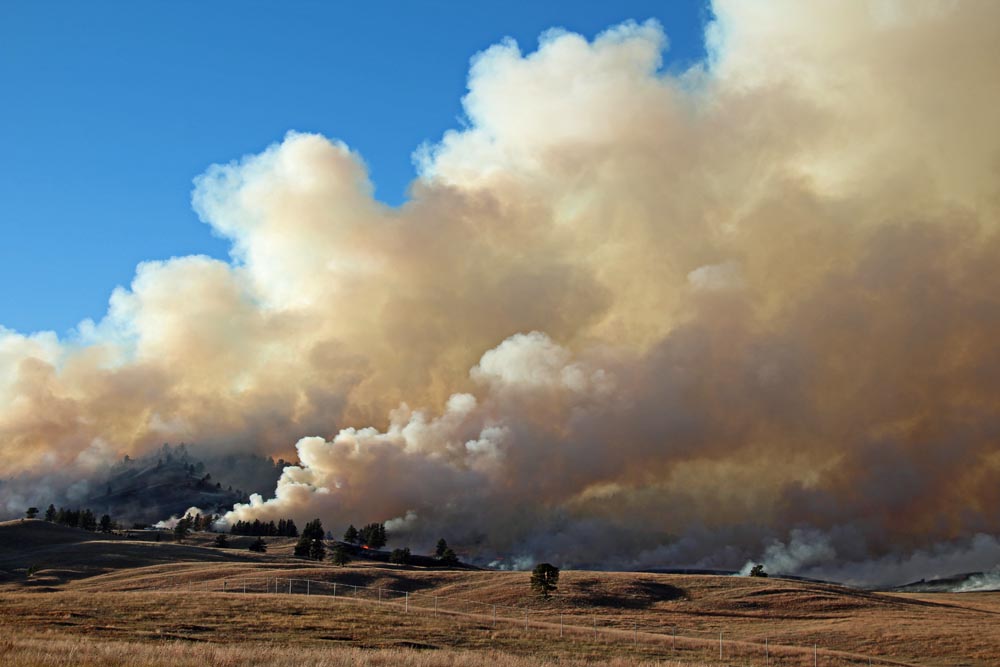
Norbeck prescribed fire
Norbeck prescribed fire, Custer State Park and Wind Cave National Park, October 20, 2014. Photo by Bill Gabbert.

A report commissioned by the British Columbia Forests Ministry suggests that with impending climate change, more emphasis should be placed on preparing structures and communities to co-exist with fire, rather than hoping to suppress every fire.

Below is an excerpt from an article in the Vancouver Sun. Unfortunately the author conflates the prevention of fires with fuel reduction and community preparedness.

As the planet heats up and the risk of “mega fires” rises, B.C. will no longer be able to lean on its world-class wildfire-fighting teams to keep people and property safe, according to a draft provincial document.

The Forests Ministry paper, called Climate Change Adaption Action Plan for Wildfire Management 2014-2024, suggests fire prevention should become the top priority of the province.

“It is not an option to continue to increase fire suppression response and associated costs, because even the most aggressive action would neither be safe nor effective for the extreme wildfire events such as those seen in Kelowna in 2003 and Slave Lake in 2010,” reads the draft, obtained through an access to information request.

“During these events, suppression response cannot be relied upon to protect communities or natural resource values. The only protection provided will be the protection established before the fire, provided through wildland-urban interface fuel reduction and landscape fire management…”

Investigation report released for Black Forest Fire

Origin of the Black Forest Fire

The El Paso County Sheriff’s Office has released a summary report on the investigation of the Black Forest Fire which started June 11, 2013 near Colorado Springs, Colorado. The fire killed two people and burned 489 houses and 14,280 acres, resulting in $420 million in insured losses.

The investigators eliminated natural causes, such as lightning. That left human-related ignitions.

Below are excerpts from the report:

…Given the known devastation of the fire at that point, an Investigation Team was formed consisting of recognized experts in the area of Wildland fire investigation from agencies including the USDA Forest Service, the Aurora Fire Department, the US Bureau of Alcohol, Tobacco, Firearms and Explosives (ATFE), the 4th Judicial District Attorney’s Office and others. This team was assisted by surveyors from the El Paso County Public Services Department.

…

The only clearly established fact was that no natural causes existed and thus the fire was human caused. A potential cause associated with the metal particles can not be ruled out, or positively identified. A potential cause associated with an intentional ignition is not supported by the evidence or circumstances, but can not be completely ruled out. The origin of the fire is in an area that is not readily accessible from a roadway, allowing an easy escape, as is typical in intentionally set Wildland fires. There was no evidence of any other miscellaneous cause such as blasting, fireworks, welding, target shooting, etc.

…

Upon the completion of the investigation, the entire case was reviewed by the Sheriff’s Office Investigations Division and the District Attorney’s Office to determine if any additional leads remained. It was the determination of the El Paso County Sheriff’s Office and the District Attorney’s Office that there was not sufficient evidence to warrant criminal prosecution at this time. None of the investigation or forensic examination supported any one possibility to the extent needed to pursue criminal charges. Additionally, no additional recommended follow-up work could be identified at this time.

Three other reports have previously been released about the Black Forest Fire:

  1. Report on how the fire was managed on the first day, issued by the Black Forest Fire District Board on February 19, 2014. The complete report can no longer be found on the District’s web site.
  2. A 2,000 page, 345 megabyte report, released March 14, 2014, commissioned by the Black Forest Fire District which evaluated how the fire was managed, including the performance of Fire Chief Bob Harvey during the first hours of the fire. Sheriff Terry Maketa had been extremely critical of the Chief in numerous interviews with the media. The complete report can no longer be found on the District’s web site.
  3. After Action Report, by the El Paso County Sheriff’s Office, May 15, 2014. We preserved this report on the Wildfire Today web site.


NY Times and NBC report on Yarnell Hill Fire videos

Major media outlets are reporting on the release of the 21 videos (that we wrote about on November 8) filmed at the the Yarnell Hill Fire, June 30, 2013, the day 19 firefighters were killed on the fire. The New York Times posted one of the videos, along with an article written by Fernanda Santos.

NBC news produced their own video (above) that contained clips from several of the firefighter-filmed videos, and added subtitles in an attempt to better understand some of the overheard conversations among the firefighters.

NFPA report about vegetation fires

The National Fire Protection Association has produced a report about vegetation fires. The organization only takes into account fires that were reported by local fire departments, and did not consider fires reported by state and federal agencies, which leaves out national and state lands such as parks, forests, wildlife refuges, and BLM lands.

Here we have the eye candy (an infographic) and below that the executive summary. The entire report is here.

NFPA vegetation fire stats NFPA vegetation fire stats

Executive Summary

Fires in the wildland/urban interface have often been in the news in recent years. Nine of the 25 costliest (in terms of property loss) fires in U.S. history were described as forest, wildland or wildland/urban interface fires. The eight costliest fires were in the last two decades. Federal or state agencies are typically involved in these massive fires. The term wildland/urban interface (WUI) is typically used to describe areas where extensive vegetation mixes with numerous structures and their inhabitants. WUI fires of note often begin and grow large in the vegetated areas before spreading to structures.

Many people do not realize how often local (municipal or county) fire departments around the country are called to smaller brush, grass and forest fires.

During 2007-2011, local fire departments responded to an estimated average of 334,200 brush, grass, and forest fires per year. This translates to 915 such fires per day.

  • Only 10% of these fires were coded as forest, woods, or wildland fires;
  • Two of every five (41%) were brush or brush and grass mixtures;
  • More than one-third (37%) were grass fires; and
  • 13% were unclassified forest, brush or grass fires or unclassified natural vegetation fires.

In three-quarters (76%) of the brush, grass, and forest fires handled by local fire departments, less than an acre burned. Only 4% burned more than ten acres. Fires in forests tended to be larger than other vegetation fires. Only three-fifths (59%) of the forest fires were less than an acre, while 9% consumed more than ten acres.

Report released about entrapment of three firefighters on the Beaver Fire

Beaver Fire entrapment
Photo taken of the Beaver Fire the day after three firefighters were entrapped. It was shot from along the Klamath River about a mile west of the Incident Command Post, looking in the direction of the entrapment, which occurred beyond the smoke visible in this photo taken by Bill Gabbert.

A facilitated learning analysis has been released about the entrapment of three firefighters August 11, 2014 on the Beaver Fire northwest of Yreka, California.

Entrapped that day were a Dozer Operator (DZOP), a Heavy Equipment Boss (HEQB), and a Heavy Equipment Boss Trainee (HEQBt). They all got inside fire shelters in a small deployment site that was not large enough to qualify as a safety zone. Their injuries included some first and second degree burns, but overnight hospitalization was not required.

The dozer operator’s story in his own words:

By the time I got off the dozer, the fire had closed in on two sides—and was closing in on my third and fourth sides. I worked as long as I could to get us more protection. I intended to push up more berms. Embers were falling everywhere. I spent too much time getting dug in. I backed the cat in. I should have deployed sooner. My intent was to get us all together under the dozer. I was not in the best position.

I tossed off my ball cap, put my hard hat on, grabbed my gloves and shelter. I had my web gear bungeed to the cage. I grabbed it quick and rolled in the dirt under the dozer. I pulled the shelter’s tabs, but they didn’t work. So I ripped at it to get it open.

It was a confined space so it took a while to get the shelter open. I had to physically unfold every fold to get it deployed. That’s when my leg got a little scorched. Overall, the shelter worked the way it was supposed to. Those shelters no doubt saved our lives.

The video below includes videos and still photos taken during the entrapment.

beaver fire convection column
Don Hall sent us this picture of a convection column over the Beaver fire, saying it was taken at about the same time the three firefighters were entrapped.

We first wrote about the entrapment on August 12.

Report released on swamp buggy fire in Florida

burned swamp buggy
The burned swamp buggy. Photo from the report.

The Wildland Fire Lessons Learned Center has published a report on a swamp buggy that caught fire and was destroyed while working on a prescribed fire in Big Cypress National Preserve in Florida in August.

According to the report:

The exact cause of the swamp buggy fire remains unknown. However, physical examination of a very similar buggy—as well as the first-person accounts from those present during the burn—suggest that the fuel line running from the buggy’s gas tank to the pump failed.

swamp buggy

Report released on engine burnover in Idaho

Richfield fire, engine burnoverAn investigation report has been released for an engine that was destroyed by a wildland fire near Richfield, Idaho on July 16, 2014.

During the initial attack phase on the Bureau of Land Management Fire, a Type 4 engine from the Richfield, Idaho Rural Fire Department responded. The two people on the engine attempted to make a frontal attack on the head of the fire.

The engine got stuck, or high-centered, on a rock and could not be moved. The two people on the engine, a city employee and a “part-time” volunteer, in an attempt to protect the truck from the approaching fire used two small booster hoses, one-half inch in diameter with a flow rate of 10 gallons per minute. They had to abandon the engine as the fire got closer, and it was destroyed. There were no injuries to the personnel.

Below is an excerpt from the report. “ENG3” is the apparatus that was destroyed by the fire:

****

“…ENG3 proceeded south on the two track toward the head of the fire with FF2 riding on the top of the engine. The engine left the two track road and drove off-road toward a lava blister trying to access the active fire perimeter. Near the base of thelava blister, ENG3 struck a rock cluster high centering the rear axle of the vehicle and rendering ENG3 immobile. FF1 utilized four-wheel drive in an attempt to dislodge the vehicle, but sandy conditions caused ENG3’s side tires to sink. The rear axle of the apparatus pivoted on the rear differential, listing the vehicle to its right side. The driver’s rear tire was raised off the ground by 8-12 inches.

WT1 operator, FMO, and AFMO hiked west from the highway over the lava blister and observed ENG3 high centered on a rock in unburned fuel north of the active fire perimeter. The AFMO notified the IC at approximately 1215 of the immobilized engine. ENG3 crew deployed booster hose off both sides of the truck. FF2 worked from the right hose reel in front of the truck and south about 50 feet up the lava blister into sparser fuels. FF1 stayed near the front of the truck wetting a heavier pocket of unburned grass and brush.

ENG1 left the west flank and drove to the location of ENG3 to help remove ENG3 from the rock. ENG1 determined that an attempt to dislodge ENG3 would be unsuccessful. ENG1 then drove southwest and established an anchor point at the lava blister, approximately 200 yards from ENG3. ENG1 resumed mobile attack working back towards the disabled engine.

Between 1220 and 1225, wind direction changed from west to south. Fire behavior increasedand the fire made a rapid run toward the disabled engine. The FMO and AFMO made verbal contact with the two individuals on ENG3. The FMO and FF1 retreated to a safety zone in the black on top of the lava blister approximately 25 yards east of the disabled engine. The AFMO urged FF2, still by ENG3, to immediately retreat toward him into the safety zone. FF2 delayed until he felt excessive heat from the fire, closed the nozzle, and retreated to the safety zone.

At 1227, ENG3 was engulfed by the fire and completely destroyed…”

Richfield fire, engine burnover

Three preliminary accident reports

The Wildland Fire Lessons Learned Center has published preliminary reports for three recent accidents — two burnovers and one very serious snag incident. Below are the summaries of the three accidents. It usually takes many months for the final, complete reports to be written and released.

Snag accident on the Freezeout Ridge Fire, Nez Perce National Forest in Idaho, one injury, September 21, 2014:

Firefighters from the Winema Hotshot crew were working on the Northeast edge of the Freezeout Ridge Fire when a snag fell and struck a Firefighter. The individual was knocked unconscious and it was determined by personnel on scene that life flight medical attention was needed. The individual was treated on scene by crew members, then transported via helicopter, long lined to a heli-spot where he was treated by a paramedic and transported to a hospital in Boise. He is being treated for severe head injuries including a skull fracture, broken jaw, lacerations to the face and head, two broken arms, dislocated thumb, and minor burns.

A Facilitated Learning Analysis (FLA) team has convened and began to assess the incident.

Because a decision was made to deviate from aviation policy in order to potentially save the life of the injured firefighter, a SAFECOM was filed. That aspect of the incident is covered at Fire Aviation.

Entrapment on the King Fire in northern California, no serious injuries, September 15, 2014:

We wrote about this entrapment live as it was developing.

Below is the information from CAL FIRE’s preliminary report:

SYNOPSIS:
The following information is a preliminary summary report referencing a Heavy Fire Equipment Operator , a Fire Captain B and CAL FIRE inmate fire crewmembers involved in a burnover during a wildland fire incident. There were no serious injuries suffered by CAL FIRE personnel or inmate crewmembers. The extent of the damage to the CAL FIRE bulldozer is unknown at the time of this report.

NARRATIVE:
On September 15, 2014, a CAL FIRE Fire Captain (FCB-1), with inmate fire crewmembers (CRW-1), and a CAL FIRE Heavy Fire Equipment Operator (HFEO-1) were assigned to Division K (DIV K) on the King Incident in El Dorado County. CRW-1 and HFEO-1 were working on the northeast side of the King Incident. The reported assignment was to go direct and contain a slop over on a mid-slope road. At approximately 1245 hours, FCB-1 observed an increase in the fire behavior, and determined to cancel the assignment. FCB-1 notified HFEO-1 and with the inmate crewmembers took refuge at a deployment site. HFEO-1 was forced to leave the bulldozer by foot and took refuge at the deployment site with FCB-1 and CRW-1. The personnel deployed their fire shelters. Air support was requested, accountability maintained and their location was communicated. The personnel were evacuated by helicopter and transported to the helibase. They were evaluated by paramedics and returned to the Incident Base later the same day. There were no serious injuries suffered in this incident.

Entrapment on the Black Fire in California’s Mendocino County, September 13, 2014, two minor injuries, three engines damaged:

The Willits News has a photo of one of the engines that burned.

Below is the summary from the CAL FIRE preliminary report:

SYNOPSIS
On Saturday September 13, 2014, at approximately 1625 hours, a rapidly moving wildland fire burned over two local agency Type III engines and one CAL FIRE utility vehicle; destroying one of the two engines and the utility. The second engine sustained significant heat damage. Two local agency fire personnel suffered minor injuries, and were treated and released at a local medical facility. During the same fire run, firefighters on a CAL FIRE engine having to take refuge in a structure. The CAL FIRE engine sustained minor damage. The engine operator suffered minor injuries and was treated and released at a local medical facility.

NARRATIVE
On Saturday September 13, 2014, the BLACK fire was approximately 50 acres and actively burning with spotting at ¼ mile. The fuel type was primarily oak woodland intermixed with grasslands and areas of chamise. Two local government Type III engines were operating at a structure (Structure 1) along a ridge with the Division Group Supervisor (DIV C) in a utility. At the same time, a CAL FIRE engine had staged next to a separate structure (Structure 2) approximately 100 yards to the south along the same ridge within DIV C.

At approximately 1625 hours, the fire made a rapid, upslope run through a large area of chamise and manzanita located below the road that accessed the structures. All of the structures along the ridge were threatened. Structure 1 ignited and the residential propane tank began to vent. DIV C determined personnel couldn’t safely take refuge in the structure or the fire apparatus. Ultimately it was determined the apparatus couldn’t be moved quickly enough to ensure a safe exit and all personnel at the structure exited the area on foot to a Temporary Refuge Area.

During this increased fire activity a CAL FIRE engine crew took refuge in Structure 2. When the fire front passed, all personnel exited the structure and drove from the fire area. There was minor damage to the state engine.