Yarnell Hill Fire report released

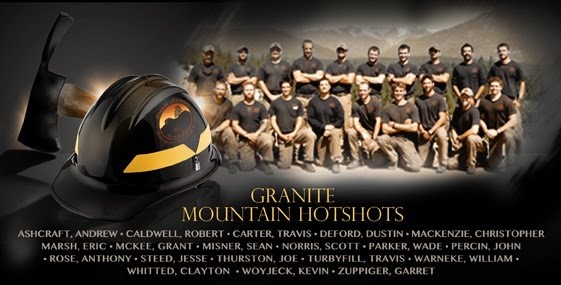
Granite Mountain Hotshots

(Originally published at 11:19 MDT, September 28, 2013; updated at 6 p.m. September 28, 2013. Observations after reading the report are at the bottom of this article.)

The Arizona State Forestry Division has released the Serious Accident Investigation report of the Yarnell Hill Fire, which on June 30, 2013, killed 19 members of the Granite Mountain Hotshots. It was produced by a very large cast of characters, 18 core Team Members, 17 Support Team Members, and 19 Subject Matter Experts, for a total of 54 people.

The report found:

The judgments and decisions of the incident management organizations managing this fire were reasonable. Firefighters performed within their scope of duty, as defined by their respective organizations. The Team found no indication of negligence, reckless actions, or violations of policy or protocol.
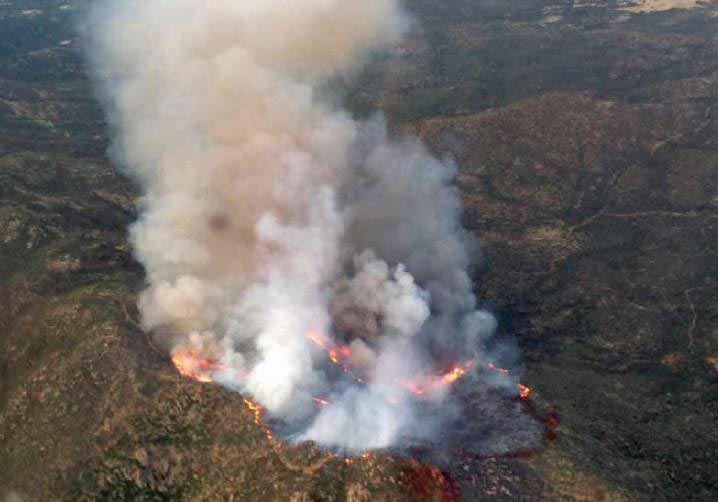
Yarnell Hill fire
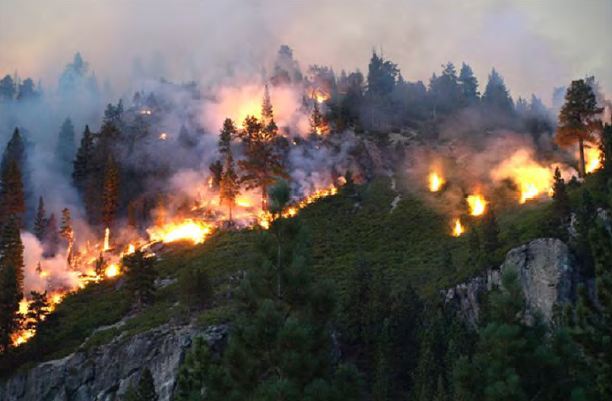
Air Attack’s photo of the Yarnell Hill fire at 7:24 p.m. June 29, 2013

A news conference about the report was live-streamed by at least two Phoenix area television stations. In the question and answer period several national news organizations as well as local media asked questions of the five-person panel which consisted of the Arizona State Forester, two people from the investigation team, and two officers from the Prescott Fire Department.

You can download the report (6Mb file) and some “Frequently Asked Questions” about the investigation.

Below is a 21-minute video released by the investigation team today, which they described as a “A brief overview of the Yarnell Hill Fire Investigation report.” Much of it comes word for word from the report but it makes effective use of Google Earth to provide an overview of the geography of the fire.

Granite Mountain Hotshot Christopher MacKenzie shot the two video clips below shortly after 4:00 p.m. on June 30, 2013. These are the last images of the hotshots before they died. The video was unexpectedly made available today for the first time by the Prescott Daily Courier, which has an article about how the video and other photos of the fire were found.

Our observations after reading the report and viewing the press conference and the question and answer session.

The official report commissioned by the Arizona State Forestry Division, a case of them investigating themselves, did not break much new ground. There was little of a negative nature written about the crew or their employer, the Prescott Fire Department, which was barely mentioned. The Granite Mountain Hotshots were fully qualified, staffed, and trained and they were on day 13 of a permitted 14 days in a row of fighting fire. And, there was “no indication of negligence, recklessness actions, or violations of policy or protocol”.

Why did the Granite Mountain 19 leave the “black”?

The investigators emphasized that they were unable to answer one of the most-asked questions about the fatalities — why the crew left the safety of the already burned area, the black, to attempt to walk 1.6 miles mostly through unburned brush to another safety zone, the Boulder Springs Ranch. They came to within 0.38 miles of their destination when they encountered one of the heads of the fire that had wrapped around the ridge to their left in the box canyon and was headed toward them, cutting off their path probably much to their surprise. Click the map below to see a larger version of the wind at the deployment site.
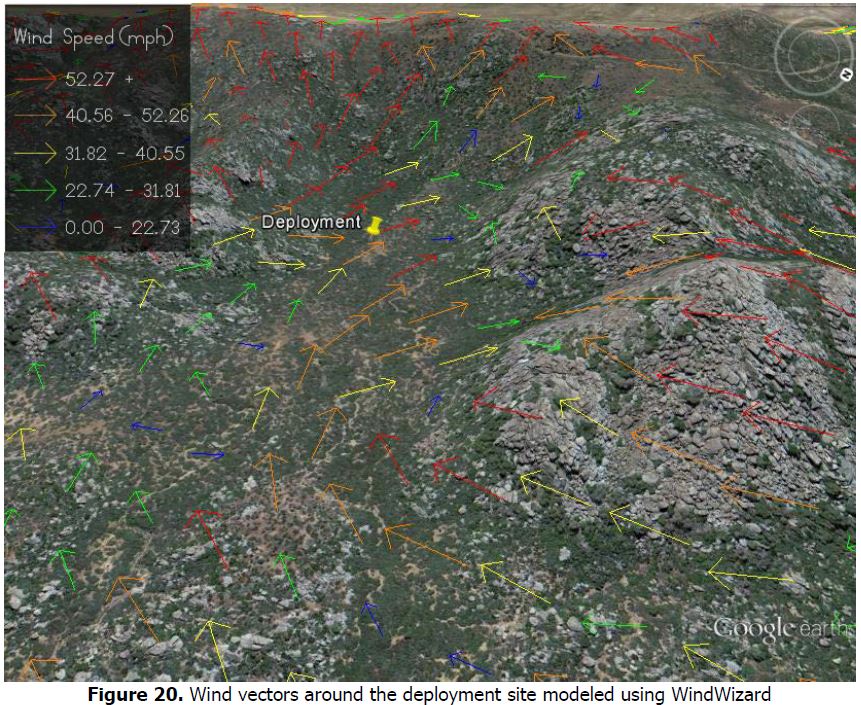
Wind at the Yarnell Hill Fire

No one knew where the crew was in relation to the fire

There was confusion about the location of the crew. Other firefighters thought they had either remained safely in the black where they had been for a while, or they had headed north to another safety zone. But instead, they traveled south. When they reported that they were entrapped and were deploying their fire shelters, no one knew where they were. Finally they told Air Attack they were on the “south side”, but even though a DC-10 air tanker was orbiting and ready to drop on them, airborne personnel could not find them, either due to heavy smoke or because they were looking in the wrong place. But under the extreme wind and fire conditions, it is unlikely that air support would have helped the firefighters very much.

Improving situational awareness

This is another fire, like the Esperanza Fire, where if the fire overhead, such as a Division Supervisor, Operations Section Chief, or Safety Officer, had known the location of the personnel on the fire in relation to the real-time spread of the fire, it could have saved lives — 24 on these two fires alone.

It is irresponsible for the wildland fire agencies to continue to do nothing to improve the situational awareness of firefighters, which has proved fatal to too many of them.

We have written about this several times before. Many local fire departments, EMS divisions, and police units have the ability to send location data to dispatchers. If the analog or digital ground-based radio systems being used today can’t handle this task in remote areas, then use a satellite-based system. The U.S. Forest Service asked for proposals to purchase thousands of little location devices last year, and adding high tech video systems to air attack ships could help. We have also written about a device we called a Firefighter’s Emergency Situational Awareness Device, a FESAD.

One of the recommendations in the report was to “review current technology that could increase resource tracking, communications, real time weather, etc.” The Q&A panel today said, in response to a question, that the surviving family members of the 19 Hotshots strongly suggested while being briefed this morning that tracking systems for firefighters be utilized.

Very Large Air Tanker not ordered because of “steep terrain”

The information that the state of Arizona released on July 16 about the resources deployed on the fire said a DC-10 Very Large Air Tanker (VLAT) was in Albuquerque and available on June 29, but was not ordered due to Air Attack’s concern about its effectiveness in steep terrain and inability to deliver retardant before cut-off time. The way this was addressed in today’s report was “ICT4 declines the VLAT offer at 1750 [June 29] based on fire conditions.” There was nothing about “steep terrain”, which didn’t exist on the fire to the extent that it would severely limit the effectiveness of a DC-10 VLAT. In fact, the next day, June 30, they used the hell out of both DC-10s, dropping over 88,000 gallons in 8 flights. A recommendation in today’s report was to “…develop a brief technical tip for fire supervisors/agency administrators on the effective use of VLATs.”
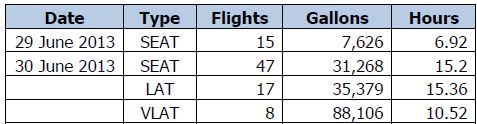
Air tanker drops on Yarnell Hill Fire
Air tanker drops on Yarnell Hill Fire, June 29 and 30, 2013.

The DC-10s may have been effective on June 29 when the fire was still small, but by the time they both arrived on June 30, the day of the entrapment, the wind event was making it difficult for anything dropped from the air to slow down the fire — too much heat, and too much wind blowing the retardant away before it hit the target.

Aerial Supervision Module taking on too many roles?

During the time of the entrapment the roles of Air Attack and Lead Plane were filled by a single aircraft called an Aerial Supervision Module (ASM), coordinating all of the aerial firefighting, directing air traffic, preventing aircraft from bumping into each other, developing tactics, AND serving as Lead Plane, physically leading the air tankers into their targets about 200 feet above the ground. The Lead Plane duties limited their ability to perform full Air Attack responsibilities over the fire at the same time. The report said,  “ASM was too busy handling multiple duties to communicate with the crew just prior to the deployment”.

One of the recommendations in the report is to request the National Wildfire Coordinating Group to develop guidance to identify at what point is it necessary to separate the ASM and Air Attack roles to carry out required responsibilities for each platform.

No overwhelming force

The ordering and use of ground and aerial firefighting resources was less than aggressive on June 29, the day before the tragedy when the fire was still small. The only air tankers used that day were two single engine air tankers, and for only part of the day, dropping a total of 7,626 gallons. After being released, they were requested again by Air Attack, but dispatch only allowed one to respond to the fire, wanting to keep one in reserve in case there were other fires. General Norman Schwarzkopf’s philosophy when confronting the enemy was to use “overwhelming force”. This strategy also is effective when confronting a wildfire. Overwhelming force for a short amount of time can prevent megafires burning for weeks, consuming many acres, dollars, and sometimes homes and lives.
An unusual way to publicize the release of the Yarnell Hill Fire report

If a politician has to release information, but they want it to attract as little attention as possible, they do it late on a Friday afternoon or on the weekend. The thinking is that fewer people consume news on a Saturday or Sunday and there are not as many reporters on duty to cover it.

The Arizona State Forestry Division decided to release the Serious Accident Investigation report of the Yarnell Hill Fire fatalities at 10 a.m. MST tomorrow, September 28. The choice of the day of the week led some people to assume the agency wanted to keep the report as much under the radar as possible.

The timing of the relase was a puzzling decision, especially in light of another one they made that will have the opposite effect. A person or organization calling themselves “The Yarnell Hill Fire Investigation Report Rollout Team” sent an email to many, many people Wednesday (about 150 other names were on the distribution list of the message I received) asking them to help spread the word about the report by joining something called “Thunderclap”. After you join using your Facebook and Twitter user names and passwords, “Thunderclap” will use those social media sites to send messages on your behalf so that everyone who reads your posts on those services will see a message that looks like it came from you, but was sent by Thunderclap announcing that the report on the Yarnell Hill Fire has been released.

An excerpt from the email:

…Once the report is released on September 28, 2013 10:00am, Arizona Standard Time, this tool allows us to utilize other people’s Facebook and Twitter accounts to push out the link to the report, nationally, all at one time. To make this work, we need people to know about the campaign we have built on the Thunderclap website and we hope you will be willing to get involved and let people know via your email lists and social media sites.

Arizona State Forestry Division using Thunderclap is a solution in search of a problem — and creates some serious privacy concerns, turning over your social media passwords to a company no one has ever heard of.

No matter what the Arizona State Forestry Division does to encourage or discourage coverage of the report, it is going to be huge news. I expect it to be covered by the big five national television networks. Since the deaths of the 19 members of the Granite Mountain Hotshots June 30 on the Yarnell Hill Fire, the mainstream media has been all over wildland fire, firefighters, and hotshot crews. So a Saturday release of the report will not eliminate coverage, and asking hundreds of people to turn over their Facebook and Twitter accounts to spread the word is not going push the tidal wave of media frenzy much faster.

If the State of Arizona follows the new federal guidelines for serious accident reports, it will not include any conclusions, or recommendations. This will make it difficult for the media to come up with coherent, introspective, meaningful coverage. They will be able to report facts, but their relevance to the fatalities could be difficult for them to understand. We heard from an Associated Press reporter who made an appointment to talk with us Saturday afternoon, that the State will not write a second, secret report containing the conclusions and recommendations as required in the new guidelines for federal agencies. That is because the State of Arizona has a very strong open records law prohibiting such shenanigans. But the concept of open records is on the back burner in the U.S. Forest Service as Fire Aviation confirmed when attempting to get a simple list of Type 1 helicopters on exclusive use contracts. It took five months and a great deal of time, going through the Freedom of Information Act process.

Below are some excerpts from the 6,212 words in the Thunderclap terms of service.

****

“We reserve the right to modify or replace these Terms of Use and/or to change, suspend or discontinue the Services at any time in our sole discretion.

The way you support a message is to grant the Service access to your Facebook®, Twitter® or Tumblr® account to post that message on your behalf as a status update in your timeline or as a Tweet, as applicable.

When you join a Thunderclap, your username and profile picture from the third party service you joined through may appear on this Website (or otherwise through the Services) indicating that you are a supporter of that message. Also, after you join a Thunderclap, you have the option of sharing that you support that message via Twitter, Tumblr and/or Facebook. You do this by granting the Services access to your Twitter, Tumblr and/or Facebook accounts through standard Twitter, Tumblr and/or Facebook APIs.

By supporting a Thunderclap via Facebook, you grant us the right to use, reproduce, modify, display and distribute for purposes of displaying your Facebook username, Facebook profile picture, and any modifications or changes you make to the message on or through the Services and Facebook to indicate you have joined, supported or your other affiliation with that message.

By supporting a Thunderclap via Twitter, you grant us the right to use, reproduce, modify, display and distribute for purposes of displaying your Twitter username, Twitter picture, and any modifications or changes you make to the message on and/or through the Services and Twitter to indicate you have joined, supported or your other affiliation with that message.”

Yarnell Hill Fire report to be released Saturday

Granite Mountain HotshotsThe Arizona State Forestry Division has announced that the Serious Accident Investigation report of the Yarnell Hill Fire fatalities is complete and will be released Saturday, September 28. It will be given to the families of the 19 firefighters that were killed before the public sees the document.

A press conference will be held at 10 a.m. Saturday at the Ruth Street Theater at Prescott High School, 1050 Ruth Street, Prescott, AZ. Officials available to answer questions will include:

  • Scott Hunt, Arizona State Forester,
  • Jim Karels, Serious Accident Investigation Team Leader
  • Mike Dudley, Co-lead for Serious Accident Investigation Team
  • Chief Dan Fraijo, Fire Chief, Prescott Fire Department

The Arizona Division of Occupational Safety and Health, a state version of federal OSHA, is also working on a report. It is required to be complete no later than six months after their investigation was announced, which would make it due no later than the first part of January, 2014.

Controversy surrounds the Yarnell Hill Fire fatalities

Yarnell Hill Fire
Yarnell Hill Fire. Photo by Joy Collura.

It is enough of a tragedy that 19 members of the Granite Mountain Hotshots died while fighting the Yarnell Hill Fire on June 30. But several issues continue to pour salt into the wounds of the grieving families and others that mourn their deaths. Some issues will hopefully diminish when the two reports become public. Or, in a worse case, they could be made worse, or new ones could be unearthed.

The Serious Accident Investigation which was commissioned by the Arizona State Forestry Division is expected to be public within the next week or so, but only after it is distributed first to the families of the 19 victims.

The Arizona Division of Occupational Safety and Health, a state version of federal OSHA, is also working on a report. It is required to be complete no later than six months after their investigation was announced, which would make it due around the first part of 2014.

The controversy about the the large differences in the survivor benefits for the families of the full time and seasonal firefighters on the Granite Mountain Hotshots has been festering for weeks and is now being discussed in the Arizona legislature.

Another issue that came to light recently is the refusal of the Yavapai County Sheriff’s and Medical Examiner’s offices to release the autopsy reports for the 19 firefighters. This has escalated to the point where the Arizona Republic and 12 News have filed suit against the agencies. The Arizona Republic and 12 News realize that certain photographs of the bodies and perhaps other evidence may not be appropriate to be released, but they are adamant that the remaining records should be released and feel their demands are backed by state law.

Still another issue that will be debated was published by the Arizona Republic and picked up by the USA Today. It relates to the reports prepared by the Serious Accident Investigation team. The latest Serious Accident Investigation Guide, revised August, 2013, recommends that two reports be prepared. One, the Factual Report, would be made public, and the other, the Management Evaluation Report, would be kept confidential, intended for internal agency use only. The public report would not include any conclusions or recommendations. This would result in a public report that is much different from many of the reports we have seen in recent years.

UPDATE: we wrote more about these changes to the Serious Accident Investigation reports.

Infrared mapping, the New York Times on Lassen’s Reading Fire, and more Yarnell Hill articles

Reading Fire
Reading Fire. Photo by Lassen National Park.

Several online articles came to our attention today that you may be interested in.

New York Times

The Times has an excellent article about last year’s Reading Fire in Lassen National Park in northern California. It was a fire use fire that started on July 23, 2012, escaped the maximum management area, and burned outside the park, blackening a total of 28,000 acres. The author, Paul Tullis, oddly, but in a very interesting way, also writes about fire behavior research being conducted at the Missoula Fire Lab. Checking out the article is worth it, if only for the great photos taken by photographer Richard Barnes.

More articles about the Yarnell Hill Fire

The monthly magazines are now coming out with their articles about the fire on which 19 members of the Granite Mountain Hotshots died. They pale in comparison to the good one that was in Outside Magazine, but if you are obsessed with that multiple fatality incident, like many of us are, you’ll want to see the articles in Popular Mechanics and Men’s Journal.

The USFS infrared mapping program

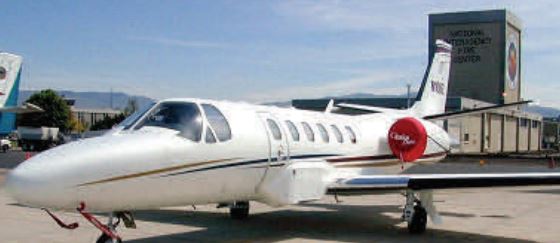
USFS IR aircraft, Cessna Citation Bravo
One of the U.S. Forest Service’s Infrared aircraft, their Cessna Citation Bravo, N144Z, parked at NIFC in Boise.

Earthzine has an article that does a good job of summarizing the U.S. Forest Service program that operates two fixed wing aircraft that map ongoing wildfires. Here is an excerpt:

…The two IR aircraft are a twin-engine Beechcraft Super King Air B-200 and a small jet, the Cessna Citation Bravo II. Both aircraft take off at between 7-9 p.m. and continuing mapping runs until 4 a.m.

Mapping flights follow a grid plotted out in advance, at an altitude of 10,000- 14,000 feet. From that height, each pass scans a swath 6.5 miles wide. For accuracy, passes overlap each other by 25-30 percent. Flying at 300 miles per hour, a map produced by the Super King is accurate by plus or minus 1 foot. The faster moving jet is only slightly less precise – providing maps accurate to plus or minus 10 feet.

The imagery is sent in real-time to interpreters on the ground while the aircraft are still making runs over a fire. Some 48 interpreters are scattered across the country and will have completed maps on the screens of firefighter command centers before the aircraft make their last landings of the night.

Outside Magazine covers the Yarnell Hill Fire

Granite Mountain Hotshots Yarnell Hill Fire
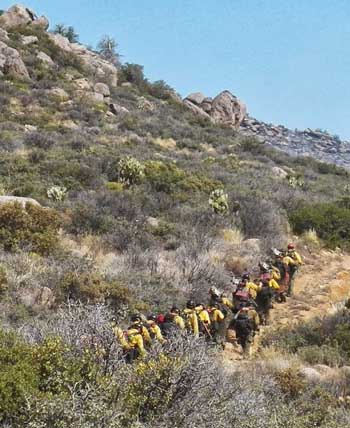
Granite Mountain Hotshots hike to the Yarnell Hill Fire, June 30, 2013. Photo by Joy Collura.

Outside Magazine has a lengthy article in their November issue about the last days of the 19 members of the Granite Mountain Hotshots who were killed when they were overrun by the Yarnell Hill Fire southeast of Prescott, Arizona on June 30, 2013.

Author Kyle Dickman obviously spent a lot of time interviewing Brendan “Donut” McDonough, the sole survivor from the crew, and several family members of the 19 hotshots. The article not only provides some personal information about some crew members and their spouses, but also has a few details about the fire suppression activities that has not yet been made public.

One of the devices used by the author was to tell us what some of the hotshots were thinking, or how they made decisions at key times. It was sometimes preceded by phrases such as “they would have been thinking…”, but it was distracting as I read it, since those firefighters died before they could tell anyone what they were thinking, or why they made certain decisions. Usually Mr. Dickman’s assumptions seemed logical, but he took a bold step by using that writing trick.

For the article, Mr. McDonough apparently provided some information about his actions on the fire as well as his conversations with the Granite Mountain crew leadership and the superintendent of the nearby Blue Ridge Hotshots the afternoon of the entrapment

Surprisingly the article includes a progression map, showing the spread of the fire at 10 to 20 minute intervals before the crew was trapped. It would be interesting to know the source of that very detailed information, or if Mr. McDonough was able to see all of the fire and remembered or recorded the data.

In the excerpt from the article below, “Eric” is Eric Marsh, the superintendent of the Granite Mountain Hotshots who during the Yarnell Hill Fire was serving as Division Supervisor for the geographic division which included the Granite Mountain Hotshots. “Donut”, Mr. McDonough, was away from the crew serving as a lookout, adding an element of safety for the crew by observing the location of the fire and taking hourly weather observations. The article explained that one of the reasons he was selected for that task was that he had just recovered from an illness, and the relatively light duty would give him another day to recover. The sad thing is, any firefighter would have trouble recovering from what was supposed to have been “light duty” that June 30 afternoon.

From Outside Magazine:

****

“THE GRANITE MOUNTAIN crew could see Donut on the UTV racing across the flats. They could see the helicopters and air tankers pivoting from Peeples Valley to Yarnell and dozens of emergency vehicles, lights flashing, speeding down Highway 89 toward Glen Ilah, the subdivision where Truman lived. It would have been difficult for the hotshots, who had been trained to help however they can, to sit idly by and watch houses burn. They would have been thinking of their fellow firefighters placing themselves in harm’s way.

With conditions changing so dramatically, Eric and the crew’s leadership—[acting crew superintendent Captain Jesse] Steed, Clayton [Whitted], Travis [Carter], Robert [Caldwell]—would have gathered for a moment on the ridge to discuss their options while the other hotshots sat perched on white granite boulders watching the drama unfold.

Do we hunker down in the black and do nothing but watch Yarnell burn? Or do we head down there, do some point protection, and try to save a couple of homes? Eric would have made the decision. He couldn’t have imagined that, by heading for town, he was leading his crew toward a series of increasingly compromised circumstances, each more desperate than the last.

He radioed out that Granite Mountain was moving back toward Yarnell.”

****


Thanks go out to Bruce

Arizona legislature to debate benefits for first responders

After it was revealed that there was a large discrepancy between the survivor benefits for the families of full time and temporary firefighters on the Granite Mountain Hotshots, some members of Arizona’s legislature have been considering what, if any, action should be taken for the families of the 19 firefighters that were killed June 30 on the Yarnell Hill Fire, and for future fatalities.

A committee in the state’s House of Representatives is taking up the issue today. Alia Rau, a reporter for the Arizona Republic, will be live tweeting about the hearing Tuesday afternoon. You can follow her at @aliarau.

According to AZCentral, the bills the legislature is considering could cover an array of issues, including:

  • Who reimburses fire departments that helped fight the Yarnell Hill Fire.
  • Who helps pay for Yarnell infrastructure repairs.
  • Who pays death benefits in wildfire situations.
  • Whether seasonal first responders can participate in state retirement systems.
  • Whether there is a way to retroactively provide benefits to the 13 seasonal hotshots.

“Before the Yarnell fire, nobody thought we were doing anything wrong. We didn’t hear fire coming in saying ‘Our hotshots aren’t covered if something happens.’ We didn’t have cities saying, ‘If something happens, we’ll be in deep trouble,’ ” House Speaker Andy Tobin said. “This has been a punch in the gut. Now it’s time to talk about what we’ve learned from it and what our policy should be going forward.”

Wildfire briefing, September 12, 2013

Live streaming of memorial service for Token Adams

The memorial service for Token Adams, the firefighter who was killed in an apparent ATV accident while scouting a fire in New Mexico, will begin at 10 a.m. MDT today, Thursday, at KRQE and also KOBT.

Inmate firefighter truck rolls over in Arizona

An Arizona Department of Corrections crew carrier transporting a wildland fire crew rolled over Wednesday afternoon on State Route 79 near Florence, Arizona. Several inmates and one corrections officer were injured, but none of the injuries were considered life-threatening. It is unclear what caused the accident but authorities are looking for a newer white Chevrolet Tahoe or Suburban that may have been involved. The older male driver of the SUV is believed to have left the scene traveling south.

Deceased person found in Clover Fire in Northern California

On September 10, 2013 during the late evening hours, the Shasta County Sheriff’s Office located a deceased person inside the Clover Fire perimeter on Coal Pit Road in the community of Igo, California while conducting a welfare check. Next of kin was notified and the person has been identified as Brian Stanley Henry, 56. We send out our sincere condolences to the family of Mr. Henry.

Survey says voters have strong connection to national forests

A recent survey of voters commissioned by the National Forest Foundation concluded that they have a strong personal connection to National Forests. These connections are so strong that four in five voters polled said despite federal budget problems, funding to safeguard National Forests should not be cut. Seventy-two percent of voters surveyed would support additional funding to maintain and restore National Forest lands even if it meant a small tax increase.

Such supporters include groups that are traditionally more tax sensitive: 63 percent of seniors and 56 percent of conservatives said they would support additional funding even if it meant a small tax increase.
wildfire serious problem
Forty-four percent (44%) of voters see uncontrollable wildfires as a serious problem. Just under half (44%) of U.S. voters say “uncontrollable wildfires that destroy property and forests” “is a serious problem, facing the nation” – with one-in-four calling it an “extremely” or “very” serious problem. This is the highest proportion to register this view since 2007. Concerns about this issue are drastically different by region, with 67% of voters in the West saying wildfires are an extremely or very serious problem and two-thirds deeming them to be at least somewhat serious.

Distribution of federal disaster aid to states

Elected representatives of some of the states that received the most federal disaster aid for wildfires, crop insurance, and storm damage, voted against federal aid for victims of superstorm Sandy.

Thief hit fire stations while firefighters fought wildfire

While crews in Walnut Creek were out fighting the Morgan Fire east of Berkeley, California Sunday night, a thief broke into Fire Station No. 7 and rummaged through lockers, desks and gym bags making off with money, an iPad, two firefighters’ wedding bands, and a watch. A second firehouse was also targeted, but a sleeping firefighter scared away the thief.

Since then, firefighters say they’ve received endless food donations, hundreds of dollars in gift cards, and offers from multiple jewelry stores to replace the stolen rings.

Tanker 131 certified

T 131 taxiing
T 131 taxiing. Photo by Dan Megna.

Coulson’s Air Tanker 131, a converted C-130Q, has been fully certified by the FAA, the Interagency AirTanker Board, and the U.S. Forest Service. The 3,500-gallon aircraft was carded on Tuesday and the pilot check rides occurred Wednesday. It should be ready to drop retardant on fires today, Thursday.

Conair begins flight testing their BAe Avro RJ85 air tanker 

Conair RJ85 first flight
Conair’s BAe Avro RJ85 first flight. BAE Systems photo.

Conair Group of Abbotsford, British Columbia has started flight testing their BAe Avro RJ85, identified as Tanker 160, which is being converted from a jet-powered airliner into an air tanker. The RJ85 is a derivative of the BAe-146, but with improved engines. The 146 first flew in 1981 while the RJ85 was first delivered in 1993. Conair is the largest air tanker operator in the world with a fleet of around 50 fixed-wing special mission aircraft, including Convair 580s, Conair Firecats, Douglas DC-6s, and Lockheed Electra air tankers.

Tanker 160 first flight
Conair’s Tanker 160, a BAe Avro RJ85 after first flight, August 21, 2013. Photo by Coastal Pacific Aviation.

The aircraft still has to be certified by the FAA, the Interagency AirTanker Board, and the U.S. Forest Service before it can be used on federal fires in the United States, a process which could take days, weeks, or months.

More information about the BAe conversion projects going on at four different companies.

Fire department packs up Granite Mountain Hotshots memorial fence

From The Daily Courier:

The chain-link fence in front of Prescott’s Fire Station 7 stood bare Tuesday morning for the first time since soon after 19 Granite Mountain Hotshots died in the line of duty more than two months ago.

In an effort to move forward from the June 30 Yarnell Hill wildfire tragedy, the Prescott Fire Department called for the removal this week of the thousands of items that materialized on the fence in the days and weeks after the Hotshots’ deaths.

Several dozen firefighters from around the area were on hand at the Sixth Street station to work with about 30 volunteers in taking down and packing up the curtain of interwoven flags, T-shirts, signs, and photos that had shrouded the fire station.

Wildfire briefing, September 6, 2013

Map elevated wildfire risk, climate change

Scientists expect fire risk in the U.S. to escalate by the end of the century

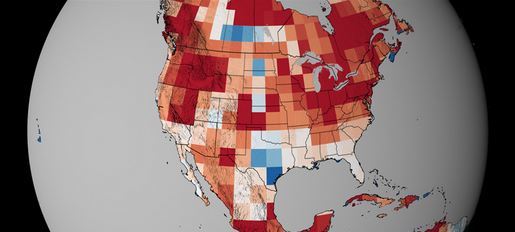
Map elevated wildfire risk, climate changeHot and dry conditions lead to more fires. Those were the findings presented in 2012 by a team of researchers that used NASA satellite data and climate models to predict fire activity in the United States. Now, a new animation shows how dry conditions will cause different parts of the U.S., Canada and Mexico to experience an increased risk of fire by the end of the century. By mapping projected values for a measure of dryness known as the potential evaporation—a calculation that’s based on temperature, rainfall and wind speed estimates—scientists are able to interpret how fire activity will be influenced by future climates. Changes in dryness relative to 1980 levels are shown in the animation using colors, where reds represent an increase in dryness and blues represent a decrease. Watch the video to see how dry conditions are expected to spread across North America by the year 2100.

Another firefighter fatality in Portugal

A seventh firefighter in a month passed away in a hospital in Portugal after suffering burn injuries on a wildland fire last week.

MAFFS demobilized

Five military Modular Airborne FireFighting System C-130 air tankers were released  from fire suppression duty yesterday. Since the year’s initial activation June 11, MAFFS crews have flown 572 missions and made 535 drops using 1,375,981 gallons of fire retardant. That works out to 2,406 gallons per mission.

Granite Mountain Hotshots memorial items to be removed

Soon after 19 members of the Granite Mountain Hotshots were killed on the Yarnell Hill Fire on June 30, mourners began placing memorial items on the fence surrounding their compound at the Prescott Fire Department. Now over two months later the city decided they have to do something with the hundreds of objects which include T-shirts, photos, posters, and other items. The City announced Thursday that the Fire Department and area volunteers would begin to remove them on Sept. 10.

Below is an excerpt from an article in the Daily Courier:

Now, officials say, it is time to begin packing away the items for preservation, and possible inclusion in a more permanent memorial in the future.

“Items that are able to be preserved will be temporarily stored until plans are finalized for the future permanent memorial,” the city’s new release stated.

City officials have noted that the outdoor elements have taken a toll on many of the items. Flowers, cardboard signs, and other perishable items were earlier removed. Many of the T-shirts from fire departments around the country have faded from dark-blue to gray.


Wildfire briefing, September 1, 2013

Rim Fire becomes fourth largest in California history

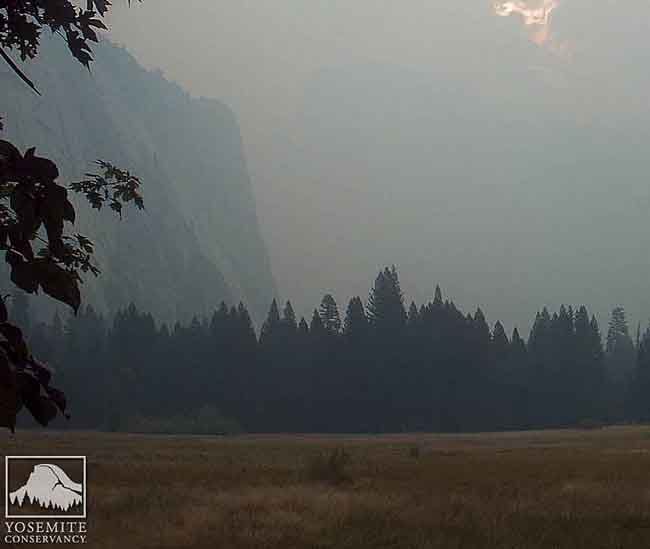
Yosemite Valley's Half Dome obscured by smoke
Yosemite Valley’s Half Dome, normally seen in this view, was obscured by smoke at 8:36 a.m. September 1, 2013

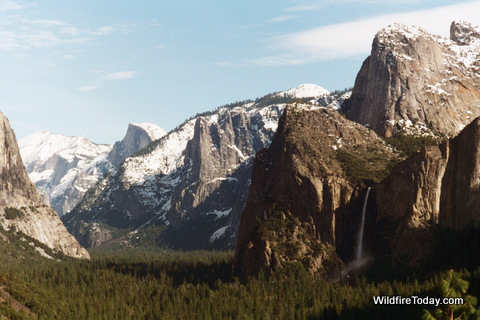
Our main article about the Rim Fire is updated daily but here are a few recent facts about the fire. On Saturday it continued to grow, adding another 3,000 acres to become at 222,77 acres the fourth largest fire in California history. Winds that shifted to come out of the west over the last two days have blown smoke into downtown Yosemite National Park, into the heavily visited Yosemite Valley. Compare these two photos of the valley; the one above was taken Sunday morning by a web cam, and the photo below we took on a day when the air was much cleaner. The fire is still eight to ten miles away from Yosemite Valley.

Yosemite Valley January, 1997
Yosemite Valley January, 1997, a few days after a flood caused major damage to National Park Service facilities in the valley. Photo by Bill Gabbert.

The 5,115 personnel assigned to the fire are fighting it by constructing direct fireline along the fire’s edge, and by indirect methods including burning out the fuel ahead of the fire. The smoke has limited the use of air tankers and helicopters for the last two days.

According to the Daily Telegraph, the fire may have been caused by activities at an illegal marijuana farm.

“We don’t know the exact cause,” Todd McNeal, fire chief in Twain Harte, a town that has been in the path of the flames, said on Friday. But he told a community meeting that it was “highly suspect that there might have been some sort of illicit grove, a marijuana-grow-type thing.”

“We know it’s human caused. There was no lightning in the area,” he said.

LA Times article about the Rim Fire

Julie Cart, who with Bettina Boxall wrote a series of Pulitzer Prize winning articles in 2008 about wildfires for the Los Angeles Times, has a new article about the Rim Fire. She mentions how firefighting policy differs between the U.S. Forest Service and the National Park Service, but greatly over-simplifies to the point of distortion the concept of “fire use” fires which are not aggressively and immediately suppressed.

Reuters: how budgets affect fires

Reuters has an article about how federal budgets may be contributing to the occurrence of larger fires by reducing the number of fuel treatment projects and prescribed fires. They have a quote from Jonathan B. Jarvis, the Director of the National Park Service:

Part of the problem, experts and many fire officials say, is that funding has been low for the controlled burns and forest-thinning work that makes it harder for a wildfire to spread.

“We’ve got to invest up front in terms of controlling and managing these fires,” said Jonathan Jarvis, director of the National Park Service from his smoke-filled post in Yosemite National Park. “Just waiting for the big fire and then throwing everything you’ve got at it makes no sense.”

In recent years, Jarvis said, the trend has been to shift money from fire prevention to firefighting.

Montana Supreme Court will decide case about firefighting strategy

The Montana Supreme Court will make a decision by November that could have an effect on how firefighters select a strategy for suppressing a fire. A Montana rancher who said firefighters’ backfires ruined his ranch won a suit against the state of Montana in 2012 which is being appealed to the Supreme Court. A jury awarded Fred and Joan Weaver $730,000 in a trial over the strategy and tactics that were used on the Ryan Gulch fire in 2000 – $150,000 was for the loss of timber, $200,000 for rehabilitation of pasture land, and the balance was for the mental suffering and anguish of seeing their ranch threatened by the fire. About 900 acres of the Weaver’s land burned during the fire.

The heart of the Weavers’ case was their contention that firefighters who usually fought fire in the flat, wet southeast United States used poor judgement in selecting and implementing an indirect strategy of backfiring, rather than constructing direct fireline on the edge of the fire. In the process, they argued, more land burned than was necessary, including 900 acres of their ranch.

We wrote an analysis of the 2012 court decision last year.

Recent articles at Fire Aviation

Prescott’s Granite Mountain Hotshot crew nearly paid for itself

When the Granite Mountain Hotshots worked on federal fires the terms were established by their contract or agreement with the U.S. Forest Service. The Prescott Fire Department paid the personnel on the crew around $12 an hour according to The Daily Courier, but the department was reimbursed by the federal government at the rate of $39.50 an hour. Below is an excerpt from the article:

In fiscal year 2012, the city estimated that the crew brought in $1,375,191, and had $1,437,444 in operating expenses – for a difference of $62,253.

On June 30 of this year 19 members of the crew were killed on the Yarnell Hill Fire near Prescott, Arizona. A controversy is brewing in Prescott and the state of Arizona about the differences in compensation for the survivors of the seasonal and permanent firefighters on the crew.

It is not unusual for firefighting resources that are contracted to the federal government through local fire departments to be compensated at rates far higher than those at which federal firefighters are paid.


Thanks go out to Dick