On Tuesday we were at the Beaver Fire northwest of Yreka, California, watching it move down and across slopes above the Klamath River. Below are some photos we took. Over the next two days we will post more.
The Beaver Fire has already reached Highway 96 in several places along a 12 to 14 mile stretch of the road. On Tuesday it was backing, primarily, down the hill in the vicinity of the Klamath River School, and east of the school. Generally it was moving fairly slowly while we were there, with one to three trees succumbing to flames at a time, or torching as firefighters call it.
Firefighters are protecting structures up in the woods away from the road as best they can. Helicopters were assisting ground-based firefighters by dropping water from the river and fire retardant from a portable retardant plant. At Fire Aviation you can see photos of a Sikorsky Air-Crane reloading with retardant. During the three hours we were at the south end of the fire we did not see any air tankers.
The last size estimate from the Incident Management Team was a couple of days ago when it was mapped at about 28,000 acres. Clouds at night have interfered with the ability of the airborne infrared mapping crew to accurately provide a fire perimeter and current acreage. The Team is calling it 30 percent contained.
Water was being pumped from the Klamath River to an overhead fill pipe for refilling water tenders. Sleeping quarters for firefighters at the Klamath River School. A strike team of engines being briefed. The hillside across from the Klamath River School. Free haircuts in Yreka, CA for firefighters. I didn’t ask if tanning was also free.
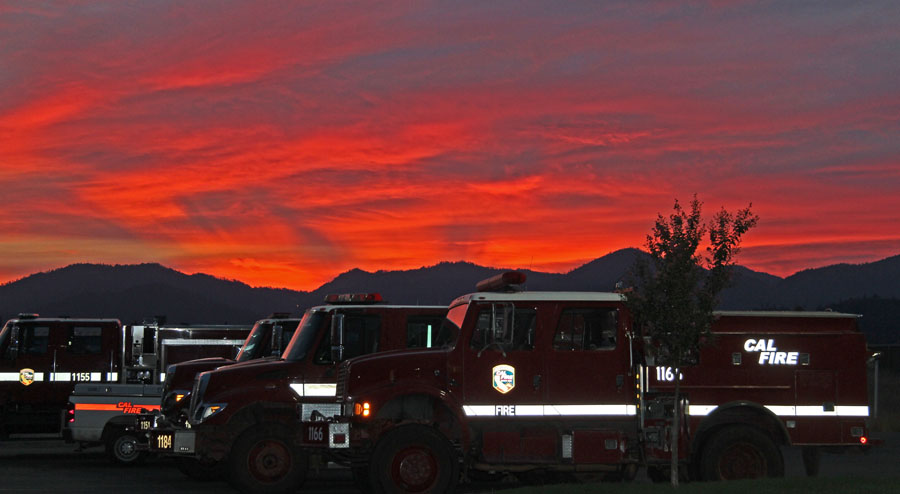
Sunset in Redding, California, August 10, 2014. A strike team of CAL FIRE engines assigned to the Eiler Fire is in the foreground. (Click to see a larger version.) Photo by Bill Gabbert.
Some of the readers of this site may agree with the supposition that a beautiful sunset can be enhanced if there are fire engines in the foreground. OK… probably not MANY will agree — but maybe there’s one or two that will. Or, at least ONE. Right? Help me out here!
This was a strike team of CAL FIRE engines that is assigned to the Eiler Fire 40 air miles east of Redding, California. They are working 24-hour shifts and every other day come in to Redding to stay in a motel, where this photo was taken tonight, August 10.
Two Firewatch Cobras going through their 150-hour service at Redding, California, August 8, 2014. Photo by Bill Gabbert.
While we were at Redding on August 8 the two U.S. Forest Service Firewatch Cobra helicopters were both going through their 150-hour service. Dan Johnson, the Regional Aviation Group Supervisor for the U.S. Forest Service’s North Zone in California, told us that they have both been heavily used in recent weeks and the 150-hour came due quickly.
The helicopters are retrofitted Bell AH-1 Cobra attack helicopters, two of the 25 that the U.S. Forest Service acquired from the military. Most of the other 23 are at the aircraft boneyard at Davis-Monthan Air Force Base near Tucson. A couple that are used for spare parts are sitting outside the hangar at Redding.
Cobras used mostly for spare parts at the Redding Airport. Photo by Bill Gabbert.
We first wrote about the Firewatch program in 2010 at Wildfire Today. The USFS has them outfitted with infrared and other sensors so that they can be used for close-in intelligence support for ground troops, such as GIS mapping, real time color video, geo-referenced infrared, and infrared downlink. In addition to intelligence gathering, they are also used as a platform for an Air Attack Group Supervisor (ATGS) or a Helicopter Coordinator (HLCO). Mr. Johnson said it would be possible to use them as lead planes, but he feels fixed wing aircraft are better suited for that role.
Sensors on Firewatch Cobra. Photo by Bill Gabbert.
T-41 and T-131 at RDD 8-7-2014 T-41 at RDD 8-7-2014 T-41 landing at RDD 8-7-2014 T-41 landing at RDD 8-7-2014 Seen from the rear with the speed brakes deployed, is T-41 landing at RDD, 8-7-2014
All photos were taken by Bill Gabbert and are subject to copyright.
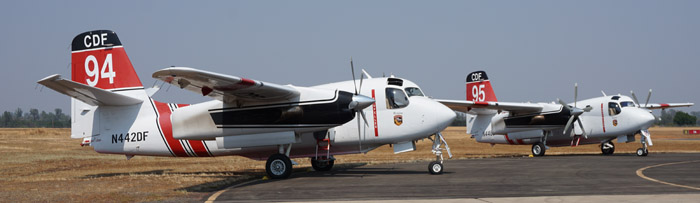
We spent some time yesterday at the Redding Air Attack Base in California and shot photos of the aircraft and will be posting them over the next few days. Here are a few to get started. Click on the photos to see slightly larger versions.
T-94 and T-95 at RDD 8-7-2014 AA-240 and AA-505 (OV-10s) and the Coulson support rig at RDD 8-7-2014 AA-120, an OV-10, landing at RDD 8-7-2014 California National Guard Chinook at RDD Two Cobras and a Sherpa at RDD , 8-7-2014
All of the photos were taken by Bill Gabbert and are protected by copyright.
Yesterday we stopped by the air tanker base at Chester, California where Terry Grecian, the manager, was kind enough to allow us out on the ramp to talk with one of the pilots.
Since it rained heavily a couple of days ago it has been less hectic at Chester. Earlier in the week they had Single Engine Air Tankers, Large Air Tankers, and several helicopters working out of the airport. On Wednesday there were just two SEATs and one Type 2 helicopter parked there.
Pilot Fred Celest and air tanker 873 at Chester, Calif. Photo by Bill Gabbert.
Fred Celest is the pilot for Tanker 873, an Air Tractor 802-F. He has previously flown crop dusters, private jets and P2V air tankers. He likes flying air tankers better than corporate jets, he said, because with air tankers he travels less. While talking with him we detected a bit of an accent, and it turns out that he is French and German, but is a United States citizen.
Mr. Celest felt it was important to point out that the 800-gallon aircraft has a 1,650 HP Garrett-14 engine. The air tanker is under contract through New Frontier Aviation out of Fort Benton, Montana. The company also operates 550-gallon M-18 Dromader SEATs.
David Shepard’s house in the Eiler Fire. Photo by Bill Gabbert.
Yesterday we had the privilege to meet David Shepard, the owner of a house deep in the woods in northern California. His log house with a metal roof survived an onslaught from the 31,000-acre Eiler Fire about 40 air miles east of Redding, California without a scratch. Even his stacks of firewood on the porch and in the yard are completely intact. The fire burned completely around his place, right up to the structure on one side. Helpfully for when a fire burns through the property, the house is flanked on two sides by a creek that forks just upstream from the structure.
The Shepard house. Trout and salmon have been caught in the stream. Photo by Bill Gabbert.
When we asked Mr. Shepard if he was at the house during the fire, he said, “Do you think I’m crazy?”
Creek adjacent to the Shepard house in the Eiler Fire. Photo by Bill Gabbert.
As you can see in the photo above, just across the creek multiple tree torched, indicating that it was burning intensely just 75 feet away from the house. We saw no indication of any retardant drops from air tankers, probably because they were not allowed to place retardant near the streams.
Mr. Shepard, who prefers not to have his picture taken, is a film preservationist — he restores film. We asked if he worked with old nitrate base films which are extremely flammable and can even spontaneously combust if stored at a high temperature in an area where the heat can’t dissipate. He said he has some in the house but they are stored in metal containers.
We later Googled Mr. Shepard and discovered that the modest man produces movies and is an award-winning film preservationist, receiving, among others, the Lifetime Achievement Award from the Denver Silent Film Festival.
Tahoe Douglas engine crew at a house in the Eiler Fire. Photo by Bill Gabbert.
While we were at the house an engine crew from the Tahoe Douglas Fire District arrived to do some additional mopup. Much of the area had already been heavily mopped up, to the point of becoming muddy, probably by using water drafted out of the creek. But there had not been much done on the other side of the creek, and a few smokes created some concern for Mr. Shepard, who had called and requested some additional work from the firefighters.
Tahoe Douglas engine crew installing a ladder across a creek adjacent to a house in order to mop up on the other side. Photo by Bill Gabbert. Tahoe Douglas engine crews crossing a creek to mop up near a house in the Eiler Fire. Photo by Bill Gabbert.
One reason the area across the creek had not received much attention was that there was no easy way to cross the six to ten-foot wide water course. Captain Chris Lucas and his crew of Jessie Rowan, Ben Pratt and Shean Bailey solved that problem by taking a ladder off the engine and using it as a bridge. After extending it vertically, they lowered it across the water by using “baby hose” as a rope. The firefighters then got on all fours and crossed on the ladder.
Tahoe Douglas engine crew mopping up in the Eiler Fire. Photo by Bill Gabbert.
The National Transportation Safety Board has released preliminary information about the June 15 accident in which Minden’s Tanker 48, a P2V, experienced a hydraulic failure, resulting in the nose gear collapsing while it landed at Fresno, California.
****
“NTSB Identification: WPR14TA248
14 CFR Public Use
Accident occurred Sunday, June 15, 2014 in Fresno, CA
Aircraft: LOCKHEED SP 2H, registration: N4692A
Injuries: 2 Uninjured.
This is preliminary information, subject to change, and may contain errors. Any errors in this report will be corrected when the final report has been completed. NTSB investigators may not have traveled in support of this investigation and used data provided by various sources to prepare this public aircraft accident report.
On June 15, 2014, about 2044 Pacific daylight time, a Lockheed SP-2H, N4692A, was substantially damaged when the nose wheel landing gear collapsed during landing roll at the Fresno Yosemite International Airport (FAT), Fresno, California. The airplane was registered to Minden Air Corporation, Minden, Nevada, and operated as Tanker 48 by the United States Department of Agriculture (USDA), Forestry Service, as a public use flight. The airline transport pilot (ATP) rated captain and the ATP rated first officer were not injured. Visual meteorological conditions prevailed and a company flight plan was filed for the local fire fighting flight. The flight originated from Porterville Municipal Airport (PTV), Porterville, California, at 1934.
The captain reported that following an uneventful aerial drop, the flight was returning to PTV. During the descent check, he noticed that the hydraulic pressure indicated 0 and that the first officer subsequently verified that the sight gauge for the main hydraulic fluid reservoir was empty. The first officer opened the jet engine doors successfully as the captain selected gear down with no response. The captain notified base personnel at PTV of the situation and informed them that they would be orbiting to the east of the airport to troubleshoot. The captain and first officer performed the emergency checklist, and extended the nose wheel landing gear successfully. The captain stated that the first officer then installed the pin to the nose wheel landing gear as part of the emergency checklist.
The flight diverted to FAT due to a longer runway and emergency resources as both pilots briefed the no-flap landing procedure, airspeeds, and approach profile. As the flight continued toward FAT, the flight crew informed Fresno Approach Control of the hydraulic system failure and continued to perform the emergency gear extension checklist. The first officer extended the main landing gear using the emergency gear release, which resulted in three down and locked landing gear indications in the cockpit. As the flight neared FAT, the first officer added two gallons of hydraulic fluid to the main hydraulic reservoir while the captain attempted to extend the flaps unsuccessfully. Subsequently, the flight landed on runway 26R. During the landing roll, the nose wheel landing gear collapsed and the airplane came to rest nose low.
Examination of the airplane by representatives from the Forest Service revealed that the forward portion of the fuselage was structurally damaged. The airplane was recovered to a secure location for further examination.”
****
Below is photo of Tanker 48 after landing on all three wheels at Rapid City, July 21, 2012, while working the Myrtle Fire.