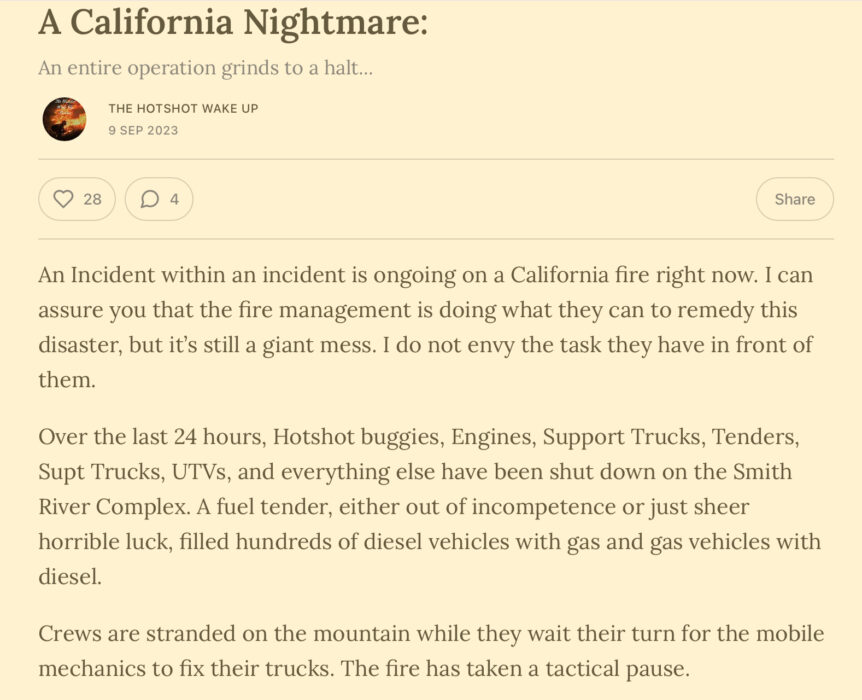
Fuel “disaster” on Smith River Complex

thehotshotwakeup.substack.com/p/a-california-nightmare

I’ve not verified this yet, but I will. Read more at the link.

15:25 UPDATE FROM THE IMT:

We do not have a fuel disaster taking place.  We did have a fuel issue that has been resolved. 
Thank you,
Stacy King-Powers
PIO
SWIMT 2
Smith River Complex 


Hotshot Wake Up

Neither the USFS update nor the Inciweb page makes any mention of this.  But then the “Hotshot Wake Up” has no name or contact info attached to it. Anyone vouch for that “author” ?

Forest Service update 09/09/23
Inciweb update 09/09/23

And, two days later, an update:
6 Rivers

Thanks to TS for the tip and to Bill Morse for the answers.

NTSB releases initial report on Cabazon mid-air

A midair collision in Cabazon, California in August involving two on-duty contracted Cal Fire helicopters, one of which crashed and killed the three men on board, was the result of one aircraft colliding with the other in mountainous terrain, with the pilots apparently not aware of where they were in relation to each other.

According to City News Service, the National Transportation Safety Board on Friday released its preliminary report on the August 6 crash that destroyed a Cal Fire Bell 407 helicopter en route to a fire just south of Interstate 10 in the area of Apache Trail and Pipeline Road.

Cal Fire Assistant Chief Josh Bischof, 46, of Menifee, Cal Fire Capt. Timothy D. Rodriguez Jr., 44, of San Jacinto and contract pilot Tony Sousa, 55, of Red Bluff were killed in the accident.

Aviation International News reported that the Sikorsky S-64E Skycrane was descending when the collision occurred. The Bell 407 — a derivative of a LongRanger — was flying in an observer-coordinator role.  The two aboard the Siller heavy helicopter were uninjured; they were able to land the Sikorsky and walk away.

Both aircraft were under contract to Cal Fire and were part of the late afternoon initial attack response to the Broadway Fire west of Palm Springs. “The Sikorsky landed nearby without further incident,” reads the report. “The right main landing gear tire was damaged, with an approximate 12-inch portion not located.” (It’s likely that a foot-long piece of the snorkel was missing, not the landing gear.)

Both aircraft had taken off from nearby Hemet, 11 miles southwest of the fire, with the 407 airborne approximately three minutes ahead of the S-64. The two helicopters flew different routes around mountainous terrain toward the fire, and ADS-B data showed both helicopters on a converging flight path until the time of collision west of the fire.

The report said a piece of delaminated main rotor blade marked the beginning of the 407’s debris path, which was about 950 by 550 feet, and that the main rotor blades, mast, and transmission came to rest around 285 feet northwest of the main wreckage, upslope from the initial impact point.
 
Our sincere condolences to the family and friends of all involved, including the Sikorsky crew.


Torrential rains follow wildfires in Greece

Reuters reported today that torrential rains have flooded homes, businesses, and roads in Greece — with at least one death reported after a man died when a wall collapsed, according to fire officials on Tuesday.

The Guardian reported that Greece has been stricken by hundreds of wildfires this summer, with dozens of new fires starting each day. Most are controlled quickly but some have exceeded fire services’ capacity. One fire in the northeast has destroyed homes and vast tracts of forest since it took off on August 19.

Another fire on the island of Rhodes burned for days in July, forcing holidaymakers and locals to evacuate homes and hotels.

Storm Daniel has battered much of Greece since Monday, with  hundreds of calls to emergency services to pump out water just days after a deadly wildfire that has burned for more than two weeks in the north was finally controlled.

Meanwhile, videos posted online on August 23 show Greek members of the political extreme right illegally “arresting” migrants in Evros, a Greek region that borders Turkey. The videos show militants forcing men to sit in the dirt while other migrants were crammed into a trailer. The attackers accuse the migrants of being responsible for the widespread fires in the region.

Oregon’s Tyee Ridge Complex almost 3000 acres

The Tyee Ridge Complex consists of 19 fires ignited by lightning on the evening of August 24. About 200 people have been evacuated.

As of August 29, the fires had burned 2,899 acres in the hills around the community of Umpqua, approximately 10 miles west of Sutherlin. According to a report by KPIC-TV, the fires are under unified command with the Oregon Department of Forestry (ODF) Team 1 and the Oregon State Fire Marshal’s Red Team. The fires are in rugged, steep, and difficult terrain, but crews are making progress and the fire is now estimated at 5 percent containment.Tyee Ridge Complex map

Firefighters have been working since Tuesday night with very active fire behavior on the Cougar Creek and Lighthouse fires. Active fire behavior is predicted  till cooler conditions and expected showers arrive.

On Wednesday firefighters worked on a number of spot fires that Had crossed containment lines.

Water and retardant drops are supporting ground crews in areas of steep or inaccessible terrain. Single-engine airtankers and helicopters worked closely with heavy equipment operators and hand crews. Among the aircraft were two Chinook CH-47 helicopters from the Oregon Army National Guard.

To the north, the Big Tom Fire saw more active fire, while there was increased mop-up on the Hardscrabble, Blue Hole, and Yellow Point fires, all moving toward patrol status in coming days, according to a KPIC report.

Oregon State Fire Marshal task forces worked around structures, installing sprinkler kits along Hubbard Creek, Briarwood Road, and the Lighthouse community. They are integrated with ODF crews to HELP in cutting line and protecting homes.

Fuel moistures are well below average for this time of year. There is a heavy dead and down component to the fire area, with fuels burning actively and intensely. Even though humidity recoveries are good to excellent overnight and moderate during the day, heavier fuels are slow to respond. The steep terrain is also a factor in fire behavior that accelerates upslope fire runs, torching, and potential for spotting.

Tyee Ridge Complex at night
Nighttime on Tyee Ridge:  Headlamps of firefighters on night shift trace a bright trail beneath the rising moon on one of the fires of the Tyee Ridge Complex. Photo ©2023 Dan Morrison, photojournalist at the University of Oregon.

Currently the evacuations are: Level 3 (Go) from the 11000 block of Hubbard Creek Rd. to Millwood Dr., Level 2 (Set) from Hubbard Creek Rd. from Millwood Dr. to Melqua Rd., and Level 1 (Ready) for Tyee Road at the intersection with Rock Creek Rd. to Fanchin Lane. Closures: Hubbard Creek Road at Millwood Drive.

KPIC has a 5-star photo gallery by Dan Morrison.

PLEASE ground your drone. Please.

The Texas A&M Forest Service reminds drone operators that they are not allowed to fly drones when there is a wildfire nearby.

A helicopter recently delivering water on a fire in Caldwell County nearly collided with an airborne drone, and the state firefighting agency says the drone came within just feet of the firefighting aircraft, according to a report by KBTX-TV.

Firefighters in the state of Washingon (among others)  are fed up with people flying their drones above wildfires. A state DNR official says the problem is massive and just getting worse. On Tuesday, the Washington State Department of Natural Resources posted a series of online messages warning drone operators about flying near wildfires.

The DNR said fire vs. drone incidents have occurred “multiple times this year” and have prevented aircrews from flying on fires. “It’s not cute!” it added.

Officials remind the public that drones are a serious hazard and someone could be killed if a drone should collide with a firefighting aircraft. Air ops on fires will be shut down — grounding helicopters and fixed-wing ops — if you or your buddies are flying a drone anywhere near a wildland fire.

If a drone is spotted in the fire area, firefighting aircraft will be grounded and air ops suspended until the drone leaves or is otherwise taken down.

KAGS-TV reported that the recent drone incursion in Texas came within just feet of fire aircraft. “Pilots have no way to detect a drone or know there is one present in the airspace until they see it,” said Texas A&M Forest Service Aviation Manager Jared Karns.

The FAA restricts activity around wildfires (Temporary Flight Restrictions) to ensure that firefighters have a safe space to operate in fire areas and fight fires. Incursions with a drone into a fire TFR can result in charges and very expensive fines in many states.

Scoopers onboard in Texas

Things are just getting hotter in Texas, and Gov. Greg Abbott has declared a wildfire disaster with ongoing triple-digit temperatures in the forecast for the Brazos Valley — and the Texas A&M Forest Service (TAMFS) has stationed more airtankers in College Station.

Wes Moorehead, associate director and fire chief for the TAMFS, said the department uses numerous different aircraft to fight fire, but in College Station, they now have two new super scoopers.


“They are made to scoop off of open water lakes and then deposit that water onto an active fire scene,” Moorehead said. “Other aircraft, they will be loaded at the airport with retardant or water and then fly to the fire location and drop it. They’ll have to return to the airport and get reloaded.” In a report by KXXV, Moorhead said, “These in particular hold 1,400 gallons, which is a sizeable amount of water. Typically, a firetruck will hold around 500 gallons, so three times the amount of water a local fire truck can deliver.”

CBS Austin reported last week that TAMFS has brought in dozens of aircraft  to work on nearly 3,000 fires across the state since the beginning of this year.

The Super Scooper is a specialized water-dropping airtnker, according to pilot Elic Kirby. “It’s just a giant, yellow beast,” he said. “It’s made to fight fire. It’s all it’s made to do, it’s all it does.” Kirby’s been flying scoopers for a couple years now, and says they’ve been flying Texas fires every day lately. His airtanker is one of about 30 aircraft brought on by TAMFS a couple weeks ago to fight fires — thousands of fires since the first of the year.

“Since January 1, we’ve actually seen 3,000 wildfires burn in the state of Texas,” said Moorehead. “These triple-digit temperatures are actually driving the moisture out of fields and driving the wildfire scene that we have in Texas right now.” He said airtankers are most helpful when aiding the crews who fight wildfires on the ground.

As Fire Aviation reported back in January, the special purpose acquisition company (SPAC) of Jack Creek Investment Corp. collaborated with the long-time aerial firefighting delivery company, Bridger Aerospace Group Holdings, LLC (BAER/BAERW), moving onto Wall Street via the Nasdaq Global Market. Shares began trading on January 25 and dropped by a third on day three, with the company’s market capitalization at a robust $760.64 million.

Three years ago today


Three years ago today, Doe Fire on the Mendocino National Forest in northern California.

Fire on the Mendocino, view from Hwy 162

photo from facebook, Doe Fire as viewed from Hwy 162.

California’s becoming uninsurable

Several major insurance companies have stopped accepting California homeowners for new policies because of growing wildfire risks. As the number of fires in the state increases and other factors escalate, insurance companies worry about the risk — and the expense.

In 2022 there were over 5,000 wildfires, according to Cal Fire, that burned about 118,000 acres. Already this year 4,337 fires have burned over 114,560 acres.

Residents in high-risk fire areas or hurricane regions need homeowners’ insurance — and lenders require it. No insurance, no home loan. More people are moving into the interface, costing insurance companies too much to repair and replace houses while battling inflation, said Janet Ruiz with the Insurance Information Institute. Two insurance giants withdrew from California’s home insurance marketplace, explaining that increasing wildfire risk and soaring construction costs have resulted in their decisions to stop writing new policies in the state. State Farm announced last week it would stop accepting applications for all business and personal lines of property and casualty insurance, according to the Associated Press. The company cited inflation, a challenging reinsurance market, and rapidly growing catastrophe exposure.

“We take seriously our responsibility to manage risk,” State Farm said. “It’s necessary to take these actions now to improve the company’s financial strength.”

Unlike heavyweights State Farm and Allstate, which declined to sign new homeowners in the state, AmGUARD and Falls Lake will also drop their existing policyholders.

Allstate, another insurance powerhouse, announced in November it would pause new policies for homeowners, condos and commercial properties in California to protect current customers.

Homeowners may have to turn to the California FAIR Plan, which provides basic fire coverage, if they aren’t able to find an insurer that will cover fire expenses. The high-risk pool known as the FAIR Plan is not a government entity or a state program. Taxpayers do not fund the FAIR Plan — it’s supported by all carriers licensed to do business in California, which spreads the risk among all the insurance carriers. Because the FAIR Plan is a high-risk policy, people should expect to pay more than they would for a standard homeowner policy.

The San Francisco Standard reported last week that two more companies quietly left the California market, further narrowing options for those trying to insure their home or purchase one with a mortgage.

AmGUARD Insurance — a subsidiary of Berkshire Hathaway GUARD Insurance Companies — will withdraw its homeowners and personal umbrella programs, and Falls Lake Insurance will also end its homeowners program. Both companies made the announcements July 21 in little-noticed filings submitted to the state regulator. AmGUARD and Falls Lake are the latest insurers to end or limit their business in the state during the past year.

Unlike heavyweights State Farm and Allstate, which declined to sign new homeowners in the state, AmGUARD and Falls Lake will also drop their existing policyholders. Safeco plans to drop 950 policies in October in San Francisco and the East Bay.

An SFGATE report noted that State Farm held the most policies in the California property market in 2021, and the company experienced about a 60 percent loss that year.

 

Bonny Fire helicopter ops

Ryan Grothe sent us a collection of eye candy from the Bonny Fire. “Numerous helicopters were getting water from Riverside Lake while assisting with the Bonny Fire,” he said, including a Columbia CH-47 and a PJ Helicopters CH-47, Cal Fire Copter 202 and an Erickson Aircrane.

“The Bonny Fire burned 2,322 acres in Riverside County. It started on July 27 and was fully contained on August 9. Cause of the fire remains under investigation.”

ABC7-TV reported that numerous airtankers also worked on the fire.

Photo ©2023 Ryan Grothe

Photo ©2023 Ryan Grothe

Photo ©2023 Ryan Grothe

Photo ©2023 Ryan Grothe

Photo ©2023 Ryan Grothe

Photo ©2023 Ryan Grothe

Photo ©2023 Ryan Grothe

THANKS RYAN!

Canada’s NWT capital evacuated

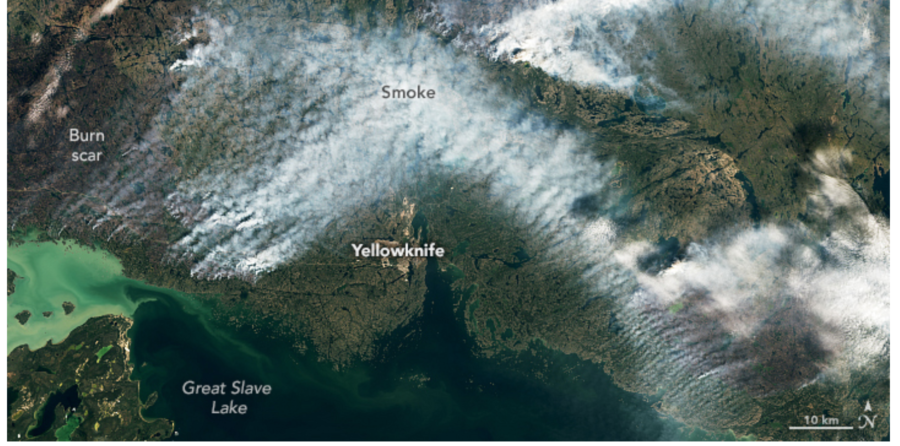
Hundreds of wildfires burning in Canada’s Northwest Territories have resulted in emergency declarations and the evacuation of the capital city of Yellowknife — by road and by air. About 20,000 residents of Yellowknife have been ordered to leave, as more than 230 fires burn across the territory and smoke drifts south into the United States. CNN reported that Yellowknife accounts for about half of the total population of the remote territory, located north of Alberta and east of Yukon.

The BBC reported that thousands of people on the outskirts of Yellowknife, one of the largest cities in Canada’s north, have crowded into the local airport and choked the road out of town. Hundreds have lined up for emergency military evacuation flights, and officials have given Yellowknife residents a deadline of noon Friday to leave.

NASA image of NWT smoke August 16, 2023

“We’re all tired of the word unprecedented,” said Premier Caroline Cochrane.

This afternoon the fire had burned to within 16km (10 miles) of the city. “Very tough days ahead,” said the territorial fire service, predicting more high winds. The closest evacuation shelter is 1,100km south of Yellowknife.

Military evacuation flights were scheduled today, with five flights to Calgary in the neighboring province of Alberta. The federal transport minister said Air Canada is capping the cost of flights out of Yellowknife and has added two extra flights out of the city.

One of the fires west of Yellowknife is at 165,000 hectares — over 407,000 acres. “We’re all tired of the word unprecedented,” said Premier Caroline Cochrane. “Yet there is no other way to describe this situation in the Northwest Territories.”