Mid-air collision on SoCal fire kills three

A Cal Fire observation helicopter crashed east of Los Angeles on Sunday evening after a midair collision with another firefighting helicopter, killing three crew members aboard. The Bell 407 collided with a Sikorsky S-64E, which was also working the fire, and the crash killed the two Cal Fire employees and their contract pilot on board the Bell. The Siller heavy helicopter experienced a hard landing but its crew of two parked the aircraft and walked away.

Those lost in the crash were a Cal Fire division chief, a Cal Fire captain, and a contract pilot. The Press-Enterprise reported that Cal Fire Southern Region Chief David Fulcher and other fire personnel at a midnight news conference wore black tape over their badges.


UPDATE: CALFIRE says Assistant Chief Josh Bischof and Fire Captain Tim Rodriguez were killed in the crash, along with the Bell helicopter contract pilot Tony Sousa.

After the crash, emergency personnel were dispatched to the site near the unincorporated community of Cabazon around 7:20 p.m., according to the Riverside County Sheriff’s Department. The crash occurred south of the 10 Freeway east of Banning, California, on tribal land south of the Morongo Casino.

A CBS News report said the Bell 407 (a derivative of a LongRanger) was flying in an observer-coordinator role when it collided with the Sikorsky Skycrane while battling the brush fire. Fixed-wing aircraft were also fighting the fire, with a total of six aircraft on the fire Sunday evening an hour or two before sunset. “This area has a lot of the light, flashy fuels that are becoming very prevalent with this fire season,” said Cal Fire Public Information Officer Rob Roseen. “Where we have a lot of these annual grasses and brush, they’re getting five, six feet tall.”

The fire, which reportedly started in a structure about 6 p.m., had spread to nearby brush, Cal Fire Southern Region Chief David Fulcher in a news conference, and had grown to about 20 acres. He said that Riverside County Fire Chief Bill Weiser had met with two family members. “We just want to let them know that we are there for them,” he added.

Cal Fire and Riverside County Fire crews were working on the fire near Broadway and Esperanza avenues; skies were mostly clear early Sunday evening, with winds ranging from 9 to 14 mph and gusts of 17 to 25 mph.

Our heartfelt condolences to families and friends of those lost, and also to the crew aboard the Sikorsky.

Oregon firefighter killed Friday

A 21-year-old federal firefighter was killed in an on-duty vehicle accident on Friday, August 4, near Powers, Oregon. Benjamin Sapper from Boulder, Colorado was a handcrew member on the Gold Beach Ranger District of the Rogue River – Siskiyou National Forest in southwest Oregon.

“This is a devastating loss of one of our own Gold Beach firefighters,” District Ranger Kailey Guerrant told KATU-TV. “We have a tight-knit community on the Gold Beach and Powers Ranger Districts, and we stand together in grief and support for his family, friends, and fellow firefighters during this heartbreaking time.”

Benjamin Sapper
Benjamin Sapper photo courtesy USFS

Benjamin graduated from Boulder High School and the University of Colorado with a degree in Applied Mathematics.

KDRV-TV reported that Sapper was on duty and traveling with his crew when their rig was involved in a vehicle crash. Coquille Fire & Rescue said the vehicle left the roadway above the community of Powers.

Sapper was an avid baseball player, chess player, and skier who planned to attend grad school in earth sciences this fall at the University of British Columbia.

Our sincere condolences to his family and friends, and to his co-workers on the Gold Beach crew.

British Columbia’s world-class fleet

The British Columbia Wildfire Service and its six regional fire centers coordinate the province’s wildfire suppression efforts in Canada’s southwestern province using strategies the service has developed over its 121-year history. One of its key strategies is an aviation fleet and program that makes the U.S. look like amateurs by comparison.

Western Canada forests are dense and often inaccessible from the ground, so the province relies heavily on its aerial firefighting program to keep fires from burning into huge mega-fires. The job of conducting aerial attacks has become more challenging in recent years due to hotter weather, lower humidity, longer and smokier fire seasons, and an ever-present load of fuels to feed fires. A recent report by the Prince George Citizen helps explain what Michael Benson knows from experience.


Before he joined Conair Aerial Firefighting this spring as the company’s director of business development, Michael Benson spent 17 years flying with the B.C. Wildfire Service as an air attack officer. For seven of those years he led the provincial airtanker program.

“From my perspective, British Columbia has the most advanced airtanker program in the world,” Benson declares, “and the power of the fleet is immense.”

From his base in Abbotsford, he explains that B.C. has a lot of planes and a lot of speed. “It’s quite an amazing fleet. Most people in B.C. just don’t know how fortunate we are to have such a mighty fleet and a competent wildfire agency managing the fleet.”

Conair Aerial Firefighting has 70 firefighting aircraft, 29 of which are based in B.C. alone. It is the world’s largest privately owned fixed-wing aerial firefighting fleet, operating in Canada, the U.S., Australia, and France.

Parattack jump ship

Benson says other provinces are having to catch up to B.C.’s firefighting equipment and labor force capacity. Fire season started earlier this year in Alberta, Saskatchewan, Ontario, Quebec, and Nova Scotia — and more countries are facing similar wildfire battles brought on by climate change.

“One of the characteristics of this year is it wasn’t just B.C. that was busy; much of Canada was busy at the same time, and that creates some real challenges in that resources are shared across Canada,” said Benson. “Because the demand was so high nationally, it was difficult for any agency to free up their resources and help another agency. We have been lucky that in the USA it’s been an unusually slow season for them, so there has been some added capacity for them to come up to Canada.”

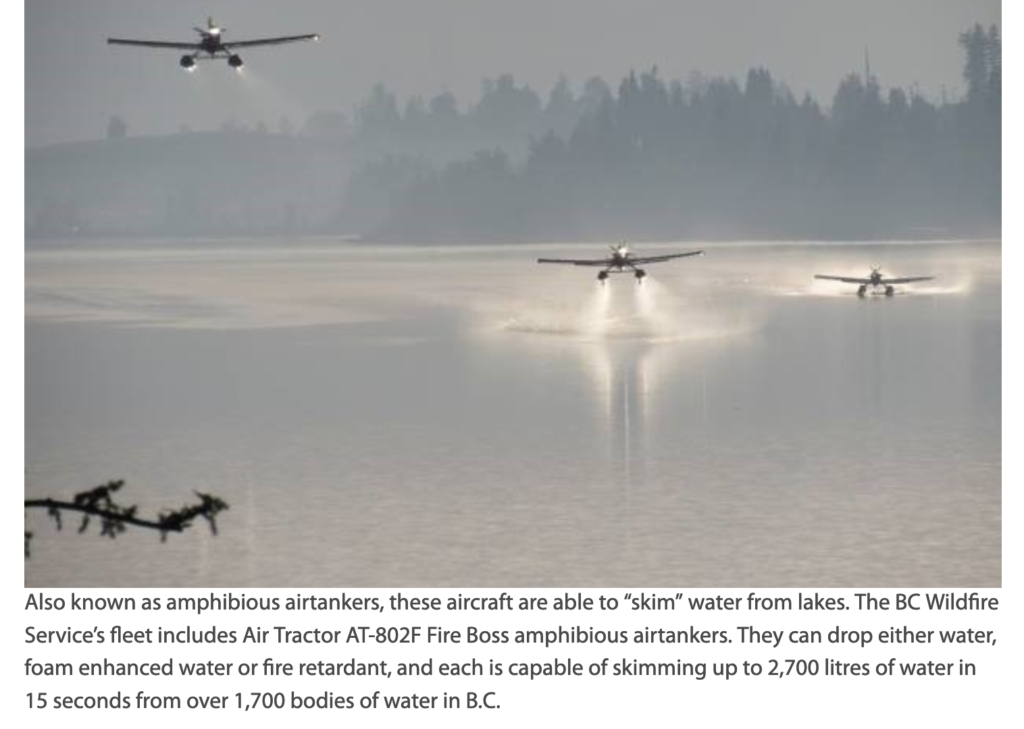
Five of the most destructive fire seasons ever in B.C. occurred during the past 10 years. Amphibious waterbombers that scoop from lakes or rivers are now often used alongside land-based tankers loaded with retardant — one of several adaptations B.C. has made in its fire aviation program. The scoopers fly over the fire to dump water and foam directly while the airtankers skirt the perimeter with retardant. Once those firelines are complete, the land-based tanker is free to go to another fire, while the waterbombers continue to dump water to cool the fire for ground crews.

Prince George is the base for five Conair aircraft for part of the season — a Cessna 208 Grand Caravan birddog that’s used to coordinate aerial attacks and provide air traffic control, plus four Air Tractor AT-802AF Fire Boss waterbombers. Benson says they work well together and it’s not uncommon to get 10 or 12 aircraft on one fire.

Fire Boss trio

“For me, I think it’s the coolest job out there,” he says. “Working for an airtanker program you can effect change in a short period of time because the power of the fleet is incredible. The capability to have 15 or 20 airplanes on your fire in a short period of time gives you the chance to contain the fire and buy time for the hard-working ground firefighters to arrive and actually extinguish the fire.”

Conair Dash 8
Conair Dash 8

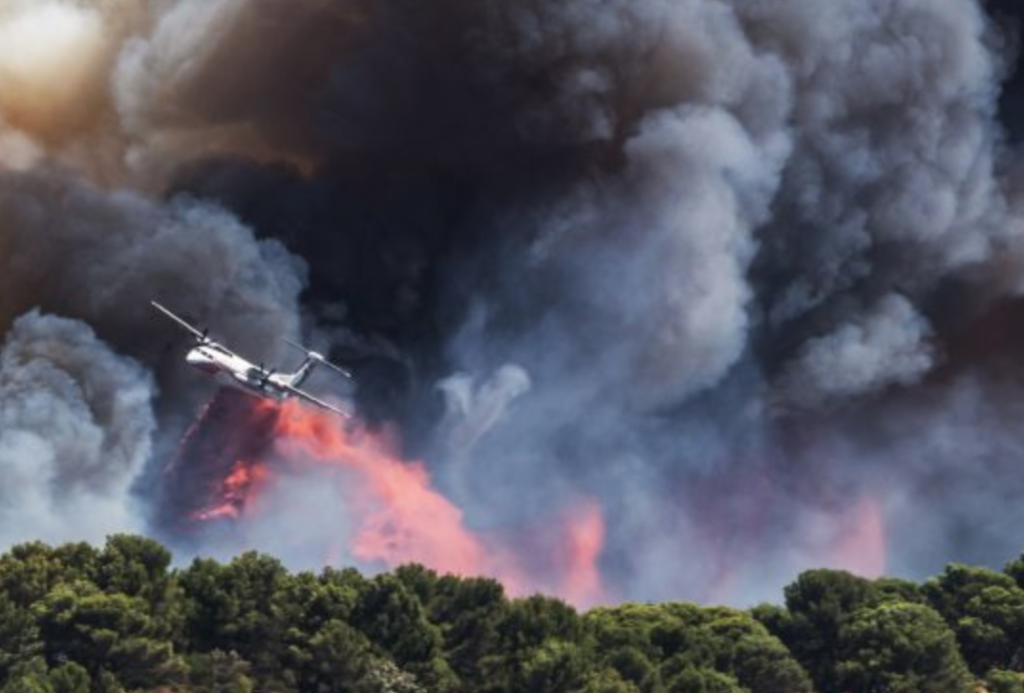
At its base in Abbotsford, Conair takes De Havilland Dash 8-400 twin-engine turboprops — commonly used for passenger flights — and in 75 days converts them into airtankers that can deliver 10,000-litre payloads — about 2650 gallons.

They offer more than double the fuel efficiency of other more traditional large tankers, and the loaded cruising speed for a Dash 8 is 360 knots (well over 400 mph), faster than most jets over short distances. First introduced as an airtanker in 2020 in Australia, there are now 19 Dash 8-400s flying firefighting missions around the world. Eight are owned and operated by France — built in Canada by Conair — with the rest operating in Conair’s fleet, four of which are on contract in B.C. this fire season.

Check out these videos on Vimeo:
Conair’s Tactics and Training Centre
Conair’s Changing Tactics
Conair’s Dash 8-400 Airtanker

Montana firefighters busy

A heavy aerial and ground attack by firefighters kept homes safe on the north side of Whitefish Lake over the weekend. Fire managers with the Montana Department of Natural Resources and Conservation said the human-caused fire was ignited by equipment operating in a dry hayfield; the fire burned onto forested areas of the Stillwater State Forest.

The North Lake Fire burned only about 5 acres, but spot fires quickly spread to a 17-acre perimeter. The fire was 80 percent contained by Monday and crews were still mopping up. The fire was first reported by the Warner Peak Lookout, according to the Western News out of Libby, Montana.

Aerial support was dispatched Saturday afternoon and included Type 1, 2 and 3 helicopters. Five engines, two watertenders, a hotshot crew and another crew assisted. Homes and other structures were within the vicinity, but no evacuations were necessary. Flathead County requested assistance from the Red Cross to open a shelter at Canvas Church in Kalispell.

Montana Public Radio reported that another relatively small fire late Sunday took off from the outskirts of Lolo. Firefighters kept the wind-driven fire, burning through dry grass and brush, to about 20 acres — but it destroyed a mobile home and damaged a second one. According to the Missoula Rural Fire District, the fire also destroyed four shops and garages and another 12 outbuildings; it also totaled or damaged about a dozen vehicles. The fire is under investigation.

Colt Fire ICP
Hand crew headed for supper at the Colt Fire base camp

Numerous fires burned actively across northwest Montana and at least three new fires took off in the Mission Valley Sunday after a dry lightning storm. The Niarada Fire west of Elmo was at 1,000 acres Monday morning, and Confederated Salish and Kootenai Tribes (CSKT) fire managers said Hwy 28 was closed Sunday after the fire jumped the highway; it was estimated at 200 acres by Sunday evening, about 11 miles west of Elmo, and 18 smokejumpers were working the fire. Four SEATs, a helicopter, and other resources also responded.

The Middle Ridge Fire southwest of Sloan’s Bridge, at 500 acres, was burning in grass and timber. North of Dixon, the Communication Butte Fire was estimated at 255 acres, with 20 firefighters assigned. CSKT fire managers said no structures were threatened by any of the fires.

Numerous other small fires cropped up Sunday in Lake and Flathead counties.

The Woodward Point and Porcupine Creek fires were detected in the Mission Mountains on the east side of Flathead Lake; along Hungry Horse Reservoir, the Ridge Fire had burned about 5 acres and the Emery Fire was less than an acre. Other smaller fires were reported farther down the reservoir.

The Kah Mountain Fire in the Swan Mountains was at 15 acres.

Colt Fire northwest of Seeley Lake
Colt Fire northwest of Seeley Lake, inciweb photo.

The Colt Fire, northwest of Seeley Lake on the Flathead and Lolo National Forests, had grown to nearly 6,200 acres Monday. It is burning in dense timber with heavy dead and down fuels, about 12 miles northwest of Seeley. Fire behavior has included torching, spotting, and active consumption of heavy fuels. The fire was started by lightning on Monday, July 17, and Montana DNRC and USFS firefighters responded the next day. The fire is burning on the Lolo National Forest but is under Montana DNRC fire protection.

Colt Fire community meeting in Condon
Colt Fire community meeting in Condon, July 26.

Fire managers expect the fire will increase in size with the forecasted weather conditions. The Colt Fire is a full-suppression fire and crews are creating fuel breaks and containment lines, along with doing structure protection assessments and prep. Air resources will be assigned as needed. Several forest roads and other areas have been closed.

The USDA has designated Flathead and Lincoln counties as primary natural disaster areas, according to a KPAX-TV report, meaning farmers and ranchers can apply for emergency loans. Gov. Greg Gianforte asked Agriculture Secretary Tom Vilsack that 11 counties be designated drought disaster areas. The USDA responded that Flathead and Lincoln counties will be named primary natural disaster areas, so farm operators there can be considered for Farm Service Agency (FSA) emergency loans.

ARSON: Man arrested on suspicion of starting 103-acre fire in Banning

An arson suspect investigators say may have started a wildland fire that burned over 100 acres Thursday night in southern California has been arrested; 45-year-old Andre Cox was taken into custody just after midnight in Highlands Springs in Banning. Cal Fire said investigators determined the fire was arson-caused.

The suspect will be charged with multiple counts of arson, along with possession of methamphetamine. He is being held on $60,000 bail.

He hasn’t been officially charged by the District Attorney’s office, according to a report by KESQ-TV, but is expected to be arraigned in court on Tuesday.

The Sunset Fire was reported at around 6:50 p.m. on Mesa Street and Gilman Street, and it was burning at a dangerous rate of spread; firefighters were able to contain the fire the next day.

The Desert Sun reported that Cal Fire did not say specifically how Cox is accused of setting the fire. He was arrested on suspicion of two felony counts, arson to forest land and arson during a declared emergency, and two misdemeanor drug counts, possession of meth and drug paraphernalia.

The fire started Thursday on the north side of Banning; by noon Friday, it was 103 acres and 90 percent contained. It did not reach any structures.

Anyone with information related to this incident should contact the Cal  Fire/Riverside County Fire Department’s arson hotline at (800)633-2836.


Yet another Canadian firefighter dies … on the largest fire in British Columbia’s history

Second firefighter to die in B.C. in 2023  responding to wildfires

A Canadian wildland firefighter in British Columbia died while responding to the Donnie Creek Fire in northeast B.C., according to the Royal Canadian Mounted Police. This is the second firefighter death on the front lines during the 2023 wildfire season in the province, along with other fatalities in Canada this season. RCMP said in a statement that the firefighter was a 25-year-old man from Ontario who died on Friday.

According to police, the firefighter, who was contracted to the B.C. Wildfire Service, was working in a remote area about 150 km (a little over 90 miles) north of Fort St. John when his utility terrain vehicle rolled over a sharp drop in a gravel road. “He was transported by helicopter to the Fort St. John Airport, but sadly succumbed to his injuries while en route,” reads the statement.

B.C. Premier David Eby said Saturday that the Donnie Creek Fire is the largest ever recorded in B.C. history. “I am heartbroken that another firefighter was lost protecting our communities and our province during this devastating wildfire season,” Eby said.

The incident’s still under investigation.

Bedrock Fire over 6000 acres

As the Bedrock Fire near Fall Creek Reservoir east of Eugene, Oregon burns on the Willamette National Forest, officials are asking the public to help with tips to determine who or what started the fire.

According to a report by KLCC Radio, the fire was called in on Saturday, July 22, and grew to 300 acres by the next day. Crews worked overnight on the fire — and to protect nearby buildings on private land. A Type 2 team took over Sunday evening.

Named for the nearby Middle Fork Ranger District’s Bedrock Campground, the fire put up enough smoke on Tuesday to temporarily pause air ops, but firefighting helicopters and fixed-wing aircraft returned later. Two CL-415s scooped water from Lookout Point Lake, and additional aircraft have been ordered.

Chris Pietsch shot of Erickson Aircrane on the Bedrock Fire.
Chris Pietsch with the Register-Guard caught this superb shot of an Aircrane working the fire.

KEZI-TV reported that crews are building lines along the ridges between Little Cowhorn Mountain and Fawn Peak, and are assessing firelines that remain from previous incidents (including the Cedar Creek Fire) to help in containment.

Fire Behavior Analyst Dean Warner said the fire has been more active than expected in this area for late July. “Fuels are abnormally dry for this time of the season due to drought,” he said. “Drier fuels take less energy to ignite, and burn more rapidly and intensely than wetter fuels.”

Fire crews are working to establish firelines along the ridgelines between Little Cowhorn Mountain and Fawn Peak.

Little Cowhorn Mountain Lookout to the north of Bedrock Fire. The main body of the structure has been wrapped with fire-resistant material.
Little Cowhorn Mountain Lookout to the north of the Bedrock Fire. The main body of the structure has been wrapped by crews with fire-resistant material.

The fire is currently sized at 6,161 acres. Smoke from the fire is spreading into central Oregon, affecting air quality as far east as Bend. Weather conditions are expected to remain hot and dry, which could exacerbate the fire’s spread, according to the Northwest IMT 13 headed up by Brian Gales and Eric Riener, which took over on July 25.

Bedrock Fire map
Bedrock Fire map

Bedrock Fire mapExtreme fire behavior and gusty winds have pushed the fire to rapid growth, and mixed ownership of private and federal lands coupled with old fire scars means a checkerboard of fuel types. Mixed age classes of timber from slash and young managed stands to late seral stage timber are spread across the landscape, with light dry lichen moss draped in the canopies, exacerbating spotting. Steep slopes in the area have encouraged uphill runs, so the fire gets established in crowns and makes for spotting up to ¾ mile from the fire’s edge.

Afternoon winds have driven the fire to spread up drainages — including Alder, Hehe, and Fall creeks to the northeast and in the south at both Andy and Rubble creeks. As fire has moved into old burn scars, the intensity decreases, but abundant fine fuels (likely resulting from this year’s late rainy start to the season) maintain the fire’s spread.

On Thursday, it’s predicted that consistent weather conditions will mean persistent fire growth in the active drainages. Fire spread is predicted to crest the ridgeline in the Hehe drainage.

The origin of the fire is still being investigated. The USFS is requesting any information, tips, photos, or videos of the area from July 22 when the fire started. Anyone with information is asked to email the U.S. Forest Service’s TIP LINE; people with info can also email the Lane County Sheriff’s office or the Willamette National Forest Supervisor’s Office. The Middle Fork office in Westfir is at 541-782-2283.

By Wednesday afternoon the fire was still at zero containment, with over 200 firefighters assigned. Containment’s estimated for the first week of October.

Bridger buying Bighorn Airways fleet

Bridger Aerospace, one of the country’s largest aerial firefighting companies, is purchasing Bighorn Airways’ fleet of 12 aircraft used for smokejumping and special mission transport for government agencies. The transaction, valued at $39 million, is expected to close by the end of September, financed through a combination of cash and stock.

“This expands our aerial firefighting services to new mission critical areas,” said Tim Sheehy, CEO at Bridger. “Bighorn provides year-round logistics for the Department of Defense. From providing aircraft and flight crews in support of the smokejumper program, to flying missions in the North Pole region of Alaska, Bighorn adds to what is now the largest specialty wildfire aviation fleet in the country. We are honored to welcome Bighorn to the Bridger family.”

Bridger Aerospace

Bighorn Airways was founded in 1947 with three planes working aerial spray operations for local ranchers. The company grew into Wyoming’s largest aviation service provider, with aircraft and helicopter charter service, aerial spraying, and full FBO services including aircraft refueling, maintenance, and avionics service.

Based in Sheridan, Bighorn has a fleet of 12 aircraft including three Dash-8 planes (De Havilland Canada DHC-8s) with a 7500 lb. payload capacity, a range of 1200 miles, and capability of low-level flights. Bighorn also operates four Casa 212-200 and five Dornier 228-200 twin turboprops capable of short takeoff and landings.

“Mountain flying is a very demanding skill set, you got to spend years learning how to fly safely in the mountains,” Sheehy, who flies Bridger’s Super Scooper, recently told KHQ-TV. “Amphibious aviation is a very specific skill set, people will spend years learning how to be high-speed boat drivers and pilots at the same time.” Sheehy said aerial firefighting combines all those skill sets together.

Bridger Aerospace, started by Sheehy in 2014 after nearly a decade as a Navy SEAL, has contracts with agencies in both the U.S. and Canada, and has two scoopers currently at Coeur d’Alene airport flying for the Forest Service.