A helicopter used for monitoring wildfires crashed May 4 in the Russian republic of Bashkortostan, according to TASS which received information from regional emergency services. Three people were on board when it went down 30 kilometers south of the community of Inzer in the Beloretsk district. The reports are that there were no survivors.
Below is an excerpt from TASS:
The helicopter belonged to the Lightair company. The news it went missing came at 14:20 Moscow time. The helicopter had left Bashkortostan’s capital Ufa for Beloretsk. The distress signal from its emergency beacon was picked up by a satellite rescue system. The local office of the Investigative Committee has launched a probe.
Our sincere condolences go out to the family, friends, and coworkers.
BLM Unimog Engine 2410 when it was new in 2006. BLM photo.
The Bureau of Land Management has released an Accident Investigation Factual Report for the July 10, 2016 engine rollover north of Winnemucca, Nevada in which two firefighters were killed and a third was seriously injured.
Jacob O’Malley and Will Hawkins lost their lives in the single-vehicle accident on Nevada State Route 140 when a rear tire suddenly and catastrophically failed. The truck only had four tires, there were no duals on the rear. When the right-rear rim dragged along the pavement the left-front was in the air, eliminating any possibility of control by the driver. The 33,000 pound GVWR engine fishtailed and then rolled several times.
The cab was higher than the water tanks and pump package, so it took the majority of the impact as the top of the vehicle struck the roadway during the rollover. All three occupants were wearing seat belts but with the top of the cab and the A pillar being damaged or sheared off, the restraint system failed to operate as designed. Mr. Hawkins was ejected from the cab and then was hit by the rolling wreckage.
Below is an excerpt from the report:
Finding 3.1 (Material): During the rollover, the upper cab structure (made of reinforced carbon fiber) sheared away from the truck frame, exposing the vehicle’s occupants to a hazardous environment. The disintegration of the cab compromised the driver’s and right side passenger’s seatbelt systems.
Discussion 3.1: The lack of cab crashworthiness did not cause the rollover; however, it contributed to the fatal conditions which occurred during the crash. The reinforced carbon fiber cab on the Unimog was manufactured in France and was built to United Nations Code ECE r29 (commercial vehicle occupant protection), which exceeds U.S. cab crashworthiness standards. The U.S. National Highway Traffic Safety Administration (NHTSA) submitted a report to Congress in 2015 on the need for improved heavy truck crashworthiness standards; however, no action has been taken on this report as of February 2017.
The wildland fire agencies should fund research conducted by engineers to determine how to prevent the passenger compartments in their fire engines from collapsing in accidents.
Thanks and a tip of the hat go out to Eric. Typos or errors, report them HERE.
The Green Valley News is reporting that several sources they spoke with said a target shooter using exploding targets started what became the Sawmill Fire 8 miles east of Green Valley, Arizona. The shooter reportedly tried to put out the fire, but after he failed he called to report it. The officials in charge of suppressing the fire have not confirmed what caused it.
As of Thursday April 27 the fire has burned approximately 40,000 acres and required the evacuation of several areas. The Green Valley News reported that approximately $1.6 million had been spent to suppress the fire as of Wednesday afternoon.
Exploding targets consist of two ingredients that when mixed by the end user create an explosive when shot by a high-velocity projectile. They have caused many fires since they became more popular in recent years, have been banned in some areas, and caused the death of one person. In June, 2013 a man attending a bachelor-bachelorette party in Minnesota was killed after shrapnel from the device struck him in the abdomen causing his death. The Missoulian reported that several years ago a woman in Ohio had her hand nearly blown off while taking a cellphone video of a man firing at an exploding target placed in a refrigerator about 150 feet away.
After the ingredients are combined, the compound is illegal to transport and is classified as an explosive by the Bureau of Alcohol, Tobacco, Firearms, and Explosives and is subject to the regulatory requirements in 27 CFR, Part 555.
Coulson Aviation distributed this photo today of their three C-130-type air tankers lined up at Reno for “USFS carding”. As we reported on April 10, they introduced their third tanker this month, another L-382G. They also have a C-130Q. The tanker numbers when used in the USA are 131, 132, and 133.
At the end of this month the company will be conducting their annual pilot training.
And, on another subject, can you find the two air tankers in the photo below that was taken by the RAAF at the Avalon Air Show in Australia around March 4?
There are reports that five civilians, not firefighters, have been killed in wildfires in recent days in Texas and Kansas.
In Gray County, Texas, approximately 60 to 80 miles east of panhandle city of Amarillo, three ranch hands were killed as they were moving cattle out ahead of a fire, according to Judge Richard Peet. In Texas county judges are responsible for suppression of wildfires.
Another person was killed in Hemphill County, Texas near Oklahoma border.
The Kansas Highway Patrol says 39-year-old Corey Holt, of Oklahoma City, jackknifed Monday while trying to back up his tractor-trailer on highway 34 in Clark County due to poor visibility from the fires. He was killed after he got out of his vehicle.
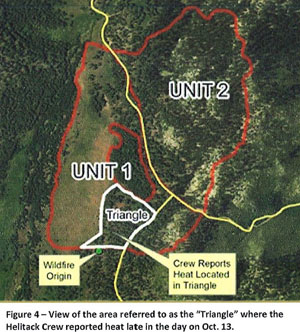
Hours before the fire escaped, all eleven firefighters that had been mopping up the prescribed fire left the project and returned to their stations between 1:30 p.m. and 4:45 p.m. on October 13, 2016. During that day there were a number of smokes that received the attention of the firefighters. During the last two hours before the seven-person helitack crew departed they noticed the wind increasing — trees were blowing down and branches were falling.
The RGJ reported on the reason the firefighters were ordered to leave the burn site.
Gene Phillips, NDF forest health specialist and burn boss for the Little Valley Burn, made the decision to pull crews from the burn site after discussing the high wind forecasts for the evening with a burn boss trainee, according to the review.
The decision not to staff the site on the evening of Oct. 13 was made, according to NDF, “based on the limited amount of heat near the control lines, success of the current mop-up effort, and the risk to firefighters working in timber during high winds.”
From the NIMO report.
At 5:38 p.m. the Little Valley weather station recorded sustained winds out of the west at 15 mph with a maximum gust of 39 mph. By 12:38 a.m. on October 14, about the time the fire escaped, the wind was at 19 mph with gusts up to 87 mph. The relative humidity was 32 percent.
A Red Flag Warning for gusty winds and low humidity was in effect from the morning of October 11 through 5 p.m. on October 14. Strong winds persisted until mid-day on October 17.
The NDF’s report was written by the U.S. Forest Service’s Phoenix National Incident Management Organization (NIMO), a team that usually manages fires and other incidents that are often of longer duration than a typical wildfire. The team was supplemented with a Fire Behavior Analyst, a GIS/Fire Behavior Analyst, a Public Information Officer, a Fire Investigator, and others for a total of 10 personnel that were listed in the report.
The NIMO team concluded that the fire escaped when embers from a burning stump hole were blown 34 feet and crossed the fireline at a corner, or “dog leg” in the fire perimeter.
According to the RGJ there was confusion in initially responding to the fire after it escaped at around 12:38 a.m. on October 14:
Response to the fire was delayed, affecting how fast it could be contained: A call at 1:23 a.m. about smoke at the burn site was later dismissed as “unfounded,” causing a TMFPD [Truckee Meadows Fire Protection District] fire engine to return to the station three minutes after it left. After a second call about smoke at the burn site, it took TMFPD more than an hour to get to the site after crews were dispatched, according to 911 transcripts.
Gizmodo is reporting that all bureaus in the Department of Interior, including the U.S. Park Service, have been banned from using Twitter. This may or may not be related to a retweet by the NPS on Friday that showed pictures of the crowds at the 2009 and 2017 Presidential inaugurations.
From Gizmodo. Click to enlarge.
Gizmodo said the text below is from an internal NPS email:
All:
We have received direction from the Department through [the Washington Support Office] that directs all [Department of Interior] bureaus to immediately cease use of government Twitter accounts until further notice.
PWR parks that use Twitter as part of their crisis communications plans need to alter their contingency plans to accommodate this requirement. Please ensure all scheduled posts are deleted and automated cross-platform social media connections to your twitter accounts are severed. The expectation is that there will be absolutely no posts to Twitter.
In summary, this Twitter stand down means we will cease use of Twitter immediately. However, there is no need to suspend or delete government accounts until directed.
This does not affect use of other approved social media platforms. We expect further guidance to come next week and we will share accordingly.
Thanks for your help!
Presumably this ban includes messages about road conditions and real time information about fires and other emergencies.
If you are considering leaving a comment below, please adhere to our terms of service.
UPDATE at 10 a.m. MT January 22,2017: As the submitted comments began to veer away from the decision to ban tweets that could include important, urgent information for citizens, and the conversation moved into the political realm, we closed comments for this article.
On July 29 a member of the Great Basin Smokejumpers was injured while scouting fireline on the Tokewanna Fire near Mountain View in southwest Wyoming. The firefighter sustained burn injuries to the hands, calves, knees, elbows, cheeks, nose and ears. He was transported by air ambulance to the Salt Lake Burn Center where he was admitted.
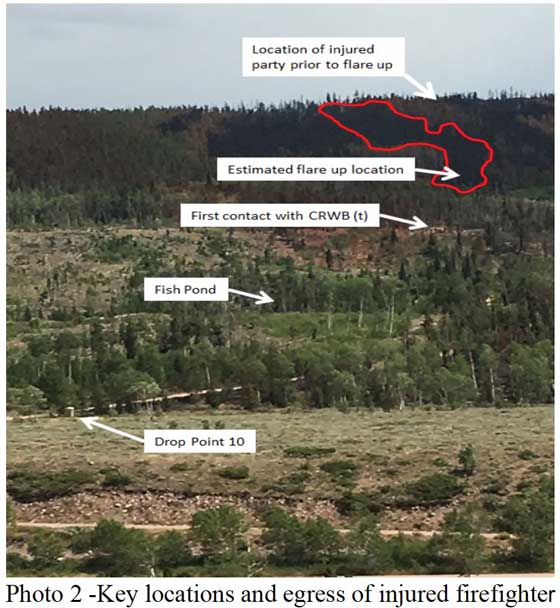
The fire started at about 1500 on July 28. The overhead structure worked through the night and began transitioning to replacement personnel after smokejumpers arrived at approximately 1252 on July 29. The person that was later burned became the new Division Supervisor (DIVS) on Division W at 1300. Official transition to the new Incident Commander occurred at 1505.
Illustration from the report.
Below is an excerpt from the Factual Report that was completed September 15, 2016:
“Between 15:30 and 15:45 the DIVS was scouting fireline and reached the highest point of where the fire had progressed on the ridge. At this location a flare up occurred downhill from the DIVS on the other side of a large stringer of lodgepole pine which had been heavily treated with retardant (Reference Materials photos 2-5). The DIVS stated, “I heard something I didn’t like and determined I needed to leave.” He retreated to his predetermined safety zone, which was the black and opted to continue downhill rapidly. While retreating he experienced an extreme pulse of radiant heat coming from the right accompanied by smoke and blowing ash. Because of the pulse of radiant heat, he used his helmet to shield the right side of his face. In recounting this he expressed “I wish I had my gloves on, but prior to the event I was away from the fire edge using a GPS and taking notes in my notepad.” The radiant heat caused burns to the DIVS’s hands, calves, knees, elbows, cheeks, nose and ears.”
Also from the report:
“Summary
Three key findings were brought out during this investigation:
Timely recognition and reporting of burn injuries is critical
The absence of PPE can contribute to the severity of injuries
Firefighters were unable to contact the air ambulance utilizing pre-established radio frequencies
Lessons Learned from the Interviewees:
When asked if there were any lessons learned or best practices the interviewees would take away from the incident the following was captured:
Recognize your own limitations and don’t expect to have all of the answers or information on a rapidly emerging fire.
Time of day and incident complexity were not optimal for transferring command, but in this case it was a better option than continuing to utilize fatigued resources.
Sometimes you just need to safely engage to ensure you are not transferring risk to someone else later.
Make the time to tie-in with your overhead to assure face-to-face interactions occur during transition.
Participation with district resources in pre-season scenario based training alleviated tension while coordinating a real life medical incident at the dispatch center.
Frequency sharing with local EMS will help facilitate efficient medevac procedures.
Continue to encourage EMS certifications among line firefighters and/or identify ways to improve access to Advanced Life Support on emerging incidents.”