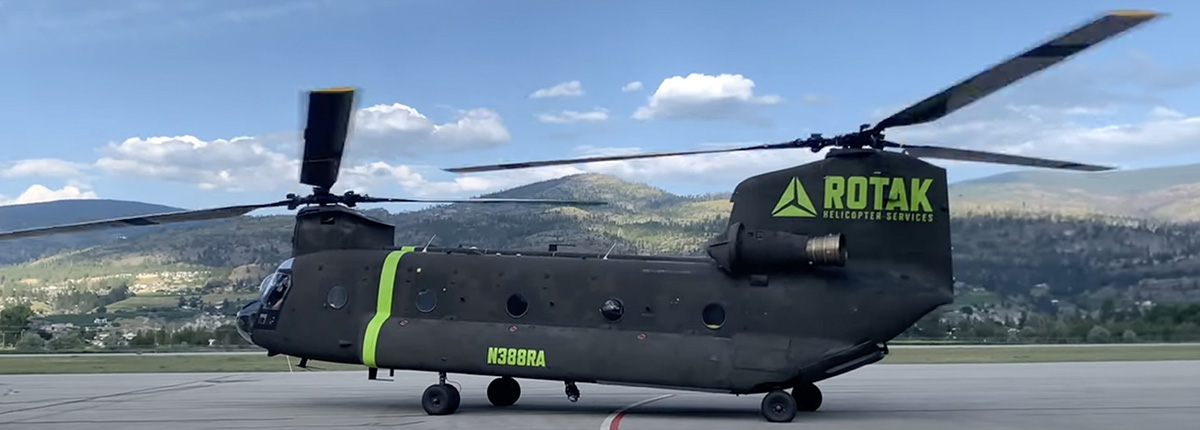
N388RA Boeing CH-47D preparing to take off at Penticton Airport in British Columbia July 16, 2022. Image from VMC Aviation Videos.
The US Forest Service has released a brief initial report about the July 21 crash of the Boeing CH-47D helicopter in the Salmon River while working on the Moose Fire 20 air miles northwest of Salmon, Idaho. The two pilots were killed.
Below is the complete text of the narrative section of the document which was dated July 22, 2022, but was not posted on the Wildland Fire Lessons Learned site until today around noon.
On Thursday, July 20, a call when needed CH-47D Series Chinook Helicopter crashed into the Salmon River, adjacent to the Indianola Work Center approximately 11 miles west of North Fork, Idaho on the Moose Fire. The aircraft sustained severe damage, the pilots were extracted and transported to hospitals but both sustained fatal injuries. The NTSB has been notified and will be conducting an accident investigation. The USDA Forest Service has assigned a learning review team.
The pilots, the only personnel on board, were Thomas Hayes, 41, of Post Falls, Idaho, and Jared Bird, 36, of Anchorage, Alaska.
The helicopter was operated by Anchorage-based ROTAK Helicopter Services.
The FAA confirms that the registration number of the helicopter is N388RA, which is one of two CH-47D ships ROTAK recently purchased from Columbia Helicopters.
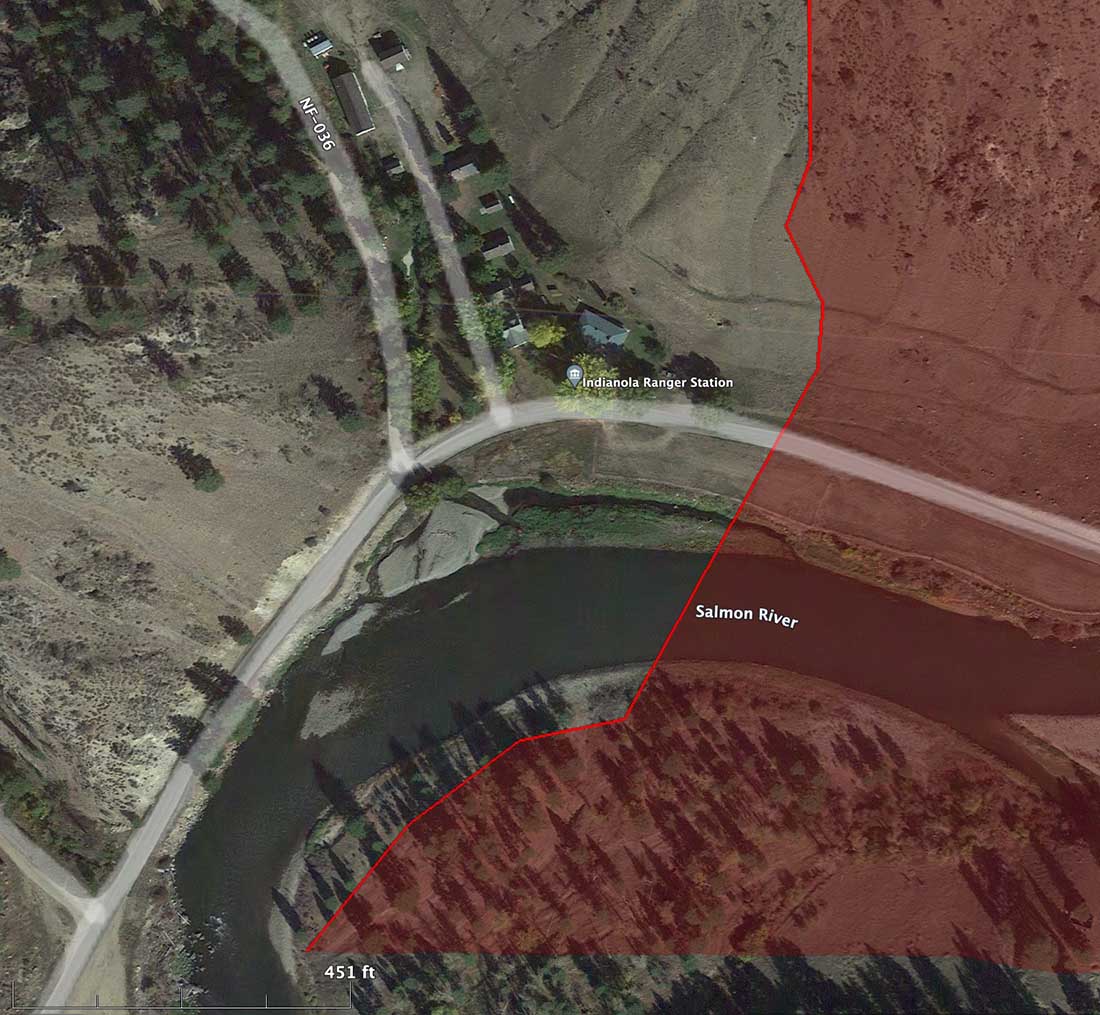
The general area where the CH-47D crashed July 21, 2022. Google Earth. The red shading represents an area burned in the Moose Fire.
There are unconfirmed reports that a hotshot crew was nearby when it crashed and they went into the Salmon River and extricated the pilots in an attempt to save them.
The last time Flight Aware tracked N388FA was at 3:02 p.m. MDT July 21. Because of the rugged terrain, it first showed it north of the Salmon Airport. Then it went northwest generally toward the Moose Fire and lost tracking at 3:12 p.m., minutes before it reached the river.
As an example of the terrain here is a photo of the Comet Fire I took a few years ago from Highway 93 just east of the current Moose Fire, 13 air miles north of Salmon, ID. The Salmon River is in the foreground.
Comet Fire, July 28, 2016. Photo by Bill Gabbert.
The video below was shot at Penticton Airport in British Columbia July 16, 2022 when it stopped for fuel en route from Alaska to Idaho.
N388RA Boeing CH-47D at Penticton Airport in British Columbia July 16, 2022. Image from VMC Aviation Videos. It had stopped for fuel on the way from Alaska to Idaho.
The US Forest Service has released a brief initial report about the July 21 crash of the Boeing CH-47D helicopter in the Salmon River while working on the Moose Fire 20 air miles northwest of Salmon, Idaho. The two pilots were killed.
Below is the complete text of the narrative section of the document which was dated July 22, 2022, but was not posted on the Wildland Fire Lessons Learned site until today around noon.
On Thursday, July 21, a call when needed CH-47D Series Chinook Helicopter crashed into the Salmon River, adjacent to the Indianola Work Center approximately 11 miles west of North Fork, Idaho on the Moose Fire. The aircraft sustained severe damage, the pilots were extracted and transported to hospitals but both sustained fatal injuries. The NTSB has been notified and will be conducting an accident investigation. The USDA Forest Service has assigned a learning review team.
The pilots, the only personnel on board, were Thomas Hayes, 41, of Post Falls, Idaho, and Jared Bird, 36, of Anchorage, Alaska.
The helicopter was operated by Anchorage-based ROTAK Helicopter Services.
The FAA confirms that the registration number of the helicopter is N388RA, which is one of two CH-47D ships ROTAK recently purchased from Columbia Helicopters.
The general area where the CH-47D crashed July 21, 2022. Google Earth. The red shading represents the approximate area Moose Fire, but the portion of the fire at the bottom of the image is cut off.
There are unconfirmed reports that a hotshot crew was nearby when it crashed and they went into the Salmon River and extricated the pilots in an attempt to save them.
The last time Flight Aware tracked N388FA was at 3:02 p.m. MDT July 21. Because of the rugged terrain, it first showed it north of the Salmon Airport. Then it went northwest generally toward the Moose Fire and lost tracking at 3:12 p.m. before it reached the river.
As an example of the terrain here is a photo of the Comet Fire I took a few years ago from Highway 93 just east of the current Moose Fire, 13 air miles north of Salmon, ID. The Salmon River is in the foreground.
Comet Fire, July 28, 2016. Photo by Bill Gabbert.
The video below was shot at Penticton Airport in British Columbia July 16, 2022 when it stopped for fuel en route from Alaska to Idaho.
On Monday National Public Radio’s flagship station in Southern California, KCRW, interviewed Brianna Sacks, a Buzzfeed News reporter who has been covering the hiring and retention problems faced by the U.S. Forest Service and other federal agencies that have wildland fire responsibilities.
“The burnout is really real for these firefighters who are making no money. They make their living doing thousands of hours of overtime and they still can’t afford to make ends meet,” Sacks tells KCRW. “They’ve been leaving en masse, hemorrhaging firefighters to go to CalFire, PG&E, or private sector jobs. And they’ve also been part of the great resignation with the pandemic.”
You can listen to the entire 8-minute interview by clicking below.
Tanker 12, a BAe-146, dropping on the northwest side of the Alisal Fire near Santa Barbara, California, Oct. 13, 2021. Photo by Santa Barbara County FD.
Thirteen members of Congress signed a letter February 2, 2022 asking the Secretaries of the Interior and Agriculture about a long-overdue report regarding shifting from 1-year to 10-year contracts for firefighting aircraft.
Many of the contracts for firefighting aircraft issued by the Forest Service in recent years have been for only one guaranteed year with a few more years possible on a year by year approval basis. Some air tanker vendors have found it challenging to develop the aircraft and then hire, train, and retain employees with nothing guaranteed beyond one year.
The Consolidated Appropriation Act of 2021 which became law December 27, 2020 required that the report about 10-year contracts be submitted no later than March 27, 2021. When the letter (below) was written, the document still had not been submitted, and was more than 300 days overdue.
On Tuesday March 1, a spokesperson for the US Forest Service, Stanton Florea, told Fire Aviation that the agency sent the report to the Committee on Appropriations, Subcommittee on Interior, Environment, and Related Agencies, on February 8. In compliance with Public Law 111–88, Mr. Florea said, after 45 days it will be posted to the Forest Service website at: www.fs.fed.us/about-agency/budget-performance.
When we asked for a copy of a letter that would have been in response to the February 2 inquiry from the 13 members of Congress, Mr. Florea said it is”currently going through clearance and is not yet available.”
Elizabeth Daniels is the Communications Director for the Congressional Western Caucus which posted the letter to the USFS on the Caucus’ website. The Caucus, rather than individual Representatives’ offices, are the lead on issues like this, we were told by Amanda Fitzmorris, the Press Secretary for Rep. Dan Newhouse, the Chair of the Caucus.
The Congressional Western Caucus lists 85 members on its website, many of which are from surprising locations considering the name of the organization — Louisiana, Pennsylvania, North Carolina, New York, Puerto Rico, and American Samoa. Most, however, are from states west of the Mississippi River.
Ms. Daniels confirmed that the Caucus has the report from the USFS about the 10-year contracts, but she could not send us a copy.
“We’ve got a lot of different cooks in the kitchen on this one…I’m trying to get the information out as soon as possible,” Ms. Daniels said. “Hopefully we’ll be able to turn some of the recommendations and things that they’ve put into the report into some legislative items. So while you may not get the actual physical report, you’ll kind of get the gist of what they said through our actions.”
She later said if the report is approved for release, she could then distribute it.
In testimony April 15, 2021 before the House Appropriations Subcommittee on Interior, Environment, and Related Agencies, U.S. Forest Service Chief Vicki Christiansen was asked about the report, which at the time was about 19 days late.
“Relative to your question about air tankers, the contracting air tanker community has really come on line, they are meeting our needs of contemporary air tanker capacity for wildland fire in the U.S,” Chief Christiansen said. “We are studying the question about going to a 10-year contract, what the pros and cons are. We’re nearly complete with that report. It will be going through clearance in a matter of a few days and it will be getting to the committee here shortly. So we’d be glad to discuss more about air tankers. But we think we are really on the right track with our air tankers. And thank you for being such a help and an advocate for getting us get the right resources.”
We have written about 1-year and 10-year contracts several times. Here is an excerpt from an article published December 17, 2021, titled, Forest Service says there’s not enough time to issue new helicopter contracts for 2022.
Our take
Less than three months after Forest Service Chief Christiansen said the agency was going to release a report “shortly” about the feasibility of moving to 10-year contracts, they issued a presolicitation for helicopter contracts that guaranteed one year. (Fire Aviation requested a copy of the report at the time, but it was not provided.)
In December, 2017 the US Forest Service canceled a five-year exclusive use (EU) contract it had issued the previous year for two CL-415 water scooping air tankers. So a one-year contract with each additional option year at the discretion of the agency with unreliable congressional funding is not a concept that makes potential vendors feel all warm and fuzzy.
That year the FS also reduced the number of Type 1 helicopters on EU contract from 34 to 28 and canceled a solicitation for up to seven large air tankers, citing a lack of funding.
In 2018 when the Forest Service began issuing one-year contracts for air tankers we wrote:
Few if any vendors can simply write a check to purchase and convert an air tanker, so they have to convince a lender to give them large sums of money usually even before they have a contract with the USFS. With this new one-year contract policy, obtaining those funds could be even more difficult.
Below is an excerpt from the Missoulian:
“They’re only offering a one-year contract,” said Ron Hooper, president of Missoula-based Neptune Aviation. “We can’t go to the bank with a one-year contract to finance airplanes. They just laugh at us.”
Even if a vendor received a guaranteed five-year contract it can be difficult to establish and implement a long-term business plan that would make sense to their banker and the solvency of the company.
These one-year firefighting aircraft contracts need to be converted to 10-year contracts, and the number of Type 1 helicopters must be restored to at least the 34 we had for years.
Below is the letter sent by the 13 members of Congress dated February 2, 2022.