
Yet it is is barely mentioned in the annual lessons learned review
Continue readingReport released about entrapment of 15 firefighters on the 2020 Dolan Fire
The Nacimiento guard station, two fire engines, several personal vehicles, and two dozers burned — there was one very serious injury
Continue readingNTSB releases report on helicopter that crashed during aerial ignition operations on prescribed fire
There was one fatality and two serious injuries in the 2019 crash in Texas
Continue readingReport released for burnover on the Harris Fire near Joliet, MT
One firefighter was severely burned
Continue readingReports released about fatality on the 2020 El Dorado Fire
“The system was not designed to handle this”
Continue readingCounty Sheriff’s office completed a report on the Gales Fire fatality
A contract firefighter was killed by a falling tree in Oregon, August 23, 2021
Continue readingABC News reports on technology in wildland firefighting
“In many cases, we’re still fighting fire with sharpened pieces of metal attached to the ends of sticks,” said Bill Gabbert.
Continue readingBillions in losses, thousands could die if wildfire response unchanged: report

A team of scientists from British Columbia, the United States, and Spain say Western Canada must address the threats posed by highly destructive wildfires or face deadly consequences.
The scientists, including Mathieu Bourbonnais, assistant professor of earth and environmental sciences at the University of British Columbia Okanagan, predict devastating wildfires such as those currently burning in B.C. and elsewhere in the country will be commonplace by 2050.
The group has released a paper predicting billions of dollars in suppression and indirect fire costs as well as hundreds or thousands of premature deaths due to exposure to wildfire smoke if climate change and fire causes are not resolved.
The warning comes as statistics from the B.C. government show 1,251 wildfires have charred more than 4,500 square kilometres of bush since the start of the fire season on April 1.
Three dozen of those blazes are considered extremely threatening or highly visible and include the 395 square kilometre fire southwest of 100 Mile House that remains out of control and prompted an evacuation alert for another 161 properties on Wednesday.
Environment Canada has issued heat warnings or special weather statements for inland sections of the north and central coasts and much of southern B.C., as the BC Wildfire Service warns the combination of high temperatures and low relative humidity will make wildfires even more intense.
Bourbonnais, who spent years working as a wildland firefighter, says in a statement that a new long-term plan is needed because it’s simplistic and insufficient to blame the wildfire crisis on the forest sector or wildland fire management agencies.
“Wildfires affect so many facets of our society and environment including health, the economy, biodiversity, ecosystem function and more,” he says in the release.
“Wildland fire management must engage additional proponents, including Indigenous Peoples, industry and communities, to help people learn to live with the realities of landscapes and ecological systems that include wildfires but, over time, work to reduce their more catastrophic effects.”
The economic and social costs of wildfire response are unsustainable, the scientists argue.
—
First published by The Canadian Press
Firefighter reported missing on Montana wildfire found hours later
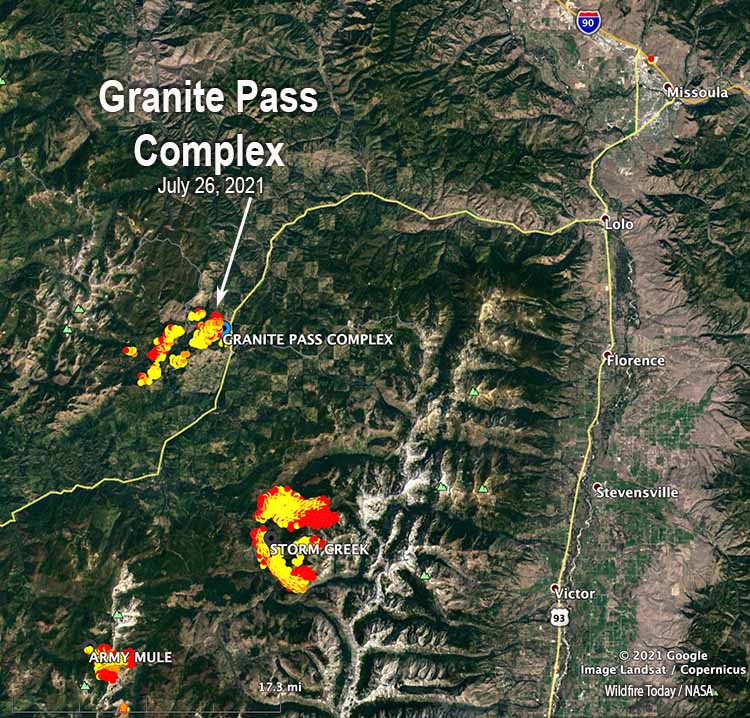
A firefighter on the Granite Pass Complex about 28 air miles southwest of Missoula, Montana was found about five hours after he was reported missing July 25.
The individual had been scouting an area suitable for a fireline and missed his scheduled check-in. At about 7:30 p.m. Missoula County Dispatch was notified of the missing firefighter, and California Interagency Incident Management Team 15 began multiple attempts to contact him. After there was no success, the team began to search by ground and air.
Missoula County Sheriff’s Office Deputies and Missoula County Search and Rescue were dispatched at 8:20 p.m. The individual’s vehicle was located in the vicinity of the White Mountain Lookout and Pilot Knob, southwest of Missoula at approximately 9:40 p.m. The Missoula County Search and Rescue and the Sheriff’s Office issued a Mutual Aid Request to Two Bear Air for aviation assistance. Airspace was cleared with the Incident Management Team and Two Bear Air began assisting Missoula County Search and Rescue ground resources.
The individual who had been reported missing realized they were not in their intended location and could not contact anyone by radio or phone. To minimize impacts to himself and local search and rescue resources, he explained later that he found an area suitable to stay the night.
He was located by Missoula County Search and Rescue just after midnight on July 26, 2021. He was tired and thirsty but uninjured and able to make his way out unassisted by search personnel.
Two Bear Air provides aviation support in portions of the Northwest to search and rescue teams. It is run by a philanthropist at no cost to taxpayers. Fire Aviation has several articles about the organization.
The Granite Pass Complex consists of four wildfires burning in the vicinity of Lolo Pass on the Nez Perce-Clearwater National Forests in Idaho and the Lolo National Forest in Montana. They are being managed together under one Type 2 Incident Management Team. Since the fires started from lightning on July 12 they have burned a total of about 3,700 acres.

Forest Service document reports 25% of hotshot crews can’t meet required standards
Recruiting, retention, and inept contracting is degrading the nation’s preparedness and ability to suppress wildfires
Continue reading