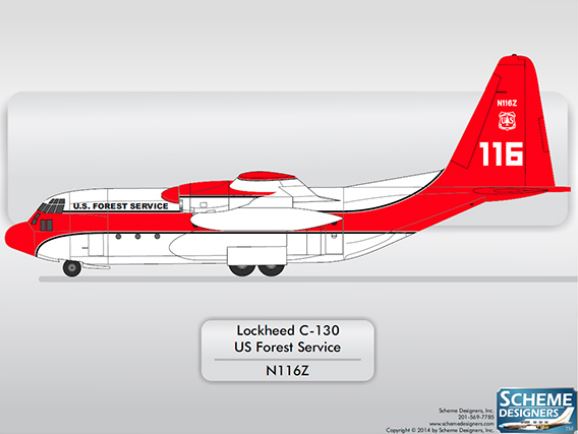
The paint design that has been approved by the Forest Service for the seven C-130s that are being transferred from the Coast Guard to the Forest Service.
It will probably be a year before any of the seven C-130H aircraft that are being transferred from the Coast Guard, to the Air Force, and finally to the Forest Service will be seen dropping retardant on a fire. Tom Harbour told us last month that he expects at least one to be flying by 2015.
The aircraft all need various levels of maintenance and it is thought that at least five will have to have the wing boxes replaced, a 10-month project that costs around $7 million each. Then the retardant systems will be installed. The Air Force, the agency overseeing the work on the aircraft, is expected to issue a solicitation for bids on the retardant system within the next two to three months. The Forest Service is working with the Air Force to write the specifications, which will reflect some of the language in the existing air tanker contracts, and information that the agencies have learned about retardant systems over the last 50 years.
The Forest Service is partnering with the Coast Guard for training and higher level, or Depot level, maintenance for the C-130s. The discussions within the Forest Service have been that the logistics, support, routine maintenance, and pilots for the C-130s would be provided by contractors, making it a government-owned/contractor-operated (GO/CO) program.
But no solicitations have been issued for these services. The Forest Service’s recent track record for awarding aerial firefighting contracts can lead one to an assumption that contracts for a GO/CO operation will not be awarded any time soon. Three USFS air tanker contracts have been officially protested in the last two years. Two of those were sustained by the GAO — the recent sole source contract and the original attempt to issue contracts for next-gen air tankers, while the third, filed by Neptune, was dropped five months before the company received the sole source award in December.
It could take longer to award the contracts than to refurbish and retrofit the C-130s. We would be very surprised if it happens by the end of this year.
After the contracts are signed, it could take quite some time for the contractors to ramp up to procure equipment, and to hire pilots, mechanics, and other employees to provide the services. If the pilots have no air tanker experience or qualifications, that will be another issue that has to be overcome. However, there is probably a large pool of ex-Air Force, Air National Guard, and Air Force Reserve C-130 pilots. Some of them may even have prior Modular Airborne FireFighting System (MAFFS) experience. In fact, Coulson has hired several pilots with MAFFS experience to fly their recently converted C-130Q air tanker.
The good news is that it is much easier to find and hire a C-130 pilot with recent experience than it is to find a P2V pilot that has flown the aircraft recently.
Aero Union’s P3A Tanker 22 getting reloaded at Hemet Ryan Air Attack Base while another P3A is headed towards the fire.
We are honored to present a photographic essay of air tankers by professional photographer Joe Cupido. He tells us below about his career in photography.
I grew up in a military family and acquired the love of aviation early on. When I was in high school I started photographing aircraft. Then later while in the military I became a Combat Photographer / Photojournalist and continued photographing aircraft professionally. I specialized in Air to Air photography working with the military and for some of the major aircraft companies. I was lucky enough to finish my career with about 5,500 hours in over 100 different airframes, 7 books and over 2,000 magazines articles on aviation subjects.
I’ve always enjoyed chasing fire-fighting aircraft whenever I had the time. The images below were captured over time and with a lot of cooperation from a lot of good people in the Air Tanker business. Without their help I could not have captured the images that I did and I thank all of you. Hope you enjoy!
Thanks Joe!
Hawkins & Powers Tanker 121, a PB4Y2, an ex-US Navy World War II patrol bomber. McDonnell-Douglas DC 10s, Tankers 911 and 910, operated by10 Tanker Air Carrier One of Butler Aviation’s Douglas DC7s, Tanker 66 during engine start. Nothing better than four smoky Pratt & Whitney radial engines.
A Colorado state senator who is also a candidate for county Sheriff hosted a demonstration for an air tanker yesterday. Senator Steve King, who has been very outspoken about the need for the state to have their own aerial firefighting resources, invited Coulson to display their C-130Q air tanker at the Centennial airport on the southeast side of Denver. The aircraft, which has a contract with the U.S. Forest Service, conducted a drop near the runway after flying in from their base in Sacramento.
The video below details some of the sophisticated imaging and mapping capabilities of Coulson’s Sikorsky S-76 helicopter, including identifying targets and a data link for transferring them to the C-130.
[link to video no longer works]
Interior of the S-76. Photo by Bill Gabbert.
Another report on the air tanker demonstration that has better shots of the C-130 drop can be found at KWGN.
On Wednesday Tom Harbour was kind enough to make time in his busy schedule at the Aerial Firefighting Conference at McClellan Air Force Base in Sacramento, California to give us an update on the air tanker program. He talked about the status of the C-130Hs that were recently transferred from the Coast Guard and commented on Buffalo Airways’ purchase of a P3 air tanker formerly owned by Aero Union.
Colorado Senator Mark Udall continues to push the U.S. Forest Service and now the Air Force to expedite the retrofitting of the seven C-130Hs that will be used as air tankers. The National Defense Authorization Act for 2014 that was passed in December required that the aircraft be transferred to the Air Force where they will be updated with new wing boxes as needed and receive retardant tank systems. After the conversions they will be owned by the U.S. Forest Service, but operated and maintained by private contractors while being used to help suppress wildfires.
Senator Udall wrote letters to the USFS and the Air Force “requesting assistance in expediting the necessary upgrades to the C-130H aircraft”. He also asked for reports that describe the “expected timeline for the completion of the upgrades to these C-130H aircraft and identification of possible issues that could delay this timeline”.
A provision in the farm bill (H.R.2642) passed by the House on Wednesday authorized the U.S. Forest Service to “establish a large airtanker and aerial asset lease program”, allowing the agency to “enter into a multiyear lease contract for up to five aircraft that meet the criteria described in the Forest Service document entitled `Large Airtanker Modernization Strategy‘ and dated February 10, 2012, for large airtankers”. That 2012 strategy stated that the next generation of large airtankers would have a 3,000 to 5,000 gallon capacity and would be turbine powered. These are the specifications of the seven next-gen air tankers that received contracts in 2013. The USFS has been contracting for large air tankers for decades. So, we were confused about the purpose of this language in the farm bill, placed there by two Senators from Colorado, Michael Bennet and Mark Udall. It seemingly allows for what the USFS does routinely, but does not appropriate any additional funds.
We checked with the U.S. Forest Service to try to understand if there was an intended difference between the routine contracting for air tankers that has been going on for decades and this new “leasing” language. We received the following, uh, explanation from their Washington, DC office:
The language in the Farm Bill clarifies our existing authority to lease up to five airtankers annually. Depending on our budget resources, this authority may be useful. At present, the Forest Service is relying on next generation airtanker contracts and the seven C-130 planes transferred in the Defense Appropriations Bill to modernize the fleet as we retire the legacy airtankers in the coming years.
That certainly clears that up.
We reached out to the offices of Senators Bennet and Udall, and received the following from James D. Owens, Press Secretary for Senator Udall:
The United States Forest Service is allowed to acquire large air tankers in two ways: (1) as surplus from other federal agencies or (2) contracting. The provision that Senator Udall successfully included in the Farm Bill gives the Forest Service a third, more flexible option to acquire air tankers, i.e. leasing.
“Leasing” might involve renting the air tankers without pilots, and possibly without a maintenance agreement. We have a hard time understanding why the USFS would want to become involved in that type of situation. They are going to have a hard enough time arranging for the operation and maintenance of the 15 Sherpas and 7 C-130Hs recently acquired from the military and the Coast Guard — aircraft which they will own.
The bill is now in the Senate. The White House says President Barack Obama will sign it if it reaches his desk.
The Chief of the U.S. Forest Service has approved the paint design for the seven C-130H aircraft the agency is receiving from the Coast Guard. The National Defense Authorization Act required the transfer of the C-130Hs plus 15 Shorts C-23B Sherpas from the military. The C-130Hs are being converted by the Air Force into air tankers, while the Sherpas will be used to deliver smokejumpers and cargo and to perform other wildfire support missions. The C-130Hs will be owned by the USFS but will be operated and maintained by contractors. Some of the Sherpas will be flown by agency personnel and others by contractors. All of the Sherpas will all be maintained by private companies.
The paint for the C-130Hs was designed by a company in New Jersey, Scheme Designers. Craig Darnett, their founder and CEO, told Fire Aviation that they have also designed the paint for other USFS aircraft, including the DC-3 and some smokejumper planes. Other examples of their work can be found at Airliners.net. Scheme Designers will not actually paint the C-130Hs; most of their work is done on computers, however sometimes the aircraft owner will pay them to be on site and monitor the painting as it is done.
If someone is restoring an automobile that is at least 27 years old, as these C-130Hs are according to our research, paint is the very last step in the process. Five of the seven have to go through a 10-month wing box replacement, and then the rest of the conversion process can begin, including cutting a hole in the belly and installing a retardant tank system.
Initially bringing the 22 aircraft into the agency will be extremely complex and time-consuming, with FAA approvals, inspections, evaluating, painting, writing then awarding contracts for maintenance and pilots, deciding on a tanking system, contracts for installing tanking systems, avionics, etc. And, developing a comprehensive PLAN of how to manage the aviation assets now and in the future. The Air Force will do some of this, other than the planning, before the actual final transfer of the C-130s to the USFS (the Sherpas will not receive retardant tanks), but the Forest Service has to be involved in the decision making. Then, after the 22 aircraft are completely up and running, managing the programs on a continuing basis is not simply a part time job for one person.
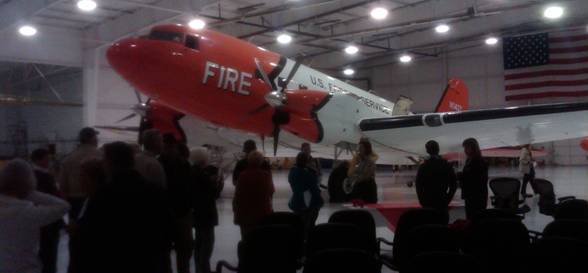
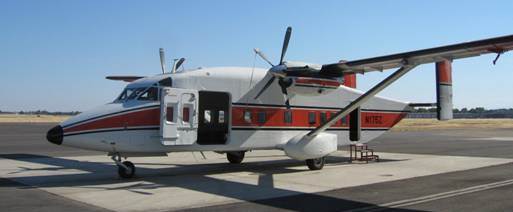
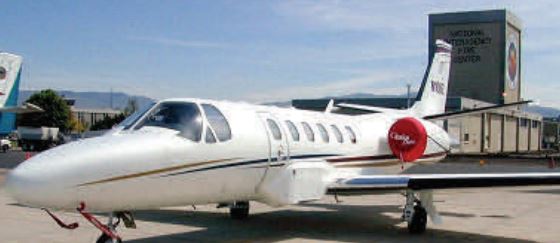
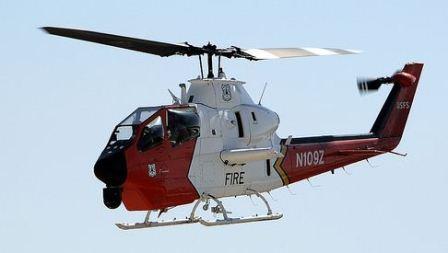
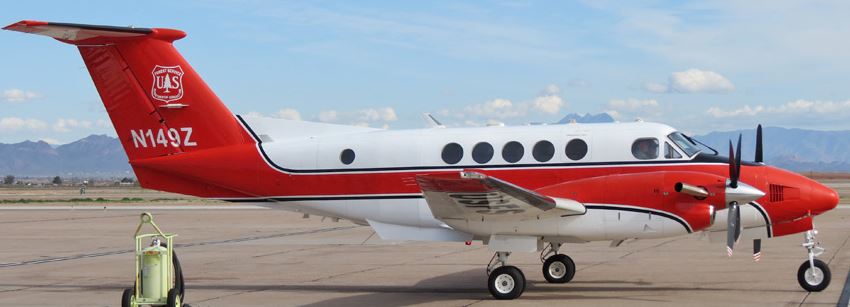
Below are some other paint designs on USFS aircraft:
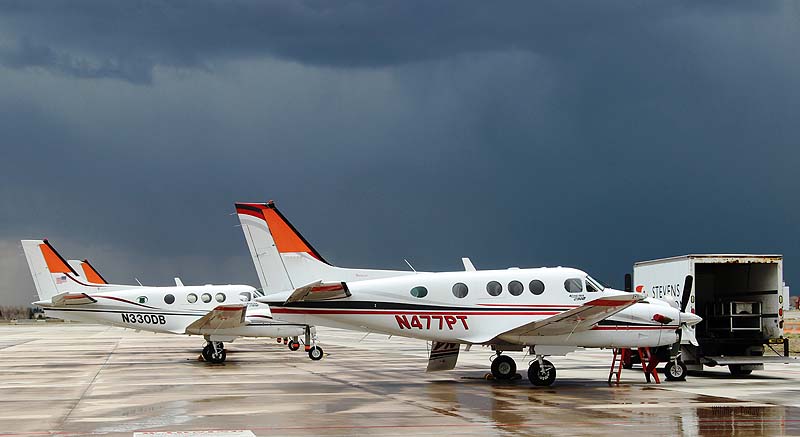
J-42, a US Forest Service DC-3, retires. USFS photo, taken at Ogden, Utah, October 24, 2012. Redding smokejumpers’ Shorts 330 Sherpa. USFS photo. Smokejumper aircraft, N143Z. USFS photo. One of the U.S. Forest Service’s Infrared aircraft, their Cessna Citation Bravo, N144Z Lead planes at Cheyenne, WY, May 7, 2013. These were not government owned, but were under contract to either the USFS or BLM. Photo by Bill Gabbert. The U. S. Forest Service’s Fire Watch Cobra helicopter. July 28, 2011. USFS infrared aircraft N149Z at Phoenix in 2013
A Coast Guard C-130H, No. 1709, October, 2008. This is one of the seven C-130Hs being transferred to the USFS. Photo by Bob Garrard.
Until now the U.S. Forest Service has never had to manage a fleet of 22 medium and large transport aircraft. But in the coming months the agency that was created to grow trees will be reminded of the phrase, “be careful what you wish for”, as they become the owners of seven large four-engine C-130H transport planes and 15 smaller C-23B Sherpa transport planes “given” to them by the Coast Guard and the Army. The Forest Service is still going to grow trees and clean toilets in campgrounds, while taking on this air force of 22 very expensive aircraft.
Transfers to take place no later than February 11
The legislation requiring the transfer of the aircraft required that both the C-130Hs and C-23B Sherpas be transferred within 45 days after the bill was signed, which makes February 11, 2014 the last day for the transfer to take place. The C-130Hs will go first to the Air Force which will arrange for maintenance, upgrades of the air frame, and the installation of the retardant system. Then the Air Force will transfer them to the U.S. Forest Service. The Sherpas will be transferred directly from the Army to the USFS by February 11.
Last week a USFS employee with knowledge of how their aviation section is organized told Wildfire Today that up to that point the agency had not made any decisions about an organizational structure that would manage this air force within the agency. Individual short-term tasks were being handed out one at a time, while multiple functional areas were trying to get involved, lobbying for their piece of the pie.
Initially bringing the 22 aircraft into the agency will be extremely complex and time-consuming, with FAA approvals, inspections, evaluating, painting, writing then awarding contracts for maintenance and pilots, deciding on a tanking system, contracts for installing tanking systems, avionics, etc. And, something the USFS has not done well, developing a comprehensive PLAN of how to manage the aviation assets now and in the future. The Air Force will do some of this, other than the planning, before the actual final transfer of the C-130s to the USFS (the Sherpas will not receive retardant tanks), but the Forest Service has to be involved in the decision making. Then, after the 22 aircraft are completely up and running, managing the programs on a continuing basis is not simply a part time job for one person.
Jennifer Jones, a Public Affairs Specialist for the Forest Service at the National Interagency Fire Center, told us today that the agency, at this point anyway, plans to use a Government Owned/Contractor Operated (GO/CO) model for the seven C-130H aircraft. The government will own them and the maintenance and operation will be handled by private contractors. The 15 Sherpas will be owned by the Forest Service — some will be flown by USFS pilots and others by contractors. All of the Sherpas will be maintained by private industry under contract, similar to how the existing four C-23A Sherpas are maintained. You could call this GO/CO-GO I suppose.
Coast Guard to assist with managing C-130Hs
We were surprised to hear from Mrs. Jones today that a joint U.S. Coast Guard and U.S. Forest Service program office will provide logistics, operations, training, higher level maintenance, and support for the C-130H aircraft. The Coast Guard has been managing a fleet of C-130s since 1959, using them for long range search and rescue, drug interdiction, illegal migrant patrols, homeland security, and logistics. They have 24 older C-130Hs which are being upgraded with new center wing boxes and cockpit equipment with new multi-function displays. In 2008 they began replacing some of the C-130Hs with new C-130Js; they have six now with three more on order. All these numbers were valid before the Coast Guard agreed to send seven C-130Hs to the USFS if the Coast Guard could get the 14 almost new C-27J aircraft from the military that had been earmarked for the Forest Service.
Before we heard that there was going to be a USFS/Coast Guard collaboration, we asked a former fighter pilot for his opinion about how the C-130Hs should be managed. Gary “Bean” Barrett was a Navy Captain, the Commanding Officer of an adversary squadron and of a GO/CO squadron of heavy aircraft:
I would recommend standing up an organization like a composite group. One single individual in charge of the entire group [no rule by committee … it won’t work]. Since there are mission differences between C-23’s and C-130’s the group commander should probably have two “squadrons” under him. One for C-23’s, one for C-130’s and perhaps one or two maintenance squadrons depending on how the USFS choses to organize themselves. I am familiar with both the USAF concept of independent maintenance squadrons and the Navy concept of an integrated operational squadron with its own maintenance department. Either can work with contract maintenance but either way, the group commander has to “own” the program budget and the maintenance and the operations programs and the COTAR has to work for the group commander. When maintenance is directly involved in producing sorties instead of off in another state independently “fixing airplanes” the entire process seems to work better. Heavy or Depot level maintenance should be a separate contract.
Modification of the C-130 is a big hurdle since there is no military equivalent modification but I would think that it would be far easier to incorporate the tanker mod into a mil based maintenance program than to be forced to operate C-130’s under the FAA FAR’s. and the FAA C-130Q type rating.
C-23B Sherpas
The Sherpas have been stored at Fort Sill in Lawton, Oklahoma for an extended period of time but have been under a maintenance contract and could be put into service fairly quickly. While at Fort Sill, on a regular basis they have been started, run up to 80 percent power for five minutes, systems have been cycled, and the aircraft have been taxied. No scheduled maintenance has been performed so they may be due for some routine work. The USFS will need to run the Sherpas through the Smokejumper Aircraft Screening and Evaluation Board (SASEB), which is the focal point for all interagency smokejumper/paracargo aircraft, much like the Interagency AirTanker Board evaluates air tankers. Other items on the to-do list include painting, avionics, removal of any unneeded military equipment, and ensure conformance with the FAA Certificate, but since they will not be used as air tankers, retardant tank systems will not have to be installed.
C-23B. Department of Defense file photo.
Ms. Jones said the C-23B Sherpas will be used to deliver smokejumpers and cargo and to perform other wildfire support missions. They are capable of carrying up to 10 smokejumpers or 30 passengers and up to 7,000 pounds of cargo. The C-23B Sherpas will replace all four U.S. Forest Service owned C-23A Sherpas and the DC-3T currently used for smokejumper missions. The additional aircraft will eventually replace contracted smokejumper aircraft and support other fire missions. They expect to begin using two of the newer Sherpas in 2014 to drop cargo and will begin using it in 2015 to deliver smokejumpers.
The C-23B Sherpa has a rear cargo ramp which can be opened during flight which could be used for paracargo or by smokejumpers, both of which would be new to the USFS. The C-23A Sherpa has a rear cargo ramp, but it does not open in flight.