At least a couple of Erickson Aero Tankers’ MD-87’s have been taking to the skies again after a long hiatus. Terry Cook took this photo yesterday June 16 as Tanker 103 was departing Missoula on the way to a fire.
You can see the external tank, or pod, that was installed below the retardant tank doors, lowering the release point by 46 inches to mitigate the problem of retardant being ingested into the engines.
July 13 we posted a video of T-105, another Erickson MD-87, dropping on the Whittier Fire.
Warning: Trying to access array offset on value of type bool in /home/customer/www/wildfiretoday.com/public_html/wp-content/themes/jupiterx/lib/api/image/functions.php on line 61
Deprecated: ltrim(): Passing null to parameter #1 ($string) of type string is deprecated in /home/customer/www/wildfiretoday.com/public_html/wp-content/themes/jupiterx/lib/api/utilities/functions.php on line 206
Deprecated: preg_replace(): Passing null to parameter #3 ($subject) of type array|string is deprecated in /home/customer/www/wildfiretoday.com/public_html/wp-content/themes/jupiterx/lib/api/image/class-image-editor.php on line 177
Warning: Undefined array key "extension" in /home/customer/www/wildfiretoday.com/public_html/wp-content/themes/jupiterx/lib/api/image/class-image-editor.php on line 179
Deprecated: preg_match(): Passing null to parameter #2 ($subject) of type string is deprecated in /home/customer/www/wildfiretoday.com/public_html/wp-includes/functions.php on line 3089
Deprecated: is_file(): Passing null to parameter #1 ($filename) of type string is deprecated in /home/customer/www/wildfiretoday.com/public_html/wp-includes/class-wp-image-editor-gd.php on line 95
Deprecated: preg_match(): Passing null to parameter #2 ($subject) of type string is deprecated in /home/customer/www/wildfiretoday.com/public_html/wp-includes/class-wp-image-editor-gd.php on line 95
Above: One of Erickson Aero Tanker’s MD-87’s, Tanker 105, makes a drop on the Whittier Fire northwest of Goleta, California. Santa Barbara County Fire Department photo.
Originally published at 11 p.m. MDT July 13, 2017
We have not seen the MD-87 air tankers over fires for a while, but the photo above and the video below were posted on Twitter July 13, 2017 by Mike Eliason of the Santa Barbara County Fire Department.
As we reported in March, we talked with Kevin McLoughlin, the Director of Air Tanker Operations for Erickson Aero Tanker, who told us that they have fixed the problem with their recently converted MD-87 air tankers and expect to have five of them available this summer. Two are on exclusive use contracts and they hope to have the others on call when needed contracts. The issue involved retardant dispersing over the wing which left open the possibility of it being ingested into the engines. They had an external tank, or pod, fabricated and installed below the retardant tank doors, which lowers the release point by 46 inches, mitigating the problem, Mr. McLoughlin said. In November the aircraft took and passed the grid test again, certifying it for coverage levels one through eight.
Check out the video below of a drop on the Whittier Fire northwest of Goleta, California.
In September of 2015 an Erickson MD-87 experienced an engine failure after departing from Fresno Airport. Pieces of the engine fell into a residential neighborhood, with at least one fragment shattering the rear window in a car. The aircraft returned to the airport.
KMPH reports that the pieces of metal that fell into a Fresno neighborhood Sunday afternoon September 13, breaking a car window, came from an engine that failed on an air tanker, reportedly an Erickson MD-87. Below is an excerpt from their article:
…The plane had departed the Fresno Airport around 3:30 p.m. Sunday when, according to the Federal Aviation Administration and Fresno Firefighters, the pilot reported a left engine failure.
Shortly after, families in a neighborhood near Ashlan and Highway 168 said they heard a boom and saw smoke coming from the plane.
In the process, pieces of the plane’s engine fell into a neighborhood. At least one piece shattered a windshield. Others landed on the streets.
The plane returned to the airport moments later…
****
(Originally published at 5:43 p.m. PT, September 13, 2015)
We don’t know what caused the engine to fail, and it might not be related, but here is a link to a story we ran in June of 2014 about all three of Erickson’s MD-87s being recalled“ due to intermittent engine surges when dropping [retardant at] high coverage levels”.
This Rapid Lesson Sharing, below, about a fire in southern California was distributed by the Wildland Fire Lessons Learned Center.
****
“At approximately 1430 hours, a report is radioed to Dispatch of a 1/4-acre vegetation fire located directly behind our Mill Creek Fire Station. Stepping outside the office, my swamper and I see heavy smoke to the north of the compound. We quickly make our way to the transport to off-load the dozer and engage the fire.
Upon size-up of the rapid rate-of-spread and eliminating the option of anchoring at the heel and cutting direct due to steepness of terrain, I prioritize my tactics to protection of life and property. I then make a decision to track my dozer up an indirect route—knowing there are homes and property owners at risk at the top of the ridge in the fire’s path.
At this point, one ridge to my north separates the ridge I am tracking up and the main fire. Air resources are enroute. At the pace I am ascending the ridge, I figure the air resources will arrive on scene and slow the forward rate-of-spread down long enough to allow me to reach the homes.
Fire Advances Toward Homes
As I crest the ridge, I only have a shallow drainage to cross—in which the fire has established itself just below me and is making a strong push toward the homes. At that moment, emergency traffic airs over command frequency that all aircraft have been grounded due to a drone sighted in the fire area.
As the fire advances, I make eye contact with the property owner across the drainage. At this time, the only option I have is to hope the fire will crest the ridge and minimize in intensity long enough for me to cross the drainage to the homes.
I take a moment to size-up and reevaluate my escape route and safety zone and try to develop a contingency plan with my swamper.
Drone Operator Confronted
Fortunately, the fire does as I had hoped. My swamper and I are able to cross the drainage and engage the fire directly, assisting the crews and engine personnel behind the threatened homes. Next, the drone clears the area and air suppression resources reengage.
When the drone is spotted returning, a U.S. Forest Service employee is able to follow it and confront the person responsible. His vehicle information is documented and he is notified that the authorities are enroute to educate him on drone use in wildfire areas.
However, the drone operator refuses to wait and flees the scene.
LESSONS
With the recent high frequency of drone use affecting wildfire suppression tactics, this incident has raised my awareness to the impact that drones have on wildfire suppression tactics.
In the future I plan on being more cautious when implementing air support into my tactical decisions and suppression efforts.”
****
Note from Bill: I know someone will say planned firefighting tactics should not depend on the predicted availability of aviation resources. However, to give the dozer operator the benefit of the doubt, his initial plan may have been to wait for the expected retardant drops to slow the spread of the fire before he committed himself to crossing the drainage to defend the structures.
The video shows multiple retardant drops by Air Spray’s Tanker 489, a Lockheed Electra, on a fire in Kokanee Creek Provincial Park in British Columbia (map).
Here is the description provided by the videographer:
****
“Published on 4 Jul 2015
Fire season has arrived in the Kootenays! This video was taken July 3rd, 2015 showing the new small forest fire near Kokanee Creek Provincial Park towards Kokanee Glacier. This video features many of the aircraft involved in battling the blaze including water bombers, air tankers and helicopters with bambi buckets.
–The aircraft featured in this video include:
–Air Spray Lockheed L-188 Electra Airtanker
–Air Spray Twin Commander 690 Birddog C-FZRQ
–Cessna Caravan Birddog
–Selkirk Mountain Helicopters Aerospatiale AS 350 B-2 C-GSKL with water bucket
–Air Spray Air Tractor 802 Fire Boss Amphibious Tanker Plane
This was my first time ever seeing aircraft fighting a wildfire in person and it was truly an impressive sight. It was especially cool seeing the massive Electra turboprop diving down into the valley near Kokanee Creek Park and dumping fire retardant onto the flames.”
****
BONUS VIDEO
This video of an MD-87 dropping on a fire in Laguna Canyon in southern California on July 3, 2015 is shot from pretty far away but you can clearly see the retardant and after the drop, the air tanker as it exits the area closer to the camera. It looked like an excellent drop. I could not make out the tanker number.
****
BONUS VIDEO #2, added July 9, 2015
I found this video today, and it looks like the same air tanker, the MD-87, making another drop on the fire in Laguna Canyon. It’s interesting how at 0:48 it disappears into a canyon while making the drop.
New paint for Tanker 66. Photo on March 19, 2015 at Medford, Oregon. Photo by Tim Crippin.
Tim Crippin sent us the photo above of Erickson’s Tanker 66, saying it just returned to Medford, Oregon after getting a new paint job at Phoenix Goodyear Airport.
The photo below is what it looked like a year ago. It is our understanding that Tanker 60 will get the same paint scheme very soon.
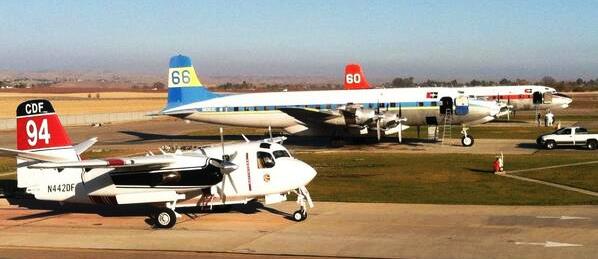
Two DC-7 air tankers and an S-2T air tanker at Paso Robles Air Tanker Base, January 19, 2014. CAL FIRE photo.
The paint is similar to the three Erickson MD-87s:
Tanker 101, an MD-87, during the grid retardant test, January 15, 2014. Photo by Jeff Zimmerman. (click to enlarge)
Now that we have summarized the evolution of the federal large air tanker fleet over the course of 2014, it’s time to look at what is in store for 2015. There could be between 14 and 21 large air tankers on exclusive use contracts this year. Jennifer Jones, a Public Affairs Specialist with the U. S. Forest Service in Boise, told us that the list should include these aircraft:
1 DC-10, 10 Tanker Air Carrier
1 C-130Q, Coulson
2 RJ-85s, Aero-Flite
2 MD-87s, Erickson Aero Air
1 BAe-146, Neptune
6 P2Vs, Neptune
1 C-130H, U.S. Forest Service
In 2014 a DC-10 and three more BAe-146s were brought into service as “additional equipment” on a 1-year temporary basis under exclusive use contracts awarded in 2013. Due to a change in Department of the Interior procurement policies, this will not be done again in 2015.
The USFS expects to award another “next generation” contract for up to 7 more air tankers in 2015. We will be watching to see how long it takes the agency to advertise and award the contracts. Last time it took 555 days.
The USFS will also have one CL-415 water scooping air tanker on contract this year. And, eight military C-130s equipped with Modular Airborne Fire Fighting Systems (MAFFS) are expected to be available if needed.
Tankers 105, 06, and 101 (L to R) at Redmond Oregon, June 8, 2014. Photo by Jeff Ingelse.
According to an FAA report, one of Erickson Aero Tanker’s aircraft was struck by a garbage truck while parked at San Antonio, Texas January 5, 2015. There were no injuries, and the amount of damage to Tanker 105 is unknown.
The aircraft is an MD-87, N295EA, first certified by the Interagency Airtanker Board in 2014. One of its sister air tankers, T-101, made the first drop on a fire by an MD-87 June 7 on the Two Bulls Fire west of Bend, Oregon.
The aircraft is off contract now and the start date for 2015 hasn’t been determined.
A phone call to Erickson Aero Tanker was not returned.
DC-10s, Tankers 910 and 911, at Medford. Photo by Kristin Biechler.
Kristin Biechler sent us these photos that she and Dave Clemens shot at the Medford, Oregon Airport (map) over the last few days. She said her house is directly under the tankers’ flight path to the Happy Camp and Beaver Fires in northwest California. The planes depart MFR, she explained, bank west, and mostly follow Highway 238 toward Jacksonville and out to Applegate Reservoir and into California.
A P2V (Tanker 07) and a DC-10 at Medford. Photo by Kristin Biechler. Neptune’s BAe-146s, Tankers 01 and 10, at Medford. Photo by Kristin Biechler. Tanker 910, a DC-10, at Medford. Photo by Dave Clemens. Tanker 101, an MD-87, at Medford. Photo by Dave Clemens. Tanker 101, an MD-87, at Medford. Photo by Dave Clemens.