These videos were shot with a GoPro camera attached to Tanker 131, a C-130Q, while it was dropping on the King Fire between Placerville and Lake Tahoe, California. That was the fire where 12 firefighters deployed their fire shelters in front of advancing flames and were led to safety by a pilot in a helicopter.
Thanks go out to Britt Coulson for making these available.
We wish other air tanker operators would invest a couple of hundred dollars in a camera they could attach to their aircraft.
I’d love to see a split screen video of an air tanker dropping. On one side we would see the ground and the drop itself, and the other side would be shot from the cockpit and would include the audio of the crew — like this video shot from MAFFS 3 in July. It would take a little bit of advanced video editing, but I imagine if the raw footage was available we could find a volunteer who could put it together.
The photo below of Coulson’s Tanker 131 was shot while it was on final for landing at Redding, California, August 7, 2014.
T-131 landing at Redding, California August 7, 2014. Photo by Bill Gabbert.
The Silverado Fire in southern California seven miles southwest of Corona has spread very little over the last 24 hours. A spokesperson for the incident management team, Jake Rodriguez, said 1,084 personnel are assigned and they are calling it 20 percent contained, up from yesterday’s 10 percent. The official size of the fire is 1,600 acres, Mr. Rodriguez said. It is listed in some places on InciWeb at 1,500 acres, but a reliable source tells us that it has burned just under 1,100 acres. The Orange County Fire Authority puts it at 1,220 acres, according to the Pasadena Star-News.
For the second night in a row a night-flying helicopter worked the fire to assist firefighters on the ground.
There have been six minor injuries on the fire, some of them heat related. The high temperatures are again in the forecast for Sunday, with a prediction for 102 degrees, 10 percent relative humidity, and a 15 to 18 mph wind.
Map of Silverado Fire at 4 a.m. September 14, 2014. (click to enlarge)
****
(UPDATED at 10:15 a.m. PDT, September 13, 2014)
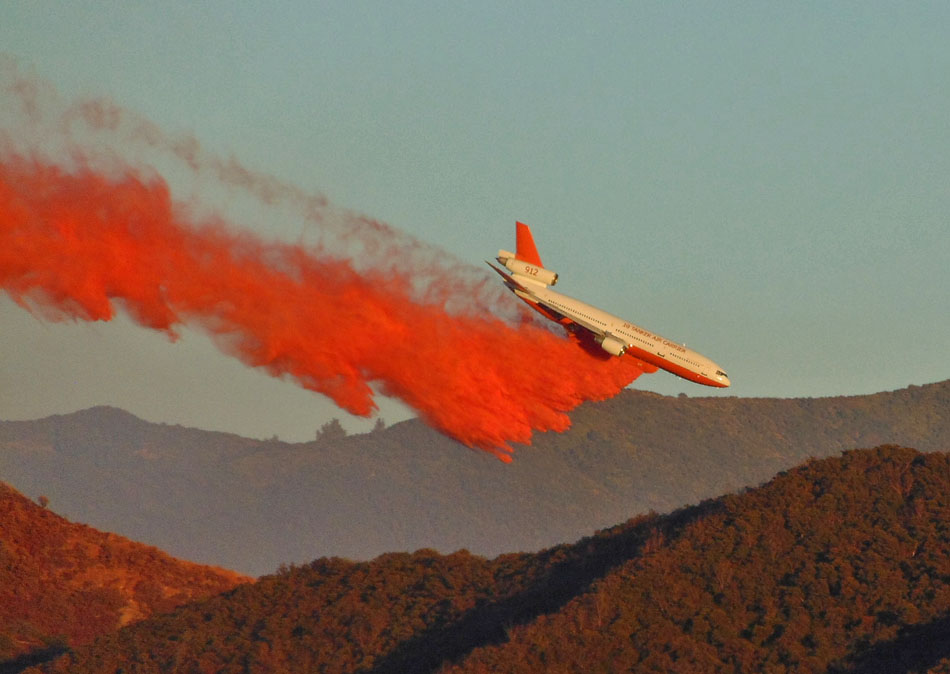
Tanker 912, a DC-10, drops on the Silverado Fire September 12, 2014. Photo by Initial Attack Fire Media. (click to enlarge)
The spread of the Silverado Fire in southern California seven miles southwest of Corona was slowed late in the day on Friday by an aggressive initial attack with firefighters on the ground and in the air. It started in the back yard of a home in Silverado Canyon and a few hours later bumped up against the road at the top of the main ridge, the North Main Divide.
The U.S. Forest Service estimates the fire has burned 1,600 acres and they are calling it 10 percent contained. On Saturday morning there were 738 personnel assigned.
****
(UPDATED at 6:48 p.m. PDT, September 12, 2014)
Mandatory evacuations were ordered late Friday afternoon for some areas near the Silverado Fire which has burned 1,300 acres in southern California seven miles southwest of Corona.
While the temperature at the fire area was quite toasty on Friday, reaching 101 degrees at Temescal 8 miles east of the fire, and the relative humidity was low (in the upper teens), the wind was not a huge factor — 3 to 8 mph, except 11 to 12 between 1 and 3 p.m. Friday night the relative humidity will remain low, in the high 20s. The forecast for Saturday calls for more moderate conditions, with a high of 90 degrees, wind out of the north then west at 1 to 11 mph, and a relative humidity in the low 20s.
The night-flying helicopter, H-531, and the night fixed wing air attack platform based on the nearby Angeles National Forest has been ordered for Friday night.
Tanker 911, a DC-10, dropping on the Silverado Fire at 6:08 p.m. PDT 9-12-2014. Screen grab from NBC Los Angeles.
T-41 and T-131 at RDD 8-7-2014 T-41 at RDD 8-7-2014 T-41 landing at RDD 8-7-2014 T-41 landing at RDD 8-7-2014 Seen from the rear with the speed brakes deployed, is T-41 landing at RDD, 8-7-2014
All photos were taken by Bill Gabbert and are subject to copyright.
We took these photos at Coulson’s hangar at McClellan Air Force Base in Sacramento, March 21, 2014 after the Aerial Firefighting conference (except for one photo that was taken a couple of days earlier). We appreciate the fact that Wayne and Britt Coulson feel confident to talk about and show others their firefighting operation.
T-131, a C-130Q. Any suggestions for a caption for this photo? T-131 being pushed out of the hangar Stickers in the tool box of one of the Coulson mechanics. These guys are not JUST mechanics, pilots, and crewmembers. Many of them are passionate about fire aviation.
Britt Coulson sent us this very impressive video and the excellent photos of their C-130-Q, Tanker 131, dropping on the Wheeler Fire in southern California. The still photos were taken by Michael Meadows on Thursday, November 14 and are used here with his permission.
You have to watch this video. I have seen lots of forward-looking videos shot from the cockpit of air tankers, but this one looking toward the rear allows you to see where the retardant hits the fire. Very impressive. We asked Britt for some details about the camera:
It is the newest version of GoPro and they mounted it on the rear ramp door. The C-130Q has a hole where the low frequency RF cable used to go out that was later converted to a window with bars over it so it doesn’t get damaged. We build a housing that attaches to the bars and holds the camera. I believe they activated it before they took off then just cut the video down.
They have another camera mounted on a wing tip but it was not turned on for this flight. The photo below was taken from that camera.
The Wheeler Fire, north of Santa Paula in Ventura County, was contained at 64 acres. T-131 dropped 10,500 USG over 3 sorties and 5 drops.
Coulson’s exclusive use contract with the U.S. Forest Service ended for the year on November 15 but the agency gave them an extension based on fire activity.
Click on the photos to see larger versions. Thanks Britt and Michael!
Air Tanker 131, Coulson’s C-130Q, made its first drop on a wildfire Friday, September 20. It split one load, dropping on both flanks of the Sanctuary Fire on the Los Padres National Forest near the Hopper Mountain Condor Sanctuary where the U.S. Fish and Wildlife Service raises the Condors.
The video above is the first drop for T-131 ever on a wildfire. The second video, below, is the second drop on the other flank.
Tanker 131 and T-44, a P2V, worked the fire with lead plane Bravo-52. The fire was contained at 27 acres.
A big thanks go out to Gary Monday of Ventura County Fire Department who shot the video.
T -131 at San Bernardino, August 24, 2013. Photo by Dan Megna
(UPDATED at 1:47 p.m. PDT, September 20, 2012)
Tanker 131 was dispatched to its first fire today, September 20, near Santa Maria, California.
****
(Originally published September 13, 2013)
Coulson’s Air Tanker 131, a converted C-130Q, has been fully certified by the FAA, the Interagency AirTanker Board, and the U.S. Forest Service. The 3,500-gallon aircraft was carded on Tuesday and the pilot check rides occurred Wednesday. Its first assignment was to report to the San Bernardino airport, which ironically is where it spent the last several months while going through the conversion process.
Wayne Coulson, President and CEO of Coulson Aviation USA Inc., said, “This C-130Q has been outfitted with a Coulson RADS-XL Constant Flow tank and a state-of-the-art drop controller system that will enhance the accuracy of retardant drops by using GPS speed and other inputs.”
T-131 becomes the second air tanker to be certified and activated, of the original seven that were awarded “next generation” contracts.
As you may know, the USFS announced on May 6 that contracts were going to be awarded for seven next generation air tankers. The contracts were for exclusive use and for five years, with options for the USFS to extend them for an additional five years. Another option allows the addition of more air tankers from the vendors. The activation of the contracts was held up by two rounds of protests in 2012 and 2013 from Neptune Aviation, 10 Tanker, and Coulson, but the awards, after over 500 days of dithering, finally went to:
Only one of the five companies had their air tanker fully certified and ready to go when the awards were announced — 10 Tanker Air Carrier and their DC-10. They put Tanker 910 to work around June 1. In fact, their second DC-10, Tanker 911, was activated on a Call When Needed (CWN) contract June 14 (later changed to a 90-day exclusive use contract) and both of them have been flying fires since then. The two DC-10s, which always carry 11,600 gallons, dropped approximately 698,000 gallons of retardant in the month of June.
The mandatory availability period for the six next generation air tankers was supposed to begin in the first part of August, 2013. Other than the DC-10, none of them made that date. Minden, Aero Air, and Aero Flite are still working on their conversion projects.
Coulson’s C-130Q, Tanker 131, can see light at the end of the tunnel. The aircraft has the new wrap applied and looks pretty spiffy. Today they flew it from San Bernardino up to McClellan to get approval for FAA Part 137, which is for “Agricultural Aircraft Operators”, for “dispensing of any chemical designed to treat the soil or crops”.
Britt Coulson told us they are still working out a few certification details with the U.S. Forest Service, but their goal is to have the aircraft ready to drop retardant over fires as early as the end of this week, or at the latest, next week. The tank holds 3,500 gallons and very seldom will they have to reduce that load due to density altitude. Eventually they may install a larger tank.
T-131’s first partial drop test, San Bernardino, August 15, 2013
Coulson completed their static tests and door calibration for Tanker 131, a C-130Q, and today did their first partial drop. They are also working on the FAA Type Certificate.
A video of the drop is below.
HERE is a link to a video of the aircraft taking off for the first time after the conversion and maintenance that has been underway for the last several months.
And below is a video of the doors opening and closing. (I know, but if you’re at home on a Thursday night, you might as well spend 18 seconds watching this.)