Juvenile sentenced for starting Weber fire in Colorado

Weber Fire, 2012

Weber Fire, June, 2012.  The communication towers at the top-left were threatened by the fire. Photo by Erin Yeoman.

Following a two-day trial a juvenile charged with starting the Weber Fire six miles southwest of Mancos, Colorado in June, 2012 has been sentenced. Few details were provided by the U.S. Attorney’s news release, but reportedly the juvenile apologized for the acts of delinquency and to those who were damaged by the fire. The court is in the process of determining an amount of restitution. The fire burned 10,133 acres.

Ryan Handy reported in the Colorado Springs Gazette that recently officials discovered at least seven smoldering coal fires this spring that they believe were ignited by the Weber fire. Four are coal-refuse piles and three are natural coal seams that have apparently been burning for almost a year. As we have reported previously, coal seam fires can be a challenge to suppress, since much of the burning coal is underground.

Map of Weber Fire

Map showing the location of the Weber Fire in southwest Colorado. Inciweb.

Thanks go out to Ryan

Share

More evidence about the effects of beetles on wildfires

Millions of dollars are being sought or spent on mitigating the effects of bark beetle mortality in the name of preventing disastrous wildfires. Sometimes these efforts are a smoke screen by private companies, or those influenced by their lobbyists, who want to reduce regulations and environmental restrictions on cutting timber on federal lands. At other times the public or even firefighters see dead trees and assume that beetle-killed forests will lead to catastrophic fire behavior. While there is not complete agreement, most of the available science and the preponderance of evidence contradict that assumption.

Beetles are a natural part of the environment and have been around as long as forests. The recent surge in their numbers is due to two factors: warmer weather that kills off fewer of them during the winter, and drought in some areas that reduces the vigor of the trees, decreasing their ability to fend off the attacks.

Dr. Dominik Kulakowski conducted research on insect outbreaks and fires in Rocky Mountain forests for fifteen years. During that time he worked as a research scientist at the University of Colorado and now is a professor at Clark University where he continues to pursue this research.

Below is an excerpt from Dr. Kulakowski’s testimony on April 11, 2013 before the Subcommittee on Public Lands and Environmental Regulation of the Committee on Natural Resources of the United States House of Representatives. He was providing information for the committee members to consider when they vote on H.R. 1442, a proposed bill with a strange name, the “Depleting Risk from Insect Infestation, Soil Erosion, and Catastrophic Fire Act of 2013″.

****

“…Another example is that of a major outbreak of spruce beetle in spruce and fir forests in Colorado in the 1940s, following which there was substantial concern about the increased risk of fire. But although over 300 fires occurred in that region in the decades that followed, our research found that the forests affected by beetles were no more likely to have burned than other forests. Furthermore, no major fires occurred in those beetle-affected forests in the years and decades that followed the outbreak despite the abundance of dead trees. The most likely explanation for this lack of large severe fires is that climatic conditions in these forests are a more important factor in determining fire risk than is the presence of dead trees. In fact, it was not until a severe drought in 2002 that a large fire affected these forests. During that year there were many wildfires in Colorado, the majority of which burned forests with no recent history of outbreaks.

During the drought of 2002, wildfires also burned some forests in northern Colorado that were attacked by beetles just prior to 2002. The potential increase of fire risk immediately following bark beetle outbreaks is the subject of active research. During this so-called “red phase” dry red needles persist on recently killed trees. It has been hypothesized that the risk of fire may therefore increase during and immediately after outbreaks of bark beetles. Relatively little research has examined fires during the red phase of outbreaks and more research is necessary. However, our examination of the 2002 fires found that outbreaks that immediately preceded those fires affected neither the extent nor severity of fires, most likely because changes in fuels brought about by outbreaks were overridden by weather conditions and other variables.

To understand these scientific findings, which may seem counter-intuitive, we need to consider that (1) bark beetles affect fuels in several ways and (2) several factors are necessary for the occurrence of wildfires. Recent research indicates that reductions in canopy density following outbreaks are actually more important to fire risk than are increases in dead fuel. In other words, beetle-killed trees rapidly lose their needles and this reduces the amount of potentially flammable material in the forest canopy. In contrast, live trees have dense canopies which are critical to the spread of wildfire. Furthermore, and most importantly, in forests dominated by lodgepole pine and spruce there is generally no shortage of flammable material, even in the absence of beetle outbreaks. These forests are characteristically dense and during droughts the risk of severe wildfire is likely to be high, regardless of outbreaks. In sum, catastrophic fire is not an inevitable outcome of bark beetle outbreaks. Instead climate is so important to fire risk in these forests that the effects of outbreaks appear to have comparatively little or no influence.”

****

Dr. Kulakowski’s complete testimony before the committee.
More information on Wildfire Today about beetles.

Share

Dispatcher may have mishandled 911 call about Waldo Canyon Fire

If a 911 dispatcher had handled an incoming call differently, it is possible that the disastrous Waldo Canyon Fire could have been suppressed long before it killed two people and burned 18,000 acres and 347 homes in Colorado Springs.

On April 19 we covered the time line on the fire, including the fact that it took firefighters 16 hours to find it after the first smoke report at 7:50 p.m. on June 22, 2012. Between 7:30 a.m. and 7:50 a.m. the next day another 911 caller reported the fire and indicated that he had been running on a trail and apparently had been close to the fire and knew the actual location. But the dispatcher said the Forest Service was responding, and thank you. Four hours later at noon firefighters finally found the fire 16 hours after the first report.

KKTV transcribed the 911 call from the runner:

Dispatcher: “On Saturday, June 23, 2012 at 7:50 a.m.”

Dispatcher: “This is the El Paso County Dispatch.”

Caller: “I’m calling on the suspected Waldo fire; I was running the trail today and went up on one of the dog legs after I smelled a little bit of smoke. There’s a spot about a couple hundred feet wide that’s still smoldering a little bit.”

Dispatcher: “Right….Pueblo Forest Service checked on that last night they said that they would be sending up another unit first thing this morning to check on it, but they are aware of it and they will be up there shortly this morning. Okay?”

Caller: “Yeah. I just wanted to make sure.”

Dispatcher: “Sure. Thank you.”

The El Paso County Sheriff’s Office report about the fire mentioned the runner’s call:

…[The caller] was advised that responding agencies were aware of the report. The reporting party’s contact information or specific location was not captured or reported to responding agencies as the dispatcher believed responding agencies were aware of the location of the fire.

Later in the Sheriff’s report, the call was referred to again:

…Pinpointing more specific location would potentially expedite response. Obtaining specific information from witnesses as to their location with respect to the sighting of smoke/fire and responding to reporting parties’ locations as they were reporting signs of the fire would more narrowly identify the location of the fire.

There is no indication in the reports that the U.S. Forest Service requested a helicopter or any other aerial resources to assist in locating the smoke, which was in the Pike National Forest just west of Colorado Springs.

Share

Red Flag Warnings, April 29, 2013

Red Flag Warnings

Red Flag Warnings for enhanced wildfire danger have been issued by the National Weather Service for areas in New Mexico, Arizona, Colorado, and Montana.

***

The Red Flag Warning map above was current as of 9:45 a.m. MT on Monday. Red Flag Warnings can change throughout the day as the National Weather Service offices around the country update and revise their forecasts. For the most current data, visit this NWS site.

Share

Slower start to fire season in some areas

The recent cooler than normal weather and very heavy snow has led to a slower start of the wildfire season in Colorado and the Black Hills of South Dakota. By this time last year we had written about two significant timber fires in these areas, the 4,140-acre Lower North Fork Fire southwest of Denver that killed three residents in their homes on March 26 and the Apple Fire south of Custer, South Dakota that burned 500 acres on March 28.

The primary reason for fewer large timber fires is the weather, of course. Boulder, Colordo had twice the average amount of snow in March, with 22 inches. April brought record-setting snow to parts of Colorado and the Black Hills. Boulder experienced not only the snowiest April on record, about 50 inches, but it was the snowiest of any month in history there. In Rapid City, South Dakota a new record was also established for the most snow ever recorded in the month of April with 43 inches, crushing the previous record of 31 inches.

The snowpack map below was current as of April 1 and does not include the heavy snow this month.

Mountain snowpack, April 1, 2013. It does not include the heavy snow in CO and SD in April.

Mountain snowpack, April 1, 2013. It does not include the heavy snow in CO and SD in April.

Compare this year’s map above, with the map for last year below:

Mountain snowpack, April 1, 2012

Mountain snowpack, April 1, 2012

And then there is the drought to consider.

Drought Monitor

As we have often stated, precipitation and temperature in the winter and early spring are not the only factors that influence the severity of the wildfire season in mid-summer and fall. Sure, a wet, cool Spring can delay the occurrence of late Spring and early Summer fires, but by mid-Summer the most important variable is the recent weather at that time. If it is hot, dry, and windy, you can have a busy fire season even following a wet winter. Predictions in April of how active the July through November fire season will be should be taken with a grain of salt. They are about as accurate as flipping a coin.


Share

Fire briefing, April 26, 2013

California firefighter entrapped and injured

A Lieutenant with Tulare County in California suffered minor burns to his hands when his patrol unit became stuck in a ditch as a vegetation fire approached. Working by himself, he attempted to knock down the fire using the pump and hose on the truck but was unsuccessful. He was transported to a hospital complaining of difficulty breathing in addition to the burn injuries.

Texas legislature considers bills to promote prescribed fire

The Texas legislature is considering two bills that would make it easier in some cases for landowners to use prescribed fire as a tool. SB 702 would establish standards for prescribed burners, as well as education and insurance for those conducting the prescribed fires. A second bill, SB 764, would limit prescribed burning liability on government-owned agricultural lands, making it easier for government agencies to use prescribed fire, even under a burn ban. Both bills passed unanimously in Senate committees.

Colorado’s risk assessment tool for residents

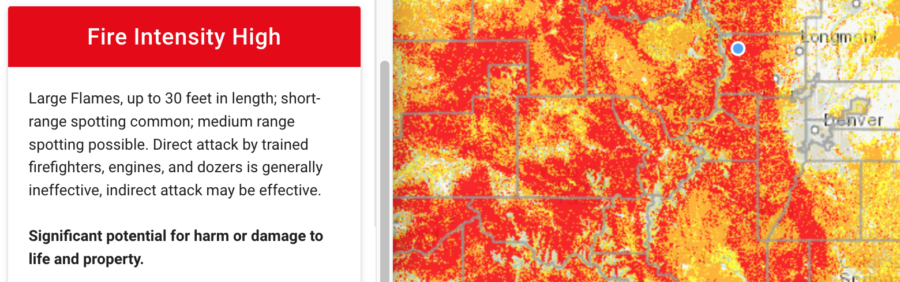
The Colorado State Forest Service has an online tool available for residents which allows them to explore wildfire risk levels within a 1/2-mile radius of a home, or any other point of interest on the map.

Steam engine starts fires in England

steam engine

North Yorkshire Moors Railway photo

A steam-powered train started three vegetation fires in North Yorkshire County on Sunday in the United Kingdom. The fires burned about 19 acres in a remote area that was difficult for firefighters to access. Some of them hitched a ride on a train from Goathland that was packed with tourists. On Tuesday the train started another fire in Beck Hole. Weather has prevented the North Yorkshire Moors Railway from conducting their usual prescribed fires along the railway.

MAFFS annual training

MAFFS 2 training

A C-130 Hercules from the 302nd Airlift Wing drops a load of water April 22, 2013 near Fairplay, Colo during training. (U.S. Air Force photo/Staff Sgt. Nathan Federico) Click to enlarge.

Two of the four military units that provide military C-130 aircraft configured to serve as air tankers are conducting their annual training, certification, and recertification. Peterson Air Force base in Colorado Springs had their’s April 19-23 and Warren Air Force Base in Cheyenne has chosen the week of May 5. The military Modular Airborne FireFighting System (MAFFS) can help fill a need for a surge capacity when all of the privately owned contract air tankers are committed.

Share