Wiretap produces federal charges including bid-rigging and fraud

Editor’s note: This news ran almost a month ago and we missed it.
Thanks to Stanley for bringing it to our attention.


Following a court-authorized wiretap investigation, a federal grand jury in Boise returned an indictment last week charging two executives of competing companies with conspiring to rig bids and allocate territories in violation of the Sherman Act (which prohibits trusts, monopolies, and cartels), conspiring to commit wire fraud, and committing wire fraud, according to U.S. Attorney Josh Hurwit.

LocalNews8 reported in December that the seven-count felony indictment specifies that the conspiracy by 60-year-old Ike Tomlinson of Terreton and 61-year-old Kris Bird of Salmon affected contracts for firefighting services. The U.S. Forest Service runs a competitive bidding process for these contracts; the indictment alleges that beginning in February 2014  Tomlinson and Bird coordinated their contract bids to “squeeze” and “drown” competitors; they accepted payment for fuel trucks at collusive and noncompetitive daily rates, and then tried to conceal their actions.

The East Idaho News reported that the two were indicted by a grand jury on one count of felony conspiracy to commit wire fraud, five counts of felony wire fraud, one count of conspiracy in restraint of trade: bid rigging and territorial allocation. The charges involve actions between February 2014 and March 2023. The Jefferson Star reported in December that Tomlinson and Bird pleaded not guilty to the charges.

The indictment quotes a text conversation between Tomlinson and Bird, in which the two are discussing raising prices for water tenders.

Tomlinson: Got my water tenders in. Did not put any in salmon. FYI.

Bird: You are the man!! If you wan to put a couple here for a high amount I don’t really care!

Tomlinson: I think I might do that. What should I bid?

Bird: All find out what my bid was and then maybe we’ll both raise them.  😄

Tomlinson: K just let me know Thanks

In 2020 Tomlinson admitted to collusion with Bird in a recorded conversation, suggesting to another (unnamed) individual that if they did not work together, that individual would “make no money.” Tomlinson told this person:

“As far as the fuel trucks go, I mean it’s just like – you know how Kris Bird and I work together? We basically talk once or twice a year and decide what we’re going to do. And we work it out. Now, if I wasn’t honest and didn’t work it out with you guys that year, trust is gone, we’re done. You know what I mean? We’re back to battling but -- and if we’re back to battling, then we’re both back to making no money. You see what I’m saying?”

Tomlinson then suggested the individual could “buy all the trailers” and then he  and Bird would “do the fuel trucks,” allowing them to “have an agreement where we don’t compete against each other.” The indictment says the other person told Tomlinson that his collusion with Bird was illegal — but the two continued anyway. Through a wiretap on Tomlinson’s cellphone, investigators heard him and Bird discussing how to push other contractors out of the bidding process, with Bird saying, “We could punch them suckers down so that it hurts ’em.”


The investigation was conducted by the Department of Justice Procurement Collusion Strike Force (PCSF). FBI agents, with judicial authorization, intercepted phone calls between Tomlinson and Bird, who spoke with each other just before the USFS deadline to submit bids on fuel truck contracts.  They agreed to rig their bids, allocate territories between their companies, and target other competitors.

A violation of the Sherman Act carries a maximum penalty of 10 years in federal prison and a $1 million fine for individuals and a maximum penalty of a $100 million fine for corporations. Violating the wire fraud statute carries a maximum penalty of 20 years in federal prison. A federal district court judge will determine sentences after considering the U.S. Sentencing Guidelines and other statutory factors.

Trial Attorney Matthew Chou and Assistant Chief Christopher J. Carlberg of the Antitrust Division’s San Francisco Office and Assistant U.S. Attorney Sean Mazorol for the District of Idaho are prosecuting the case.

Anyone with information in connection with this investigation can contact the PCSF HERE. You can also contact Cassie Fulghum, public information officer, at (208)334-1211.

Iain’s C-54 collection

Iain Mackenzie wrote us today:  “The Privateer was at Mesa Falcon Field and was probably the highlight of my trip finding it there!”   Iain Mackenzie took these photos on a 1990 road trip in Arizona and has recently shared these with us.
Part of his earlier message back in December:
Looking for info.
In 1990 during a photo tour of Arizona, I came upon a C-54 tanker sitting on what I thought was a random field near Picacho. We were told it was on standby or stored for the quiet season. Later years I see that there used to be an auxiliary airfield there, and it's now
a U.S. Army helo training field. Can anyone confirm this is indeed where the aircraft was parked. And the reason.
Thanks and Happy New Year from Scotland!!

You can follow along in the comments [HERE] how readers on this site have been keeping up with Iain and awaiting his photos (slides in the attic!) and here you have a couple of them:

N67034 -- Tanker 150 in October 1990. photo ©Iain Mackenzie
N67034 — Tanker 150 in October 1990. photo ©Iain Mackenzie
N96541 -- Tanker 111 in October 1990. photo ©Iain Mackenzie
N96451 — Tanker 111 in October 1990. photo ©Iain Mackenzie

… AND … my personal favorite photo here (THANKS Iain) for several reasons ….

Tanker 30, October 1990 in Arizona, photo ©Iain Mackenzie

THANKS VERY MUCH, Iain, for taking the photos so long ago, and saving the slides all this time, and going to some serious effort to go find them in your attic and scan them and send them to us. Hope you have a WONDERFUL 2024 !

FAA blesses retractable tank for Chinook helicopters

Helitak Firefighting Equipment, a developer of firefighting tanks for helicopters located on the Sunshine Coast in Queensland, Australia, has received an FAA Supplemental Type Certificate (STC) for the FT-11K retractable aerial fire tank for CH-47 Chinook helicopters.

Aerial Fire Magazine reports that the FT-11K has been in development and testing for several years; with its retractable design, the tank can be fitted to any CH-47 with no modifications required. Together with its launch customer, Alaska-based Rotak Helicopter Services, it debuted at Heli-Expo 2023 in Atlanta and began testing last year in California, Idaho, and Arizona, before the granting of the STC this month.

According to Vertical Magazine, the FT-11K tank also does not take up any internal space to carry water or flame retardant. This video from a year ago shows off Helitak’s FT4250 Super Puma Fire Tank:


The FT-11K tank is now the only one in the marketplace that can carry more than 2500 gallons, the current maximum capacity of existing tanks. The CH-47 tank comes with both hydraulic and electric pump fill options, and it can be fitted or removed from in about a half hour.

The new FT-11K tank has a capacity of 2905 US gallons (11000 liters) that can be dropped in stages or in a single load. The tank can optionally carry a 132-gallon (500-liter) load of foam if needed. Tank fill time is about 60 seconds using the included hover fill pump. Empty weight of the tank is specified at 2,030 lbs., with full weight measured at 26,455 lbs. and a height of 14 inches (36 cm). Hover fill pump time is recorded at 2,641 gallons per minute.

“As a team, we are ecstatic to finally have the FT-11K tank certified by the FAA after many years of development and testing at our facility in Australia,” said Jason Schellaars, CEO of Helitak. “The hard work of the team at Rotak Helicopters assisted us in gaining the FAA STC for the product.” He said Helitak and the team are looking forward to the tank’s first season. “I am immensely proud of the work put in by over one hundred people in two countries that helped make this product a reality for the market.”

Here’s some clips from Day 1 of the Heli Expo last year in Atlanta, courtesy of AIN Media Group online:

Heli-Expo

Helitak will display the FT-11K at the 2024 Heli Expo in Anaheim, California, the last week of February. The company will also bring its FT- 1300-1800-2500-4500 tanks to Anaheim for the AS350, Bell Meduim, and UH-60 airframes.

For further information on this or any other Helitak Firefighting Equipment tank, you can contact sales@helitak.com.au or check them out online at  helitak.com.au

Bushfires north of Perth in Western Australia

Residents near Perth on the southwestern coast of Australia  are being warned to evacuate or risk losing their lives, with an emergency bushfire warning in place.

The bushfire alert was in effect on Monday morning, and the Department of Fire and Emergency Services (DFES) warned that homes and lives were at risk. Residents in other towns including Bindoon, Breera, Gingin, Lennard Brooke, Mooliabeenee, and Moondah were warned that they were “in danger and need to act immediately to survive,” with homes on Wowra Drive and Lennard Road under direct threat by fire.

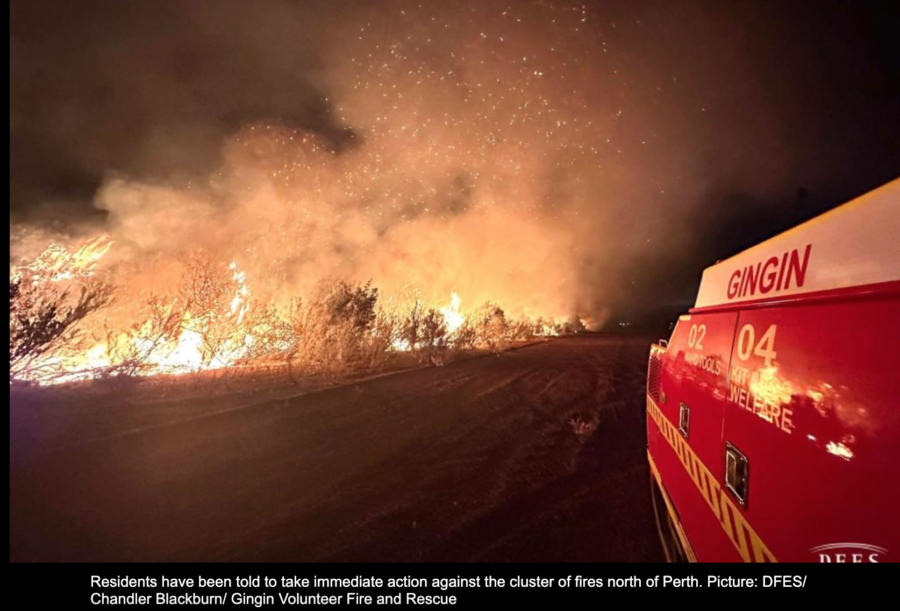
Gingin Volunteer Fire & Rescue
Photo by Chandler Blackburn, Gingin Volunteer Fire & Rescue
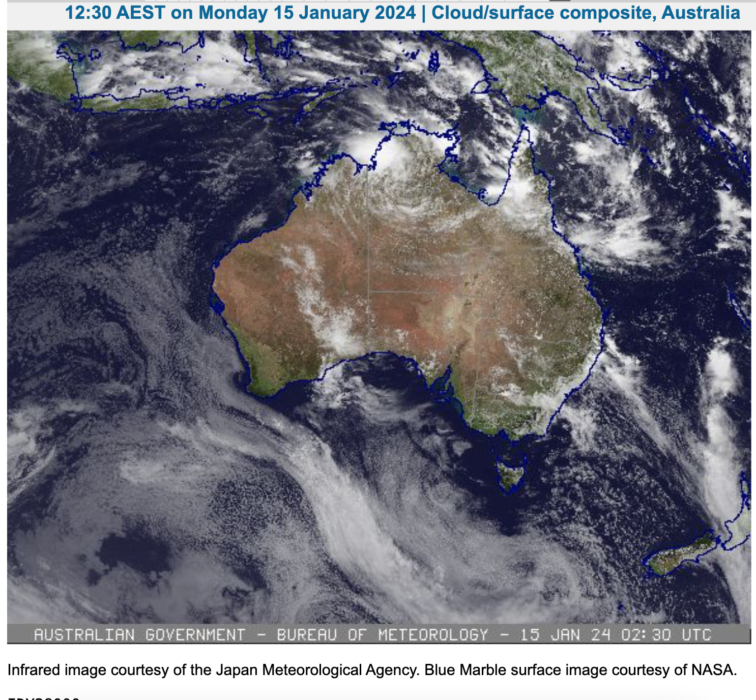
Infrared image, Australia, 15. January 2024
Residents were told to take immediate action with the cluster of fires north of Perth and were warned to either leave for safety — or take shelter in their homes if it’s not safe to evacuate. Residents not at home were warned to not try to return.

More than 200 firefighters and aviation support staff are fighting the cluster of fires in the Gingin and Chittering shires, and a severe heat warning indicated that temperatures were rising into the mid-forties (40°C = 104°F).

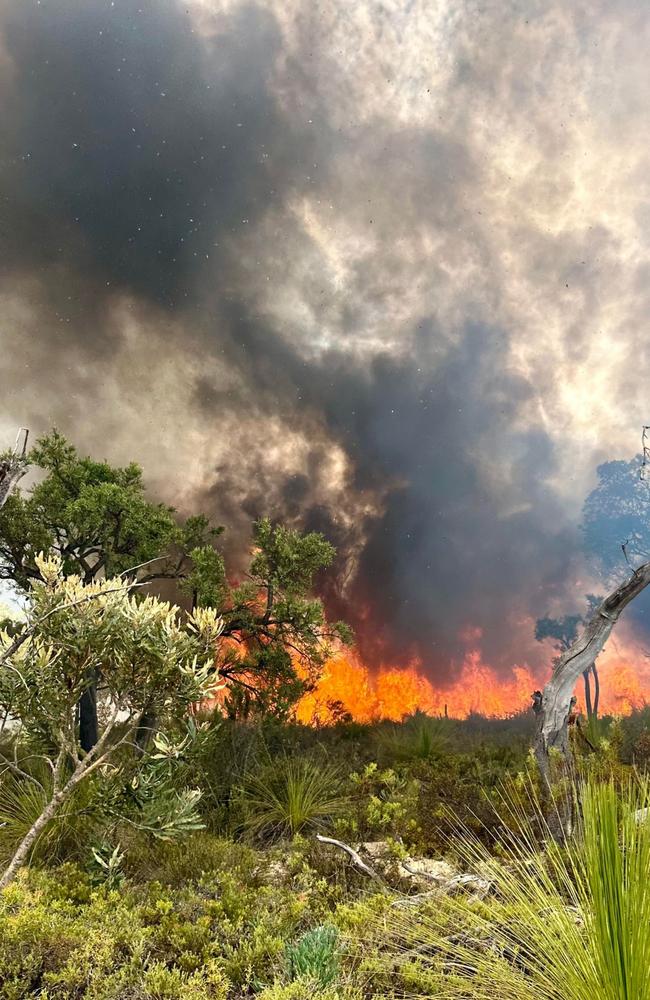
An emergency bushfire alert has been issued for residents just an hour away from Perth. Picture: DFES/ Nikki Woods/ Gingin Volunteer Fire and Rescue
Nikki Wood photo, DFES – Gingin Volunteer Fire & Rescue
An emergency bushfire alert has been issued for residents just an hour away from Perth, the Australian reports. Warnings were issued for Bambun, Coonabidgee, Breera, and Lennard Brooke. “There is a possible threat to lives and homes as a fire is approaching in the area and conditions are changing,” the DFES warned.

Bushfire-prone weather conditions are expected for the rest of this week, with a thunderstorm warning adding to the fire danger. The Bureau of Meteorology issued an extreme fire danger warning for the areas of Barrup and Blackwood with hot, dry and windy conditions increasing fire danger. Lightning and wind from thunderstorms in the South West Land Division could also ignite and exacerbate fires, and heatwave warnings were issued for much of Western Australia.

Australia leases new Bell 204B helicopter

Australia’s Green Triangle Fire Alliance (GTFA) has acquired on a 3-year lease a new Bell 204B firefighting helicopter. Equipped with a 1,250-liter bucket — about 330 gallons — the 204B carries more water than the B2 Squirrel hired by GTFA in 2022.

The Border Watch reported that the Green Triangle’s timber plantation companies are investing in firefighting upgrades to increase protection for plantation estates, the natural environment, and the community. The nine forest companies in the GTFA will fund operations for as-needed locations in the region. An investment into floating collar tanks was also made, supplying water to the helicopter in areas with limited surface water.

GTFA General Manager Anthony Walsh said the helicopter’s 1,250-litre bucket could draw water from a variety of sources. “This helicopter is highly complementary to the fixed-wing firebombers that operate in the region,” Walsh said.

According to AirMed&Rescue, the helicopter is registered as VH-EJL and owned by Forest Air Helicopters out of New South Wales. Forest Air Helicopters provides Australia-wide aviation services and is based on the NSW/VIC border at Albury.

The Green Triangle [PDF] region is on the southern coast, spanning the border between South Australia and Victoria. The GTFA includes a broad-based lumber industry and thus is susceptible to an above-average summertime fire risk.

Green Triangle Fire Alliance

The helicopter was contracted by the government of Victoria; it will come on as a part of the Victorian fleet, based in Casterton for the 14-week summer fire season — unlike other aircraft that are usually relocated as needed. “Other aircraft may leave the region to attend fires elsewhere across Victoria and South Australia,” explained Walsh, “but this helicopter will remain at its Casterton base for the 14-week service period until March.” It’s expected that the new Bell 204B will also operate in South Australia.

Is that risk map current? Depends on the state.

Colorado’s wildfire risk map was so inaccurate that state officials just about ignored it — for many years. The map was outdated, especially in western Colorado, where 3+ million acres of forest was covered in beetle-killed pines.

Carolina Manriquez, a lead forester with the state’s forest service, said they were supposed to use the state risk map, but they knew it was not accurate and therefore couldn’t rely on it. As the E&E News recently reported, an infusion of $480,000 in state funds resulted in a new Colorado map with updates including pine beetle damage and densely populated mountain towns.

Colorado wildfire risk viewer

Including 2017 and 2020, when annual wildfires burned more than 10 million acres, the last decade has marked some of the worst fire seasons in history. The risk is compounded by both climate change and growing wildland/urban interface areas, particularly in the West. Some states — including Colorado, Oregon, Utah, and Texas — have moved toward ensuring their fire risk information and maps are updated and more accurate, displaying areas of highest risk and most in need of prevention and mitigation.

“There is a slowly growing push among different states to do this,” said Joe Scott, founder of Pyrologix in Missoula. The firm provides utility wildfire risk assessment, catastrophe modeling, fuels treatment prioritization and management, and exposure analysis.

To improve wildfire risk maps, many states are partnering with firms such as Pyrologix that can build public-access display of fire risk data and conditions. Using satellite imagery, census information, and other data, advanced tools can  determine locations and ranges of ignition probability and fire intensity, along with threatened resource types. Gregory Dillon, director of the USFS fire modeling institute, says the state-specific maps are not a duplication of federal fire maps, but rather a more refined product.

The Kansas Forest Service unveiled in September its new wildfire risk explorer, a digital interactive map that provides a detailed look at statewide fire risk. The effort began in 2018 after several major wildfires including the 2017 Starbuck Fire, which burned some 500,000 acres and destroyed or damaged more than $50 million worth of livestock, fencing, and other resources.

“A lot of state-led efforts are trying to communicate to  communities and residents about the risk to private property or municipalities,” said Jolie Pollet, wildfire risk reduction program coordinator at the Department of the Interior.

That’s slightly different from federal mapping efforts focused on protecting federal lands, Pollet said. State-focused mapping can assess evacuation routes, encourage homeowners to reduce their  risk, and improve prepared applications for federal grants. State improvements such as those in Kansas also help forestry and fire officials allocate limited resources to focus on the highest priority areas.

Caldor Fire shooters won’t go to trial

A judge ruled last week that there is insufficient evidence to take to trial the men arrested for allegedly starting the 2021 Caldor Fire, which burned more than 221,000 acres south of Lake Tahoe, California.

David Scott Smith, 66, and his son Travis “Shane” Smith, 32, were arrested and charged with reckless arson in December 2021, months after the start of the fire. The two were accused of violating section 452 of the California Penal Code, commonly referred to as “reckless arson,” which causes inhabited properties to burn and results in great bodily injury to multiple victims. This charge can be filed against someone who unintentionally starts a fire. Both David and Travis were held on a $1 million bail, the district attorney’s office said. Both pleaded not guilty to the charges.

One firefighter was severely burned while assigned to the fire. Richard Gerety III of Patterson was on a four-person engine crew from West Stanislaus Fire when he fell into burning material. It was his tenth day on the fire. He suffered third-degree burns on his arms and hands and second-degree burns to his legs, said his wife, Jennifer Gerety.

Capital Public Radio reported that prosecutors said the two men started the fire “when a projectile discharged from a firearm and struck an object.” But El Dorado County Superior Court Judge Vicki Ashworth has ruled there was not enough evidence to move the case to trial. “As to reckless burning charges, the court found there was insufficient evidence to meet the legal requirements that the behavior was reckless,” said the El Dorado County District Attorney’s office.

The Caldor Fire burned for 67 days in El Dorado, Alpine, and Amador counties, destroying more than 1,000 structures and forcing 53,000 people from their homes. It was the second fire to burn across the crest of the Sierra Nevada in state history, the first being the Dixie Fire earlier in the summer of 2021.

The pair still face gun-related charges, Shane Smith for possession of a machine gun, and David Smith for possession of a silencer. They will be arraigned in February.

According to a CBS News report, the relevant law specifically states that a defendant’s behavior must be “reckless as defined in Penal Code section 450, requiring that an individual knows their actions present a substantial and unjustifiable risk but consciously disregards that risk.” Prosecutors said they showed evidence that David and Thomas Smith drove out of a location where the Caldor Fire started, and they were shooting a gun on a day with dry conditions.

The USFS determined a bullet strike was the probable cause of the fire. Travis Smith will be arraigned on February 2 for possession of a machine gun, and David is scheduled to be in court the same day for arraignment on a charge of possessing a silencer.

Will firefighters EVER get the pay cap removed?

A bill in the U.S. Senate to remove overtime pay caps for wildland firefighters, according to a report by Arizona Public Radio, might remove that cap, after many years of arguing whether fire crews receive  overtime pay when they work overtime hours. Federal crews in both the DOI and the USDA face annual limits on the number of hours of overtime they can work — but they often exceed those limits, and it’s become more of an issue as fire seasons become longer with bigger fires.

Riva Duncan, the vice president of Grassroots Wildland Firefighters, explains that the group has endorsed this legislation. “However, we’ve also highlighted the gaps it does not address,” she says. “While we support lifting this pay cap, the reality is it affects only a few of those at the highest levels (GS-13 and above) engaged in fire management. I spent several years as a Forest Fire Chief and Deputy (GS-12 and GS-13) on high complexity national forests with long, complex fire seasons, and I never hit the cap. But I do know this affects many ICs who are GS-13 or higher — on IMTs as well as NIMO personnel — and it also affects some agency administrators. We believe those folks deserve to be paid for the work they’re doing and the sacrifices they make.”

Duncan explains that this legislation does not lift the biweekly pay cap for hazardous work that’s not officially deemed “emergency,” which  thousands of wildland firefighters and support personnel engage in. “This includes prescribed fire, blowdown cleanup (operating chainsaws in extremely dangerous conditions), and other day-to-day hazardous work such as falling dead trees in campgrounds. Employees earn hazardous duty pay on wildland fires, and on some all-hazard incidents such as hurricanes, but this pay is not authorized by policy for ‘non-emergency’ work.  It is important to acknowledge that while these changes can be accomplished through legislative solutions, it is well within the administrative power of the USFS, OPM, OMB, and the DOI agencies to provide these commonsense solutions for the actual boots on the ground. We challenge the agencies to find the courage to work together on this critical reform, just as firefighters find the courage to do their jobs every day.”

According to bill sponsor Sen. Kyrsten Sinema, the Wildland Firefighter Fair Pay Act would ensure firefighters receive the overtime time pay they’re owed. The USFS says up to 500 supervisors either stop working or work on without pay when they reach the pay cap each year.

Back in November, Senator Alex Padilla (D-Calif.) and Representative Zoe Lofgren (D-Calif.) introduced legislation to permanently raise caps on overtime pay for federal firefighters. The bill would increase the pay caps to compensate federal wildland firefighters for their service. The legislation is cosponsored by Senators Steve Daines (R-Mont.), Martin Heinrich (D-N.M.), Ben Ray Luján (D-N.M.), Catherine Cortez Masto (D-Nev.), Jacky Rosen (D-Nev.), and Jon Tester (D-Mont.).

“As increasingly devastating wildfire seasons scorch our forests and endanger communities across the West, our federal wildland firefighting force deserves our full support,” said Senator Padilla. “The overtime pay caps force firefighters to make an impossible choice: walk off the line or work for free. This legislation is a necessary step to make sure they get fair compensation.”

One of the 2020 fires overran the ICP established to fight one of western Oregon's many wildfires.

In mid-November the House passed an amendment to extend a temporary pay increase of $20,000 (annually per firefighter) through next year, which was approved by President Biden. Another bill to make a pay hike permanent remains stalled, though, and NPR’s Morning Edition reported that this latest budget deal averting a federal  shutdown will also — for now — avert a massive pay cut for federal firefighters.

“Federal wildland firefighters perform dangerous, back-breaking jobs protecting our communities. Yet after they reach pay caps, they receive no overtime pay for the additional hours they work,” said Representative Zoe Lofgren. “This commonsense legislation will strengthen the  workforce and ensure firefighters receive the overtime pay they deserve.” In mid-November, Government Executive reported that the House and then the Senate — and yet again, at the last minute — passed short-term resolutions to avoid a government shutdown and pay employees on time.

But most agencies are funded only through February 2 and some — Veterans Affairs, Agriculture, Energy, Transportation, and Housing and Urban Development (plus construction projects for Defense) will remain at fiscal 2023 funding levels until January 19.

Gray Fire 08/19/23
Gray Fire 08/19/2023 — WSDOT photo

Despite risking their lives and traveling cross-country for months at a time to fight wildfires, many of the 11,000+ federal firefighters live paycheck to paycheck, working overtime hours without overtime pay. This inequity has contributed in a major way to a firefighter workforce shortage — in both recruitment and retention. Something like 20 percent of Forest Service permanent firefighter positions are vacant, and the federal government cannot — or won’t choose to — compete with pay rates  offered by state and local agencies.

Three years ago, Bill Gabbert wrote that Diane Feinstein had introduced the Wildland Firefighter Pay Act, a bill that would raise the maximum limit on overtime pay for federal firefighters. The limit at that time affected higher level employees at the GS-12 and above level, along with  some GS-11s depending on whether they were exempt from provisions in the Fair Labor Standards Act. Under those provisions, if they worked  hundreds of hours of overtime they might reach the cap, after which they earn no more money. In some cases later in the fire season, employees who spent a long season fighting fires were told they’d earned too much and were forced to pay some of it back.

Chris Pietsch shot of Erickson Aircrane on western Oregon's 2023 Bedrock Fire.
Chris Pietsch with the Register-Guard in Eugene caught this superb shot of an Aircrane working the Bedrock Fire, 2023 in Oregon.

Proposed legislation in 2021 would have eliminated the annual and pay period limits and created a new limit that set the maximum annual pay including overtime at Level II of the Executive Schedule, which in 2020 was $197,300.

The USFS estimated then that up to 500 senior-level firefighters either stop participating or do not request pay for hours worked once they reach the cap. This has a huge effect on wildfire response capabilities.

Oregon wineries suing PacifiCorp for 2020 wildfires

After a Lane County Circuit Court judge in Oregon denied PacifiCorp’s motion to dismiss the negligence claims back in December, KOIN-TV reports that a Willamette Valley winery is wanting accountability from utility companies after the devastating 2020 Labor Day fires.

Brigadoon Vineyards filed in June 2023 with negligence charges against Pacific Power — and its parent company PacifiCorp. KGW-TV reported last week that several vineyards in the Pacific Northwest have sued the utility company, claiming that the utility company’s  powerlines started some of the 2020 Labor Day fires, which tainted grape crops at numerous wineries with smoke wafting over Northwest vineyards during and after the 2020 firestorm.

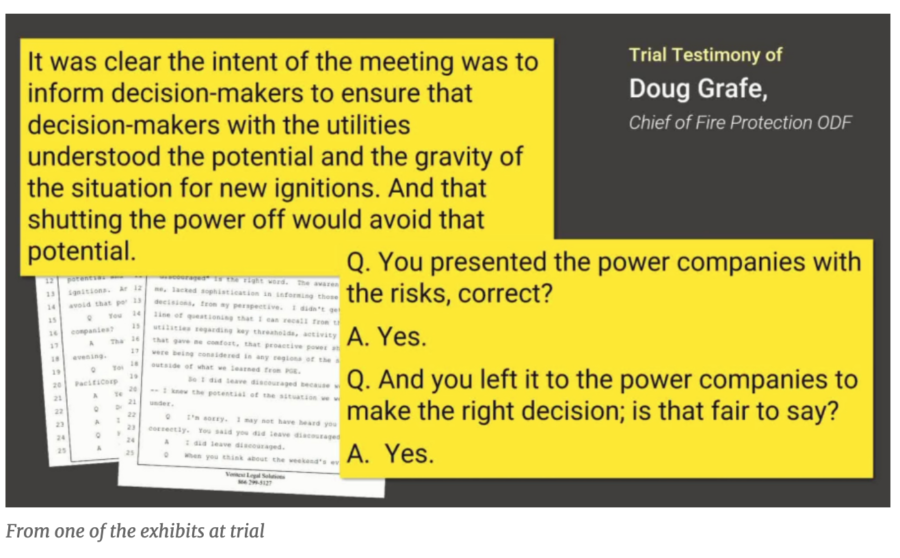
“It boggles the mind that they had an opportunity to turn off the power and they didn’t do it.”

Brigadoon argues in court that the Labor Day fires — the Santiam, Echo Mountain, Archie Creek Complex, 242, and South Obenchain  fires in western Oregon in 2020 — resulted from PacifiCorp’s electrical system failures and the utility’s decisons to not de-energize its powerlines — caused smoke to taint the winery’s grapes, which crippled wine production and the winery’s sales.  Multiple lawsuits filed by Willamette Valley vineyards and wineries against PacifiCorp, the parent company of electric utility Pacific Power, will proceed in court after several recent rulings. Attorneys for the winemakers plan to get other affected  businesses on board with the legal action.

Elk Cove Vineyards, Willamette Valley Vineyards, and Brigadoon Winery thus far are just three of the affected winemakers to sue PacifiCorp individually. The complaints were filed separately but are all substantively similar  — they each allege that PacifiCorp equipment failures ignited several of the Labor Day fires of 2020, and that the smoke from those fires then damaged grapes, the grape harvest, and wine sales for the wineries. Complainants are seeking almost  $16 million in damages.

Oregon vineyards

KOBI5 recently reported that Elk Cove Vineyards, Willamette Valley Vineyards, and Brigadoon Winery are just three of the winemakers to sue PacifiCorp so far, alleging that the power company’s lines, which they chose to not de-energize, started some of the 2020 fires that tainted or ruined the vineyards’ grape crops with heavy and longterm smoke.

Lawsuits from the 2020 Labor Day weekend fires have already cost PacifiCorp more than $73 million. Brigadoon Vineyards says PacifiCorp decided to not shut off power despite warnings from the National Weather Service and Oregon officials that a “historic red-flag-warning weather event would occur, producing catastrophic winds in excess of 50 mph, and hot dry air that was likely to cause electrical system failures that would cause dangerous fires.”

courtroom exhibit in the PacifiCorp trial

Brigadoon Vineyards says they were unable to sell wines to the public at their regular price — if at all –and the winery claims that it lost retail shelf spaces and also suffered reputational damage, which may take 5 to 7 years to recoup after the fires. Brigadoon is just one of several wineries, including Willamette Valley Vineyards, suing PacifiCorp for damages from the 2020 Labor Day fires.

Willamette Valley Vineyards

“Our grapes were just in the process of ripening at that time. And so many of the growers in the wineries were not able to use significant amounts of fruit they had grown,” said Jim Bernau, the founder of Willamette Valley Vineyards.