
The lightning-caused fire has burned over 32,000 acres eight miles northwest of Wheatland, Wyoming
Continue readingFour of Neptune’s BAe-146 air tankers are deployed

Another five are at Missoula, MT and Alamagordo, NM
Continue reading2017 was a busy year for air tankers

In spite of that, the numbers of air tankers and helicopters are being slashed
Continue readingTanker 170 debuts at Aerial Firefighting Conference

It has a CWN contract but still needs to take a grid test and be approved by the Interagency Airtanker Board.
Continue readingVideo of multiple air tankers working the Liberty Fire near Murrieta, CA

Above: The Liberty Fire east of Murrieta, California, December 7, 2017. Screengrab from the KTLA video.
(Originally published at 7 p.m. PST December 7, 2017)
KTLA shot some excellent stabilized video from a helicopter Thursday of the Liberty Fire that has burned about 300 acres northeast of Murrieta, California. This is a new fire that erupted this afternoon 17 miles north of another new fire, the Lilac Fire south of Temecula which was 3,000 acres at 7 p.m. PST.
The video, which is almost 2 hours long, has at least 8 shots of air tankers dropping. We skimmed through it quickly and noted where the drops occur, probably missing a few.
13:00 – DC-10
17:00 – BAe-146/C-130
35:30 – C-130
38:35 – BAe-146
49:15 – S-2
1:05:00 – MAFFS
1:30:00 – 747
1:40:20 – MAFFS
Air Spray and Coulson to roll out additional air tankers
Both companies expect to introduce new air tankers in the next few months.
Continue reading18 BAe-146/RJ85 air tankers expected to be operational this year

Above: T-10 (a BAe-146), another BAe-146, and an RJ85 (center) at La Grande, OR. Photo by Josh Annas.
The number of RJ85 and BAe-146 air tankers continues to grow. According to BAE Systems there are likely to be 18 of the aircraft that are operational by later this year and there are four more in various levels of conversion.
The two quad-jet aircraft are similar — both are made by BAE — and can carry up to about 3,000 gallons of retardant utilizing gravity to empty the tanks.
During the 2016 wildfire season the 14 in-service BAe 146-200s and Avro RJ85s of Neptune Aviation and Conair/Aero-Flite flew a combined total of over 5,800 tanker missions, dropping in excess of 12.5 million gallons of retardant.
A further eight BAe 146/Avro RJs are under conversion, with four scheduled to enter service during 2017.
Neptune Aviation’s fleet of seven BAe 146s flew a total of 2,880 hours on airtanker operations in the United States and Canada. Dan Snyder, Neptune’s Chief Operating Officer explained: “We are a US national resource. Wherever the US Forest Service has the need or request we can and do get dispatched”.
He added: “The yearly utilization average per aircraft varies greatly from year to year based on the fire season. Some years it is 200 hours per aircraft; others it can be 400 hours per aircraft. Fire operations in a day vary greatly as well. Some days there are no flights; some days only one. Sometimes it can be up to 10-15 missions a day. The distance to the fire, weather, and fire activity all affect this number.”
Seven of Neptune’s BAe 146s are under Exclusive Use Contracts with the USFS, along with four P2V Neptunes. An additional BAe-146 is contracted to CAL FIRE in California.
More recently, one of Neptune’s BAe 146s was on an assignment in Chile for several weeks.
Neptune has acquired and is converting a further two BAe 146-200s into airtankers to be ready for this year’s fire season.
Conair of Abbotsford, Canada, and its US subsidiary Aero-Flite, has a total of seven Avro RJ85s in service as airtankers, with an eighth aircraft under conversion ready for the 2017 fire season.
Four of Conair/Aeroflite’s RJ85s are earmarked for the 2017 Exclusive Use Contract with the USFS.
Jeff Berry, Conair’s Director of Business Development, stated that by early November the seven in-service aircraft had flown more than 430,000 km in support of wildfire operations on hundreds of fires in the United States and Canada during 2016. He added: “That is equivalent to a distance greater than 10 times around the world and the volume of retardant delivered to control wildfires was greater than the volume of six Olympic swimming pools.”
In addition, one of Conair’s RJ85s was recently deployed during the down under summer under contract to the State of Victoria to help in suppressing bushfires.
The back story: How the deployment of U.S. air tankers to Chile happened

Above: The 747 Supertanker being reloaded at Santiago, Chile, January 28, 2017. Photo by Bill Gabbert.
In January and February two large air tankers traveled from the United States to South America to assist firefighters in Chile that were dealing with an unprecedented number of wildfires. Global SuperTanker’s 747 left Colorado Springs on January 24 and returned on February 13. A BAe-146 operated by Neptune Aviation was down there from about February 4 to March 5.
As far as I know this is the first time that any large air tankers from North America have assisted with wildfires in South America. One limiting factor is that up until recently most of the U.S. air tankers were former military aircraft which were not allowed to be used outside the country. With the industry converting to used civilian airliners and cargo aircraft that restriction does not apply to the newer privately owned aircraft.
In January, 2017 I had been following the increased wildfire activity in Chile and had written about it several times on Wildfire Today. Here is an excerpt from an article published on January 3, 2017:
Wildfire burns 100 homes in Chile
On Monday a wildfire burned approximately 100 homes in Valparaiso, Chile. There are reports that 19 people were injured and hundreds were forced to evacuate. The fire was fought by firefighters on the ground assisted by [single engine] air tankers and helicopters dropping water.
Pushed by strong winds it burned about 120 acres of vegetation 75 miles northwest of Santiago.
An air tanker pilot was killed December 28 while working on a fire in the Bío Bío region.
And later, three wildland firefighters were killed January 15 while battling a fire in the commune of Vichuquén, Maule Region of Chile.
But the fires in Chile were receiving very little notice in the mainstream media in the U.S.
Eduardo Frugone, who is kind of a mysterious person in Chile with many connections, read the articles on Wildfire Today and Fire Aviation about the fires in his country and the fatal air tanker crash. I had never heard of him, but on January 18 he sent me an email message through the Contact Us page on Fire Aviation that read, in its entirety:
“We need fire figthing [sic] planes to fly to Chile, need to know if your company can establish contacts right away.
Stand by.”
I, of course, do not have any air tankers, but I forwarded his message to air tanker companies that I thought might have some available. Selecting the companies was a pretty quick decision that I didn’t want to spend a lot of time on. I figured the chances of the person that contacted me having any influence in deploying North American air tankers to South America was very, very slim. As far as I knew the paradigm of contracting for air tankers was limited to federal, state, or provincial governments, not a random person who only had links to private companies in his automatic email signature. So I didn’t want to waste the time of every air tanker company in the world.
I did not contact any company that I knew had 100 percent of their tankers committed to Australia. And I limited the short list to companies that had deployed air tankers on fires in 2016, or that I knew had recently received certification from the Interagency Air Tanker Board, and that I knew how to reliably contact. Not all air tanker companies will return my phone calls or respond consistently to my emails.
I forwarded the email to 10 Tanker Air Carrier, Neptune Aviation, and Global Supertanker. I wrote to them, “I don’t know if this is legit or not, but it might be an opportunity to use your aircraft in Chile.” Two of those companies, Global Supertanker and Neptune, followed up.
So, Eduardo got the ball rolling, through Wildfire Today.
What followed, in the case of Global Supertanker, were eight days of phone calls, email messages, and negotiations.
During the week of January 22 an heir to the Walmart fortune in Denver, Ben Walton with his wife Lucy Ana, got involved. She grew up in Chile and still maintains very strong ties to the people and the country. They have used their foundation in recent years to help the residents in her homeland. In 2016 the foundation helped arrange for $1.5 million worth of medical supplies to be sent to hospitals and rural clinics in Chile. And they also rebuilt a school after it was destroyed by the earthquake and resulting Tsunami in Chile a few years ago.
 Lucy Ana Walton and Ben Walton, (left) receive a briefing on the 747 Supertanker, January 23, 2017. Jim Wheeler is on the right. Photo by Bill Gabbert
The Waltons had been following the escalating fire situation in Chile and were familiar with my web sites, Wildfire Today and Fire Aviation, after I had written about wildfires in Colorado. They knew the 747 Supertanker was based in Colorado Springs just an hour south of their Denver home.
In discussions with Jim Wheeler, President and CEO of Global Supertanker, they offered to have their foundation, Foundación Viento Sur, provide the funds for the 747 to ferry to Chile and back, and for five days of firefighting in Chile. They hoped that after they saw the effectiveness of the aircraft, the government would retain the services of the air tanker for as long as it was needed .
Working out the details with the foundation, the Chilean government, and Global Supertanker was a complex procedure that took a while. Ben and Lucy Ana visited Global SuperTanker’s Colorado Springs facilities on June 23 and received a briefing on the use and capabilities of the aircraft. Ben has some pilot training and both of them, but especially Lucy Ana, were very enthusiastic about its 19,200-gallon capacity and its potential to assist the residents of Chile.
 Lucy Ana Walton in front of one of the 747’s engines at Colorado Springs, January 23, 2017. Photo By Bill Gabbert.
Attorneys in the U.S. and Chile got involved, and finally late Tuesday morning, January 24, the flight crew received the GO order and departed for South America at about 1:40 p.m. MST.
Mr. Wheeler offered me one of the 12 seats on the 747 for the trip south, and I accepted and became embedded with the crew. I returned on my own February 5 and the aircraft flew back to Colorado Springs nine days later.
Eduardo Frugone, who initially came up with the concept for the deployment of North American air tankers to Chile, helped to facilitate the missions before and during the assignment in exchange for a salary.
The Chilean government was very reluctant to bring in aircraft from outside the country, possibly because they had existing contracts with European companies for single engine air tankers. Questions have been raised about irregularities related to the activities of those companies in Europe and an investigation is underway now in Chile about procedures, before this year, about the acquisition of firefighting aircraft.
Chile is also considering the creation, for the first time, of a “Forest Service”-type agency that would assume the role of coordinating wildfire suppression, a task that presently is done by CONAF, a private, non-profit organization funded by the government and responsible for initiating air tanker contracts.
Helicopter mobilized from the showroom floor of convention
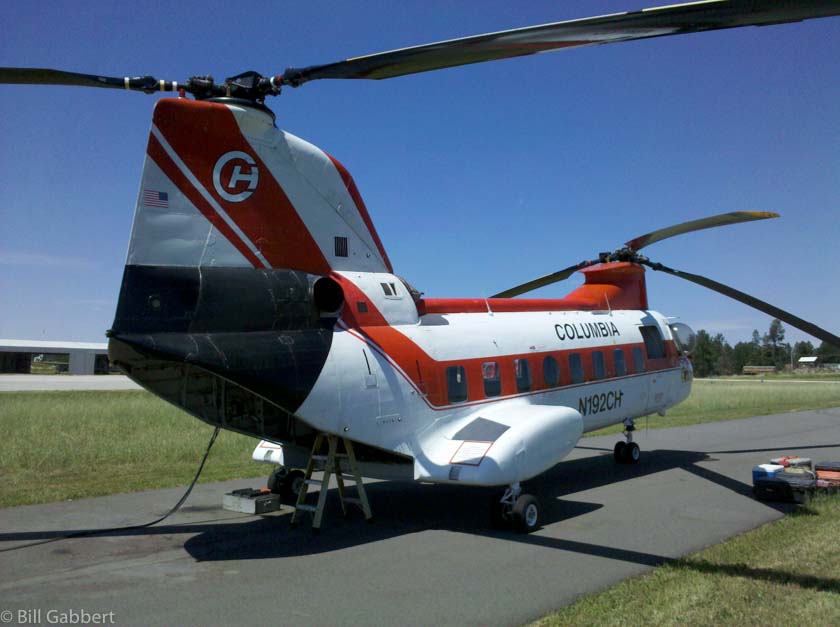 File photo of a Columbia BV-107 at Custer, SD July 31, 2011. Photo by Bill Gabbert.
In an effort to mobilize a Type 1 helicopter they contacted Columbia Helicopters who had one on display at a helicopter convention.
“This is the first time we have received a resource order for firefighting duty, while displaying our helicopter at a convention,” said Keith Saylor, Director, Commercial Operations, for the Portland, Oregon-based company. Reached by phone at the Helicopter Association International (HAI) convention in Dallas, Saylor explained that transitioning the helicopter, from a static display to a mission-ready firefighting aircraft, involved removing the rotor blades, exiting the convention center, then reinstalling the rotor blades. This was followed by a flight to a nearby airport for refueling and overnighting. Called up on March 9, the helicopter was deployed the following day to Ardmore, Oklahoma, under an optional use clause of a US Forest Service (USFS) exclusive use contract. The helicopter was dispatched with two pilots, five mechanics and ground support equipment drivers.
A former US Army-operated CH47D Chinook, the helicopter was modified by Columbia Helicopters with a 2,800 gallon capacity internal tank for water, jells, foam, or retardant dropping, and had been flown to the convention following firefighting duty on East Coast fires.
Also responding to the fires, Neptune Aviation Services dispatched three of its BAe-146 air tankers to multiple locations, according to Dan Snyder, Chief Operating Officer for the Missoula, Montana-headquartered company. Three of the tankers were dispatched from Missoula between March 9 and 11, and flown to USFS tanker bases in Ardmore, Oklahoma, Abilene, Texas, and the Rocky Mountain Regional Airport, near Denver, Colorado. A fourth BAe 146 tanker will continue to fly out of a base at Lake City, Florida, where it has been on duty since February 20.
On March 16 Neptune mobilized T-05, the first of their P2V piston engine tankers to start an assignment this year, which will probably be the model’s last season as the company completes their transition to the jet-powered BAe-146 airframe.
Firefighters are still busy in Chile

Above: Tanker 03, a BAe-146, in Chile. Neptune photo.
(This article first appeared on WildfireToday.com)
The number of active wildfires in Chile has varied from week to week depending on the weather, but the drought-driven situation that has plagued Chile since December is still of great concern to the residents of the country — especially since more than 1,000 homes burned in Santa Olga on January 25.
The tweet below refers to a fire in the Maule Region.
URGENTE: Está quedando la grande nuevamente en la region del maule con los incendios
Que #Viña2017 no tape esto por favor
San Ramón Parral pic.twitter.com/AbgqB0k6UQ— TuiteroSismico (@dngonzalo) February 22, 2017
The 747 Supertanker returned to Colorado Springs on February 13 after being in Chile for three weeks. The Russian IL-76 is still there but is expected to depart on February 25.
Neptune’s Tanker 03, a BAe-146, arrived in the country February 4. It has completed 20 missions dropping on fires, but a spokesperson for the company told us today it has not flown since February 14. It is committed to remain in Chile through the end of this month.

