
And, more details about the new Call When Needed contracts
Continue readingNot your ordinary parade float
 Neptune Christmas parade float. Neptune photo.
This photo was taken December 7 on South Higgens Avenue in Missoula, Montana. It was sent to us by Kevin McCann of Neptune Aviation who said it was designed and constructed this year by a group of very talented Neptune Aviation employees and volunteers.
It’s quite an engineering feat!
Thanks Kevin.
13 large air tankers under contract for 2019
Currently six of them have been activated
Continue readingFour of Neptune’s BAe-146 air tankers are deployed

Another five are at Missoula, MT and Alamagordo, NM
Continue readingSix P2V air tankers’ last deployment — to retirement homes

The aircraft are going to their final resting place 71 years after the model was first introduced to the U.S. Navy.
Continue reading2017 was a busy year for air tankers

In spite of that, the numbers of air tankers and helicopters are being slashed
Continue readingNews from the Aerial Firefighting conference in Sacramento, Part Two

Above: Ron Hooper, CEO of Neptune Aviation
Earlier we posted Part One of a few notes that I scribbled in a notebook at the Aerial Firefighting conference in Sacramento this week. Here is Part Two.
Neptune Aviation
Ron Hooper, CEO of Neptune Aviation, said their air tankers in 2016 averaged 180 hours while working on wildfires. In 2017, a very busy year, that number increased to 276. Their P2V’s have retired from firefighting, leaving the company with nine air tankers, all BAe-146’s.
No one outside the U.S. Forest Service knows when the agency will issue the next round of exclusive use and call when needed next-generation air tanker contracts, affectionately called Next-Gen 3.0. When forced to guess, Mr. Hooper said the aircraft receiving those new contracts may not be activated until 2019. He may know more than most, since his former job was supervising air tanker contracting for the FS.
Phos-Chek
One of the major suppliers of fire retardant, Phos-Chek, is changing hands again. In a matter of days its parent company will be Perimeter Solutions. But as in the previous four iterations it will retain the brand name Phos-Chek.
Here is the product’s history of parent companies:
1963-1997: Monsanto
1997-2000: Solutia
2000-2005: Astaris
2005-2018: ICL
2018- ???? : Perimeter
Global Supertanker
 L to R: Bob Soelberg and Jim Wheeler of Global Supertanker
Jim Wheeler, CEO of Global Supertanker Services, said the company currently has CWN contracts with CAL FIRE and two counties in Colorado — Douglas (just south of Denver) and El Paso (Colorado Springs). Other pending contracts that they hope to sign later will be with the states of Colorado, Texas, and Oregon.
Colorado
 Vincent Welbaum, Colorado’s Aviation Unit Chief
, said they are talking to vendors and expect to award a call when needed contract to at least one vendor that can supply large or very large air tankers. The state has been operating their own two Pilatus PC-12 Multi-mission aircraft for several years, using it to detect and map wildfires.
Colorado will have two Single Engine Air Tankers on exclusive use contracts supplied by CO Fire Aviation and Aero Seat as well as four other vendors on call when needed contracts. The state will also have two Bell 205’s on exclusive use contracts.
Helimax
 Pat Pilolia, of Helimax
Helimax Aviation is one of two subsidiaries of Heligroup Holdings. The other is CHI at Howell, Michigan which concentrates on heavy lift, while Helimax, at Sacramento McClellan Airport is in involved in aerial firefighting. Helimax recently sold all of their Type 2 helicopters, and now have six Type-1’s, Chinook CH-47D’s.
MAFFS Group
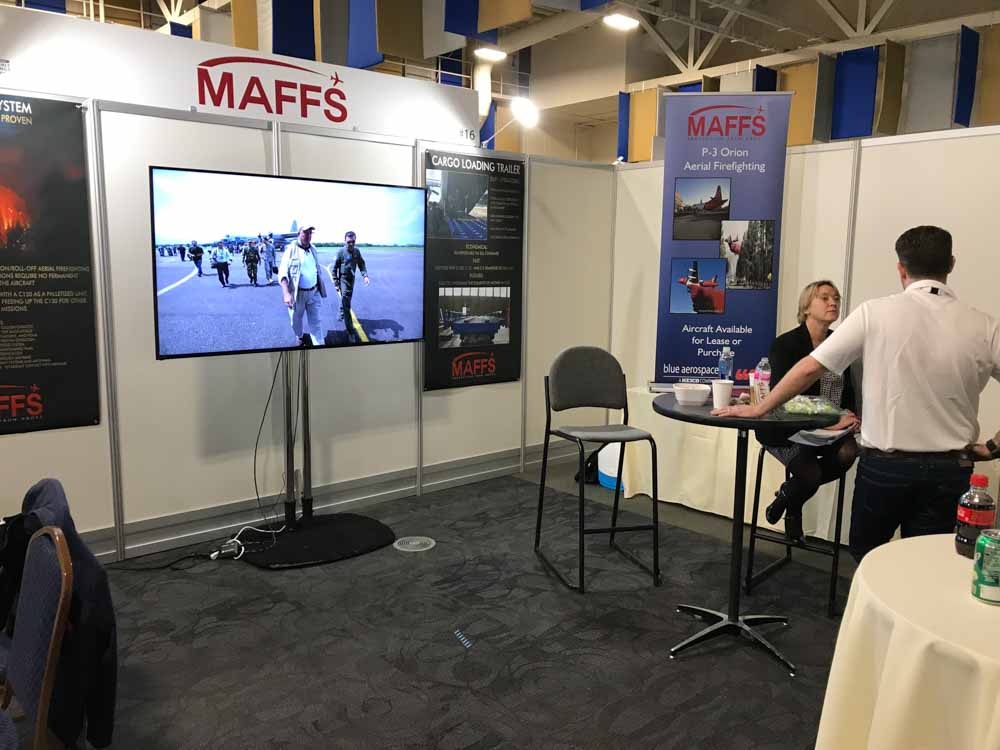 Bradford Beck, COO of MAFFS Group said the company recently sold a MAFFS II system to the Tunisia Air Force in Northern Africa. The country has operated two of the original versions of the MAFFS for 10 to 15 years. They will continue to operate the MAFFS I systems on a C-130B and will use a C-130H for the new MAFFS II which will be delivered in the third quarter of this year. The most challenging wildfires in Tunisia occur in the Atlas mountains.
This is the second MAFFS II that the MAFFS Group has sold. The first is now being used in Columbia, South America.
Viking Air
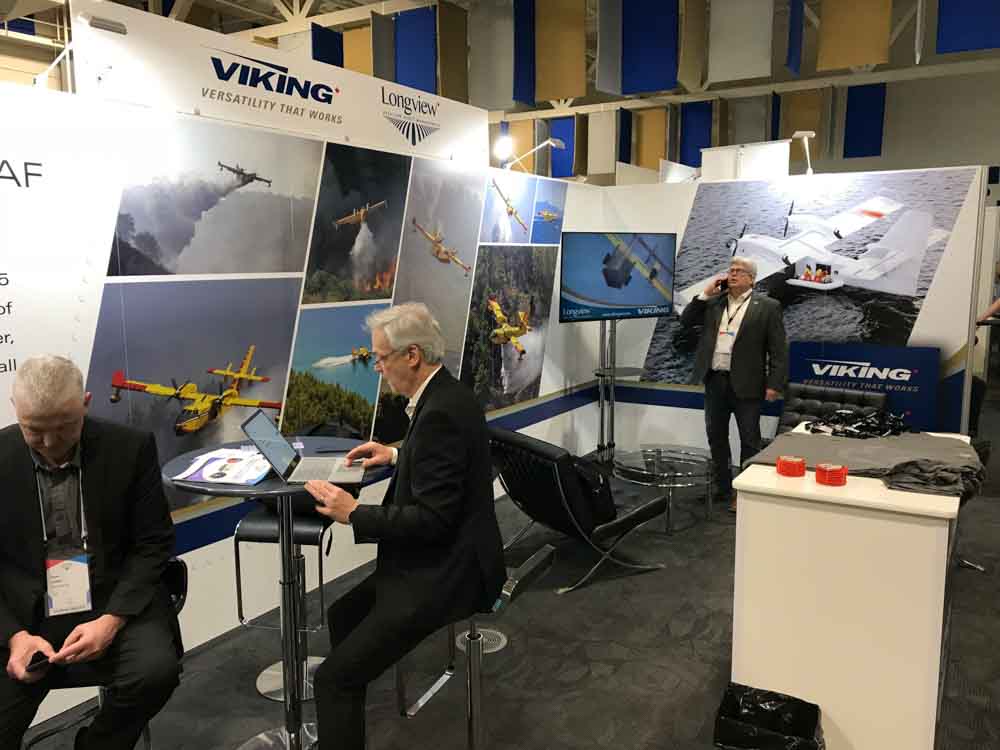 The Viking Air display at the conference.
Viking Air director of Special Projects, Sales, and Marketing Christian Bergeron said the company is currently gathering information from potential customers about what they would like to see on a new version of the CL-415 water scooping air tanker. The company expects to decide by the third quarter of this year if they will proceed with the project, which will be named CL-515. At this stage, Mr. Bergeron said, they expect it to have a larger cargo door, glass cockpit, updated avionics, and will be able to land with a full load of water. Available options will include an infrared camera system and night vision compatibility. Viking’s manufacturing facility is in Calgary, Canada.
Neptune retires their P2V air tankers

Spectators in Missoula enjoyed seeing water drops and flyovers.
Continue readingTanker 10 assumes a place of honor at Missoula Airport

Neptune’s Tanker 10 set up at it’s new home at the entrance of Missoula Airport. Neptune photo.
Today Neptune Aviation moved their retired Tanker 10, a P2V, to a place of honor at the Missoula International Airport.
“Tanker 10 is a firefighting tanker that we retired,” Neptune spokesperson Kevin Condit said. “It will now be the gate guard at the Missoula International Airport. Neptune and the Missoula aviation community have a very long history, and with the Smokejumpers and the Forest Service in Missoula, they asked Neptune Aviation if Tanker 10 could be the gate guard.”
 Neptune’s Tanker 10 in the process of being moved to the entrance of Missoula Airport. Neptune photo.
The retiree was towed by a tug today from Neptune’s ramp to a spot at the airport entrance.
The staff at Neptune has been preparing the aircraft for several months, refurbishing it, removing the reusable avionics, giving it a new paint job, and making it animal and wind resistant.
It was built in 1957 and served in the U.S. Navy with other P2V’s as a maritime patrol and anti-submarine warfare aircraft. The P2V’s were eventually replaced by the Lockheed P-3 Orion.
Thanks and a tip of the hat go out to Steve.
Typos or errors, report them HERE.
18 BAe-146/RJ85 air tankers expected to be operational this year

Above: T-10 (a BAe-146), another BAe-146, and an RJ85 (center) at La Grande, OR. Photo by Josh Annas.
The number of RJ85 and BAe-146 air tankers continues to grow. According to BAE Systems there are likely to be 18 of the aircraft that are operational by later this year and there are four more in various levels of conversion.
The two quad-jet aircraft are similar — both are made by BAE — and can carry up to about 3,000 gallons of retardant utilizing gravity to empty the tanks.
During the 2016 wildfire season the 14 in-service BAe 146-200s and Avro RJ85s of Neptune Aviation and Conair/Aero-Flite flew a combined total of over 5,800 tanker missions, dropping in excess of 12.5 million gallons of retardant.
A further eight BAe 146/Avro RJs are under conversion, with four scheduled to enter service during 2017.
Neptune Aviation’s fleet of seven BAe 146s flew a total of 2,880 hours on airtanker operations in the United States and Canada. Dan Snyder, Neptune’s Chief Operating Officer explained: “We are a US national resource. Wherever the US Forest Service has the need or request we can and do get dispatched”.
He added: “The yearly utilization average per aircraft varies greatly from year to year based on the fire season. Some years it is 200 hours per aircraft; others it can be 400 hours per aircraft. Fire operations in a day vary greatly as well. Some days there are no flights; some days only one. Sometimes it can be up to 10-15 missions a day. The distance to the fire, weather, and fire activity all affect this number.”
Seven of Neptune’s BAe 146s are under Exclusive Use Contracts with the USFS, along with four P2V Neptunes. An additional BAe-146 is contracted to CAL FIRE in California.
More recently, one of Neptune’s BAe 146s was on an assignment in Chile for several weeks.
Neptune has acquired and is converting a further two BAe 146-200s into airtankers to be ready for this year’s fire season.
Conair of Abbotsford, Canada, and its US subsidiary Aero-Flite, has a total of seven Avro RJ85s in service as airtankers, with an eighth aircraft under conversion ready for the 2017 fire season.
Four of Conair/Aeroflite’s RJ85s are earmarked for the 2017 Exclusive Use Contract with the USFS.
Jeff Berry, Conair’s Director of Business Development, stated that by early November the seven in-service aircraft had flown more than 430,000 km in support of wildfire operations on hundreds of fires in the United States and Canada during 2016. He added: “That is equivalent to a distance greater than 10 times around the world and the volume of retardant delivered to control wildfires was greater than the volume of six Olympic swimming pools.”
In addition, one of Conair’s RJ85s was recently deployed during the down under summer under contract to the State of Victoria to help in suppressing bushfires.