Report released on Schoolhouse Fire ATV fatality

position of ATV after accident

The U.S. Forest Service has released a “Learning Review Report” for the All Terrain Vehicle (ATV) accident on the Schoolhouse Fire in New Mexico that killed firefighter Token Adams. You may have followed the search for Mr. Adams, who was missing for a week before his body was found on September 6, 2013.

The report is very well written and appears to discuss in detail numerous issues directly and indirectly related to the accident. It does not use, like the first Yarnell Hill Fire report, dozens of the latest in-vogue buzz words that are in fashion this week in the human behavior community. (It only uses a few.) The report covers real issues that firefighters, and especially firefighters who operate ATVs, can relate to.

It does not place blame on anyone, and from the evidence presented, this seems appropriate, in that no one really made any serious mistakes that would normally have been avoided. All of the required personal protective equipment, training, and qualifications were in place.

The accident occurred as Mr. Token was searching for a reported fire on an ATV, as he attempted to go up a short 30 percent grade, a slope easily traversed on an ATV. A tire slipped on a rock that may have been partially hidden by pine needles, causing the center of gravity to shift. The ATV began to roll, causing Mr. Token to either jump or fall off. The ATV rolled over Mr. Token, hit a tree and then settled back on him. The rear cargo rack landed on his neck, impacting just below his full-face helmet, and he died instantly.

The video below uses some surprising techniques to illustrate how the accident occurred.

Two items listed in the lessons learned analysis generated further discussion in the report:

ATV safety culture

In the course of the search, line officers spent a lot of time in the field with employees talking about the use of ATVs in the Forest Service. The employees shared their experiences concerning close calls and minor accidents involving ATVs which had not been reported. Several of these instances were shocking to the line officers. who had no experience on ATVs. The employees thought that if these numerous incidents had been reported the agency would have banned ATVs, which were thought to be extremely useful in accomplishing their jobs. After these revelations, the line officers were stunned, and not sure what the Lesson should be. They didn’t want to make an uninformed knee-jerk decision, and felt the need to obtain a deeper understanding of ATV risks.

I can understand this culture completely. While scouting a very large planned prescribed fire on an ATV, it rolled 90 degrees. I stepped off, uninjured, as it ended up on its side. I pushed the undamaged ATV back onto its tires, started it up and continued evaluating the prescribed fire. Of course I did not report it to anyone, including the other person traveling ahead of me on another ATV.

There are probably hundreds of similar non-injury unreported ATV mishaps that occur every year in land management agencies.

Location reporting devices
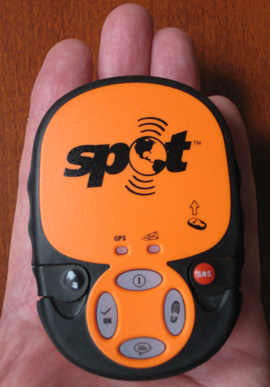
SPOT
Example of a Satellite Emergency Notification Device. Photo by Bill Gabbert

While radios and cell phones can be very useful in most cases to call for help in the case of an accident, there are times when an employee is in an area where there is no reception. Or, as in the case of this ATV accident, the victim is incapacitated and can’t make a call. While a real-time automatic location tracking device would not have saved Mr. Adams, since he died instantly, it would have made a difference to the 200+ searchers and his family who spent a week looking for him.

In 2012 we wrote about the USFS’ solicitation to buy $1.2 million worth of Satellite Emergency Notification Devices (SEND). The agency purchased 6,000 of them. This is not enough for every employee, and one was not used by Mr. Token that day. These hand-held consumer-quality devices are better than nothing, but it is a very unprofessional attempt to enhance the safety of field personnel. We can do better.

I have written before about how the inability of fire supervisors to always be situationally aware of the location of firefighters has contributed to at least 24 deaths in recent years — 19 on the Yarnell Hill Fire and 5 on the Esperanza fire.

The Holy Grail of Firefighter Safety, as I envision it, would enable firefighters’ radios to transmit their location in real time which would then show up on a remote display (on anything from a cell phone or a 7″ tablet, up to a laptop or desktop computer) that would be monitored by a dispatcher, Safety Officer, Branch Director, Operations Section Chief, Branch Director, or Division Supervisor. The display would also show the real time location of the fire. Knowing either of these in real time would enhance the safety of firefighters. Knowing both is the Holy Grail.

New protocol for accident reports?

The report was “the product of the Coordinated Response Protocol (CRP) Team convened by the Chief of the U. S. Forest Service”, and referred to the “Draft CRP Guide (9/19/2013)”. That date is two weeks after Mr. Token was found, and is 10 days before the first report on the Yarnell Hill Fire was released. This process, the report says, attempts to “minimize bias in the way we approach data gathering, synthesis, analysis and sensemaking”. And, it “integrates the accident investigation process with employee health and wellness, law enforcement investigations and other actions taken in response to a serous accident”.

We asked Jennifer Jones, a Public Affairs Specialist for the U.S. Forest Service in Boise, if we could get a copy of the new protocol. She replied:

According to Steve Schlientz, Director of the Office of Safety and Occupational Health, Washington Office, U.S. Forest Service, the guide has undergone extensive revision and is still under development. It is not expected to be completed until late spring/early summer this year and we can’t release the guidebook until it is completed and approved.

USFS bills power company $38 million for starting Las Conchas Fire

Las Conchas fire
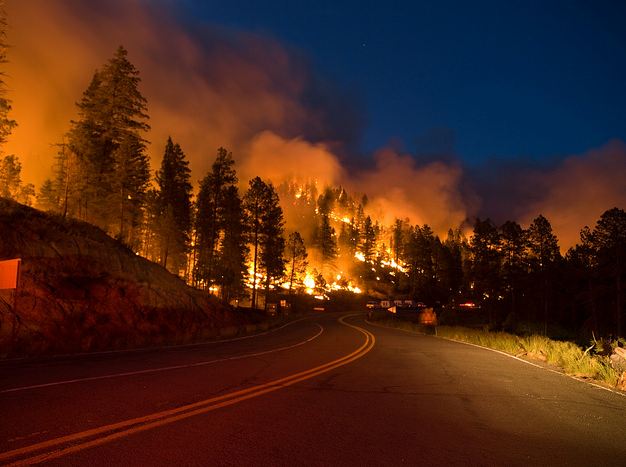
Las Conchas Fire, 7-14-2011. Photo by Andrew Ashcraft, Granite Mountain Hotshots.

The U.S. Forest Service has sent a $38 million bill to the electric cooperative that operated the power line that started the Las Conchas Fire in June, 2011. The blaze burned 156,000 acres and 63 structures in the Jemez Mountains west of Los Alamos, New Mexico near the Valles Caldera National Preserve.

An interagency investigative team led by New Mexico State Forestry determined that the fire was caused by a fallen tree that caught fire after coming into contact with nearby power lines, according to New Mexico State Forester Tony Delfin.

In addition to the USFS, others seeking compensation from the Jemez Mountains Electric Cooperative include two pueblos, several insurance companies, and dozens of property owners. Some of the claims also name the USFS which granted the power company an easement for the power line.

Report on Little Bear Fire analyzes perceptions

Little Bear Fire
Little Bear Fire, burning operation on 532 Road, June 13, 2012, Photo by Kari Greer/USFS

There can be a variety of narrative reports written about a wildfire, including 24-hour and 72-hour, After Action Review, Individual Fire Review, Fire and Aviation Safety Team Review, and Lessons Learned Review. But a type that was new to us has been released about the 2012 Little Bear Fire in New Mexico. It is titled “Little Bear Fire Summary Report” which is a vague title for a report that analyzed perceptions — how the fire was viewed by fire managers and local residents.

It could be categorized more as research than a conventional report on a fire. A team of seven social scientists from North Carolina State University, the U.S. Forest Service, University of Colorado, and Ohio State University conducted interviews of stakeholders, with a focus on perceptions of the event itself — communication, evacuation, and wildfire preparedness. They talked with community members, local organizations, and federal agency personnel.

The Little Bear Fire started on June 4, 2012 northwest of Ruidoso, New Mexico and was contained at four acres with a fireline around it during the first five days. On the afternoon of the fifth day a wind event blew embers from a torching tree outside the fireline causing the fire to eventually burn 242 houses and 44,330 acres.

The management of the fire has been a magnet for criticism from politicians, residents, and others. But this new report does not explore in detail the tactics, strategy, or suppression decisions that were made — it concentrates on how the fire was perceived.

“Gordie”, a Wildfire Today reader, in commenting on how the U.S. Forest Service expends time and energy on designating “Honorary Forest Rangers” such as Arnold Schwarzenner and Betty White, wrote in part:

…A public official in Washington state once said (paraphrased): “What we are perceived to do may be more important in our customer’s eyes than our actual accomplishments.”  A horrible truth, but for the great unknowing masses, looking good is more important [to] taxpayers than actual functionality.

Applying Gordie’s analogy, the USFS ordered research to determine if they are “looking good”.

We will get to the report’s findings, but first there was one fact about the management of the fire that was new to us. On June 9, the day after the four-acre fire blew up, the New Mexico Governor ordered a second Type 1 Incident Management Team. This decision was made without consulting the existing Type 1 team, which learned of the order hours after it had taken command of the fire. When this was discovered, the second team was assigned to stage at Albuquerque, rather than continue to the fire.

Below is the Summary section of the report:
Continue reading

72-hour report for the Token Adams fatality

Token Adams
Token Adams, USFS photo

The 72-hour Preliminary Information Report for the fatality of Engine Captain Token Adams has been released. If you followed the search for Mr. Adams, who was missing for a week before his body was found on September 6, there is not much new in the report except for the mechanism of injury.

Preliminary analysis indicates Captain Adams was thrown from his ATV as he negotiated over a slight rise and then the ATV flipped onto Captain Adams resulting in fatal injuries.

When the search began, he was last seen on an all terrain vehicle attempting to find a reported fire.

The report below was issued by the Washington office of the U.S. Forest Service.

****

“Date: September 13, 2013

Subject: 72 Hour Preliminary Information Report, Schoolhouse Mesa Fire Accident

Number and Type of Injuries: One fatality              Name: Token Adams

On the afternoon of August 30th, 41 year old US Forest Service Engine Captain Token Adams was killed in an all-terrain vehicle (ATV) accident while searching for a lightning caused fire. A Learning Review Team has been assigned to the incident and the review is underway.

Narrative:

Late in the afternoon of August 29th a crew member aboard a military aircraft reported a possible wildland fire. The location of the reported fire was estimated to be in Cebolitta Canyon on the Jemez Ranger district, Santa Fe National Forest, in the vicinity of an older fire that crews had believed to be no longer active.

At approximately 0900 on August 30th, three firefighters (Token Adams among them) responded to the general location of the reported smoke. Each of the firefighters brought an ATV. After a briefing concerning the search strategy they each separately began scouting the area. Their first mission was to confirm that the older fire was no longer active and a possible source of the smoke report. This mission was completed and the three met back at their trucks around 1030. Their second mission was to broaden their search area to locate the new fire. They discussed the broader search area and each left separately on their ATVs. Each communicated with each other periodically by two way radio to coordinate the search. Communications were also made with a lookout who was working on a nearby lookout tower and the Santa Fe Interagency Dispatch office.

At 1344, Captain Adams communicated by radio with other firefighters concerning the status of the search. After this time, calls to Captain Adams went unanswered. At about 1500 the new fire was located by one of the firefighters and he called, via radio, to Captain Adams and the third firefighter to respond to the new fire. With no response from Captain Adams, suppression on the new fire was halted and all efforts were then directed towards contacting and locating Captain Adams. Within three hours a formal Search and Rescue operation was ordered which involved numerous, volunteers, state, federal and local government personnel. His body and the ATV were found on September 6th.

Preliminary analysis indicates Captain Adams was thrown from his ATV as he negotiated over a slight rise and then the ATV flipped onto Captain Adams resulting in fatal injuries. Captain Adams was known to be a skilled ATV rider, he was properly trained and certified as an ATV operator, and he was wearing all appropriate personal protective equipment.

/s/ Liz Agpaoa,
Learning Review Team Leader”

Body of missing firefighter discovered in New Mexico

(UPDATE at 9:50 a.m. MDT, September 11, 2013)

The memorial service for Captain Token Adams will be Thursday September 12th, 2013 at 10:00 am at:

Calvary of Albuquerque
4001 Osuna Rd. NE
Albuquerque NM 87109

To get further information about the service please go to www.danielsfuneral.com.

****

Token Adams
Token Adams, USFS photo

The body of U.S. Forest Service Engine Captain Token Adams was found today. Missing since Friday, August 30, he was last seen when he boarded an ATV to attempt to locate a smoke that had been reported on the Santa Fe National Forest in northern New Mexico. His crew of three split up when they arrived at the general location of a smoke report but he did not return to the agreed upon meeting place. For the last eight days hundreds of people have been searching for him over dozens of square miles of the National Forest.

At 11:45 a.m. today searchers discovered his remains about one-quarter mile from the nearest road. In a video about this development at KRQE, the reporter said there was an apparent crash of the ATV and that Captain Adams had been wearing full protective gear, but the exact cause of death has not been determined.

Below is an announcement issued Friday afternoon by the Incident Management Team managing the search organization:

Friday September 6 2013 – 4:45 pm

We are sad to announce that the body of Jemez Ranger District Engine Captain Token Adams has been located. Token was dispatched to locate a smoke reported on Friday August 30 2013. Search efforts began late Friday afternoon and continued through this morning when his body was discovered.

Token was an Engine Captain working in Jemez Springs NM. He was 41 years old and had been an Engine Captain on the Jemez Ranger District for 1 ½ years. He was a wildland firefighter for 10 years including previous experience as a hotshot. Before coming to the Forest Service Token served in the U.S. Navy. Token grew up in the community of Coarsegold California and was a 1990 graduate of Yosemite High School in Oakhurst California.

Token is survived by his wife Heidi a 3 year old son Tristan his mother a brother and sister. Token’s wife Heidi is expecting their second child.

All public and media are asked to please respect the privacy of the firefighter’s family during this time of mourning. We will release all details of this tragedy when more information becomes available.

Wildfire Today had been publishing daily updates on the search since it became public on September 2, 2013.

Our sincere condolences go out to the family and co-workers of Captain Adams.

Firefighter missing in New Mexico

(UPDATED at 6:18 p.m. MDT, September 6, 2013)

The body of Engine Captain Token Adams was found today. At 11:45 a.m. searchers discovered his remains about one-quarter mile from the nearest road. In a video about this development at KRQE, the reporter said there was an apparent crash of the ATV and that Captain Adams had been wearing full protective gear, but the exact cause of death has not been determined.

Below is an announcement issued Friday afternoon by the Incident Management Team managing the search organization:

Friday September 6 2013 – 4:45 pm

We are sad to announce that the body of Jemez Ranger District Engine Captain Token Adams has been located. Token was dispatched to locate a smoke reported on Friday August 30 2013. Search efforts began late Friday afternoon and continued through this morning when his body was discovered.

Token was an Engine Captain working in Jemez Springs NM. He was 41 years old and had been an Engine Captain on the Jemez Ranger District for 1 ½ years. He was a wildland firefighter for 10 years including previous experience as a hotshot. Before coming to the Forest Service Token served in the U.S. Navy. Token grew up in the community of Coarsegold California and was a 1990 graduate of Yosemite High School in Oakhurst California.

Token is survived by his wife Heidi a 3 year old son Tristan his mother a brother and sister. Token’s wife Heidi is expecting their second child.

All public and media are asked to please respect the privacy of the firefighter’s family during this time of mourning. We will release all details of this tragedy when more information becomes available.

Our sincere condolences go out to the family and co-workers of Capain Adams.

****

(UPDATED at 7:45 a.m. MDT, September 6, 2013)

There is not much new to report on the search for missing firefighter Token Adams. The incident management team has released a missing person’s flyer, which contains the following information:

MISSING PERSON
Santa Fe National Forest requests your assistance in locating this person.
Search Subject: Token Adams
PHYSICAL DESCRIPTION
Age: 41
Height: 5’ 11″
Weight: 165
Hair: Peppered
Eyes: Wearing black sunglasses
Last seen wearing long sleeve yellow nomex shirt, green nomex pants, and lace up brown leather wildland fire boots. Last seen in the area of Holiday Mesa off Forest Service road 608 on Friday, 8/30/13. Mr. Adams was seen riding a red Polaris 400 ATV while investigating a possible fire start when he disappeared.
If you were in the area of Holiday Mesa and Stable Mesa on or after August 30th and may have seen this individual, please contact the Forest Service at 505-438-5600.

****

(UPDATED at 10:35 a.m. MDT, September 5, 2013)

Searchers are still looking for U.S. Forest Service engine captain Token Adams who was last seen Friday, August 30, as he boarded an ATV to attempt to locate a smoke that had been reported on the Santa Fe National Forest in northern New Mexico.

The mother of Token Adams, Letake Anderson, visited the Incident Base Camp Thursday morning. She spoke to search crews and thanked them for their hard work.

A Firewatch Cobra helicopter is scheduled to arrive today to provide additional support for the search team. This specialized helicopter has cameras as well as infrared and low-light sensors and can transmit images to search crews up to 30 miles away.

Firewatch Cobra helicopter N107Z
Firewatch Cobra N107Z on Bar Complex. USFS photo.

More information about the Firewatch Cobra.

****

(UPDATED at 11:40 a.m. MDT, September 4, 2013)

The search and rescue operation continues today, looking for Engine Captain Token Adams who disappeared Friday. Captain Adams has not been heard from since he departed on an ATV trying  to find a fire that had been reported in the Santa Fe National Forest in northern New Mexico.

Joe Reinarz’s Type 1 Incident Management Team assumed command of search efforts Wednesday morning as part of a unified command and will oversee the organization in coordination with the New Mexico State Police.

****

(UPDATED at 12:47 p.m. MDT, September 3, 2013)

Token Adams
Token Adams, USFS photo

Rain on Sunday and Monday hampered the search for Engine Captain Token Adams. The 250 personnel involved in the search are traversing topography described as extreme with sheer cliffs.

Despite the grid pattern being used by the professional and dedicated personnel on the incident, their efforts have not been successful. Searchers are using GPS as part of this grid pattern and are being asked to report their locations hourly. Searchers will focus Tuesday on determining that certain areas have been fully searched.

Weather predictions for today and tonight are for a 60% chance of showers and thunderstorms which will once again affect both air and ground operations.

HERE is a link to a map of the area being searched, but be advised it is a huge 19Mb file and will take a while to download.

****

(UPDATED at 8:23 a.m. MDT September 3, 2013)

A Southwest Type 1 Incident Management Type, with Incident Commander Joe Reinarz, will assume command of the search efforts Wednesday morning at 6:00 a.m. for missing firefighter Token Adams. The team will begin in-briefing at noon Tuesday, September 3.

Mr. Adams is 41 years old and is an engine captain with the U.S. Forest Service and a former Hotshot. He is married with one son, and is expecting another child in less than a month.

****

(Originally published at 2:27 p.m. MDT Monday, September 2, 2013)

A wildland firefighter sent out to look for a fire has been missing since Friday August 30. Token Adams was one of three people that were dispatched to a report of a smoke in the Schoolhouse Mesa area on the Jemez Ranger District of the Santa Fe National Forest in northern New Mexico. When they arrived in the general area Mr. Adams went off by himself on an all terrain vehicle to attempt to locate the smoke. He did not return as expected to the meeting point.

John Helmich, a spokesperson for the Santa Fe National Forest, told us on Monday that when Mr. Adams was first outbound to look for the smoke late in the day on Friday he called his wife on his cell phone, and has not been heard from since, either by phone or via the radio he also carried.

At least 200 people from several land management agencies, search and rescue organizations, the National Guard, and law enforcement agencies are actively searching for him. The Civil Air Patrol has used infrared equipment from a fixed wing aircraft and the New Mexico State Police have made a helicopter available.

The fire the three firefighters were trying to locate was eventually found. It was named the Schoolhouse Fire and was fully contained at 25 acres.

The last time we heard of wildland firefighters missing was late in the afternoon on June 30 — the Granite Mountain Hotshots were missing on the Yarnell Hill Fire in Arizona. We hope this incident has a better outcome.

Fatality in New Mexico while taking Work Capacity Test

A firefighter taking the Work Capacity Test (WCT) at the Northern Pueblos Agency in Ohkay Owingeh, New Mexico collapsed and died Wednesday, July 24. According to the preliminary 24-hour report, Emergency Medical Personnel that were on scene monitoring the test immediately initiated CPR and other lifesaving measures with assistance from the Agency Staff. The patient was transported to the Espanola Hospital four miles away where he was pronounced dead.

The report does not specify if the individual was a firefighter or was attempting to qualify for another fire-related position.

Our sincere condolences go out to the person’s family and co-workers.

There are three versions of the WCT, for firefighters and those who will be in less strenuous jobs. Firefighters have to take the Arduous Pack Test version, which requires hiking 3 miles in less than 45 minutes while carrying 45 pounds.

According to the report “Wildland Firefighter Fatalities in the United States: 1990–2006” (NWCG 2007) 11 fire personnel died during that seven-year period while preparing for or taking the work capacity test. Another died in 2007. In 2011 a firefighter taking the test suffered a non-fatal but severe case of rhabdomyolysis, which if not treated early can lead to irreversible muscle damage, permanent disability, kidney failure possibly requiring lifelong dialysis, and even death.

New Mexico: Silver Fire

(UPDATE at 8:15 a.m. MDT, June 29, 2013)

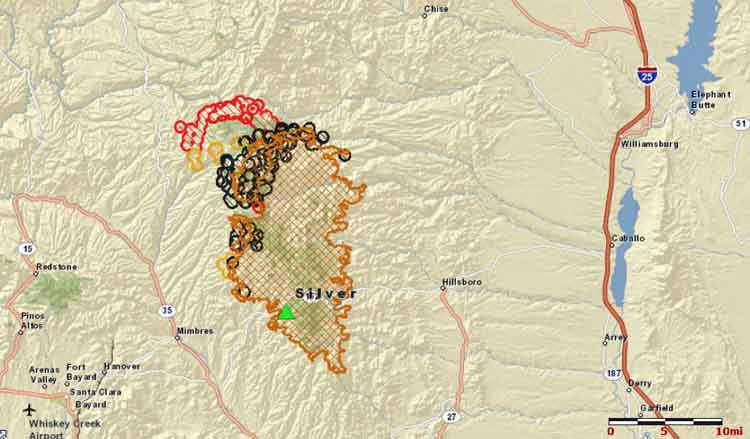
Map of the Silver Fire at 3:18 a.m. MDT, June 29, 2013. The red areas were the most recently burned. (click to enlarge)

The heat signatures captured by a satellite at 3:18 Saturday morning, shown in the map above, indicate that the Silver Fire spread several miles to the northwest over the last 24 hours.

Below is an update on the fire from the Incident Management Team, late Friday night:

Silver Fire June 28th PM Update- The Silver Fire continues to burn toward Reeds Peak to the NW and North. The South and East flanks of the fire are out and cold. The containment is 35%. The extreme weather has passed but the potential still exists for extreme fire behavior. The weather forecast calls for 20% chance of Thunderstorms with potential for dry lightning and a slight chance for wetting rain. Structure protection continues in the Cooney area.

****

(Originally published at 1:30 p.m. MDT, June 28, 2013)

Siliver Fire 6 am June 28, 2013 NWS photo by Tom Bird
Caption by the National Weather Service: “Words are hard to come by to express the nearly unbelievable nature of this photo. This shows a fully developed column off the Silver fire…BEFORE sunrise. The fire NEVER laid down last night. Intense and extreme fire behavior continued through the night. The Incident Commander asked the 100+ crew supervisors, with a couple thousand combined years of firefighting experience, how many of them had seen this before in their career. Only a handful had. This fire is exhibiting fire behavior that has never been seen in this part of the country.”   (click to enlarge)

The Silver Fire in southwest New Mexico exhibited EXTREME fire behavior late Thursday into early Friday morning. Pushed by a strong east wind it spread in a direction that was contrary to its usual movement and blackened about 10,000 more acres, bringing the total to 101,311. The Incident Commander is calling it 20 percent contained. While heavy smoke socked in the Mimbres Valley, the majority of fire growth occurred on the northwestern side of the fire. The east side near Winston did not have much activity Thursday and Thursday night.

The weather Friday will be slightly less dry, but conditions remain extreme. An upper ridge weather system will move in today, slowly moving smoke away, and allowing clouds to form. There is an opportunity for dry lightning this weekend, and a slight potential for precipitation on Monday.

Map of Silver Fire
Map of Silver Fire at 2:40 a.m. MDT, June 28, 2013, showing heat detected by a satellite. The red areas were the most recently burned. (click to enlarge)

And at 8:57 a.m. Friday, the National Weather Service out of El Paso sent this tweet:


Silver Fire
Silver Fire as seen June 17 from Incident Command Post
wrapping cabin on Silver Fire
Lolo Engine 416 beginning the process of wrapping a cabin on the Silver Fire to protect it from radiated heat and embers from the fire, undated InciWeb photo

Wildfire briefing, June 28, 2013

West Fork Complex, June 25, 2013

Former volunteer firefighter sentenced for arson

The San Francisco Chronicle reports that a former volunteer firefighter was sentenced to a total of two years in jail for setting fires in the northern California counties of Sonoma and San Mateo. Our original story on the charges is here, and the Chronicle has the details about Friday’s sentencing of Nathaniel Ridgway Schmidt, 20, of Cazadero, California.

Extreme heat forecast for some areas in the West

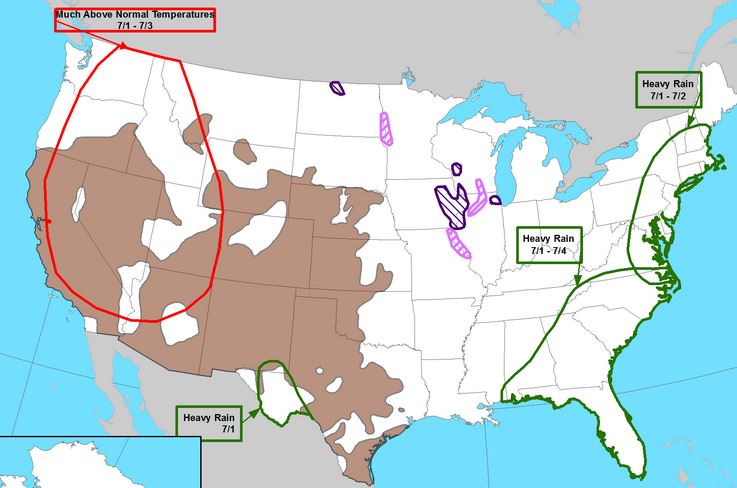
This weekend and the first part of next week some areas in the west will experience extremely hot weather. The temperature for Death Valley was expected to reach nearly 130 on Friday — just short of the 134-degree reading from a century ago that stands as the highest temperature ever recorded on Earth. More details.

This is a good time for firefighters to review the video on Heat Related Illness.

Heat wave map NWS 3-7 day outlook
Much above normal temperatures are forecast for parts of the West on July 1-3, 2013. Map: NOAA and FEMA.

Helicopter crashes into river near Missoula

A helicopter made a crash landing into a river Friday while recertifying for water bucket operations near Missoula, Montana. Both the pilot and a passenger survived, according to an article in the Missoulian. More details are at Fire Aviation.

Colorado: West Fork Complex Fire

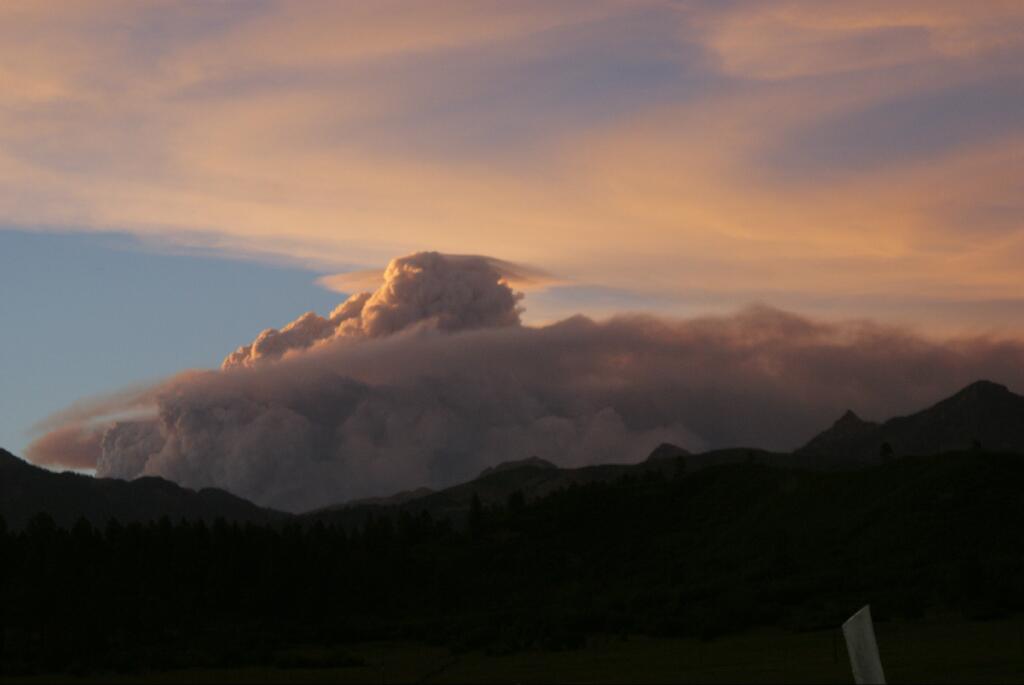
West Fork Complex, June 25, 2013
Smoke from the West Fork Complex at sunset, June 25, 2013 by @PagosaCabin

The Papoose Fire, part of the West Fork Complex of fires in southern Colorado, was extremely active Thursday night and early Friday morning, running for four miles and creating new spot fires 1 to 1.5 miles ahead. More details are in our main article about the fire.

New York Times on smaller budgets for fuel management

The New York Times is the latest news organization to run a major story on how the federal government is reducing the budgets for prescribed fire and other types of fuel mitigation which lower the fire risk by removing accumulations of thick vegetation in forests and in wildland-urban interfaces near populated areas. Here is an excerpt from their article:

The government has cut back on programs to reduce fire risks in areas where homes and the wilderness collide. The United States Forest Service treated 1.87 million acres of those lands in 2012, but expects to treat only 685,000 acres next year. Conservation advocates say that is likely to mean fewer people working to prevent runaway fires, fewer controlled burns and fewer trucks hauling away dry brush and tinder.

Trimming trees and clearing brush can make blazes less destructive, and the Forest Service said it had treated more than 26 million acres since 2000. But as the government spends an increasing amount to battle wildfires, critics say it makes little sense to cut back on prevention.

“There is a growing consensus in the West that dollar for dollar, these kinds of prevention efforts are paying off,” said Senator Ron Wyden, Democrat of Oregon. “And when the big fires break out, the bureaucracy steals money from the prevention fund and the problem gets worse. The Forest Service has become the fire service.”

Senators write letter about cuts in fuel treatments

More Senators have written another letter about cuts to fire budgets. The AP reports:

A bipartisan group of Western U.S. senators on Friday urged the Obama administration to focus more on preventing wildfires rather than taking money from programs that clear potentially hazardous dead trees and brush to fund efforts to fight the increasingly destructive blazes.

It is easy to write letters. Politicians tend to look the other way when it comes to actually DOING SOMETHING MEANINGFUL to correct the problem, such proposing and passing budget legislation. (sigh)

Wildfire smoke closes George Parks Highway in Alaska

Smoke from the Skinny’s Road Fire, which is named after a nearby bar, forced officials to close a section of the George Parks Highway between Nenana and Fairbanks on Wednesday. It reopened Thursday but travelers had to be escorted by pilot cars through the smoke. The highway is the main route between between Anchorage and Fairbanks, Alaska.

Lightning in the Yukon starts 23 fires

Fire managers in the Yukon Territory asked the British Columbia government to send 62 more fighters to help put out 23 new fires started by lightning Thursday. They will join the other 45 firefighters that B.C. sent to help out earlier.

Below is an excerpt from an article at CBC.com:

“Obviously, the emphasis right now is the protection of life and property, while maintaining the safety of our staff,” said Fire Information Officer George Maratos.

“Given the intense fire behaviour on some of these fires, the safest and most effective response was from the air with air tankers and helicopters.”

One of the priority fires is burning 18 kilometres east of Faro. Two are near Carmacks: one 45 kilometres east of the community near Little Salmon River and another 16 kilometres northwest near Free Gold Road. The fourth is 36 kilometres northeast of Mayo.

Environment Canada is forecasting more thunderstorms in the area for Friday.

Los Alamos National Laboratory criticized for wildfire preparedness

A report issued by the Department of Energy’s inspector general said the Los Alamos National Laboratory in New Mexico has not done enough to protect the facility from wildfires and other natural disasters. The inspectors were concerned about what would happen if an earthquake or fire caused damage that could lead to exposure from some of the radioactive waste stored at the lab.

On May 10, 2000, a fire that began as a prescribed fire in Bandalier National Monument burned into Los Alamos. The Cerro Grande Prescribed Fire was carried by very strong winds, with embers blowing a mile or more across the fire lines to the north, south, and east. The towns of Los Alamos and White Rock were in the fire’s path and more than 18,000 residents evacuated.

By the end of the day on May 10, the fire had burned 18,000 acres, destroyed 235 homes, and damaged many other structures. The fire also spread towards the Los Alamos National Laboratory, and although fires spotted onto the facility’s lands, all major structures were secured and no releases of radiation occurred.

Washington: Soap Lake fire department quits

The Columbia Basin Herald reports that after the Mayor of Soap Lake, Washington (map) fired the Fire Chief, 11 volunteer firefighters resigned from the fire department, leaving the town with no fire protection. This mess began from a fund raiser to replace the water tank on a wildland fire truck.

Oregon drought worries ranchers and firefighters

A severe drought in southeast Oregon has firefighters concerned and has forced the Bureau of Land Management to haul water to herds of wild mustangs and pronghorn antelope.

Mount Rushmore cancels July 4 fireworks show

Mount Rushmore has again cancelled the July 4 fireworks extravaganza, which rains down large quantities of fireworks debris into the forest and rocky slopes around the sculpture. Previous fireworks at the Memorial have caused over twenty small fires. The Park Superintendent, Cheryl Schreier, cited the fire hazard in the nearby beetle-damaged forest as the reason for the cancellation.


Thanks go out to Dick and Kelly.

Another Fuels and Fire Behavior Advisory — this time, Arizona and New Mexico

Fuels and fire behavior advisoriesOne of the Predictive Services offices has issued another Fuels and Fire Behavior Advisory. The last one, issued June 10, was for California. This new one, dated June 16, is for portions of Arizona and New Mexico.

The advisory does not mention the “Southwest Monsoon,” an event that typically starts in early July and generally begins to draw the curtain on the fire season in Arizona, New Mexico, West Texas, southern Utah and southwestern Colorado.

Below is the full text of the advisory.

****

“Fuels and Fire Behavior AdvisoryPredictive Services

Arizona and New Mexico

June 16, 2013

Subject: Persistent multi-year drought across much of New Mexico and Arizona has dropped fuel moistures to critically low levels in the large dead and live foliar fuels. These critically low fuel moistures increase available fuel loading which contributes to and supports active crown fire in timber fuels when critical fire weather is present.

Discussion: The multi-year drought has reduced the fine fuel loading across most of the region so the focus for this advisory will be the timber fuels within the region.

Difference from normal conditions: Drought creates more available fuel in timber fuel types which will increase fire intensities, crown fire potential and difficulty of control for fire suppression resources. Short duration rain events provide only short term fuel moisture improvement in timber litter fuels (1, 10, and 100 hour dead fuels). Fuels rebound quickly to previous dryness levels. Short duration rain events provide no fuel moisture recovery in large dead and live foliar fuels.

Concerns to Firefighters and the Public:

  • Surface fire will quickly transition to crown fire and only requires low to moderate surface fire intensity to transition.
  • Active/running crown fire has produced long range spotting up to one mile under the influence of an unstable atmosphere.
  • Active fire behavior can extend well into night and early morning hours even with moderate RH recovery.
  • Thunderstorm activity will create a mosaic pattern of surface fuel moistures. Surface fire intensity and fire behavior may change abruptly when fires cross these boundaries of moist and dry surface fuels.

Mitigation Measures:

  • Local briefings need to be thorough and highlight specific fire environment conditions. These include but are not limited to local weather forecasts, Pocket Cards, ERC’s, live and dead fuel moistures, and special fuel conditions such as drought and insect mortality
  • Lookouts, both on the ground and in the air, can help identify the initiation and location of crown fire. They can also provide the location of resultant spot fires from active crown fire.
  • Firefighters should acknowledge that fire growth and fire behavior they encounter this year may exceed anything they have experienced before due to the drought factor. Normal strategies and tactics may need to be adjusted to account for the drought factor.

Area of Concern: Please reference the map posted on the National Fuel Advisory Page.

http://www.predictiveservices.nifc.gov/fuels_fire-danger/fuels_fire-danger.htm

The timber fuels within this area of concern are the target for this fire behavior advisory.”

****

(End of text)


Thanks go out to Ken