
This 42-second video shows a faller finishing the process of felling a tree on the Thompson Ridge Fire in northern New Mexico. Turn up the volume so that you can hear the sound echoing through the forest of the tree hitting the flat, bare ground. The video was shot by Kristen Honig of the Valles Caldera Trust.
New Mexico: Thompson Ridge and Tres Lagunas Fires (updated June 9, 2013)
(UPDATE at 9:55 a.m. MT, June 9, 2013)
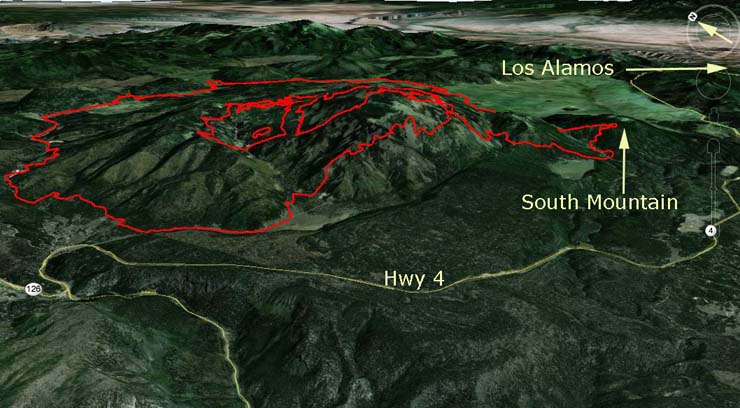
The map of the Thompson Ridge Fire above shows the perimeter at about 2 a.m. Sunday. The most recent fire spread was on the southeast side onto South Mountain, within about a mile of Highway 4.
The fire has grown to 20,687 acres and is listed at 40 percent containment. Firefighters have been completing firelines and burning out in the interior for the last couple of days. Saturday just before sunset they were firing out along a road on the southeast side, removing fuel between a planned line and the fire edge, when the fire spotted across the road and became established on the north side of South Mountain.
The plans now are to prepare for and then burn out between the southeast side of the fire and Highway 4.
Effective 6 a.m. today, June 9, 2013, New Mexico Highway 4 will be closed at the junction of State Route 126 to the junction of State Route 501. Residents in and around Sierra los Pinos are permitted entrance and exit along Highway 4 south to Jemez Springs. No traffic will be allowed to travel along Highway 4 east of Forest Road 10. Residents must show their identification to gain re-entry. There are no additional evacuations at this time. Evacuations remain in effect for Thompson Ridge, Rancho de la Cueva, and Elk Valley.
****
(UPDATE at 1 a.m. MT, June 9, 2013)
The Thompson Ridge Fire posted this “Urgent Update” at about 6 p.m. MT, June 8:
During burning operations this evening, the fire spotted across the fireline on the southeast side and established on South Mountain. Fire personnel are on scene evaluating containment options. Further updates as information becomes available.
Effective 0600 Sunday, June 9, 2013, New Mexico Highway 4 will be closed at the junction of State Route 126 to the junction of State Route 501.
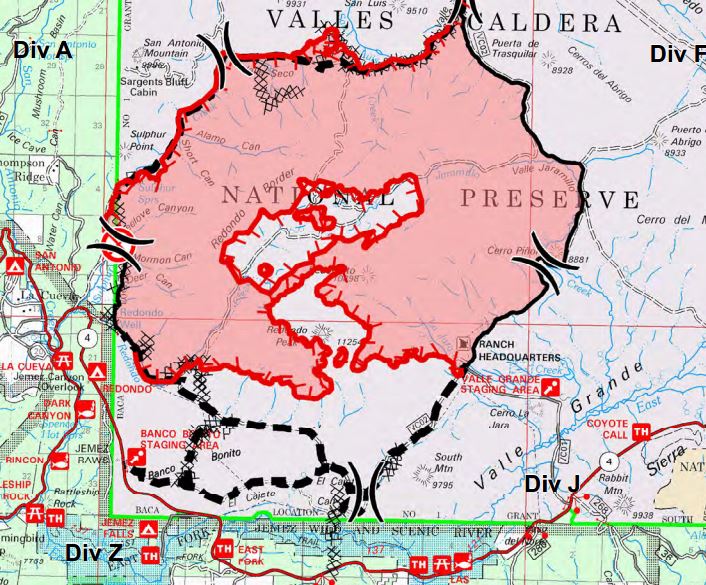
On the map of the Thompson Ridge Fire below, (created before the expansion onto South Mountain) the firefighters were most likely burning to remove fuel between the fire (the red area) and the black dashed line on the southeast side of the fire when it spread onto South Mountain, between the black dashed line and Highway 4.
The DC-10 air tanker and possibly other air tankers were dropping retardant on the Thompson Ridge fire Saturday afternoon, probably in the South Mountain area..
****
Continue reading
DC-10 air tanker at Phoenix
The news footage above indicates some of the people in the Phoenix area are pleased to have one of the DC-10 air tankers temporarily working out of the Phoenix-Mesa Gateway airport. Some Snake River Hotshots crewmembers detailed there out of Idaho are also interviewed in the piece.
After flying 10 missions on the Powerhouse Fire in southern California over two days, the air tanker flew two missions Tuesday on the Thompson Ridge fire which is spreading rapidly west of Los Alamos, New Mexico. Today they are back on the Thompson Ridge Fire again, reloading out of Roswell, New Mexico.
Two fires in northern New Mexico


Two fires in northern New Mexico are putting smoke into the air and making residents nervous.

The Tres Lagunas (Three Lagoons) Fire, 11 miles east of Santa Fe, was caused by a downed power line May 30 and has burned either 6,249 or 7,476 acres (both acreages appear on InciWeb). It is zero percent contained. Management of the fire was turned over to a Type 2 New Mexico Incident Management Team with John Pierson as Incident Commander. An Incident Command Post has been established at the Pecos National Historical Park nine miles south of the fire.
The Thompson Ridge Fire has burned about 1,700 acres 15 miles west of Los Alamos, north of Highway 4 and Jemez Springs, and is listed at 25 percent containment. Sunday at 3 p.m. there will be a public meeting at the Sierra de Los Pinos Fire Station 52.
New Mexico firefighter dies while on project work
A firefighter for the U.S. Forest Service in New Mexico collapsed and died May 5 while performing project work with his engine crew. The following message was distributed Monday, May 6, by Jeanne Higgins, Deputy Regional Forester for the USFS’ Southwestern Region.
It is with heavy hearts and great sadness that we share the tragic news of the death of Fallen Wildland Firefighter, Daniel Davidson. Davidson, age 26, was working on project work near Mayhill, NM, on Sunday afternoon with two other engine crew members, when he collapsed. CPR was administered immediately, however when emergency personnel responded with the Life Flight helicopter, Davidson was pronounced deceased at the scene.The cause of Daniel Davidson’s death is under investigation.
Davidson, a U.S. Army veteran had served two tours in Afghanistan with the 10th Mountain Infantry Division. Following his tour in the Army, Davidson became a crew member of Engine 621 on the Sacramento Ranger District of the Lincoln National Forest.
Our sincerest condolences and heartfelt sympathy goes out to the family of Daniel. Additional information will be provided as it becomes available.
FEMA’s report can be found here.
Our sincere condolences go out to Mr. Davidson’s family and co-workers.
Thanks go out to Jeff
Red Flag Warnings, April 29, 2013
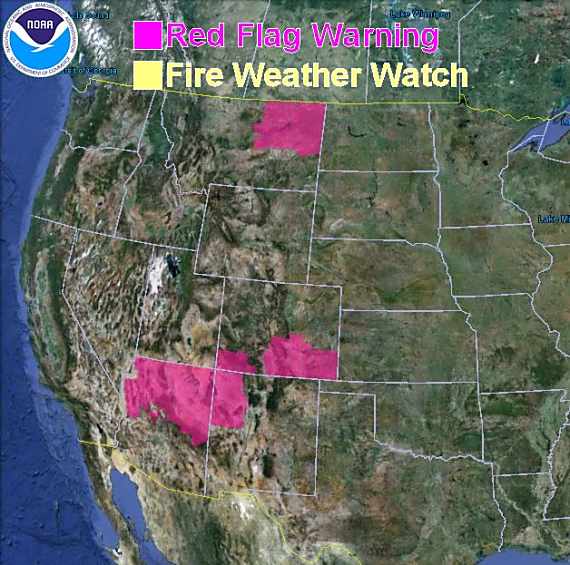
Red Flag Warnings for enhanced wildfire danger have been issued by the National Weather Service for areas in New Mexico, Arizona, Colorado, and Montana.
***
The Red Flag Warning map above was current as of 9:45 a.m. MT on Monday. Red Flag Warnings can change throughout the day as the National Weather Service offices around the country update and revise their forecasts. For the most current data, visit this NWS site.
Albuquerque: history of critical fire weather

This interesting graphic was distributed on Monday by the Albuquerque office of the National Weather Service, via Twitter:
Graphic:”Critical Fire Weather” days each year since 2000. We average about 25 critical days. #NWSABQwwb ow.ly/i/1TMA1
— NWS Albuquerque (@NWSAlbuquerque) April 15, 2013
And speaking of New Mexico fire weather, the entire state is under a Red Flag Warning for Tuesday, April 16, 2013, along with portions of Colorado, Arizona and Texas.

***
The Red Flag Warning map above was current as of 9:18 a.m. MT on Tuesday. Red Flag Warnings can change throughout the day as the National Weather Service offices around the country update and revise their forecasts. For the most current data, visit this NWS site.
Red Flag Warnings, April 4, 2013

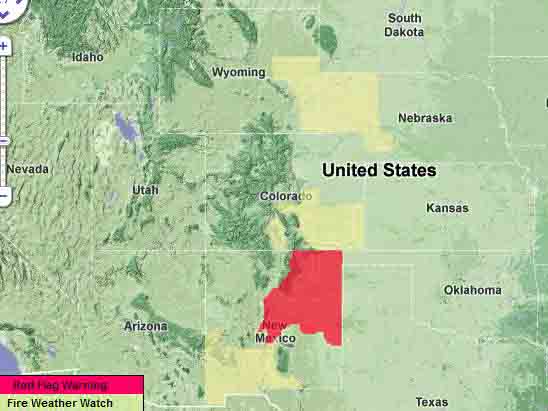
Red Flag Warnings and Fire Weather Watches for enhanced wildfire danger have been issued by the National Weather Service for areas in New Mexico, Colorado, Nebraska, and Wyoming.
***
The map above was current as of 9 a.m. MT on Thursday. Red Flag Warnings can change throughout the day as the National Weather Service offices around the country update and revise their forecasts. For the most current data, visit this NWS site.
Multiple reports released about New Mexico megafires
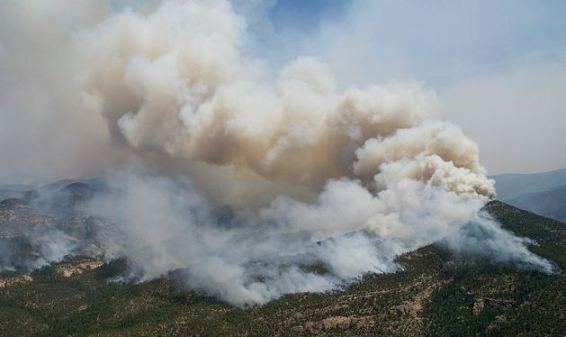
U.S. Representative Steve Pearce has assembled five reports about two huge wildfires, megafires, that burned hundreds of thousands of acres and destroyed many homes in New Mexico in 2012. The Whitewater Baldy Complex blackened over 297,000 acres and destroyed 12 summer homes, while the Little Bear Fire burned 44,000 acres and 254 structures.
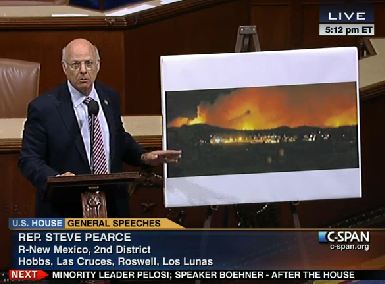 In June, 2012, Representative Pearce was extremely critical of the way the U.S. Forest Service was managing the fires, mentioning the name of Tom Tidwell, Chief of the Forest Service, many times during a 22-minute speech on the floor of the House of Representatives.
The five reports, plus one bonus article from the 1940s, can be found on Representative Pearce’s web site, and include the following:
- William A. Derr, retired as Special Agent in Charge of the Law Enforcement and Investigative program in California. Mr. Derr was asked by Rep. Pearce to evaluate the management of the two fires, and was given the title of Legislative Fellow during his fact finding mission. It was an unpaid assignment, and Mr. Derr told Wildfire Today that he is not even sure if he will ask to be reimbursed for his travel expenses.
- Roger Seewald, retired from the U.S. Forest Service, began his career in wildland fire on the El Cariso Hot Shots in California, and after a decade or two switched over to law enforcement. At one point late in his career he worked out of the Washington office as Deputy Director, Law Enforcement and Investigations. In his report he stated he was representing the U.S. Forest Service. In Mr. Derr’s report he was described as “representing the Chief of the Forest Service”.
- Doug Boykin, Socorro District Forester, New Mexico – Energy, Minerals and Natural Resources Department, Socorro District. Mr. Boykin was the Type 3 Incident Commander during one of the early stages of the Whitewater Baldy Complex. He wrote a 17-page report packed with details and photographs. One of those details that is surprising for an objective report by a government employee about a disastrous wildfire, is that he apparently thinks God controlled the fire, and wrote: “But, given what we know now, I feel this was the perfect set up by a higher power that had grown tired of our inability to use common since [sic] in forest management and chose to set things right in his own way.”
- Allen Campbell, a local resident and rancher who spent his early years “guiding clients”. His report covers the legacy and the environmental impacts of the fire, and is critical of the USFS fire management policy.
- Impact DataSource, is an economic consulting, research, and analysis firm working out of Austin, Texas. Their report is titled “The Full Cost of New Mexico Wildfires”. The purpose of the report was to “…estimate the full impact of wildfires in New Mexico both during and after the wildfire occurs.” And, “…additional environmental,societal, economic and fiscal impacts are typically not tracked by any federal, state or local government or organization making the full impact of wildfires difficult to quantify.”
- Earl W. Loveridge, formerly the Assistant Chief of the USFS, and before that the Assistant Chief of it’s Division of Operation and Fire Control. This reprint of a Journal of Forestry article appears to have been written in the mid-1940s. Chief Loveridge covered fire management policy, was critical of a “let burn” strategy, and pointed out the “importance of speed of control”. He also covered the 1935 origin of the “10 a.m. policy”, in which “Forester” F. A. Silcox stated, in part:
- “The approved protection policy on the National Forests calls for fast, energetic and thorough suppression of all fires in all locations, during possibly dangerous fire weather. When immediate control is not thus attained, the policy then calls for promptly calculating of the problems of the existing situation and probabilities of spread, and organizing to control every such fire within the first work period. Failing in this effort the attack each succeeding day will be planned and executed with the aim, without reservation, of obtaining control before ten o’clock of the next morning…. No fixed rule can be given to meet every situation; the spirit implied in the policy itself will determine the action to be taken in doubtful situations.”
The management of both fires, the Whitewater Baldy and the Little Bear, has been criticized. The Whitewater Baldy began as two fires, the Whitewater and the Baldy fires, which burned together. The Baldy was a “modified suppression” fire and was monitored, but the Whitewater was managed under a suppression strategy.
Much of the criticism of the Little Bear fire, including from Wildfire Today, was focused on what appeared from a distance to be less than aggressive suppression tactics, even though it was a suppression fire. Two firefighters worked the fire on the first day, and from day two through day five, while the fire was only four acres, a hotshot crew was assigned, but they had very, very little aerial firefighting support; limited use of one helicopter and no air tankers. On the fifth day the wind increased, a tree in the interior of the fire torched, and spot fires took off. The fire grew from 4 acres to 44,000 acres and destroyed 254 structures.
Mr. Derr’s report does not dig into the tactics of the fires, but concentrates primarily on the fire management policy of the USFS. He is critical of less than aggressive strategies, and regrets the abandonment of the 10 a.m. policy.
Mr. Seewald visited the four-acre site that comprised the Little Bear Fire for the first 5 days and cited steep slopes, heavy downed fuel, tree canopy, and rolling rocks as issues that made aerial support inadvisable, and for any more than one crew of firefighters to work the fire. He concluded that the USFS “…made every reasonable effort to extinguish the Little Bear Fire and used acceptable methods and strategies to control the fire.” He found very little to criticize other than suggesting that the USFS could “revisit” the methods used for communicating with the public and cooperators.

The Seewald report said the strong winds that caused the spot fires to take off were not predicted in the spot weather forecasts provided to the firefighters.
Doug Boykin, the Incident Commander on the Whitewater Baldy Fire, believes that the decisions about management of the Whitewater and the Baldy fires were appropriate, after taking into consideration the firefighting resources available, weather, fuels, and topography. Mr. Seewald, while he did not say so explicitly, seemed to agree with that assessment.
New Mexico passes 3 fire-related bills, will form wildfire crews of veterans
New Mexico will hire and train 40 military veterans to become wildland firefighters, and the Governor recently signed 3 pieces of fire-related legislation. Below is an excerpt from a news release from the Governor’s office:
****
April 1, 2013
ALBUQUERQUE – Governor Susana Martinez today signed into law three bills supporting New Mexico firefighters.
“While the number of human-caused wildfires was down last year, we can’t let our guard down,” said Governor Martinez. “Across New Mexico, we have seen ongoing drought and another dry winter. Conditions are in place for a potentially difficult fire season and I urge all New Mexicans to make themselves responsible for preventing wildfires.”
In 2012, New Mexico experienced its largest wildfire in recorded history, the Whitewater-Baldy Complex, and the state’s most destructive fire, the Little Bear, which burned more than 250 structures near Ruidoso. For this reason, local, state, federal and tribal interagency partners continue to stress wildfire preparedness and prevention.
At today’s news conference at the Rio Grande Nature Center State Park, Governor Martinez also joined a half dozen New Mexico military veterans to announce a new pilot program that will hire and train 40 military veterans as wildland firefighters. These veterans will be placed on four fire crews that will be available for assignment on wildfires statewide. The new program is a collaborative effort between New Mexico State Forestry, the Department of Veteran’s Services, and the New Mexico Workforce Connection.
The governor also signed three pieces of legislation that will support New Mexico’s firefighters and help protect communities:
- HB 275, increasing volunteer firefighter retirement benefits to $250 per month from the current amount of $200 per month for individuals over the age of 55 with 25 or more years of experience. Benefits increase from $100 per month to $125 per month for individuals over the age of 55 with between 10 and 25 years of experience.
- HB 615, allowing volunteer firefighters be paid a stipend by a public agency that still allows them to maintain volunteer status.
- SB 431, which gives counties the authority to contract with individuals as well as municipalities for firefighting services.